Storm chasing safety starts before you ever leave your driveway. You’ll need a trained co-pilot, verified communication tools, and at least two mapped escape routes. Never position yourself north of a storm, and always maintain a safe standoff distance from the core. Check road conditions, radar history, and vehicle systems early. Respecting property laws and knowing when to retreat aren’t optional — they’re what keep you chasing tomorrow. There’s much more every beginner must know.
Key Takeaways
- Never chase alone; always bring a trained professional and maintain working communication tools, including cell service and a reliable radar app.
- Before departure, inspect tire pressure, fluid levels, headlamps, and verify road conditions through state DOT websites for closures or flood warnings.
- Plan at least two escape routes, position your vehicle to the west, south, or east, and maintain a safe distance from the storm core.
- Retreat immediately if cell service drops, the storm accelerates unexpectedly, road conditions deteriorate, or darkness significantly reduces situational awareness.
- Always obey property laws, use only public roads, obtain landowner permission before entering private land, and yield to all emergency vehicles.
Storm Chasing Safety Rules Every Beginner Must Know First
Storm chasing demands respect for the forces you’re pursuing, and before you ever hit the road, you need to understand the foundational rules that keep chasers alive.
Never chase alone — always bring a trained professional who can make critical decisions under pressure. Maintain emergency communication tools, including cell service and working radar, so you’re never operating blind. If you lose signal, abort immediately.
Solo chasing kills. Bring a professional, stay connected, and if your signal drops — get out.
Storm chasing ethics aren’t optional; they include respecting private property, obeying road laws, and never blocking emergency vehicles. Yield instantly when responders approach.
Keep your gas tank full, your escape routes mapped, and your attention locked on shifting conditions. Freedom in this pursuit comes from discipline — cut corners, and the storm will punish you without hesitation.
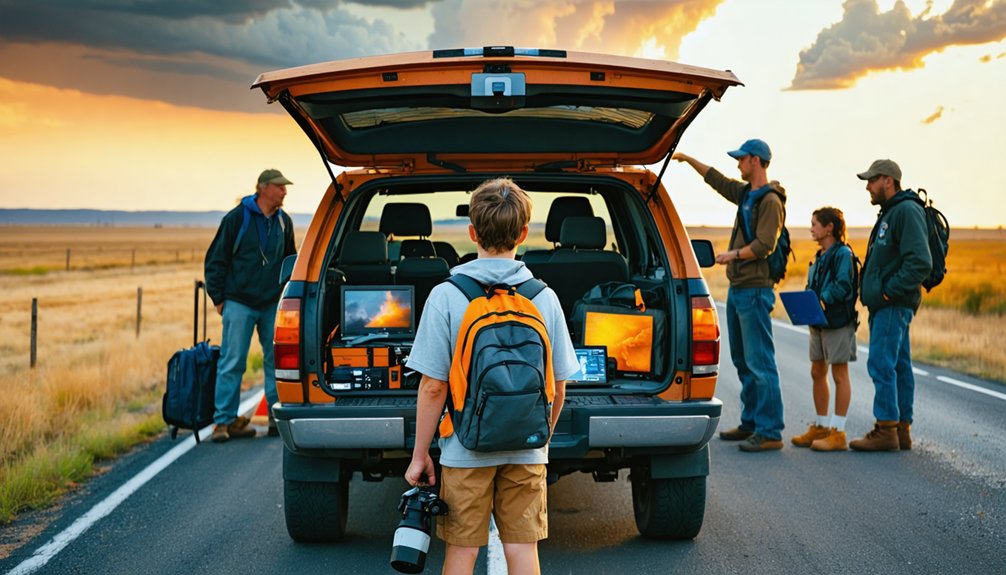
Vehicle Prep Every New Storm Chaser Must Handle Before Departure
Before you leave, check your engine components, fluid levels, and tire pressure to confirm everything is within safe operating range.
You’ll also want to verify that your headlamps and driving lamps function correctly, since poor visibility during a storm can be fatal.
Skipping these checks puts you at an immediate disadvantage when conditions deteriorate fast and you need your vehicle to perform without hesitation.
Fluid Levels And Tires
Neglecting fluid levels and tire pressure before a chase can turn a promising expedition into a dangerous breakdown at the worst possible moment.
You’ll want to check engine oil, coolant, brake fluid, and transmission fluid before every departure. Low fluids compromise performance exactly when you need reliability most. Consistent fluid maintenance keeps your vehicle responding predictably under high-stress conditions.
Tire pressure deserves equal attention. Under-inflated tires reduce handling precision and increase blowout risk on rain-slicked roads. Over-inflated tires diminish traction during rapid directional changes.
Check pressure against your vehicle’s recommended specifications, not the tire’s maximum rating. Inspect tread depth while you’re at it — worn tires won’t grip adequately on compromised surfaces. These checks take minutes but protect your freedom to chase safely another day.
Headlamp And Engine Checks
Two critical systems demand your attention before every departure: headlamps and engine condition. Storm chasing puts you in low-visibility environments where failing headlamps become life-threatening liabilities.
Test both headlamps and driving lamps before you leave — don’t assume they’re functional.
Engine diagnostics aren’t optional. Check your belts, hoses, and cooling system thoroughly. A blown radiator hose miles from civilization ends your chase and potentially your safety.
Verify oil, coolant, and brake fluid levels align with manufacturer specifications.
Headlamp maintenance extends beyond bulb replacement. Inspect wiring connections and lens clarity, since oxidized lenses reduce output dramatically.
Run your engine diagnostics while the vehicle’s cold — irregular idle patterns or warning lights signal problems you can’t ignore in the field.
Address every fault before departure, not after.
How to Plan Your Escape Routes Before a Chase
Before you head out, map at least two distinct escape routes that lead away from the storm’s projected path, ensuring you’re never locked into a single option if conditions shift.
You’ll want to check state road conditions and any active closures early, so you’re not scrambling for alternatives once you’re in the field.
Steer clear of dirt roads or unimproved surfaces, especially in areas that’ve seen recent heavy rainfall, as compromised terrain can trap you when every second counts.
Map Dual Escape Routes
Planning at least two distinct escape routes before any chase is a non-negotiable step that keeps you from getting trapped by a rapidly shifting storm.
Escape route mapping isn’t optional — it’s foundational to every safe chase operation you’ll run.
Before departure, study your target area thoroughly. Identify primary and secondary corridors that lead away from the storm’s projected path.
Dual route planning guarantees that if one road becomes compromised by flooding, debris, or traffic congestion, you’ve already got a clear alternative locked in.
Cross-reference your routes against state road condition reports and known closures.
Avoid dirt roads or unimproved surfaces that deteriorate under heavy rain. Your escape options must remain viable under the worst conditions — because that’s precisely when you’ll need them most.
Check Road Conditions Early
Dual escape routes only hold value if the roads you’ve mapped are actually passable. Early checks on road conditions keep you mobile and in control when it matters most.
Before departure, verify the following:
- Check state DOT websites for active closures, flood warnings, or construction blocking your primary and secondary routes.
- Avoid dirt or unimproved roads where recent rainfall has compromised surface integrity.
- Cross-reference radar history to identify areas where heavy precipitation has already moved through.
- Note road closures on a physical map as a backup if cell service drops mid-chase.
Road conditions shift fast during severe weather events. Your early checks must happen the morning of the chase, not the night before.
Stale information costs you options.
Avoid Compromised Dirt Roads
Dirt roads present three compounding hazards during a chase: soft shoulders, standing water, and limited turnaround options.
When storm-driven rainfall saturates unpaved surfaces, you’re risking vehicle immobilization at the worst possible moment. Dirt road safety isn’t optional—it’s operational discipline.
Before departure, conduct a thorough road surface evaluation using state DOT resources, local condition reports, and satellite imagery.
Flag every dirt or gravel segment along your planned routes and eliminate them where alternatives exist. If no paved option exists, scout the surface beforehand when conditions are dry.
Heavy precipitation transforms manageable tracks into traps within minutes.
You can’t afford a stuck vehicle when a tornado is closing distance. Prioritize paved escape corridors exclusively, and treat any unimproved road as a route you simply won’t take.
Storm Positioning Rules That Reduce Your Risk
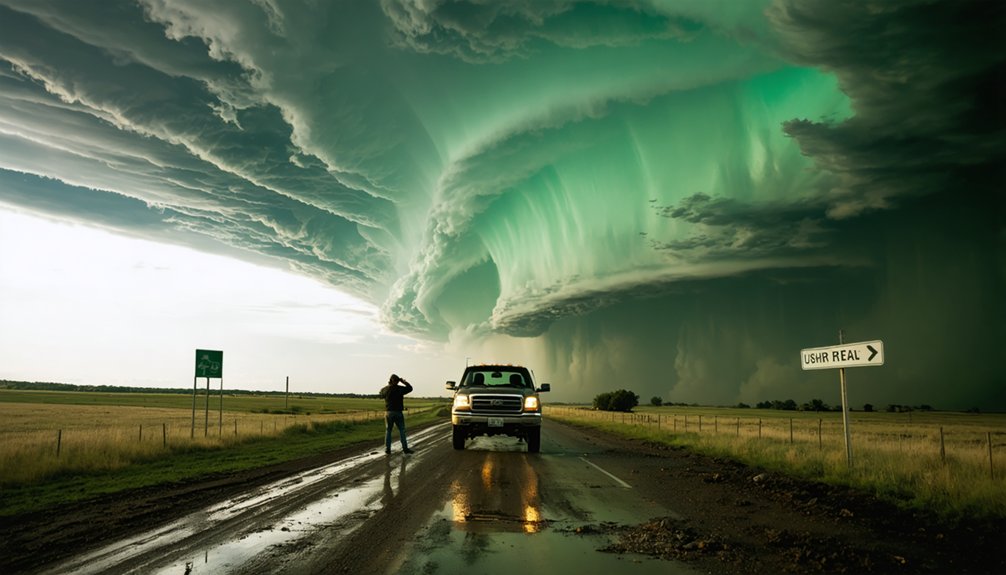
When approaching a tornadic storm, you’ll want to position yourself from the west, south, or east — never from the north, where exposure to the most dangerous quadrants is highest. Understanding storm dynamics and conducting accurate risk assessment before committing to a position separates smart chasers from reckless ones.
Follow these core positioning rules:
- Stay ahead of the storm, not behind it — trailing puts you in the debris field.
- Maintain a safe standoff distance from the core and wind shafts.
- Avoid cutting in front of dangerous storms without full situational awareness.
- Continuously monitor radar so you can reposition as storm behavior shifts.
Your position isn’t fixed — it demands constant evaluation as conditions evolve. Adaptability keeps you alive.
The Radar and GPS Tools Beginner Storm Chasers Need
Knowing your position relative to a storm means nothing if you can’t track its movement in real time. You’ll need two core tools: a radar app with live Doppler data and a GPS unit with offline mapping capabilities.
Radar types vary—dual-polarization radar gives you superior storm structure detail compared to basic reflectivity displays. Apps like RadarScope deliver professional-grade data without restricting your mobility or tethering you to a chase team.
For GPS features, prioritize units that store offline maps, since cell service can drop in rural corridors where storms frequently develop. Pair both tools with a dedicated co-pilot so you’re never reading screens while driving.
Lose either tool mid-chase, and you’ve lost the situational awareness that keeps you alive and free to chase another day.
When to Retreat and Abandon an Active Chase
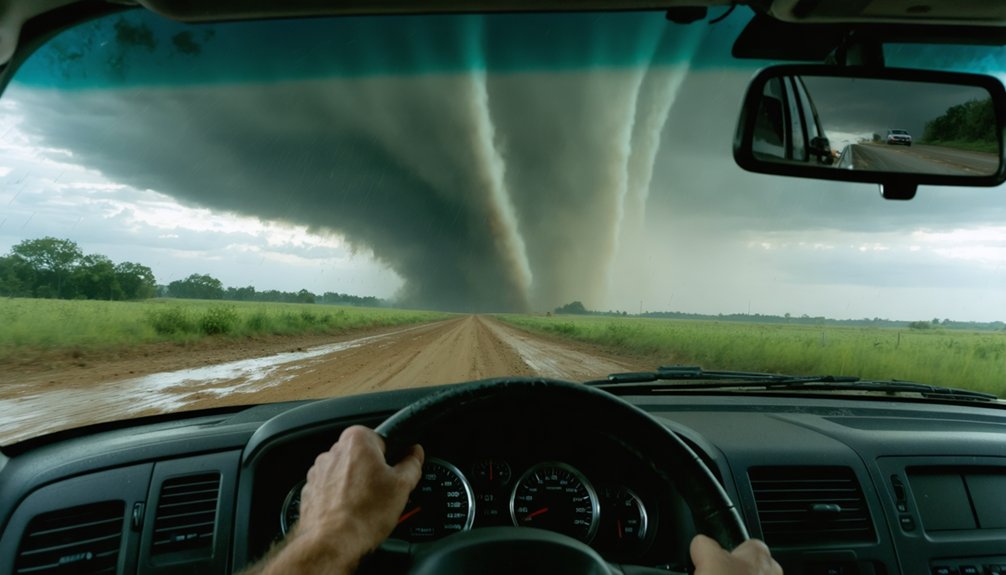
Every storm chaser must recognize the hard line between calculated risk and reckless exposure. When conditions shift against you, retreating isn’t failure — it’s discipline. Knowing your retreat signals keeps you alive for the next chase.
Abandon your position immediately when:
- You lose cell service or radar connectivity
- Safe distances collapse due to rapid storm acceleration
- Road conditions deteriorate, blocking your escape routes
- Darkness falls and situational awareness drops critically
Don’t negotiate with these triggers. Each one represents a system failure that compounds danger exponentially.
You chose this pursuit for the freedom it offers — protect that freedom by staying operational. A chaser who retreats strategically lives to document another storm. One who ignores retreat signals doesn’t get a second chance.
Property Lines and Laws You Cannot Ignore While Chasing
Chasing a storm doesn’t suspend property law or give you license to cross barriers. You must respect property rights at all times, regardless of how promising a storm looks. Trespassing onto private land exposes you to serious legal consequences, including fines, arrest, and civil liability.
Always ask landowners for permission before entering their property, and accept a refusal without argument.
Stay on public roads and avoid driving across crops, fences, or marked boundaries. Never cross barriers placed by law enforcement or emergency management personnel.
Local ordinances governing road use and parking still apply during active chases. Yielding to emergency vehicles isn’t optional—it’s the law. Your freedom to chase depends entirely on your willingness to operate within legal boundaries and demonstrate respect for both landowners and public officials.
Frequently Asked Questions
How Do Storm Chasers Handle Medical Emergencies in Remote Locations?
You’ll want to carry emergency supplies and a first aid kit at all times. Maintain cell service for calling help, know your GPS coordinates, and never chase alone so you’ve got immediate assistance available.
What Insurance Coverage Do Storm Chasers Typically Need Before Chasing?
You’ll need a mountain of coverage before chasing. Secure extensive vehicle insurance that includes storm damage protection, liability, and off-road incidents. Specialty policies covering high-risk weather activities are essential—standard plans often won’t protect you adequately.
How Should Beginners Communicate With Local Authorities During Active Chases?
You’ll want to monitor local alerts via scanner or apps while keeping emergency lines open. Use communication methods like radio check-ins to report hazards, yield to authorities instantly, and never block emergency responders during active chases.
What Physical Fitness Level Is Recommended for Beginner Storm Chasers?
You’ll need solid cardiovascular fitness to chase storms effectively. Prioritize cardio training and endurance exercises to guarantee you can move quickly, sustain alertness during long expeditions, and respond decisively when rapidly evolving conditions demand immediate physical action.
How Do Storm Chasers Coordinate With Professional Meteorologists During Expeditions?
You’ll coordinate storm tracking by maintaining cell service and GPS to share real-time data with meteorologists. Keep radar active, relay position updates constantly, and abort immediately if you lose communication during active chasing conditions.
References
- https://www.atms.unca.edu/cgodfrey/courses/swfex/pdf/ChasingSafety.pdf
- https://www.youtube.com/watch?v=6otZLjSZvPU&vl=en
- https://weather.cod.edu/chasing/assets/documents/safety.pdf
- https://www.youtube.com/watch?v=nxPSFg2R8YY
- https://www.livingskytours.com/storm-chasing-101/
- https://stormchaser.com/Storm-Chasing-Safety.pdf
- https://www.wikihow.com/Storm-Chase
- https://weather.cod.edu/chasing/assets/documents/chaserules.pdf
- https://www.youtube.com/watch?v=fABwvj0rP_A
- https://midweststormchasers.org/safety-tips/