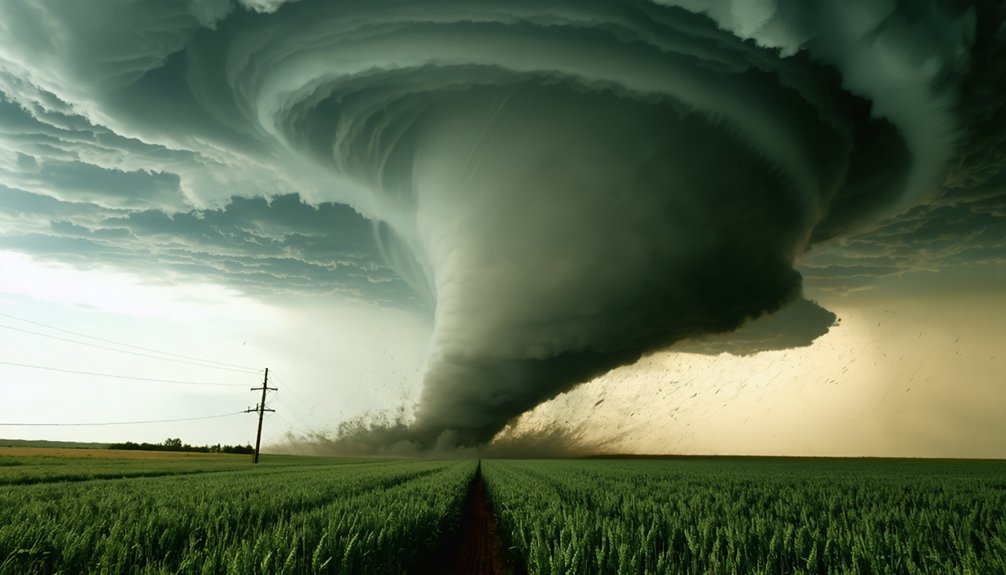
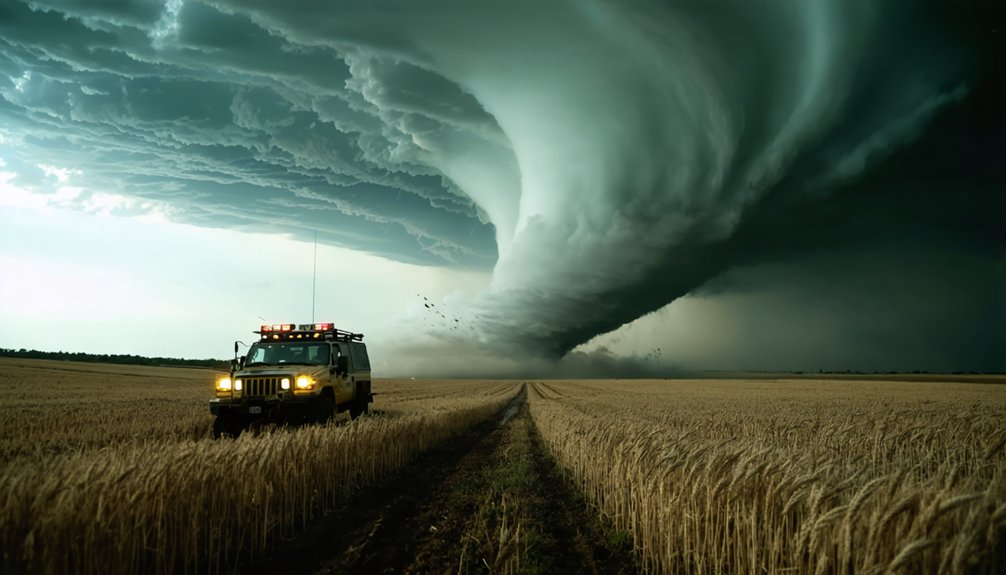
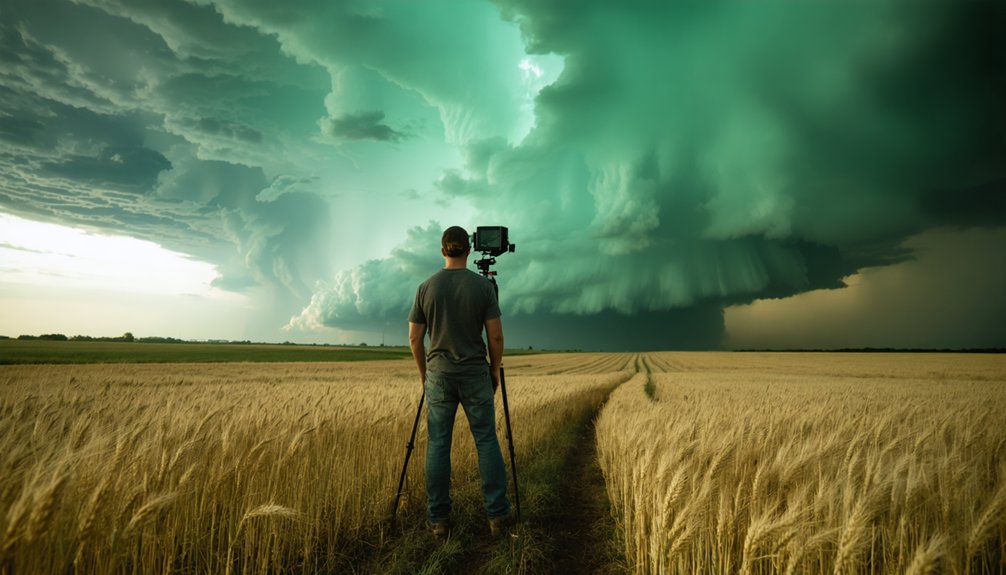
You’ll find Tim Samaras‘ documented probe deployments and fatal El Reno analysis essential for understanding mesocyclone dynamics. The Storm Chasing Handbook provides scientific forecasting fundamentals and equipment protocols, while Chris Kridler’s Storm Seekers series balances meteorological accuracy with narrative depth. Kim Cross’s What Stands in a Storm delivers data-driven analysis of the 2011 Super Outbreak. These resources span field documentation, operational guides, and biographical accounts of researchers deploying instrumentation within tornadoes. The sections below explore specialized categories ranging from visual documentation to atmospheric forecasting methodologies.
Key Takeaways
- Tim Samaras’ documented expeditions provide authentic accounts of tornado data collection methods and the inherent risks of severe weather pursuits.
- The Storm Chasing Handbook offers scientific forecasting fundamentals, equipment guidance, and targeting protocols for aspiring chasers seeking technical knowledge.
- What Stands in a Storm delivers data-driven analysis of the 2011 Super Outbreak, combining meteorological science with compelling disaster documentation.
- Chris Kridler’s Storm Seekers series balances meteorological accuracy with character-driven narratives for readers seeking both science and storytelling.
- Adventures in Tornado Alley combines memorable storm photography with forecaster analysis, offering visual documentation alongside scientific insights.
Epic True Stories of Legendary Tornado Chasers
When Tim Samaras deployed his cone-shaped probes closer than standard safety protocols permitted, he wasn’t recklessly chasing adrenaline—he was methodically collecting data that would validate tornado simulation models for years to come. His engineering expertise enabled precise measurements of pressure, humidity, and temperature within vortices, advancing understanding of tornado inner workings.
Brantley Hargrove’s biography documents how probe deployment challenges drove Samaras to push boundaries, despite being considered the safest chaser in the field. The May 31, 2013 El Reno tornado proved fatal—toppling his vehicle and killing him alongside son Paul and colleague Carl Young.
Post-event analysis revealed inadequate pre storm risk assessment during that 40-minute rampage. You’ll find these documented accounts demonstrate how even meticulous preparation can’t eliminate nature’s unpredictability.
Comprehensive Field Guides to Storm Chasing Adventures
The tragic loss of experienced chasers like Tim Samaras underscores why systematic preparation requires standardized reference materials before pursuing severe weather.
You’ll find the Storm Chasing Handbook delivers 300 pages of scientific forecasting fundamentals drawn from four decades of peer-reviewed literature, covering supercell dynamics, mesocyclone identification, and Enhanced Fujita Scale classifications. The equipment section specifies camcorder features, GPS navigation parameters, and vehicle requirements for field deployment.
Strategic modules address targeting protocols, close-range tactics, and safe positioning beneath active storms. First time chaser perspectives benefit from 100 documented Great Plains routes integrating meteorological patterns with geological context.
You’ll access NOAA weather maps, broadcast frequencies, and historical chase data while capturing unforgettable storm moments through proven interception methodologies that prioritize autonomous decision-making over restrictive guidelines.
Stunning Visual Collections From the Heart of Severe Weather
As atmospheric optics and electromagnetic discharge intensify during severe convective events, professional storm photographers document mesoscale phenomena through specialized imaging systems that capture supercell architecture, lightning propagation, and tornadic vortex signatures across North America’s most active severe weather corridors.
You’ll discover vibrant storm photography spanning Colorado to South Dakota, where Nick Selway’s collection offers prints from 12×18 to 60×120 inches on acrylic, metal, or canvas substrates. Dan Robinson provides authentic documentation without digital manipulation, licensing high-resolution imagery for commercial applications.
Getty Images maintains 743,695+ verified severe weather photographs, while iStock catalogs 561,300+ images depicting shelf clouds, tornadoes, and hurricanes. John Finney’s gallery showcases electric landscape compositions from Tornado Alley’s supercell formations, delivering unfiltered access to nature’s most powerful atmospheric dynamics.
Fiction Novels That Capture the Thrill of the Chase
Fiction narratives documenting mesocyclonic pursuit synthesize meteorological accuracy with character-driven storytelling, offering readers visceral engagement with supercell intercept operations and severe weather dynamics.
Chris Kridler’s Storm Seekers series delivers firsthand chase accounts across Tornado Alley, integrating atmospheric science with weather based romance elements throughout Funnel Vision, Tornado Pinball, and Zap Bang. You’ll find nuanced characterization alongside accurate mammatus formations and vortex genesis descriptions.
Jenna Blum’s The Stormchasers examines bipolar disorder through professional chaser Charles while documenting Plains intercepts. Jennifer Brown’s Torn Away analyzes post-tornado psychological impacts when Jersey confronts catastrophic loss.
For historical perspective, Jennifer L. Wright’s Last Light Over Galveston chronicles the 1900 hurricane during nascent Weather Bureau development. These works provide authentic storm dynamics without sacrificing narrative momentum or emotional depth.
Highly-Rated Recent Releases for Weather Enthusiasts
Contemporary meteorological literature demonstrates quantifiable reader engagement, with five standout publications averaging 4.2+ ratings across aggregated review platforms while maintaining atmospheric science accuracy.
Into the Tempest (Storm Boys #2) achieves 4.35/5 from 1,588 Goodreads ratings, representing 2023’s highest-rated storm pursuit narrative. You’ll find authentic chaser culture experiences throughout N.R. Walker’s series, which collectively demonstrates sustained reader approval.
Adventures in Tornado Alley delivers memorable storm photography across seven states, combining sequential documentation with forecaster analysis. The volume covers Colorado through South Dakota deployments with specialized sections on hail morphology and mammatus formation.
What Stands in a Storm examines the 2011 Super Outbreak‘s meteorological mechanics and societal impact, offering data-driven analysis of April’s catastrophic convective system. These publications provide unrestricted access to severe weather documentation without institutional gatekeeping.
Behind-the-Scenes Accounts of Documentary Storm Chasing
Documentary storm chasing operations require specialized production protocols that differ fundamentally from recreational pursuit methodology. You’ll discover that documentary cinematography challenges encompass equipment weatherproofing, real-time positioning decisions, and capturing scientific phenomena while maintaining crew safety margins.
Storm chasing film techniques demand dual-axis stabilization systems, high-frame-rate cameras for slow-motion analysis, and redundant recording platforms to guarantee footage preservation during extreme atmospheric events.
Professional storm documentarians implement communication networks that integrate meteorological data streams with visual tracking systems, enabling autonomous decision-making without external constraints. You’ll need weather-resistant camera housings rated for hail impact, lightning-safe vehicle configurations, and backup power systems exceeding 72-hour operational capacity.
These technical requirements separate amateur documentation from broadcast-quality storm science cinematography that advances both public understanding and research applications.
Strange Weather Phenomena and Tornado Oddities
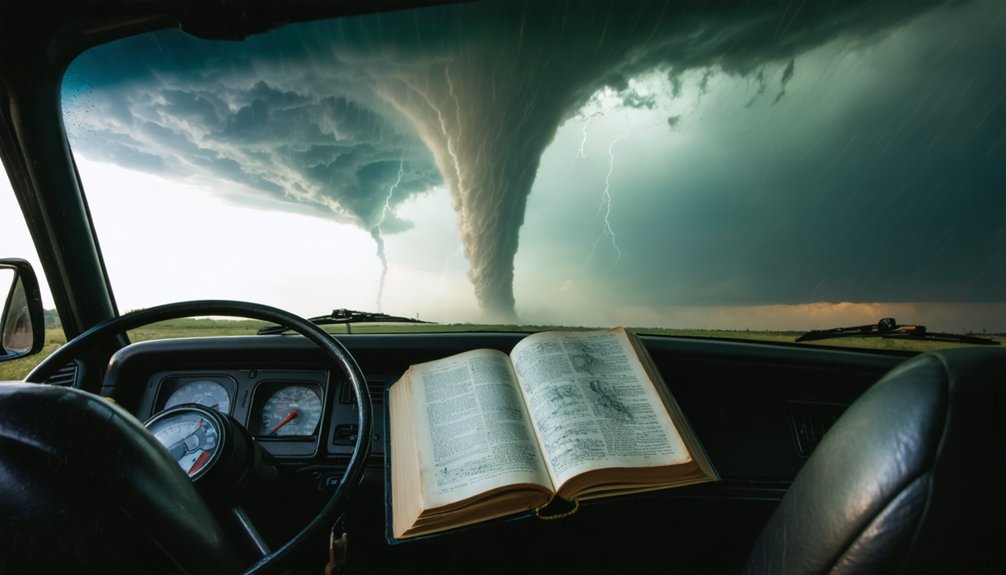
You’ll encounter documentation of tornadoes lofting cattle, vehicles, and structural debris to altitudes exceeding 300 meters, with projectile velocities calculated from impact damage and photogrammetric analysis.
Historical accounts include eyewitness reports of acoustic anomalies—regions of complete silence within 50 meters of vortices and instances where observers reported absent or severely attenuated thunder despite continuous lightning.
Research reveals unexplained phenomena such as anticyclonic vortices forming simultaneously with cyclonic tornadoes, rear-flank downdrafts exhibiting multiple wrapping cycles, and horizontal vortices ascending the main funnel at measured velocities inconsistent with conventional supercell dynamics.
Flying Cows and Objects
When tornado winds accelerate to 300 mph (nearly 500 kph), they generate sufficient force to lift livestock and heavy debris through a combination of drag forces and vertical updraft suction. CFD simulations on 1,300-pound cow models show 464 lb drag and 195 lb lift in straight-line winds, but circular vortex dynamics create far greater vertical velocities.
Real incidents document lifted livestock transport across damage paths exceeding one mile wide. Cattle trajectories mirror those of vehicles and building components caught in the tornado’s core. A 1991 check traveled 223 miles, demonstrating extreme dispersal potential.
While simplified wind tunnel tests prove inconclusive, transient compressible flow analysis confirms tornadoes regularly displace 1,200-pound animals. You won’t see raining cows, but short-distance flights occur frequently in severe storms.
Thunder Theft Stories
Beyond the spectacle of airborne debris, tornadoes exhibit counterintuitive behaviors that challenge conventional meteorological understanding. These bizarre tornado tales emerge from data-driven research revealing unbelievable storm experiences:
- Anticyclonic rotation: Clockwise-spinning tornadoes documented only 5 times as primary events under mesocyclones, defying typical Northern Hemisphere cyclonic patterns with wind speeds exceeding 480 km/h.
- Ground-up genesis: Rapid-scan radar detected surface rotation minutes before funnel formation at 250m altitude, contradicting classical top-down theory across four analyzed tornadoes.
- Multiple vortex dynamics: Horizontal vortices ride vertically through EF5 tornado cores while rear-flank downdrafts wrap, clear, then re-wrap around primary circulation.
- Mesocyclone paradox: Parent storm rotation occurs too high for tornadogenesis, requiring three distinct near-ground rotation mechanisms to bridge the gap between cloud-base and surface-level vorticity.
Unexplained Storm Behavior
While meteorologists track tornado behavior with increasing sophistication, certain storm phenomena resist predictable classification patterns. You’ll find terrain effects on storm dynamics produce contradictory results—identical topography intensifies one tornado while weakening another.
Storm chaser radar data reveals these unpredictable responses, frustrating forecasters seeking consistent algorithms. Supercell splitting behavior offers more reliability: right-moving cells typically spawn severe weather in the Northern Hemisphere, giving you actionable field indicators.
However, observation biases in tornado reporting compromise climatological accuracy. Rural twisters go undocumented, skewing risk assessments in sparsely populated regions. Research confirms prior tornado experience correlates with accurate risk perception (β=0.52, p<0.01), yet misconceptions about protective terrain features persist.
Near-ground rotation mechanisms remain incompletely understood, with multiple vorticity sources likely operating simultaneously within individual tornadoes.
Essential Reads on Forecasting and Atmospheric Science
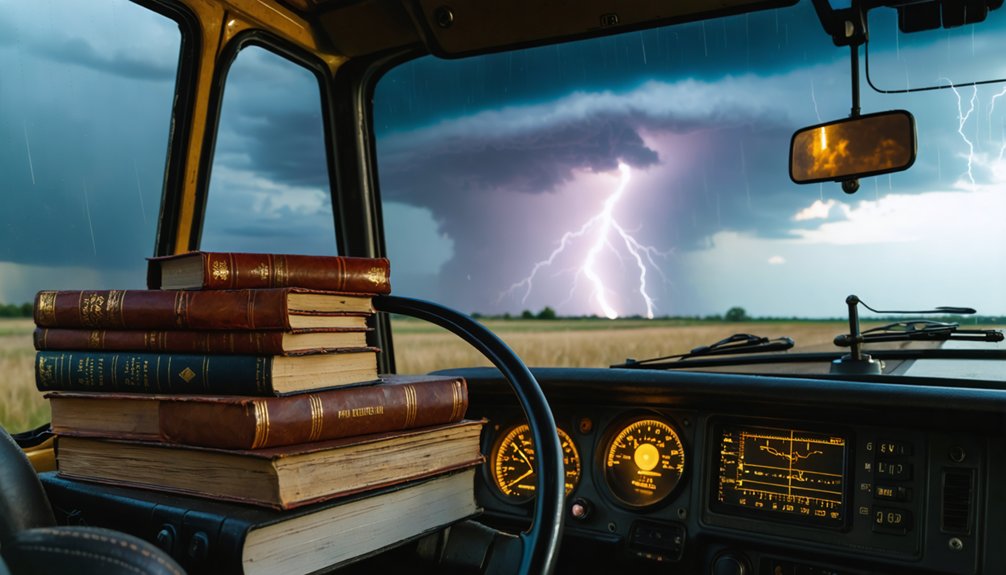
Understanding atmospheric dynamics and forecasting methodologies requires thorough resources that bridge theoretical meteorology with field observations. You’ll gain critical insights from these essential texts that combine advanced weather modeling with practical chase applications.
- Adventures in Tornado Alley delivers cutting edge forecasting techniques through insights from Doswell, Hollingshead, and Nguyen, plus specialized coverage of hail mechanics and mammatus formations ($29.95).
- Storm: Chasing Nature’s Wildest Weather presents detailed graphics breaking down hurricane formation and tornado spin mechanics, documenting three decades of field data (4 hours 15 minutes, Penguin Random House Audio).
- Big Weather examines forecasting challenges specific to Tornado Alley’s supercell environments (3.33 rating, 101 reviews).
- Storm Chaser explores atmospheric phenomena including tornadoes and severe wind dynamics (4.29 rating, published 1996).
Frequently Asked Questions
What Equipment Do Beginner Storm Chasers Need to Get Started?
You’ll need a reliable 4WD vehicle, mobile weather tracking devices, communication equipment, and cameras. However, basic meteorology knowledge and safety protocols importance supersede gear—understanding atmospheric dynamics and risk assessment guarantees/ascertains/makes certain you’re prepared before pursuing severe weather systems independently.
How Dangerous Is Storm Chasing for Amateur Enthusiasts Versus Professionals?
Amateur storm chasers face higher risks without proper safety protocols for amateurs and risk management strategies. You’ll need scientific training and meteorological expertise to match professionals’ sub-1-in-250,000 death rate versus amateurs’ elevated dangers from inexperience.
What Qualifications or Training Are Required to Become a Storm Chaser?
You’ll need an educational background in meteorology or atmospheric science, typically a bachelor’s degree with specialized coursework in radar interpretation, atmospheric dynamics, and forecasting. SKYWARN certification and field experience are essential for operational competency.
How Much Does a Typical Storm Chasing Expedition Cost?
You’ll find typical storm chasing costs range dramatically from $2,500 to $5,050 per person. Average expedition expenses depend on tour duration (5-11 days), single versus double occupancy, and peak season timing—you’re investing in meteorological freedom.
What Are the Best Seasons and Locations for Storm Chasing?
You’ll find ideal storm season runs late May through early June, with prime storm chasing regions concentrated in Kansas and Oklahoma’s Great Plains. These areas offer excellent tornado frequency, gridded road networks, and unobstructed visibility for successful intercepts.