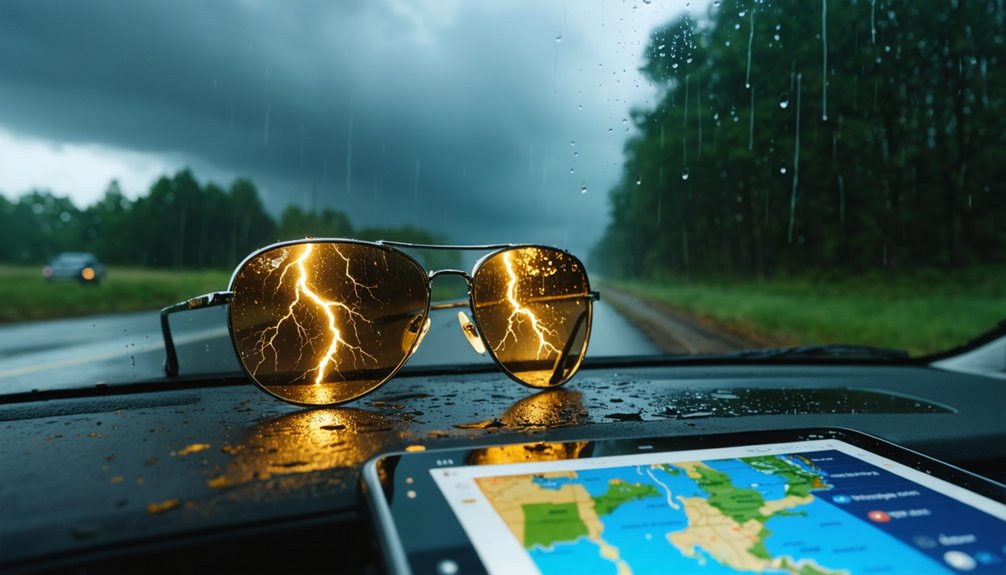
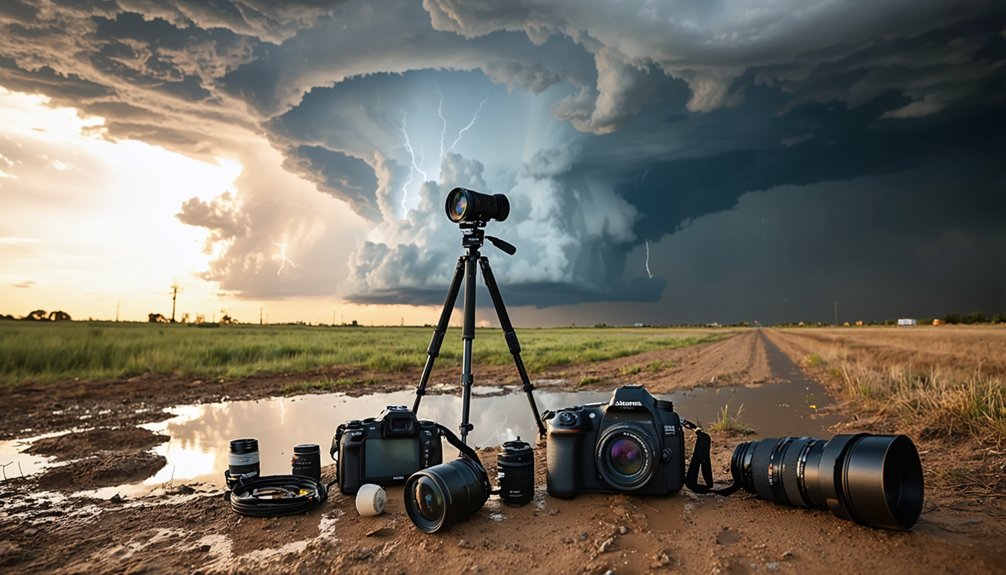
For after-dark storm chasing, you’ll need thermal binoculars with <18mK sensor sensitivity to detect cloud structure in complete darkness, ideally paired with multispectral systems that fuse optical and infrared wavelengths for variable conditions. Vehicle-mounted PTZ cameras like the A2Z VPTZL923 offer 500m laser IR illumination with stabilization for rough terrain tracking. Budget-conscious chasers can start with digital night vision devices like the Firefield Hexcore ($179.97), though performance deteriorates during moonless conditions. The right optical setup depends on your specific operational requirements and environmental challenges.
Key Takeaways
- Premium thermal binoculars with <18mK sensitivity detect heat signatures in complete darkness at ranges up to 2,515 yards.
- Multispectral systems combine optical and infrared wavelengths with data fusion for reliable visualization in any lighting condition.
- Vehicle-mounted PTZ cameras offer stabilized 36x zoom and laser IR illumination up to 500m for tracking storm features.
- Budget-friendly digital night vision like Firefield Hexcore ($179.97) provides adequate perimeter scanning with built-in IR illuminators.
- IR laser systems enable precision aiming of lighting equipment without visible signatures, maintaining operational stealth during observations.
Premium Thermal Binoculars for Complete Darkness Detection
Professional storm chasers operating in complete darkness require thermal binoculars that deliver reliable heat signature detection when conventional optics fail. You’ll need exceptional sensor sensitivity—look for <18mK ratings that register minute temperature variations critical for identifying atmospheric phenomena and ground-based hazards. The 1280×1024 resolution provides thermal contrast detection superior to standard equipment, enabling you to differentiate temperature gradients across storm systems at 2,515-yard detection ranges.
Advanced configurations featuring 640×512 thermal cores with 12-micrometer pixel pitch deliver mid-range to long-range imaging capabilities essential for tracking severe weather development. Integrated laser rangefinders extending to 1,000 yards eliminate guesswork when positioning relative to dangerous meteorological features, while GPS modules and digital compasses maintain positional awareness throughout rapidly-evolving storm environments where conventional navigation becomes impossible. Modern thermal binoculars incorporate Wi-Fi connectivity for real-time data sharing with chase teams, enabling coordinated positioning during severe weather operations. Premium units achieve 6-8 hours of battery life minimum, ensuring uninterrupted operation during extended nocturnal deployments when severe weather events develop over multiple hours.
Multispectral Systems for Variable Light Conditions
While thermal binoculars excel in complete darkness, storm chasers face rapidly shifting light conditions where traditional night vision and thermal systems struggle with fluctuating environments. Multispectral systems solve this challenge by integrating multiple sensor bands—green, red, and near-infrared—automatically adjusting to variable illumination from lightning, moonlight, or approaching dawn.
Multispectral data fusion technology that combines optical and infrared wavelengths, similar to systems providing high resolution satellite imagery for tornado track detection. These versatile sensors maintain visual clarity whether you’re traversing pitch-black rural roads or monitoring illuminated storm structures. Advanced systems employ Track-While-Scan Technology to simultaneously monitor multiple developing storm cells while providing threat detection across extended ranges. Vehicle-mounted multispectral systems work seamlessly with SAR technology for complete situational awareness, eliminating blind spots caused by clouds or darkness. Synthetic Aperture Radar offers active remote sensing capabilities unaffected by darkness, providing reliable detection even in zero-visibility storm conditions. This sensor fusion approach delivers reliable storm structure visualization across any lighting scenario you’ll encounter.
Tactical Aiming Lasers and IR Illumination
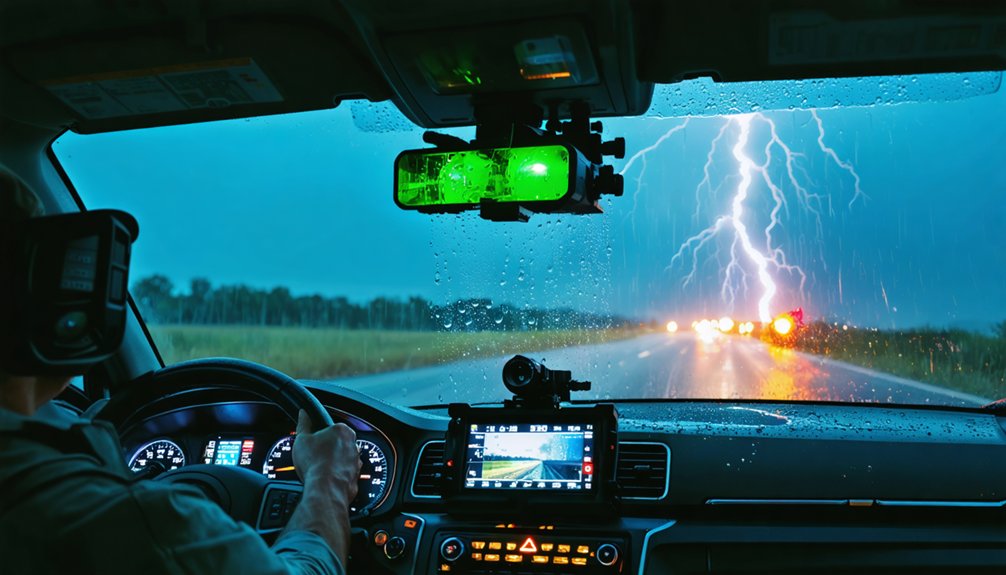
Tactical aiming lasers serve an unexpected but valuable role in storm chasing operations when you’re traversing hazardous terrain after dark. IR laser systems enable precision aiming of illumination equipment toward distant storm features without visible light signatures that compromise your night-adapted vision. Remote activation capabilities let you control lighting arrays mounted on vehicle roofs while maintaining focus on navigation and weather observation.
Civilian-legal IR lasers ($1,725-$5,000) integrate seamlessly with night vision goggles, projecting invisible beams that mark target zones for coordinated team operations. Aircraft-grade aluminum construction withstands harsh weather exposure, while waterproof ratings to 30 meters guarantee functionality during severe precipitation events. Many systems incorporate IR flood illuminators that pair with the laser beam to provide broad-area lighting when needed. Rail-mounted configurations offer versatile platform compatibility, allowing quick transitions between vehicle-mounted observation posts and handheld deployment during field reconnaissance. These systems excel at designating debris fields, marking safe passage routes, and coordinating multi-vehicle deployments across challenging nocturnal chase scenarios.
Mobile PTZ Cameras for Vehicle-Mounted Operations
When lightning-illuminated supercells dominate your windshield and hail cores obscure critical visual intelligence, vehicle-mounted PTZ cameras transform your mobile command center into an exhaustive documentation platform. The E-PatrolCCTV delivers 36x optical zoom with inertial stabilization, ensuring vehicle mounted stabilization through 3g vibration tolerance while maintaining 0.007° pan resolution. Its nitrogen-pressurized housing survives -40°C to +70°C extremes with quick-disconnect roof mounting for rapid deployment.
The A2Z VPTZL923 projects 500m laser IR illumination proportional to zoom magnification, revealing precipitation structures through complete darkness. Integrated wipers clear condensation during temperature inversions. CQ50DM’s IP66 rating withstands horizontal rain while 256 presets enable rapid repositioning between mesocyclone features. The shock-absorbing base reduces visual judder caused by rough terrain, making it easier to track rotating wall clouds and tornadic circulation.
For teams requiring analog video transmission compatibility, the E-PatrolCCTV’s 550 TVL output integrates legacy recording systems without protocol conversion overhead. The SYTIS Vehicle Mounted PTZ System provides bi-spectral infrared and optical capabilities with 30x zoom and 5.3-159mm focal length, enabling storm chasers to simultaneously capture thermal signatures and visible-light imagery during severe weather events.
Budget-Friendly Night Vision for Perimeter Scanning
Generation 1 night vision devices provide adequate perimeter scanning up to 100 yards for storm chasers monitoring approaching systems, though performance deteriorates considerably during moonless nights with heavy cloud cover. You’ll need to understand these limitations when positioning your vehicle during severe weather events, as rain and complete darkness can render budget units nearly useless for threat assessment.
Before relying on any Gen 1 device for storm chasing safety, test it under conditions matching your worst-case scenarios—heavy precipitation, zero ambient light, and electrical interference from nearby lightning strikes. Consider pairing your night vision with a smartphone camera as a backup documentation method, since any spare camera can serve as an affordable alternative when visibility becomes compromised. Digital night vision models with built-in IR illuminators can extend your effective range to 150 yards, providing better detection of funnel clouds and debris fields in complete darkness.
Gen 1 Capabilities and Limitations
Budget-conscious storm chasers often turn to Gen 1 night vision as their entry point into after-dark operations, but you’ll need to understand its significant constraints before relying on it during severe weather events.
Gen 1’s lower cost acquisition ($200-400) comes with grainy images, severe edge distortion, and a practical 40-75 yard range—inadequate for tracking distant storm structures. The required IR illuminator emits a detectable red glow, compromising your position during mobile operations.
Bright lightning causes blooming that obscures critical details when you need them most. With only 1,500-hour tube lifespan versus Gen 2’s 5,000 hours, maintenance costs accumulate quickly.
Gen 1 can’t provide thermal signature detection, leaving you vulnerable to missing tornado debris signatures. For serious storm intercepts, invest in higher generations.
Essential Safety Gear Considerations
While Gen 1 technology falls short for primary storm tracking, several budget-friendly digital night vision devices deliver adequate performance for secondary safety tasks during after-dark chasing operations.
Budget Perimeter Scanning Solutions:
- Firefield Hexcore ($179.97) – Features 1280×720 CMOS sensor with built-in IR illuminator for eight-hour battery life. Head mount configuration frees your hands for terrain mapping reliability checks around your chase position.
- Visio Gear Night Thunder X3 ($89.99) – Reads details at 40 yards with video recording capability. Front-facing tactical flashlight aids real-world navigation through wooded areas during storm positioning.
- NVG40 Budget Monocular – Excels in low-light conditions without IR supplementation. Narrow field of view suits detailed perimeter checks when you’re monitoring approach routes.
Pair these devices with wireless connectivity enhancements like vehicle weather alerts for thorough situational awareness during extended nighttime operations.
Essential Safety Equipment for Night Storm Chasing
When darkness compounds the inherent dangers of severe weather pursuit, your safety equipment shifts from recommended to critical. You’ll need an ANSI-compliant reflective traffic vest with high visibility markings for roadside operations in low-light conditions.
In low-light storm chasing conditions, reflective safety gear transforms from optional accessory to life-saving necessity.
Pair it with a helmet when working curvy or high-traffic routes. Protect your eyes with hail goggles during core punches and keep work gloves accessible for debris clearing or emergency assistance.
A headlamp proves essential for equipment adjustments and nighttime documentation. Layer thermal fabric layers beneath a lightweight wind jacket to maintain core temperature during extended observation periods.
Don’t overlook the surge-protected power strip—it’s among the most forgotten items yet keeps your navigation and communication systems operational when you’re miles from civilization tracking nocturnal supercells.
Frequently Asked Questions
Can Thermal Binoculars Detect Tornadoes Through Heavy Rain and Debris?
No, you can’t detect tornadoes through heavy rain and debris with thermal binoculars. Detection range drops from 2,300 meters ideally to nearly zero as precipitation blocks infrared cloud patterns and obscures electrical charge distribution signatures essential for identifying rotation.
Are Night Vision Devices Waterproof Enough for Direct Storm Exposure?
Most night vision devices offer water resistant durability with IP67 ratings, protecting against rain but not full submersion. You’ll need IP68-certified models for direct storm exposure, while prioritizing battery life optimization since extreme conditions accelerate power drain greatly.
How Do Lightning Flashes Affect Thermal and Night Vision Sensor Performance?
Lightning’s brilliant performance ironically blinds your tech—sensor saturation temporarily overwhelms night vision amplifiers, while thermal imaging interference remains minimal since infrared detectors aren’t measuring visible light. You’ll experience brief whiteouts with NVGs, but thermals keep rolling through strikes.
What Power Backup Options Work Best for Extended Night Chase Operations?
Portable power banks (400-6,000Wh LiFePO4) offer silent, mobile solutions you’ll appreciate during rapid repositioning, while vehicle-mounted generators provide extended runtime for multi-night operations when you’re stationary observing severe weather systems in remote locations.
Do I Need Special Permits for Tactical Lasers During Storm Chasing?
You won’t need permits like medieval torch-bearers required permission. Tactical laser legalities don’t restrict handheld use during chasing, but laser safety regulations demand you avoid aircraft, following FAA guidelines if beams enter navigable airspace above.
References
- https://pulsarvision.com/journal/best-night-vision-binoculars/
- https://www.pewpewtactical.com/best-night-vision-goggles/
- https://www.rugged-cctv.com/product/ruff-ride-mobile-storm-chaser-ptz-package/
- https://ownthenight.com/night-vision-systems
- https://stormtrack.org/threads/recommended-chaser-equipment-list.23013/
- https://www.benholcomb.com/storm-chasing/equipment/
- https://www.youtube.com/watch?v=Sr2lz72ZYwM
- https://feraltexasoutdoors.com
- https://pulsarvision.com/journal/best-thermal-binoculars/
- https://www.atncorp.com/blog/best-thermal-binoculars