To maximize Doppler radar efficiency in storm tracking, you’ll need to deploy appropriate VCPs—VCP 31 for clear air, VCP 12 for convection, and VCP 21 for severe weather. Master velocity couplet interpretation by identifying shear exceeding 2.5 m/s per 450 m and dipole patterns across zero isodops. Optimize display settings through systematic gain reduction and overlay simplification. Integrate multi-radar networks to overcome the 50-nautical-mile detection limitation and terrain blockages. Apply dual-polarization metrics alongside traditional reflectivity for enhanced precipitation classification. This article details the complete operational framework you’ll implement.
Key Takeaways
- Select appropriate VCP modes: use VCP 31 for clear air, VCP 12 for convection, and VCP 21 for severe weather monitoring.
- Identify rotation signatures through velocity couplets with shear exceeding 2.5 m/s per 450 m across zero isodop lines.
- Optimize display settings by maximizing gain initially, reducing incrementally to eliminate clutter, and enabling velocity pixel query functions.
- Integrate multiple radar sources to compensate for beam elevation limitations and maintain low-level coverage beyond 50 nautical miles.
- Mitigate interference using gauge-based bias adjustments, differential phase measurements, and strategic multi-radar positioning for terrain blockage.
Select the Appropriate VCP and Mode Based on Weather Conditions
When tracking storms with Doppler radar, your first critical decision involves selecting the Volume Coverage Pattern (VCP) that matches current atmospheric conditions. You’ll achieve ideal efficiency by implementing data quality control measures that validate reflectivity thresholds and velocity signatures before committing resources.
For clear air monitoring, deploy VCP 31’s high-resolution scans with -28 dBZ sensitivity. When convective precipitation develops, switch to VCP 12’s balanced 4-5 minute updates covering 2300 km range.
VCP 31 delivers superior clear air sensitivity at -28 dBZ, while VCP 12 provides optimal precipitation coverage across 2300 km range.
Severe weather demands VCP 21’s rapid 2.4-minute cycles prioritizing low-elevation mesocyclone detection. Modern systems employ automated VCP optimization through AVSET software, dynamically adjusting scan strategies based on real-time threat analysis.
Dual-polarization mode enhances hydrometeor classification, while SACR boosts azimuthal resolution to 0.5° for resolving fine-scale circulations within supercells.
Master Velocity Data Interpretation for Wind Pattern Recognition
How does your radar distinguish between benign wind flow and a developing tornado signature? Master velocity data interpretation through systematic feature characterization. You’ll identify rotation signatures by analyzing dipole patterns where contrasting velocities create distinct couplets across the zero isodop line.
Critical recognition elements include:
- Velocity couplets: Inbound (negative) and outbound (positive) winds adjacent, indicating rotation
- Shear magnitude: Exceeds 2.5 m/s per 450 m for significant features
- Zero isodop positioning: Marks the demarcation line between opposing flow directions
- Aliasing detection: Discontinuous jumps from +Vnyq to -Vnyq signal folded velocities
- Maximum velocity differential: Values exceeding 5 m/s define strong shear segments
You’ll leverage spectrum width data to assess turbulence intensity, enabling rapid decision-making for warning issuance without algorithmic dependency.
Optimize Display Settings to Maximize Data Clarity
While raw radar data contains critical storm information, poorly configured displays obscure the signatures you need for rapid decision-making. Start with radar gain modulation: maximize gain initially to capture full signal reception, then reduce incrementally until clutter vanishes while targets persist. Switch to auto mode for weather monitoring to maintain consistent sensitivity.
Electronic clutter reduction requires systematic approach. Minimize sea and rain controls before adjusting gain. Apply processed video settings based on range—Proc 1 under 1.5NM, Proc 2 for 1.5-3NM, Proc 3 beyond 3NM. These processor speeds filter clutter without sacrificing weak echoes.
Simplify your display ruthlessly: show one warning type, disable excessive overlays, and stop timelapse during static analysis. Enable velocity pixel query to quantify wind speeds precisely. These adjustments transform cluttered screens into actionable intelligence.
Understand Coverage Limitations and Leverage Multi-Radar Networks
Because radar beams elevate with Earth’s curvature, your detection capability degrades severely beyond 50 nautical miles—precisely where you need low-level coverage most. To leverage observation gaps effectively, you must optimize radar network integration by actively switching between available units.
Radar beam elevation creates critical detection gaps beyond 50 miles—smart integration and active switching between units compensates for coverage degradation.
Critical multi-radar strategies:
- Switch radar sources when storms approach—Lincoln to Indianapolis transitions capture low-level features missed by distant units
- Composite NEXRAD and TDWR data to maintain 6,000 ft coverage across your operational area
- Monitor terrain-induced blind spots in mountainous regions where single radars fail
- Cross-reference multiple radar angles viewing identical storms at different elevations
- Compensate for the 65% mean coverage limitation by routing between overlapping radar domains
This approach directly counters the reduced tornado warning lead times plaguing gap regions like northeast Wyoming.
Identify and Mitigate Common Sources of Radar Interference
Beyond electronic interference sources, you’ll encounter physical phenomena that degrade radar performance during storm operations. Wind farms introduce persistent false echoes that contaminate velocity data, while heavy precipitation attenuates the radar beam and reduces detectability of storms beyond the rain shaft.
Terrain blockage creates permanent blind sectors in your coverage domain, forcing you to compensate through strategic multi-radar positioning and beam elevation angle selection.
Wind Farm Contamination Effects
Wind turbines positioned within 18 km of Doppler radar installations create distinct interference patterns that degrade storm tracking capabilities through three primary mechanisms: physical obstruction, clutter generation, and multipath scattering. You’ll face contamination extending 40 km downrange as rotating blades generate false returns across Doppler frequencies, masking genuine weather signatures.
Critical Impact Factors:
- Blade rotation produces clutter spanning velocity spectrum, obscuring precipitation targets
- Tower structures create strong returns up to 300 meters high via excessive radar cross-section
- Beam attenuation exceeds 10% within 3 km, compromising 460 km detection range
- Multipath reflections generate false alarms, overloading moving target indication filters
- Algorithm disruption reduces probability of detection for actual meteorological phenomena
Implement turbine interference modeling through TSPEAR framework and signal reflection management techniques to maintain operational integrity.
Heavy Rain Attenuation Issues
Heavy rain attenuation degrades Doppler radar performance through signal absorption and scattering by raindrops, progressively reducing beam strength as range increases. You’ll encounter frequency dependent path loss—S-band systems lose only 1 dB through 60 nm of 50 dBZ precipitation, while W-band experiences measurable reflectivity decreases at 0-10 mm/h rates.
Radome attenuation characteristics become critical at C-band, where wet radome losses compound precipitation effects, causing 30% underestimation bias at 10-minute resolution and 45% during peak intensities.
Mitigate these issues by implementing hourly gauge-based bias adjustments and combining reflectivity with differential phase shift measurements. Apply path-integrated attenuation corrections using surface-referenced techniques, and cap reflectivity at 55 dBZ to suppress hail contamination. Calculate specific attenuation using Marshall-Palmer Z-R relations, ensuring your operational adjustments match local rainfall climatology for maximum tracking accuracy.
Terrain and Beam Blockage
Terrain blockage fundamentally limits your radar’s ability to detect low-level storm features, with Earth’s curvature raising beam height approximately 2.5° per 100 nautical miles and physical obstructions creating complete signal voids behind elevated terrain. Mountains in western regions completely halt signal penetration, preventing storm detection on opposite sides. These beam propagation challenges reduce rainfall estimate accuracy and obscure developing mesocyclones at critical low altitudes.
Mitigation strategies you’ll need:
- Deploy Volume Coverage Pattern 12 with 14 elevation angles for denser low-level sampling in terrain-blocked environments
- Implement terrain overlay mapping on reflectivity displays to identify blockage sources matching satellite-confirmed clear sky highlights
- Verify blockage via stationary high-reflectivity echoes that persist across multiple scans
- Utilize mobile Doppler systems to bypass fixed-site limitations during critical storm intercepts
- Cross-reference dual-pol vertical profiles with topographic data for extensive coverage assessment
Integrate Dual-Polarization Metrics With Traditional Reflectivity
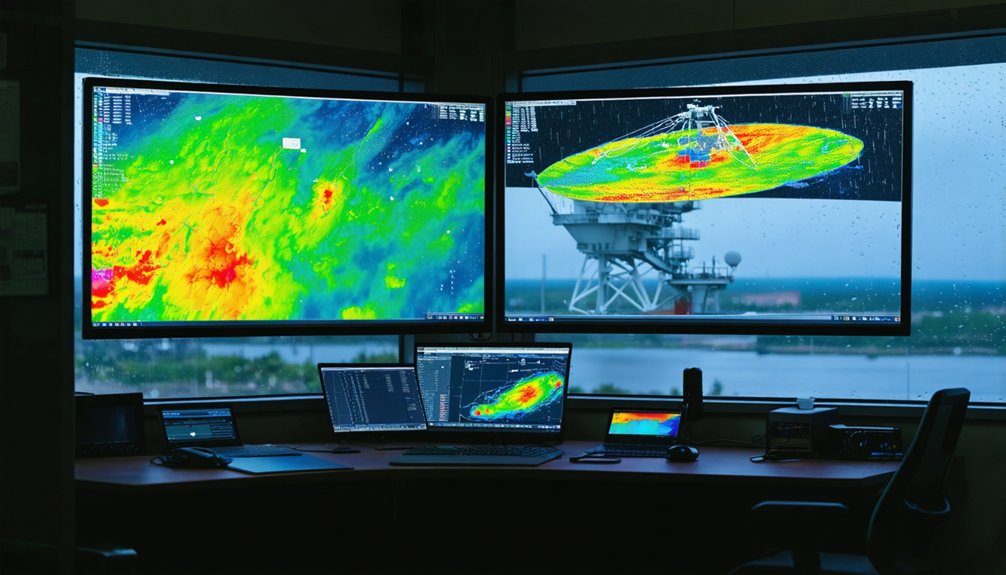
You’ll maximize storm tracking efficiency by combining correlation coefficient (ρHV) with traditional reflectivity to discriminate tornadic debris signatures from precipitation echoes.
Differential reflectivity (ZDR) paired with reflectivity enables precise hail detection, as large hailstones produce low ZDR values that contrast sharply with rain’s positive ZDR signatures.
These dual-polarization metrics eliminate ambiguities in reflectivity-only data, allowing you to identify hydrometeor types and non-meteorological targets with operational certainty.
Correlation Coefficient Identifies Debris
When dual-polarization radar detects tornadic debris, the correlation coefficient (ρhv) drops below 0.80 as irregular shapes and sizes of lofted material scatter energy inconsistently. Values between 0.45 and 0.70 confirm debris lofted into the atmosphere, enabling you to distinguish tornadic activity from uniform precipitation.
You’ll identify debris signatures by analyzing these critical markers:
- Particle geometry: Random tumbling creates CC values below 0.80, distinguishing debris from spherical raindrops
- Dielectric properties: Variable material composition produces ZDR near or below 0 dB
- Reflectivity pairing: High returns (51-72 dBZ) collocated with low CC confirm tornado damage
- Velocity integration: CC drops paired with rotation couplets verify surface tornadoes
- Detection probability: PTDS algorithm achieves 80%+ accuracy combining dual-pol metrics
This methodology enables rapid warning decisions without requiring visual confirmation.
Precipitation Type Discrimination Methods
Beyond identifying tornado damage signatures, dual-polarization radar enables you to classify precipitation types with unprecedented precision by combining reflectivity with differential reflectivity (ZDR) and correlation coefficient (ρhv) measurements. You’ll leverage fuzzy logic implementation to handle overlapping conditions across polarimetric variables, distinguishing rain from dry snow, wet snow, and ice crystals based on shape and density characteristics.
Your system identifies supercooled water detection through specific ρhv and ZDR patterns, critical for freezing rain warnings and aviation safety. This approach reduces quantitative precipitation estimation errors by factors of 1.8 to 3.7 compared to conventional Z-R relationships. You’ll eliminate arbitrary hail caps and bright-band overestimation while maintaining robust performance against attenuation. Operational validation across 150 gauge networks confirms you’re achieving accurate precipitation typing at ranges exceeding 200 km.
Hail Detection Using ZDR
How does your radar system distinguish hailstones from heavy rain when both produce intense reflectivity returns? You’ll leverage ZDR values that reveal critical shape differences. Tumbling hail kinematics create near-zero ZDR (~0 dB) due to irregular orientation, while rain produces higher values (2-2.5 dB).
Deploy these dual-polarization thresholds for hail identification:
- ZDR between -1 and +1 dB with ZH exceeding 60 dBZ confirms hail cores
- RHOHV below 0.90 combined with low ZDR signals irregular hailstone shapes
- ZH-ZDR pairs departing from rain-only relationships indicate contamination
- Melting hail signature shows spiking ZDR with dropping RHOHV values
- KDP and ZDP integration with ZH, ZDR, RHOHV strengthens classification accuracy
You’ll categorize severity using ZH bins (45-56 dBZ mild; >56 dBZ severe) paired with corresponding ZDR measurements for operational decision-making.
Combine Radar Analysis With Supplemental Weather Data Sources
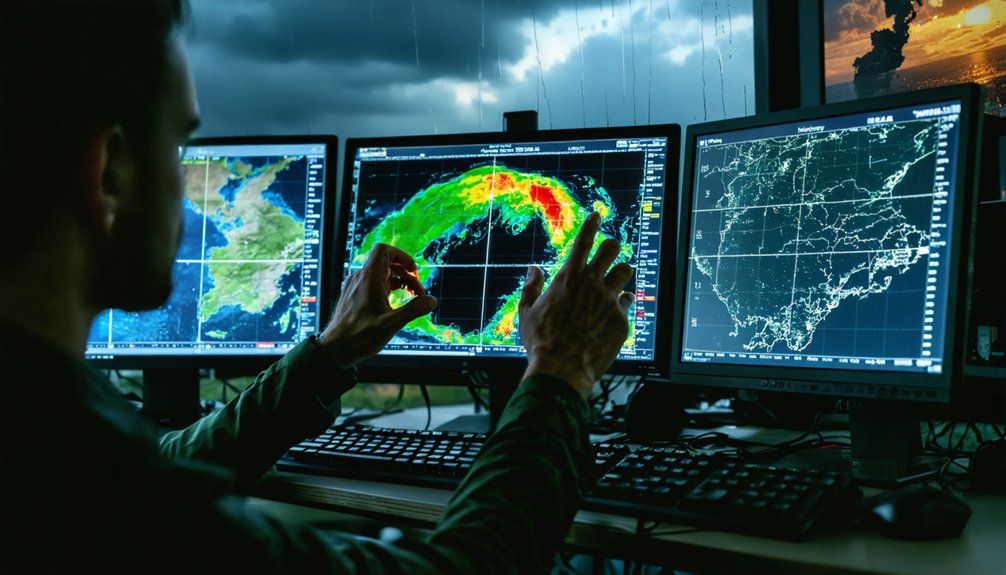
Integrate dual Doppler networks with numerical model ensembles that ingest radar data into cloud-scale simulations. You’ll verify radar-detected features through surface observations—essential when attenuation effects obscure intense storms.
Level II data provides 0.5 dBZ increments for detailed intensity analysis. Combine velocity couplets indicating rotation with ground reports to confirm mesocyclone development. This multi-source approach eliminates blind spots and validates automated detection algorithms against real-world conditions.
Frequently Asked Questions
How Often Should Radar Systems Undergo Calibration to Maintain Accuracy Standards?
You’ll need calibration every 30-60 days with daily monitoring to maintain accuracy standards. Your preventive maintenance schedules should include routine sensitivity checks tracking drifts over four-month periods, ensuring reflectivity stays within 1 dB specifications.
What Are the Best Practices for Archiving Radar Data Long-Term?
Like digital seeds planted for future harvests, you’ll implement data storage management through the 3-2-1 backup rule and tiered classifications. Your long term preservation strategies require automated retention schedules, encryption, and metadata tagging—ensuring you’re unrestricted by data loss.
How Much Does Mobile Doppler Radar Equipment Typically Cost to Deploy?
You’ll deploy mobile Doppler radar like the E700 PDR in 30 minutes for under $60,000. Equipment transportation challenges include securing modular components, while radar deployment logistics demand proper mounting infrastructure and power sources for operational flexibility.
What Training Certifications Are Required for Operational Radar Meteorologists?
You’ll need AMS CBM certification with meteorology coursework, NWS’s 150+ radar training hours, or Mississippi State’s BOMP endorsement. The importance of ongoing education guarantees you’re mastering real-time data analysis skills essential for independent, effective storm tracking operations.
How Do Budget Constraints Affect Radar Network Maintenance and Upgrades?
Equipment funding constraints force you to prioritize critical repairs over network modernization strategies, leading to longer outages and delayed upgrades. You’ll face 9-month parts lead times and rising costs that directly compromise radar availability and storm warning capabilities.