During lightning storms, you’ll stay safest by applying the 30-30 rule — if thunder follows lightning within 30 seconds, take immediate shelter. Seek enclosed buildings, avoid plumbing, corded devices, and windows, and stay indoors 30 minutes after the last thunder. If you’re caught outside, crouch low, drop metal objects, and stay 100 feet from isolated trees. Risk peaks between 2–6 PM, and boating and camping account for 22% of all lightning incidents — details that could save your life.
Key Takeaways
- Use the 30-30 rule: if thunder follows lightning within 30 seconds, seek shelter immediately and wait 30 minutes after the last thunder.
- Seek enclosed buildings or metal-topped vehicles during storms, staying away from windows, plumbing, and electrical outlets while indoors.
- Move to lower ground during storms, crouch low outside, drop metal objects, and stay 100 feet from isolated trees.
- Avoid running water, corded phones, and plugged-in appliances indoors, as lightning can travel through electrical and plumbing systems.
- Schedule outdoor activities during morning hours, monitor weather forecasts, and recognize warning signs like darkening skies and distant thunder.
Use the 30-30 Rule to Know When Lightning Is Dangerous
The 30-30 rule gives you a straightforward method for evaluating lightning danger: if thunder follows a lightning flash within 30 seconds or less, the storm’s within 6 miles and you need to seek shelter immediately.
When thunder follows lightning within 30 seconds, the storm is within 6 miles — seek shelter immediately.
Sound travels roughly one mile every five seconds, letting you calculate distance precisely. This lightning safety calculation removes guesswork from your decision-making.
Storm preparedness means acting on this data before conditions worsen. Storm cells travel at speeds reaching 60 mph, giving you only 5-15 minutes to reach safety depending on your location and group size.
Once sheltered, wait 30 minutes after the last thunder before resuming outdoor activities. That second 30-minute threshold prevents premature exposure during lingering electrical activity.
Enclosed Buildings Are Your Safest Option During Lightning Storms
When lightning threatens, enclosed buildings provide the most reliable protection available—but only if you use them correctly. With roughly 40 million ground strikes annually across the U.S., your shelter strategies must be deliberate and immediate.
Once inside, avoid plumbing, electrical outlets, and windows—approximately one-third of lightning injuries still occur indoors due to improper behavior. Don’t assume four walls automatically equal safety.
Smart shelter strategies mean staying away from corded electronics and metal pipes, which conduct electrical charges through a building’s infrastructure. Lightning statistics confirm that correct indoor positioning reduces injury severity by 72% compared to outdoor exposure.
You’ve got the freedom to dramatically cut your personal risk—but only if you act decisively, enter enclosed structures quickly, and follow proper indoor protocols once you’re inside.
Know Which Activities Put You Most at Risk Before a Storm Hits
Certain high-risk activities dramatically elevate your lightning exposure before a storm even reaches you. Recreational fishing carries a 10% fatality rate in storm-related incidents since 2006, while boating and camping account for 22% of all lightning-related incidents.
Your storm preparedness strategy must factor in these statistics directly.
Open-space activities during summer afternoons between 2-6 PM triple your strike risk compared to other periods. Outdoor workers and recreation enthusiasts face compounded exposure due to delayed shelter access combined with open terrain.
Your risk assessment should identify whether your planned activity involves water, elevated terrain, or open fields—all high-conductivity environments.
Florida residents face higher incidence rates than national averages, meaning regional variables must also factor into your personal preparedness calculations before heading outdoors.
Get Off the Water the Moment a Storm Approaches
If you’re on open water when a thunderstorm approaches, you must return to shore immediately—boating and camping account for 22% of all lightning-related incidents, making water one of the most dangerous places to be during a storm.
You should recognize warning signs early, including darkening skies, increasing wind, and distant thunder, since storm cells can travel at 60 mph and give you only minutes to reach safety.
Once you’re on land, maintain at least 100 yards of distance from the shoreline, as open water serves as an excellent lightning conductor and remains hazardous even after you’ve exited it.
Recognize Approaching Storm Signs
Darkening skies, distant rumbles, and sudden wind shifts are your earliest indicators that a thunderstorm is closing in—and on open water, these signs demand immediate action.
Storm cloud formation, particularly cumulonimbus development with anvil-shaped tops, signals active electrical activity overhead.
Monitor thunder sound frequency carefully—low, rolling rumbles indicate distant strikes, while sharp cracks signal proximity.
Apply the 30-30 rule: if thunder follows lightning within 30 seconds, the storm’s within six miles and you’re already in danger.
Storm cells travel at 60 mph, giving you a narrow 5-15 minute window to reach shore.
Don’t wait for rain to confirm the threat. Boating accounts for 22% of lightning incidents precisely because people delay their response to these early warning signs.
Return To Shore Immediately
Once you’ve spotted those warning signs, acting on them immediately is what separates a close call from a fatality.
Open water is one of lightning’s preferred conductors, and boating accounts for a significant portion of the 22% of lightning incidents tied to water-based activities.
Return to shore the moment a storm approaches, then maintain 100+ yards from the waterline.
Your storm preparedness plan should include:
- Checking forecasts before launching
- Carrying weather-alert safety gear on every trip
- Identifying the nearest shelter before departure
- Establishing a turn-back threshold before clouds build
Recreational fishing carries a 10% fatality rate in storm-related incidents since 2006.
That statistic reflects delayed decisions. You control your timeline — don’t negotiate with incoming weather.
Maintain Distance From Water
Reaching shore isn’t enough — you need to put 100 yards between yourself and the waterline before you’re actually safer. Open water functions as a primary lightning conductor, and that risk doesn’t vanish the moment you step onto land.
Boating safety protocols specifically account for this residual danger zone near shorelines.
Water awareness means understanding that electrical discharge can travel across wet surfaces and through shallow water, extending the strike radius well beyond the visible waterline. You’re still exposed if you’re standing at the edge watching the storm roll in.
Move inland deliberately and quickly. Seek enclosed buildings or metal-topped vehicles rather than stopping at the shore’s edge.
The 100-yard buffer isn’t a suggestion — it’s a measurable threshold backed by documented incident data.
Never Stand on Hills or in Open Fields During Lightning Storms
If you’re standing on a hilltop or elevated terrain during a thunderstorm, you’re concentrating electrical charge around yourself and dramatically increasing your strike risk.
Open fields compound this danger further, tripling your average lightning risk during peak afternoon hours between 2–6 PM when storm activity is highest.
Move to lower ground immediately, prioritizing underground or basement-level locations when available.
Elevated Terrain Strike Risk
Standing on elevated terrain during a lightning storm dramatically increases your strike risk, as hilltops and ridgelines concentrate electrical charge by positioning you closer to the storm’s electrical field.
Open fields compound this danger, tripling your average risk during peak afternoon hours between 2-6 PM.
Protect yourself by following these critical protocols:
- Descend immediately from any elevated terrain when storms approach
- Avoid open fields entirely, particularly during summer afternoons
- Seek underground locations like basement levels when available
- Abandon metal objects in open spaces, as they attract electrical discharge
With storm cells traveling up to 60 mph, you’ve got 5-15 minutes to reach safety.
Don’t gamble with those odds—your freedom depends on making smart, data-informed decisions before conditions deteriorate.
Open Fields Triple Danger
Open fields and hilltops create a deadly convergence of risk factors that triple your average lightning strike probability during peak afternoon hours between 2-6 PM.
When you’re exposed in open fields, you become the highest point in the immediate area, effectively making yourself a primary discharge target.
Elevated terrain concentrates electrical charge, compounding your vulnerability beyond what open fields alone present.
The physics are unforgiving: storm cells traveling at 60 mph give you only minutes to act before conditions turn lethal.
Your safest response is immediate movement toward enclosed structures or metal-topped vehicles.
Underground locations, including basements, provide superior protection.
Avoid metal objects in open spaces, as they attract electrical discharge.
Your freedom to enjoy outdoor spaces depends entirely on recognizing these risk thresholds and acting decisively before the window closes.
Seek Lower Ground Immediately
When a thunderstorm closes in, your elevation relative to the surrounding terrain becomes the single most critical factor determining your strike probability. Hilltops concentrate electrical charge, dramatically increasing your risk.
Your storm preparation must include identifying lower ground routes before conditions deteriorate.
Move deliberately to lower terrain using these protocols:
- Descend immediately from ridgelines, hilltops, or elevated open terrain
- Target depressions, valleys, or low-lying areas surrounded by taller trees
- Avoid isolated trees, metal fences, or open field centers while descending
- Crouch low on the balls of your feet if caught fully exposed—minimize ground contact
You’re not surrendering freedom by seeking lower ground; you’re exercising it.
Educated, deliberate movement protects your ability to continue outdoor pursuits without permanent consequence.
Metal-topped vehicles provide reliable emergency shelter if you can’t reach an enclosed building before a thunderstorm intensifies. Following proper vehicle safety protocols greatly reduces your strike risk.
Park away from tall trees or elevated terrain, cut the engine, and keep windows fully closed. Avoid touching metal door frames, steering columns, or any conductive surfaces inside the cabin.
Your vehicle’s metal frame creates a Faraday cage effect, redirecting electrical current around the passenger compartment rather than through it.
A vehicle’s metal frame acts as a Faraday cage, channeling electrical current safely around occupants rather than through them.
Emergency protocols require you to stay off mobile devices connected to charging cables and avoid contact with the radio system during active lightning.
Storm cells travel at 60 mph, so remaining inside until 30 minutes pass after the last thunder strike is critical for your protection.
Avoid Windows, Doors, and Corded Devices Once You’re Inside
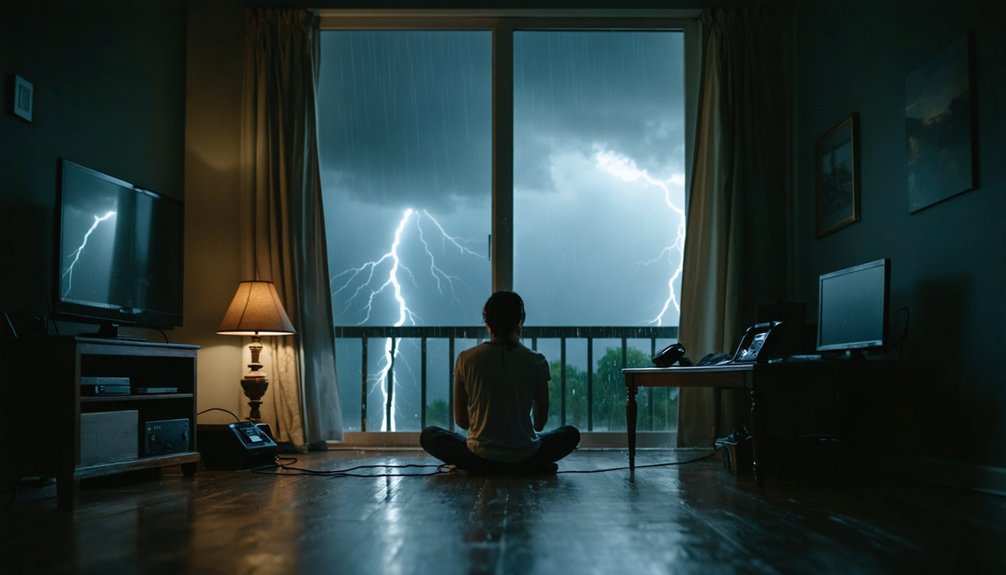
Once you’re inside, stay away from windows and doors, as lightning can arc through glass and frame materials during a strike.
You should avoid using corded phones entirely, since electrical current from a strike can travel through the line and cause serious injury.
Unplug non-essential electronic devices before the storm arrives, given that roughly one-third of lightning-strike injuries occur indoors, making these precautions critical to reducing your risk.
Stay Away From Windows
Reaching indoor shelter doesn’t eliminate your risk—about one-third of lightning-strike injuries occur indoors, and the transmission pathways are predictable.
Window safety demands your immediate attention once you’re inside.
Lightning’s electromagnetic pulse travels through conductive surfaces near openings. Your indoor precautions should include:
- Maintain six feet of distance from all windows and exterior doors
- Avoid contact with concrete walls containing metal reinforcement bars
- Stay off porches and covered outdoor extensions connected to your structure
- Position yourself in interior rooms away from exterior-facing surfaces
Windows don’t need direct strikes to transmit dangerous energy—nearby ground strikes generate shockwaves capable of shattering glass and conducting electrical surges inward.
Interior rooms on lower floors provide measurably superior protection. Your structural awareness directly determines your exposure level during active storm conditions.
Avoid Corded Phone Use
Corded phones and hardwired devices create direct conductive pathways into your structure’s electrical infrastructure. During active thunderstorms, electrical surges travel through copper wiring at speeds exceeding conventional circuit-breaker response times, meaning standard protection mechanisms won’t protect you fast enough.
Your indoor storm precautions must include completely avoiding corded telephones, wired computers, and hardwired appliances until storms clear.
Cordless phone safety presents a meaningful advantage here — battery-operated and wireless devices eliminate conductive vulnerability entirely. About one-third of lightning injuries occur indoors, confirming that internal electrical systems remain genuinely hazardous.
Maintaining your autonomy during emergencies means choosing cellular devices over landlines, using battery-powered weather radios, and unplugging non-essential electronics before storms arrive.
You control your risk profile — make deliberate equipment choices that protect your independence and safety simultaneously.
Unplug Electronic Devices
Unplugging non-essential electronics before a storm arrives eliminates surge pathways that standard circuit breakers can’t intercept fast enough.
Lightning-induced surges travel at near-light speed, destroying connected devices before protection hardware responds. Smart storm safety means taking control rather than relying on infrastructure you don’t manage.
Prioritize these disconnections immediately:
- Televisions and entertainment systems — surge damage occurs even without direct strikes
- Desktop computers and networking equipment — irreplaceable data disappears in microseconds
- Kitchen appliances with digital components — refrigerators and microwaves contain vulnerable circuit boards
- Charging cables and smart home devices — small electronics offer zero resistance to voltage spikes
Emergency preparedness requires acting before conditions deteriorate. You retain full autonomy over your equipment’s protection.
Unplugging costs nothing; replacing fried electronics costs hundreds. Make disconnection your standard pre-storm protocol.
Avoid Plumbing and Electronics: Lightning Can Travel Through Both
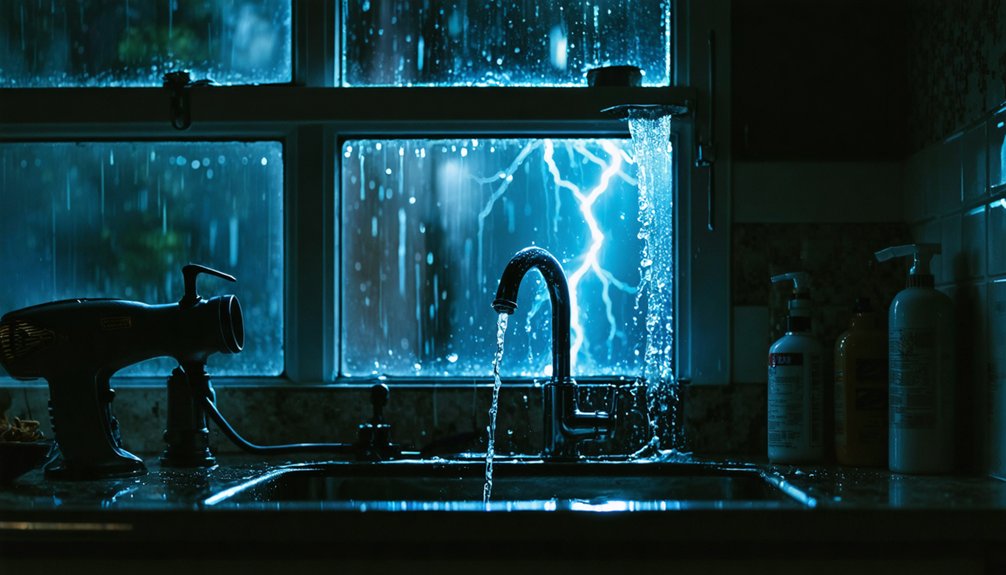
Lightning traveling through a home’s electrical and plumbing systems poses a serious risk, as roughly one-third of all lightning-strike injuries occur indoors.
To protect yourself, you’ll need to practice strict plumbing safety and electronics precautions during active storms.
Avoid running water entirely — showers, sinks, and bathtubs conduct electrical current through metal pipes directly to your body.
Similarly, don’t touch corded phones, computers, or plugged-in appliances, as electrical systems carry strike energy throughout your home’s wiring infrastructure.
These aren’t arbitrary restrictions. Lightning’s voltage travels instantaneously through conductive pathways, leaving zero reaction time once contact occurs.
Proper indoor protocol reduces injury severity by 72% compared to outdoor exposure.
Your safest position remains away from windows, plumbing fixtures, and any device connected to your home’s electrical grid.
Stay Low, Drop Metal, and Avoid Trees If You’re Caught Outside
Indoor protocols only protect you when shelter’s actually available. When you’re caught outside, your decisions in the next 60 seconds determine your risk level. Open fields triple your strike probability during peak 2-6 PM hours.
Execute these four actions immediately:
- Crouch on low ground, minimizing your body’s height profile
- Drop all metal objects—they attract electrical discharge in open spaces
- Stay 100 feet from isolated trees, which act as primary conductors
- Spread out from your group, reducing simultaneous casualty risk
Hilltops concentrate electrical charge dramatically, so descend immediately. Metal objects in open spaces aren’t just risky—they’re actively dangerous.
You’re not helpless outside, but you must act decisively. Applying these field protocols directly reduces your exposure when built shelter isn’t accessible.
Lightning Risk Triples Between 2 and 6 PM in Summer
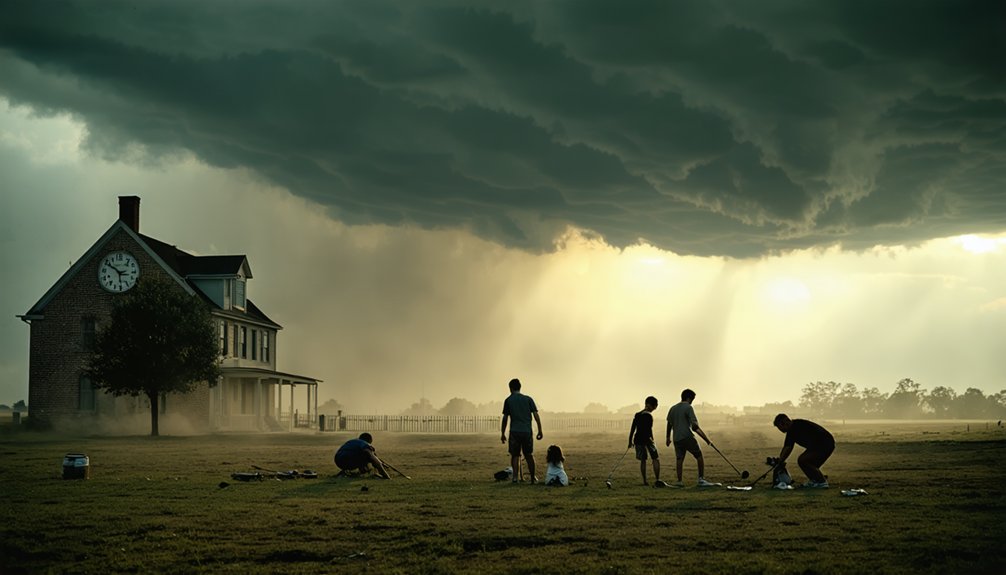
Between 2 and 6 PM during summer months, your lightning strike risk triples compared to other times of day. Atmospheric heating peaks during these hours, intensifying convective storm activity and greatly increasing strike frequency.
Don’t let lightning myths mislead you—clear skies nearby don’t guarantee safety when storm cells travel at 60 mph.
Effective storm preparedness means anticipating these peak hours before outdoor activities begin. Schedule high-exposure activities—fishing, hiking, open-field recreation—during morning hours when risk remains considerably lower.
If you’re outdoors between 2 and 6 PM and storms develop, apply the 30-30 rule immediately: thunder within 30 seconds of lightning means you need shelter now.
Florida residents and outdoor workers face elevated regional risk, requiring stricter adherence to these time-based protocols.
Frequently Asked Questions
What Are My Lifetime Odds of Being Struck by Lightning?
Your lifetime odds of being struck by lightning are approximately 1 in 10,000. Don’t let lightning myths fool you—you’ll dramatically improve those survival tips odds by consistently practicing smart, data-driven safety behaviors outdoors.
Can Lightning Strike the Same Place Twice During a Storm?
“Lightning never strikes twice” is a myth! You shouldn’t trust outdated lightning myths—it absolutely can and does. Follow safety tips: avoid tall structures repeatedly, as they’re struck multiple times per storm.
How Many Lightning Fatalities Occur Annually in the United States?
You’ll want to note that the U.S. averaged 27 annual lightning fatalities from 2009-2018, dropping to 12 direct fatalities in 2024. Prioritizing lightning safety and storm preparedness dramatically reduces your personal risk.
Does Lightning Safety Differ by Region or State in America?
Yes, lightning safety varies by region. You’ll face higher risks in Florida due to environmental factors like humidity and storm frequency. Tailor your regional preparedness strategy accordingly, as local geography and seasonal patterns directly influence your personal strike probability.
What Percentage of Lightning Strike Victims Survive Their Initial Strike?
Ironically, you’ll survive a lightning strike 90% of the time, yet survival rates don’t guarantee full recovery—90% of survivors face disabilities. Seek medical treatment immediately, as swift action dramatically improves your long-term outcomes.
References
- https://www.weather.gov/safety/lightning-odds
- https://www.cdc.gov/lightning/about/index.html
- https://www.weather.gov/media/zhu/ZHU_Training_Page/lightning_stuff/lightning/lightning_facts.pdf
- https://allsouthlightningprotection.com/lightning-strike-statistics-fascinating-facts-you-need-to-know
- https://www.iii.org/fact-statistic/facts-statistics-lightning
- https://www.osha.gov/sites/default/files/publications/OSHA3863.pdf
- https://bellmeadtx.gov/244/Lightning-Safety
- https://www.cdc.gov/lightning/safety/index.html