You’ll need a weather-sealed full-frame camera body with exceptional ISO performance paired with fast f/2.8 zooms covering 14-200mm for capturing everything from wide mesocyclones to isolated wall clouds. Professional options like magnesium-alloy bodies with IP53+ ratings withstand torrential conditions, while 4K video at 30fps minimum guarantees broadcast-quality footage. Fast primes (f/1.8-f/2.8) excel for low-light lightning work, and thorough port sealing protects critical components during extended deployments. The equipment specifications below detail exactly which camera systems consistently perform when conditions turn severe.
Key Takeaways
- Professional camera bodies need weather sealing, high ISO performance, and fast autofocus to capture lightning and rapidly changing storm structures.
- Wide-angle lenses (14-24mm) frame entire storm systems while telephoto zooms (70-200mm+) isolate specific features like wall clouds and funnels.
- Fast apertures (f/2.8 or wider) enable handheld shooting in low light; narrow apertures (f/5.6-f/11) balance lightning brightness with depth of field.
- Weather-sealed gear with IP53/IP54 ratings, rubberized seals, and magnesium alloy frames withstands rain, dust, and extreme temperatures.
- 4K video recording at minimum 30fps is the professional baseline, with 120fps slow-motion capabilities enhancing storm analysis.
Professional Camera Bodies Built for Severe Weather Documentation
When severe weather strikes, your camera body becomes the frontline defense between capturing critical storm data and returning home with damaged equipment. You’ll need professional-grade weather sealing that withstands torrential rain, dust, and extreme temperatures.
The Nikon Z9 and Canon EOS R5C deliver cinema-level durability with internal cooling systems for extended shooting sessions.
For nighttime lightning captures, the Sony A7S III’s exceptional ISO handling gives you unmatched dynamic range considerations in low-light conditions.
Don’t overlook autofocus accuracy—tracking rapidly evolving storm structures demands lightning-fast systems. The Nikon D750 remains a field-proven workhorse, while the Canon EOS R offers versatile mounting options.
Your camera isn’t just equipment; it’s your documentation freedom when nature manifests its most powerful displays.
Essential Lens Options for Capturing Storm Structure and Lightning
Your lens selection determines whether you’ll capture a supercell’s complete structure from safe distances or miss critical storm details in low-light conditions. Wide-angle glass (14-24mm) frames entire mesocyclones when you’re positioned close, while telephoto zooms (70-200mm+) isolate wall clouds and funnel formations from safer vantage points miles away.
Fast apertures of f/2.8 or wider enable handheld shooting during twilight chases and lightning photography without motion blur from slow shutter speeds.
Wide-Angle Storm Coverage
Storm structure and lightning demand wide-angle coverage that balances field of view with optical quality. You’ll want the Canon 24-105mm f/4 L II for full-frame bodies like the 6D or 5D series—it’s versatile from 24mm wide landscapes to 105mm close-range detail. The built-in image stabilization guarantees sharp handheld shots during rapidly changing conditions.
For APS-C shooters, the Canon 18-130mm delivers decent aperture range with ergonomic handling that won’t fatigue you during long chases. When storms close in fast, switch to ultra-wide primes: the Rokinon 14mm f/2.8 on full-frame or Sigma 17-70mm f/2.8-4 on crop sensors. Set f/5.6 for dim lightning, f/11 for bright bolts. This setup grants you creative freedom without compromising safety or shot quality.
Telephoto Distance Detail
Telephoto capability separates successful storm documentation from missed opportunities when tornadoes touch down miles away or lightning illuminates distant cloud formations. You’ll need 100mm+ reach to capture structure detail without dangerous proximity.
The Canon 24-105mm f/4L delivers versatile mid-range coverage on full-frame bodies, while the 18-130mm f/3.5-5.6 extends your reach when closing distance isn’t possible. For extreme focal length options, the 50mm f/1.8 prime excels after 7:30 p.m., offering superior low-light performance through digital cropping rather than poor-quality telephotos.
Nikon’s 18-105mm stretches to 157.5mm equivalent on APS-C, providing serious distance capability. Consider lens weight considerations carefully—you’ll swap glass frequently during active chases. Constant apertures like f/2.8 maintain sharpness across zoom ranges, essential for documenting rapidly-evolving storm features.
Low-Light Aperture Performance
Lightning strikes and twilight supercells demand aperture performance that standard kit lenses can’t deliver. You’ll need fast glass that pulls maximum light from storm environments where exposure adjustments become critical.
Essential low-light aperture configurations:
- f/1.4 to f/2.0 primes – Rokinon 21mm or 35mm capture night storm structure with minimal noise
- f/2.8 zooms – Sigma 24-70mm and Canon 70-200mm maintain light gathering across focal ranges
- f/5.6 to f/11 for lightning – Balances strike brightness with deep depth of field
- Wide apertures sacrifice depth – f/1.2 to f/2.8 enable handheld freedom but limit focus range
- Full-frame sensors maximize performance – Sony A7s or Canon EOS R5 pair with fast lenses for superior post processing techniques
Ultra-fast primes outperform zooms in pure light capture, giving you mobility when storm conditions deteriorate rapidly.
Weather Sealing and Durability Features That Matter in the Field
When you’re shooting in severe weather, your camera’s sealing determines whether you capture the shot or face costly equipment failure. Professional weather-sealed bodies like the Canon EOS R5 and 1DX integrate gaskets at every seam to block moisture and dust intrusion, while impact-resistant housings protect against wind-driven debris.
You’ll need construction that pairs rubberized seals with reinforced magnesium alloy frames to withstand the sustained exposure to rain, hail, and airborne particles that define storm chasing conditions.
Professional Weather-Sealed Body Construction
Professional storm chasing demands camera bodies built to survive environments that would destroy consumer-grade equipment. You’ll need magnesium alloy construction that balances lightweight maneuverability with the rigidity to handle severe impacts when you’re moving fast between locations.
Critical weather-sealing features include:
- Detailed port sealing around battery compartments, card slots, and hot shoes—where moisture typically infiltrates
- Extreme cold performance ratings down to -10°C, ensuring reliable operation in hail cores and winter storms
- Comprehensive button and dial sealing that maintains tactile feedback without compromising moisture barriers
- IP53 or IP54 ratings verified through pressurized water jet testing from multiple angles
- Freezeproof specifications in models like the Olympus OM-D E-M5 Mark II and Panasonic G9
Pro-level sealing adds weight but delivers unrestricted shooting freedom regardless of conditions.
Moisture and Dust Protection
Beyond the camera body’s intrinsic sealing, you’ll need lens-level protection that matches your chassis specifications to maintain system-wide moisture barriers. Sigma Art and Canon RF 15-35mm F2.8L IS USM deliver field-proven weather sealing that endures horizontal rain and wind-driven particulates. Deploy UV filters and lens hoods to shield front elements from immediate debris impact.
Emergency rain covers become critical when conditions exceed your gear’s IP rating. Store silica gel packets in your bag for post-exposure moisture absorption, and carry microfiber cloths for immediate droplet removal. Implement post exposure cleaning techniques using air blowers to purge dust from port seals before moisture infiltrates.
Pack extra battery charging solutions—cold temperatures and live view modes drain power rapidly during extended storm intercepts. Watertight port covers prevent dust entry on video-equipped mounts, preserving functionality throughout your chase.
Impact-Resistant Equipment Housing
Storm chasing exposes your camera equipment to conditions that’ll destroy consumer-grade housings within minutes—hailstones exceeding 2 inches in diameter, wind-driven debris traveling at 60+ mph, and sudden temperature drops of 30°F during rear-flank downdrafts. You’ll need military-grade structural reinforcement options that match the threat environment.
Professional storm-chasing housings incorporate:
- UV-stabilized polycarbonate shells rated for high-impact debris strikes with reinforced construction
- 316L stainless steel enclosures meeting explosion-proof standards for industrial-grade durability
- Aluminum support systems reducing vibration during vehicle-mounted operations at highway speeds
- Protective dome encapsulation deflecting wind forces exceeding 100 mph
- Performance monitoring systems with quick-access panels enabling field maintenance
Your equipment investment depends on housing integrity—thermal shock testing and environmental chamber validation separate reliable gear from expensive failures.
Video Recording Specifications for Dynamic Storm Footage
Modern storm chasers must prioritize 4K resolution as the baseline standard for video recording, as anything less—including 1080p or 2.7K—no longer meets professional documentation requirements. You’ll need crop sensor cameras delivering 4K at 30fps minimum, with Full HD capabilities up to 120fps for slow-motion analysis. The Sony AX100 and Panasonic VX981K offer solid 4K HDR recording at accessible price points around $800-$1,300.
Your codec capabilities determine final footage quality—seek 10-bit 422 codecs in hybrid cameras for maximum post-production flexibility. Global shutter technology eliminates rolling shutter artifacts during rapid panning across rotating mesocyclones. For lightning research, you’ll require specialized high-speed cameras reaching 10,000-50,000 ips. Budget-conscious chasers can start with the Sony AX53, which delivers professional 4K at $1,100.
Mounting Systems and Protective Accessories for Chase Operations
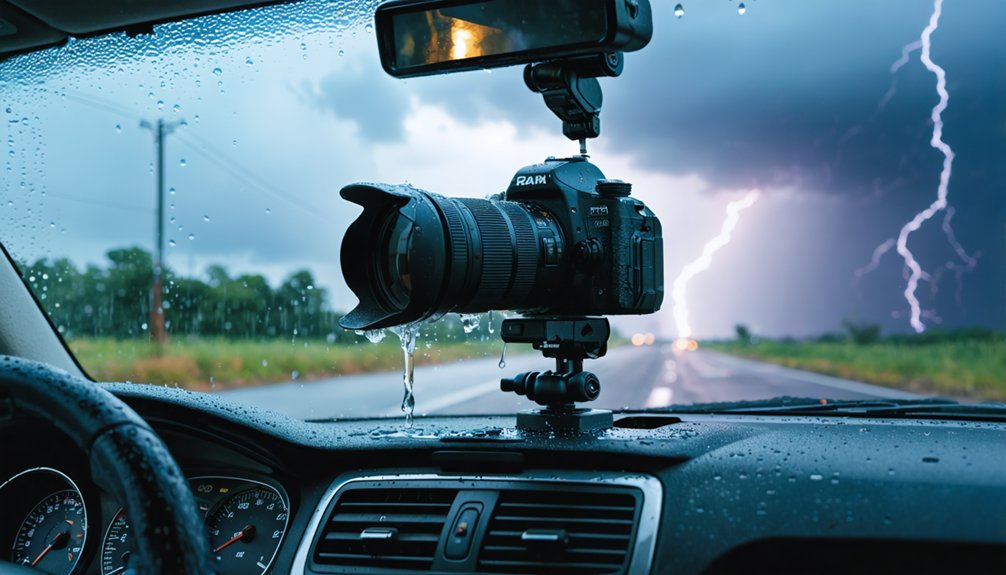
When capturing severe weather from moving vehicles, you’ll need mounting systems that withstand 70+ mph winds, torrential rain, and constant vibration while maintaining camera stability. Vehicle mounted stabilization starts with proven hardware like RAM Mounts’ Twist-Lock suction cups for rapid deployment camera rigging of GoPros and smartphones. Manfrotto’s windshield mounts pair with fluid video heads for smooth panning during active pursuits.
Mounting systems must endure extreme winds, heavy rain, and constant vibration while keeping cameras steady during severe weather pursuits.
Essential mounting configurations include:
- Magnet mounts with IP65 weather resistance for roof-mounted PTZ cameras
- Hardwired Blackvue DR750X-2CH dash cameras for continuous documentation
- Ruff Ride Mobile PTZ with integrated wiper for visibility in heavy precipitation
- 360 bubble cameras with remote presets for all-encompassing coverage
- Protective domes encapsulating equipment against hail and debris strikes
Stream Deck controllers enable real-time PTZ adjustments while maintaining focus on road conditions and storm positioning.
Low-Light Performance and Sensor Considerations for Storm Photography
Beyond securing your gear against physical hazards, sensor technology determines whether you’ll capture usable footage as daylight fades and storms intensify after sunset. Full-frame sensors excel here, handling dynamic range from dark cloud bases to bright lightning while enabling smaller apertures for panoramic focus. You’ll need cameras with high noise reduction strategies—the FX6’s dual ISO switching to 12,800 maintains image quality when light drops.
Pair this with fast primes (f/1.8-f/2.8) that gather maximum light for after-dark operations.
Global shutters prevent rolling shutter artifacts during lightning strikes. For low light autofocus techniques, switch to manual focus at infinity since autofocus fails in rain and darkness. Mount everything on a tripod—handheld shooting becomes impractical.
Use ISO 100-400 for night exposures, opening your aperture wide while avoiding overexposure from brilliant strikes.
Budget-Friendly Alternatives for Beginning Storm Chasers
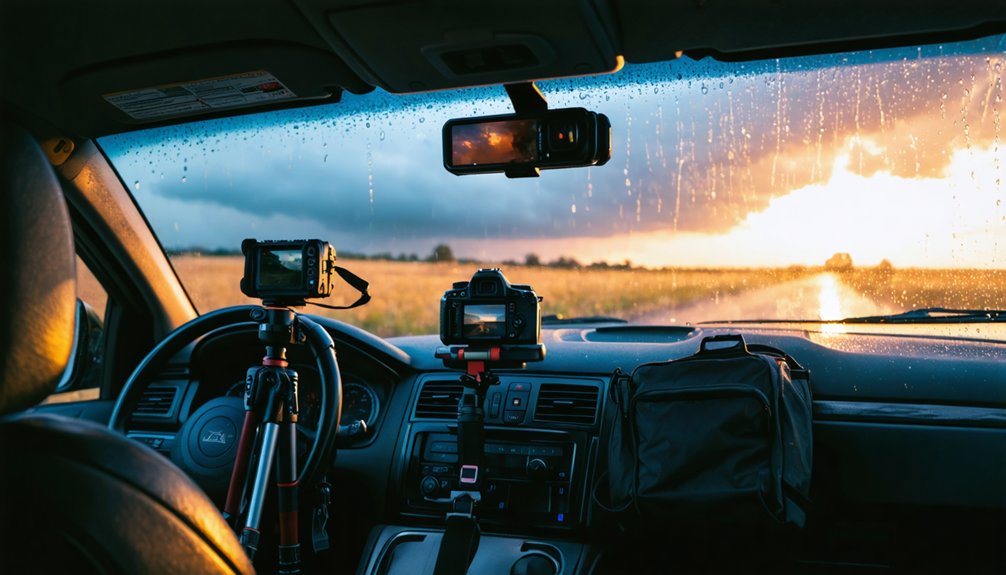
Entry-level storm chasers don’t need premium gear to document severe weather effectively—strategic budget selections under $600 deliver capable performance for learning fundamental chase techniques.
Essential Budget Camera Options:
- Canon Rebel SL2 ($400 used with kit lens) provides interchangeable lens flexibility and manual in camera video settings for exposure control
- Canon M50 ($400 with kit lens) delivers solid 4K capability with compact mirrorless design
- Sony CX900 shoots 1080p60 fps with windshield or tripod mounting for reliable camera stabilization techniques
- Nikon D5300 (under $400 used) features APS-C sensor with excellent low-noise performance
- iPhone 6s/7 with ProCam app enables ISO control for quick documentation paired with RAM Mounts for secure attachment
Supplement your primary camera with extra batteries, polarizer filters, and sturdy tripods to guarantee operational readiness during extended chases.
Data Storage Solutions and Backup Equipment for Extended Deployments
Extended storm chasing deployments generate massive data volumes that’ll quickly overwhelm inadequate storage systems—a single week-long chase producing 500GB+ from combined 4K video, RAW photo bursts, and time-lapse sequences.
A week-long storm chase easily generates 500GB+ from 4K video, RAW photos, and time-lapses—overwhelming unprepared storage systems.
You’ll need portable SSDs delivering 2000MB/s read/write speeds for real-time backup without workflow interruption. The Lexar ARMOR 700’s IP66 rating withstands water and dust in extreme conditions while handling 25MB–75MB RAW bursts during sustained outdoor mobility sessions.
Pair 1TB-1.5TB hard drives with multiple 32GB SD cards for extended battery life scenarios requiring continuous shooting. A 4-port USB-C hub automates file organization and verification logs, preventing duplicates across multi-day productions.
Flash drives enable immediate transfers between devices in remote locations. This layered approach maintains data integrity while supporting the rapid offloading freedom that storm chasing demands.
Frequently Asked Questions
How Do I Protect Camera Equipment From Hail Damage During Active Chases?
You’ll need weather sealing techniques like waterproof camera bags and lens protection strategies including UV filters and rain covers. Mount equipment inside your vehicle behind hail shields, and you’ll maintain shooting freedom while protecting your gear from destructive impacts.
What Insurance Options Cover Storm Chasing Camera Gear Against Weather Damage?
Don’t put all your eggs in one basket—you’ll need inland marine insurance and photography equipment policies for expansive policy coverage options. These protect your gear during equipment transport strategies and weather-related damage while storm chasing.
How Do I Clean Camera Sensors After Exposure to Dust and Debris?
You’ll master sensor cleaning techniques by starting with low-risk blower methods, progressing to static brushes, then wet swabs if needed. Practice sensor dust prevention through proper lens changes and regular auto-clean mode usage between storm chases.
What Backup Power Solutions Work Best for Multi-Day Storm Chasing Deployments?
Portable battery packs like Anker SOLIX F3800 deliver 3,840Wh capacity for extended mobile operations, while solar charging solutions enable field recharging without grid dependence. You’ll maintain camera gear runtime across multi-day deployments, ensuring you capture critical storm footage independently.
How Do I Prevent Lens Fogging When Moving Between Temperature Extremes?
You’ll prevent fogging by gradually acclimating your gear using camera lens insulation and temperature controlled cases. Seal equipment in plastic bags before shifting, allow 30 minutes for equalization, and avoid rushing between air-conditioned vehicles and humid outdoor environments.