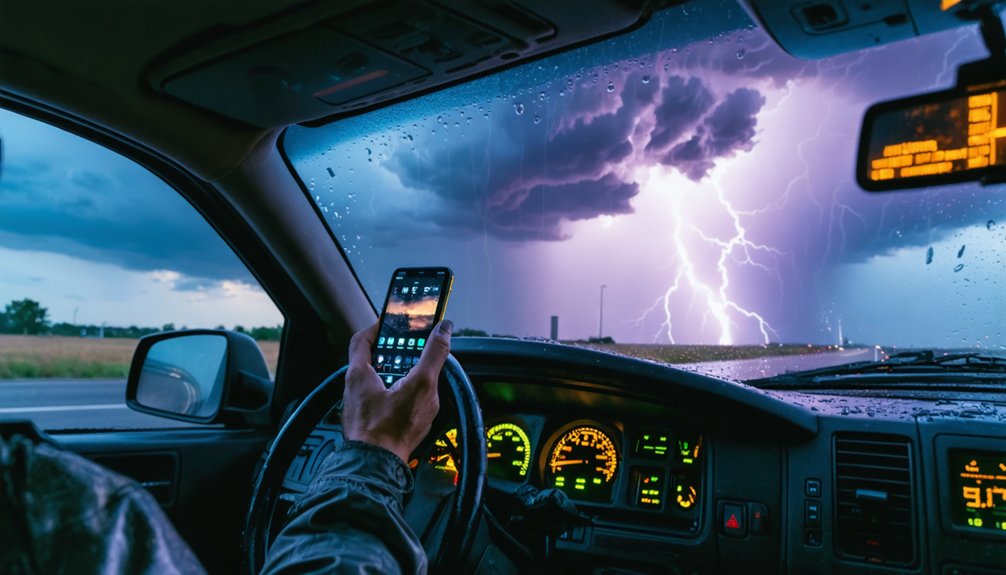
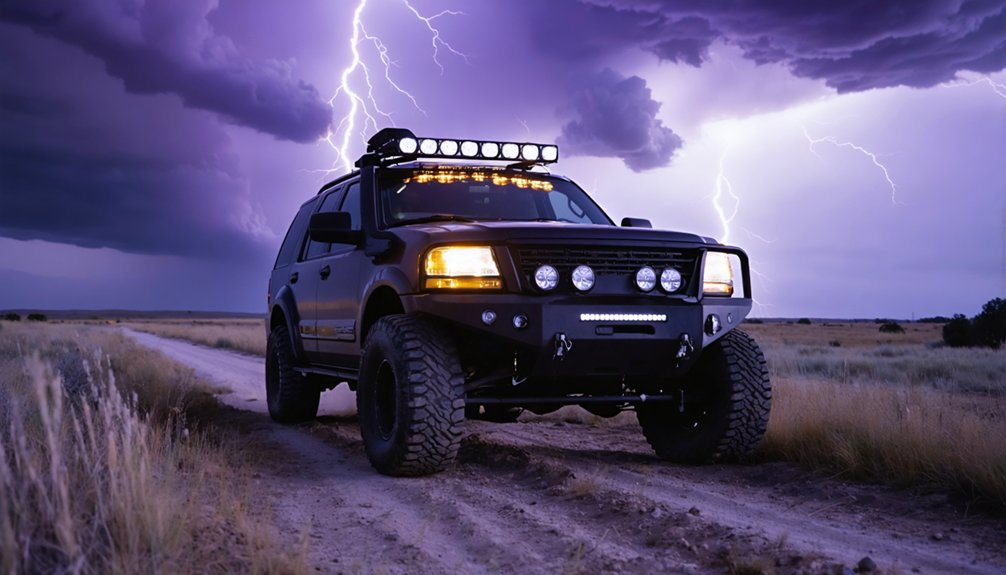
Your best storm chasing modifications under $1000 prioritize survival essentials: LINE-X spray coating protects against hail damage, while LP4 LED pods deliver 7,050 lumens for night visibility and traffic direction around downed power lines. You’ll need a CB radio with center-roof antenna for team coordination and 9.5 inches minimum ground clearance through coil spring spacers. All-terrain tires like Yokohama Geolandar X-AT provide vital traction in flooded conditions. The following breakdown reveals how to strategically allocate your budget across these critical safety systems.
Key Takeaways
- Basic suspension lift kits under $1000 provide 2-3 inches of height for larger tires and improved ground clearance.
- LINE-X spray coatings offer professional hail protection for under $1000, proven effective through multiple tornado seasons.
- LED light bars and pod lights provide miles-away visibility for night chasing and emergency traffic direction situations.
- All-terrain tire sets like BFGoodrich KM3 or Toyo Open Country M/T cost under $800 for mud traction.
- CB radio systems with center-roof antenna maintain 360-degree team coordination during storm chasing operations.
Lift Kits and Suspension Upgrades for Better Ground Clearance
When traversing debris-strewn roads and flash-flooded intersections, your vehicle’s ground clearance becomes the difference between reaching your target and sitting stranded in rising water. You’ll need at least 9.5 inches minimum for storm chasing, particularly when flooding threatens your approach angles.
Coil spring spacers offer the most budget-friendly path forward—under $100 per set adds 10-15mm clearance without compromising handling. For serious terrain work, basic suspension lift kits under $1000 provide 2-3 inches of additional height while accommodating larger tires.
Consider front suspension tuning alongside rear axle reinforcements to maintain stability. Higher lifts increase rollover risk, so stay within 2-3 inches maximum. Check local regulations before modifying—you’re balancing capability against safety margins that matter when conditions deteriorate rapidly.
Affordable Lighting Solutions for Night Chasing
As darkness swallows your chase corridor, your standard headlights won’t cut through the wall of rain between you and that developing mesocyclone. You’ll need targeted lighting packages that deliver without breaking your budget. The LP4 pod’s 7,050 forward lumens and Direct Ducted Cooling provide reliable illumination in compact form, while S1 LED pods offer specialized reflectors perfect for budget-conscious installations.
Mount LED light bars for miles-away visibility when directing traffic around downed power lines. For discreet light activation, undercover visor lights with multiple flash patterns maintain your low profile until you need them. Pair LED flashers with scene floods for all-encompassing coverage during roadside stops. The 5000° Kelvin color temperature reduces eye fatigue during marathon chases, keeping you alert when conditions deteriorate.
Protective Coatings to Shield Your Vehicle From Hail Damage
While proper lighting lets you navigate through the storm, nothing protects your investment like hardened exterior defenses against baseball-sized ice falling at 100+ mph. LINE-X spray coatings offer professional hail protection services that shield your entire vehicle—proven by Discovery Channel’s TWISTEX team through multiple tornado seasons without damage. You’ll pay less than $1000 for targeted coverage on hood, roof, and windshield areas.
DIY hail shields using wire mesh panels mounted several inches from glass withstand softball-sized impacts without window contact. Avoid Lexan alternatives that crack under highway stress. For budget-conscious chasers, pool noodles secured with Flex Tape prevented sunroof destruction during 6-inch hailstone strikes near Burwell.
Padded car covers handle moderate hail while blankets and floor mats provide emergency absorption when supercells develop unexpectedly.
Communication Equipment for Team Coordination
Reliable communication separates successful storm chasers from those who lose coordination when cellular networks fail under severe weather conditions. You’ll need to install a CB or HAM radio system—the latter requiring proper licensing but offering superior range and emergency capabilities during critical moments.
Mount your laptop securely using RAM or ProClip systems to access real-time radar data while maintaining safe vehicle operation and protecting expensive equipment from hail impact.
CB Radio Installation Basics
When pursuing severe weather across hundreds of miles, your CB radio becomes the communication backbone that keeps your chase team coordinated and safe. Mount your antenna center-roof for ideal 360-degree coverage—the metal surface creates the ground plane your signal needs. Magnetic mounts work if you’re avoiding permanent modifications, but verify strong highway-speed retention.
For non-metallic roofs or sunroof installations, choose NGP (no ground plane) antennas.
Run dedicated power wires directly from your battery, bypassing the cigarette lighter to prevent voltage drops during critical transmissions. Protect drilled holes with rubber grommets and touch-up paint.
Position your antenna as high as possible—height equals range when tracking storms. Choose microphone mounting options that keep controls accessible while maintaining your dashboard’s operational flow. Tune SWR after final installation in open terrain for maximum performance.
HAM Radio Licensing Requirements
Professional storm chasers recognize that legitimate communication infrastructure requires proper licensing—and the Technician class amateur radio license delivers exactly what you need for coordinated severe weather operations. This entry-level certification grants access to VHF/UHF bands essential for SKYWARN networks without code requirements.
Your path forward involves three critical steps:
- Pass the 35-question Element 2 exam covering FCC regulations and basic radio theory
- Access license preparation resources through ARRL manuals or online practice tests
- Configure emergency power options for mobile operations during grid failures
You’ll gain legal access to 2-meter and 70-centimeter bands where most storm nets operate. The General class upgrade provides HF capabilities for extended-range coordination, though Technician suffices for local spotting. Your $35 exam fee delivers capabilities no unlicensed service matches.
Laptop Mounting Solutions
Your HAM radio setup means nothing if you can’t access real-time radar data while pursuing a tornadic supercell. RAM Mounts delivers versatile mounting options through no-drill seat bolt bases that won’t compromise your vehicle’s integrity. The double-articulating swing arms telescope from 12″ to 18″, letting you position your laptop precisely while navigating through rough terrain.
Spring-loaded trays secure laptops through expansion—insert one side and lock. The rugged construction features withstand bumpy roads during active chases without failure. You’ll appreciate the universal compatibility across vehicles, including rentals, giving you freedom to chase anywhere without permanent modifications.
For minimal investment, twist-lock suction bases with X-Grip II holders run $84.99. The modular system requires only basic wrenches, and reusable trays transfer between vehicles, maximizing your budget’s efficiency.
Exhaust and Performance Enhancements on a Budget
A performance exhaust system reduces backpressure and heat buildup that robs your chase vehicle of critical power when you need it most. When severe weather develops rapidly, throttle response improvement becomes essential for positioning yourself safely ahead of dangerous storms.
Rapid storm development demands immediate throttle response—performance exhausts eliminate power-robbing backpressure when seconds matter most during critical chase positioning.
Strategic midpipe replacement considerations depend on your platform—turbocharged vehicles benefit most from high-flow downpipes, while naturally aspirated engines respond to quality headers.
Budget-Friendly Exhaust Upgrades Under $1000:
- Catted downpipes for turbocharged setups deliver drastic horsepower gains when paired with proper tuning
- Long-tube headers maximize high-end power on NA platforms through superior exhaust gas flow
- Axle-back systems enhance sound characteristics while maintaining emissions compliance
Pair these modifications with EFI Live tuning and cold air intakes to maximize performance. Field-tested Magnaflow systems prove reliable under demanding chase conditions.
Essential Wheel and Tire Modifications for Rough Terrain
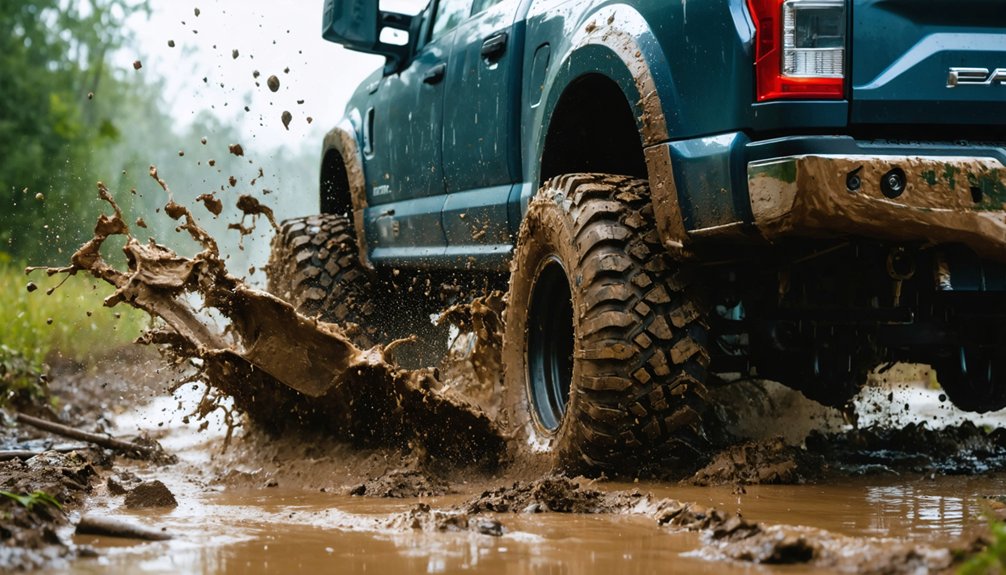
Power modifications mean nothing when your chase vehicle can’t maintain traction on deteriorating rural roads. Tire inflation strategies transform your capability instantly—dropping pressure to 15-20 PSI maximizes rubber contact with sand, mud, and loose gravel. You’ll need a portable compressor under $200 to reinflate before highway speeds.
All-terrain tires like Yokohama Geolandar X-AT deliver off road traction advantages through wider profiles that float over soft surfaces. For aggressive mud pursuit, BFGoodrich KM3 or Toyo Open Country M/T sets run under $800. Pair smaller rims with taller sidewalls for superior flex during airing down—flowformed wheels like Konig Ampliform stay under $600 while reducing weight. Beadlock wheels prevent bead slip during extreme low-pressure maneuvers, with entry options fitting your $1000 limit.
Frequently Asked Questions
What Electrical Upgrades Support Multiple Communication Devices and Camera Systems?
You’ll need a dual-battery system with an upgraded alternator to power your cellular antenna installation and dashboard camera mounting. Add a marine-grade fuse panel for reliable distribution, protecting your critical communication gear during intense chase operations.
How Do You Prevent Moisture Damage to Interior Electronics During Storms?
You’ll prevent moisture damage by installing waterproof equipment enclosures for electronics and using weatherproof cable routing through sealed grommets. Apply silicone sealant at entry points, position gear away from windows, and run dehumidifiers between deployments.
Are There Affordable Alternatives to Professional Spray-In Bedliner Installation?
You’ll save over $300 choosing DIY bed coating options like U-Pol Raptor ($129.99) or Herculiner ($83.99) versus professional installation. These spray on truck bed liner alternatives deliver comparable protection when you properly prep surfaces and follow application protocols.
What Backup Power Solutions Keep Equipment Running During Extended Chases?
You’ll need portable power stations with adequate backup battery capacity to run cameras, radios, and devices independently. Consider adding solar power charging panels to maintain equipment during multi-day chases when you’re off-grid and vehicle power’s insufficient.
How Often Should Suspension Components Be Inspected After Rough Terrain Use?
Your suspension maintenance schedule demands inspection every 6,000-8,000 miles after frequent rough terrain encounters. However, check suspension component inspection frequency immediately after severe impacts—potholes or off-road excursions—to maintain control when conditions deteriorate unexpectedly.