If you’re chasing storms, your tech stack determines whether you come home with data or don’t come home at all. You’ll need real-time radar apps like RadarScope Pro or Baron Mobile Threat Net, ruggedized GPS systems, ham radio for SkyWarn coordination, portable lightning detectors, and reliable power systems like LiFePO4 dual-battery setups. Pair those with Starlink connectivity, aerial drones, and quality cameras, and you’ve built a capable chase platform — but there’s much more to each component that separates survivable setups from dangerous ones.
Key Takeaways
- Real-time radar apps like RadarScope Pro and Baron Mobile Threat Net provide critical storm tracking data, enhanced further by Starlink satellite connectivity.
- Ham radios, two-way radios, and police scanners ensure reliable multi-channel communication and coordination between storm chasers and meteorologists.
- Ruggedized GPS systems like the Garmin Overlander 2025 Edition offer severe weather mapping overlays essential for safe storm navigation.
- Drones such as the DJI Air 3S and Autel Evo Lite+ deliver high-resolution aerial storm documentation with advanced stabilization capabilities.
- LiFePO4 dual-battery setups, solar panels, and portable power stations like the Jackery 2000 Pro sustain electronics during extended chase operations.
Real-Time Radar Apps Storm Chasers Actually Rely On
When you’re tracking a supercell at highway speeds, your radar app isn’t just a convenience — it’s your primary decision-making tool.
Baron Mobile Threat Net and RadarScope Pro dominate serious storm tracking operations because they deliver real time radar data with minimal latency and maximum resolution. You’re not guessing — you’re reading tilt sequences, velocity data, and reflectivity gradients simultaneously.
RadarScope Pro gives you dual-pol products and NEXRAD Level 3 data, letting you identify rotation signatures before they develop into immediate threats.
Baron Mobile Threat Net layers in lightning strike overlays and storm cell attributes for deeper situational awareness.
Both platforms operate reliably on cell connectivity, but pairing them with StarLink satellite internet keeps your real time radar feed uninterrupted when cellular infrastructure fails in rural chase corridors.
Lightning Detection Tools Every Storm Chaser Needs
When you’re chasing storms, a portable lightning detector like Thor Guard or StrikeAlert HD gives you real-time electrical activity alerts that keep you one step ahead of dangerous strikes.
These devices pinpoint lightning location and intensity, letting you make informed decisions about your positioning relative to an active storm cell.
You’ll want this data integrated into your chase kit alongside your radar systems, since electrical activity often signals rapid storm escalation before it’s visually apparent.
Portable Lightning Detector Options
Lightning strikes faster than any storm chaser can react, so you’ll need a reliable portable lightning detector to stay ahead of electrical hazards before they become life-threatening.
Two proven options are Thor Guard and StrikeAlert HD, both delivering real-time alerts about electrical activity location and intensity.
Following essential lightning safety tips means positioning your detector where it maintains unobstructed signal reception, typically mounted externally on your vehicle.
Both units detect cloud-to-ground and intra-cloud strikes, giving you directional awareness before dangerous cells close in.
For consistent performance, follow strict detector maintenance advice: regularly inspect sensor connections, update firmware when available, and test detection sensitivity before each deployment.
A malfunctioning detector in active storm conditions isn’t a minor inconvenience—it’s a potentially fatal equipment failure you can’t afford.
Real-Time Electrical Activity Alerts
Electrical storms develop faster than forecast models predict, so real-time lightning detection tools aren’t optional equipment—they’re mission-critical systems that directly determine whether you stay operational or become a casualty.
Devices like Thor Guard and StrikeAlert HD continuously monitor electromagnetic signatures from developing electrical activity, delivering strike alerts before conditions deteriorate beyond safe operational thresholds. Your electrical storm preparedness depends on integrating these systems with existing radar platforms, cross-referencing data streams for accurate threat assessment.
Lightning safety tips from experienced chasers consistently emphasize maintaining minimum distance protocols regardless of how productive your current position appears. Configure your detector’s sensitivity settings before deployment, establish predetermined evacuation triggers, and never override automated alerts based on visual assumptions.
Electrical activity escalates unpredictably—your detection equipment exists to remove guesswork from that equation entirely.
Lightning Intensity And Location
Tracking lightning intensity and location requires purpose-built detection tools that go beyond basic strike alerts—you need systems capable of pinpointing electrical activity with enough precision to make informed positioning decisions.
Advanced lightning detection units like Thor Guard and StrikeAlert HD don’t just warn you; they quantify strike frequency, distance, and directional bearing. That data directly supports electrical safety decisions, letting you determine whether you’re moving into or away from active electrical zones.
Pair your handheld detector with laptop-based storm software pulling live atmospheric data, and you’ve built a layered detection framework that’s genuinely reliable in the field.
When lightning detection operates at this resolution, you’re not reacting blindly—you’re reading the storm’s electrical behavior and positioning yourself with deliberate, calculated awareness.
When you’re steering through violent, fast-moving storm systems, standard consumer GPS units often fail precisely when you need them most. GPS reliability depends on ruggedized, purpose-built systems delivering real-time updates and emergency rerouting capabilities.
Standard consumer GPS units fail when you need them most — ruggedized systems with real-time updates are non-negotiable.
Prioritize these four navigation essentials:
- Garmin Overlander 2025 Edition — delivers GPS accuracy with terrain awareness and severe weather mapping overlays built for off-road storm pursuit.
- Google Maps Offline — eliminates connectivity dependencies, solving critical navigation challenges in dead zones.
- Tablet-mounted displays — enable hands-free route optimization while monitoring rapidly shifting storm tracks.
- Traditional paper atlases — provide non-negotiable backup navigation when digital infrastructure collapses entirely.
Traffic considerations become secondary to survival routing. You need systems that adapt instantly, keeping you ahead of dangerous storm cells while maintaining positional awareness across unfamiliar terrain.
Communication Gear for Multi-Vehicle Storm Chasing
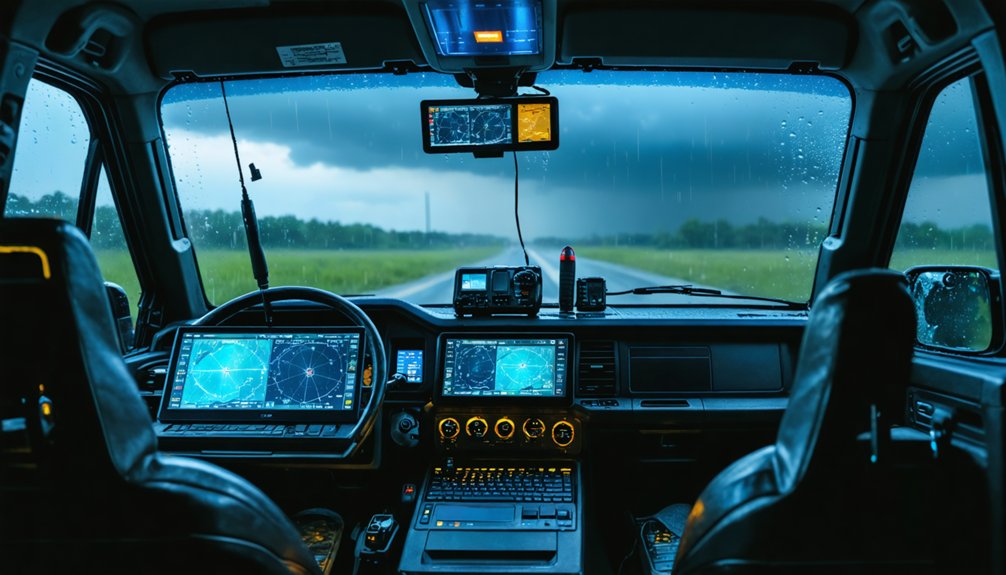
Knowing your position means nothing if your chase team can’t coordinate movement across multiple vehicles. Effective vehicle coordination demands layered communication protocols that don’t rely on a single failure-prone system.
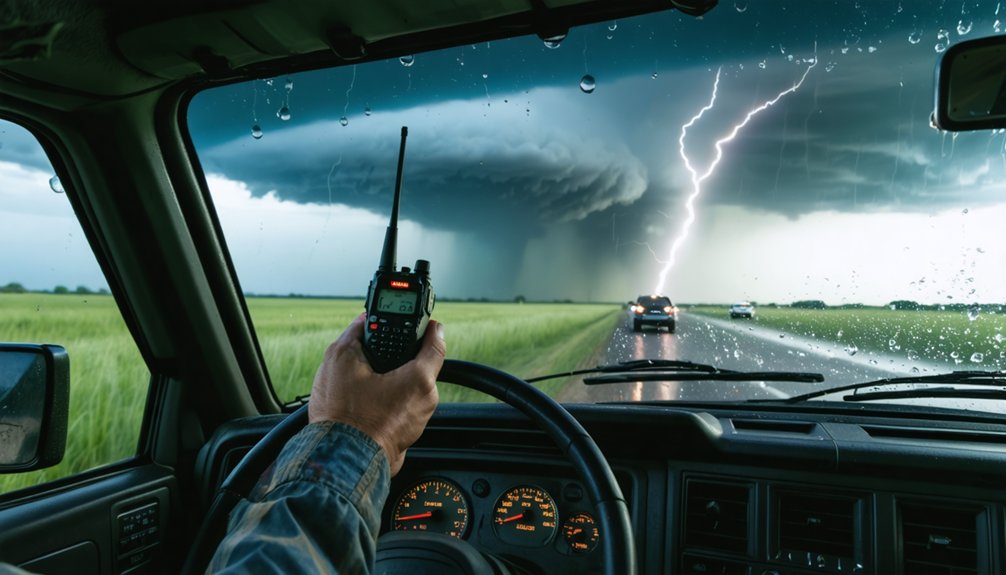
Two-way radios and walkie-talkies deliver instant, direct contact between chase vehicles without requiring cellular infrastructure. When you’re operating in rural corridors, that independence matters.
Ham radios plug you into SkyWarn networks, letting you share observations with other chasers and meteorologists simultaneously. CB radios pull in real-time road intelligence from truckers who’ve already driven through your target zone. Police scanners monitor emergency response activity, telling you where conditions have already turned dangerous.
Stack these systems together, establish clear communication protocols before deployment, and your team moves with precision regardless of what infrastructure the storm destroys around you.
Why Ham Radio and SkyWarn Still Matter in the Field
Ham radio and SkyWarn aren’t relics—they’re active force multipliers that no digital app can replicate in the field.
When cell towers fail and internet drops, your Ham Radio Basics keep you connected to networks that matter.
SkyWarn Benefits extend beyond personal safety—your observations directly feed National Weather Service forecasters making life-critical decisions.
Master these four Communication Protocols immediately:
- Monitor 146.52 MHz — the national simplex calling frequency for storm chasers
- Register with SKYWARN — submit real-time ground-truth reports during active events
- Coordinate on designated local repeaters — extend your communication range considerably
- Establish check-in schedules — maintain situational awareness across your entire chase team
Emergency Preparedness means operating independently of infrastructure.
Ham radio gives you that freedom unconditionally.
Weather Instruments Every Serious Chaser Should Carry
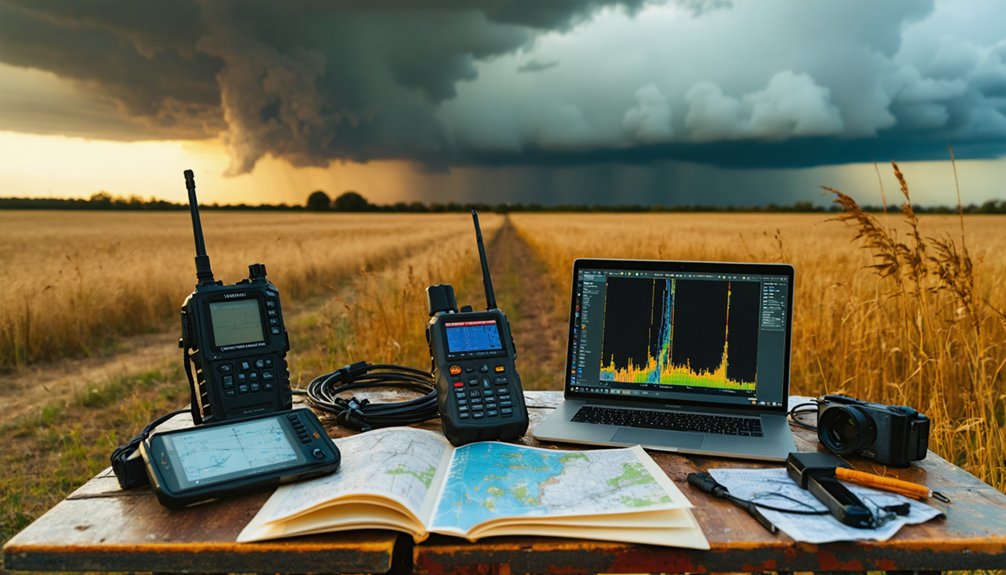
Beyond radio networks and digital feeds, your hands-on instrument package determines how accurately you can read the storm environment directly around you.
Your weather station setup should include a Kestrel weather meter for rapid atmospheric parameter tracking — temperature, humidity, dewpoint, and wind speed all in one rugged unit. Pair it with a dedicated barometric pressure instrument to catch pressure drops signaling rapid storm intensification.
Add a portable lightning detector like StrikeAlert HD to identify electrical activity before it reaches dangerous proximity. Anemometers give you precise wind velocity readings ground-level radar can’t replicate.
These instruments don’t depend on cell connectivity or satellite uplinks — they deliver raw, real-time field data you control entirely. Independent measurement capability separates serious chasers from those relying solely on remote systems.
Best Drone Systems for Aerial Storm Documentation
When it comes to capturing aerial perspectives of storm systems, you’ll want to evaluate the Autel Robotics Evo Lite+ and DJI Air 3S as your top contenders for reliable storm documentation.
Both systems deliver high-resolution footage that lets you document storm structure, rotation, and progression from vantage points impossible to achieve from ground level.
You’ll need to assess each drone’s wind resistance ratings and battery life carefully, as storm environments demand equipment that performs under rapidly deteriorating atmospheric conditions.
Top Aerial Documentation Drones
Drones have become indispensable tools for storm chasers seeking aerial perspectives that ground-based equipment simply can’t provide.
You’ll want systems balancing drone safety, battery life, and camera stabilization against challenging atmospheric conditions.
Top aerial documentation drones for storm tracking:
- DJI Air 3S — Superior camera stabilization, extended battery life, and intuitive controls make it ideal for aerial mapping during active storm systems.
- Autel Robotics Evo Lite+ — Excellent drone features including obstacle avoidance and reliable connectivity support real-time documentation.
- DJI Mavic 3 Pro — Outstanding optics deliver precise photography tips in practice, capturing multi-lens storm detail.
- Autel Evo II Pro — Strong altitude restrictions compliance built-in, with user reviews consistently praising flight regulations management tools.
Always verify local airspace restrictions before deployment.
Storm Footage Capture Capabilities
Capturing usable storm footage demands drone systems engineered for both optical performance and atmospheric resilience.
The Autel Robotics Evo Lite+ delivers 6K resolution with a wide dynamic range sensor, giving you sharp detail in rapidly shifting light conditions.
The DJI Air 3S features dual primary cameras and advanced obstacle avoidance, critical when storm photography techniques require close-range positioning near active cells.
Both systems transmit live feeds through StarLink-connected laptops, letting you monitor footage quality mid-flight.
You’ll want to shoot in RAW or LOG format, preserving maximum data for post-processing in video editing software like DaVinci Resolve or Adobe Premiere.
Wind-resistant stabilization guarantees recoverable footage even during turbulent conditions, giving you documentation that holds up scientifically and professionally.
Starlink and Live Streaming Gear for Storm Chasers
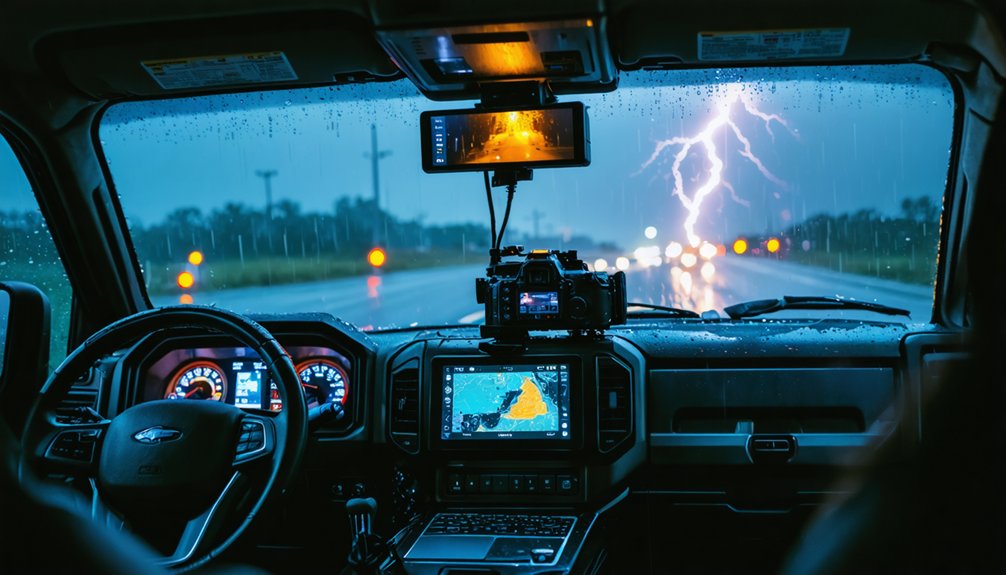
Reliable internet connectivity has become one of the most critical assets in a storm chaser’s tech arsenal, and StarLink satellite internet delivers exactly that.
Reliable internet is no longer optional for storm chasers—Starlink satellite connectivity makes it an accessible reality.
Its Starlink advantages are undeniable—you’re no longer dependent on cellular towers that storms frequently disable.
Follow these live streaming tips to maximize your setup:
- Mount your Starlink dish on a vehicle-rated bracket for rapid deployment.
- Pair with an HD camera and encoder like Teradek for broadcast-quality output.
- Use OBS Studio to manage multi-source streams simultaneously.
- Maintain a backup hotspot in case dish repositioning causes brief signal interruptions.
You’ll capture and transmit real-time storm footage independently, keeping your audience informed while operating deep in active weather zones.
Power Systems That Survive a Full Chase Day
Running 8 to 12 hours of continuous equipment operation demands a power system that won’t quit when you’re deep in a chase. Your vehicle’s alternator can’t carry that load alone.
Build a dual-battery setup using lithium iron phosphate (LiFePO4) technology — it delivers superior power efficiency, deeper discharge cycles, and faster recharge rates than AGM alternatives.
Mount a 2,000-watt pure sine wave inverter to run laptops, radar displays, and charging stations simultaneously. Pair it with a battery isolator that protects your starter battery while the secondary bank powers chase electronics.
For extended chase logistics, a rooftop solar panel adds supplemental charging during daylight operations.
Keep a portable power station like a Jackery 2000 Pro as your hard backup when primary systems fail.
Budget Storm Chaser Setups: Entry-Level to Advanced
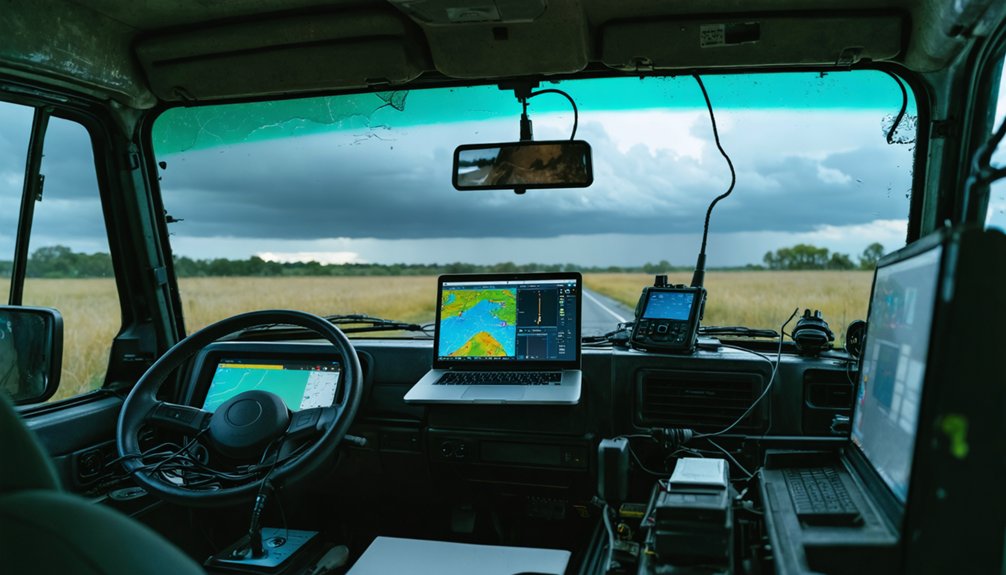
Storm chasing doesn’t require a six-figure budget to get started, but you’ll need to spend strategically to build a functional, safety-conscious setup.
Budget gear has improved dramatically, making entry level setups more capable than ever.
Consider this tiered approach to storm safety and advanced technology:
- Entry-Level ($500–$1,500): RadarScope Pro subscription, Google Maps Offline, a Kestrel weather meter, and a dash camera
- Intermediate ($1,500–$5,000): Add a dedicated Garmin Overlander GPS, portable weather station, HD video camera, and ham radio
- Advanced ($5,000–$15,000): Integrate Baron Mobile Threat Net, StarLink satellite internet, drone systems, and professional lightning detection
- Elite ($15,000+): Full redundant communication arrays, 360-degree camera rigs, and real-time radar broadcasting capability
Each tier delivers genuine operational independence without unnecessary financial compromise.
Frequently Asked Questions
What Vehicle Types Work Best for Extended Storm Chasing Operations?
Your storm-chasing vessel carries you into nature’s fury—SUV advantages like 4WD clearance and cargo space dominate, while truck modifications with reinforced frames and extended fuel tanks give you unstoppable operational endurance across unpredictable terrain.
How Do Storm Chasers Coordinate Safely With Emergency Response Teams?
You’ll coordinate with emergency teams through ham radios on SkyWarn networks and police scanners, applying strict communication strategies and safety protocols to share real-time storm data without interfering with active rescue operations.
Are There Legal Permits Required for Professional Storm Chasing Activities?
Cutting to the chase, storm chasing regulations vary by location. You’ll find no universal federal permits required, but legal considerations include local road laws, drone airspace restrictions, and emergency zone access compliance you must actively monitor.
How Do Storm Chasers Protect Their Equipment From Extreme Weather Damage?
You’ll protect your gear through equipment waterproofing with sealed cases and moisture-resistant housings, while gear stabilization mounts prevent vibration damage. Secure cameras, laptops, and instruments using heavy-duty brackets and foam-padded containers during intense storm pursuit operations.
What Insurance Coverage Do Professional Storm Chasers Typically Carry?
Like a knight armoring before battle, you’ll need storm chaser insurance combining commercial auto, equipment, and liability coverage — protecting your freedom to chase without financial storms threatening your operation’s survival.
References
- https://store.sirui.com/blogs/guides/essential-equipment-for-storm-chasing-guide-for-2025
- https://stormtrack.org/threads/what-will-you-add-change-to-your-chasing-in-2026.33258/
- https://science.howstuffworks.com/nature/climate-weather/storms/storm-chaser3.htm
- https://www.youtube.com/watch?v=st1NkSuT1BA
- https://kestrelmeters.com/collections/storm-chasing