You’ll need heavy-duty tripods like the Gitzo GT3543XLS or Benro Mach3 9X CF when winds hit 30mph during storm chasing. Aluminum models provide superior mass for stability, while carbon fiber options like the Feisol CT-3372 offer excellent portability without sacrificing the 60+ lb load capacity you’ll require. Look for twist-lock legs, center column hooks for weight suspension, and Arca-style ball heads that enable lightning-fast adjustments. The techniques below reveal how proper setup transforms these tripods into rock-solid platforms during severe weather.
Key Takeaways
- Heavy-duty tripods like Gitzo GT3543XLS and Benro Mach3 9X CF provide superior wind resistance through robust construction and weather-proof designs.
- Aluminum tripods offer better stability than carbon fiber in severe winds due to increased mass and inertia dampening vibrations.
- Center column hooks enable suspending weights to lower the center of gravity, improving stability by 62% in high winds.
- Arca-style ball heads with quick-release plates allow rapid camera adjustments during fast-changing storm conditions and evolving compositions.
- Rigid twist-lock or flip-lock leg mechanisms prevent loosening from wind vibrations, maintaining steadiness during critical long exposures.
Why Wind Resistance Matters for Storm Photography
When you’re framing a lightning strike or capturing the raw power of a supercell, wind doesn’t just threaten your composition—it destroys it. Storm-force gusts exceeding 130km/h transform camera shake into composition-killing blur, especially during those critical 1/4 to 1-second exposures that capture dramatic wave action and motion.
Your tripod becomes your anchor point—proper stance and ground anchoring determine whether you’ll nail that shot or waste hours in dangerous conditions. Heavy-duty models like Gitzo Mountaineers absorb vibrations that lighter rigs can’t handle, while wooden Berlebach tripods dampen wind-induced shake naturally.
Without serious wind resistance, you’ll burn through your safe one-hour exposure window taking unusable frames. Storm photography demands equipment that won’t compromise when conditions turn brutal.
Carbon Fiber Vs Aluminum: Choosing the Right Material
The material debate between carbon fiber and aluminum isn’t academic when you’re anchoring gear in 100km/h crosswinds—it’s the difference between capturing that shelf cloud sequence and watching your rig topple. Aluminum’s superior mass (20-30% heavier) delivers genuine stability advantages in severe weather. That extra weight lowers your center of gravity and resists wind gusts better than carbon fiber’s lightness.
While carbon fiber offers impressive vibration damping characteristics for long exposures, aluminum’s increased inertia dampens bumps more effectively in chaotic conditions.
Carbon fiber’s corrosion resistance properties shine during sustained moisture exposure, but aluminum’s ductility means it’ll bend under stress rather than catastrophically shatter. For storm chasing specifically, aluminum’s weather-proof reliability and wind-resisting mass outweigh carbon fiber’s stiffness advantages—especially considering aluminum costs considerably less when replacement becomes necessary.
Top Tripod Recommendations for Extreme Weather Conditions
Five tripods have consistently proven themselves in the field where theoretical specifications meet real-world punishment—the chaotic intersection of 70+ mph winds, driving rain, and the split-second timing storm photography demands.
- Benro Mach3 9X CF delivers professional weather proofing capabilities with glove-friendly Quick Power Lock levers functional to -30°C, while spiked feet versatility handles shifting terrain during supercell intercepts.
- Gitzo GT3543XLS maintains steadiness through 15+ years of extreme conditions, reaching 2.20m for elevated vantage points without flex under heavy telephoto loads.
- Feisol CT-3372 supports 66 lbs across desert gales at just 3.9 lbs carry weight—proven through 13 years of harsh landscape work.
- FLM CP30-L4 II features foam-core vibration dampening and saltwater-resistant construction for coastal storm positioning.
- Leofoto LP-324C Poseidon combines corrosion resistance with 33 lb capacity in a compact 3.15 lb package.
Ball Heads and Mounting Systems for Quick Adjustments
Convenient release systems transform your workflow during rapidly evolving conditions. Arca-style clamps with quick-release plates enable lightning-fast camera swaps between setups. You’ll appreciate dovetail compatibility when moving from video to stills as shelf clouds rotate overhead.
Built-in bubble levels maintain horizon accuracy without slowing your response time. For ultimate control during severe weather, separate panning bases with index markings let you return to previously scouted compositions instantly.
Stability Features That Keep Your Camera Steady in 60mph Winds
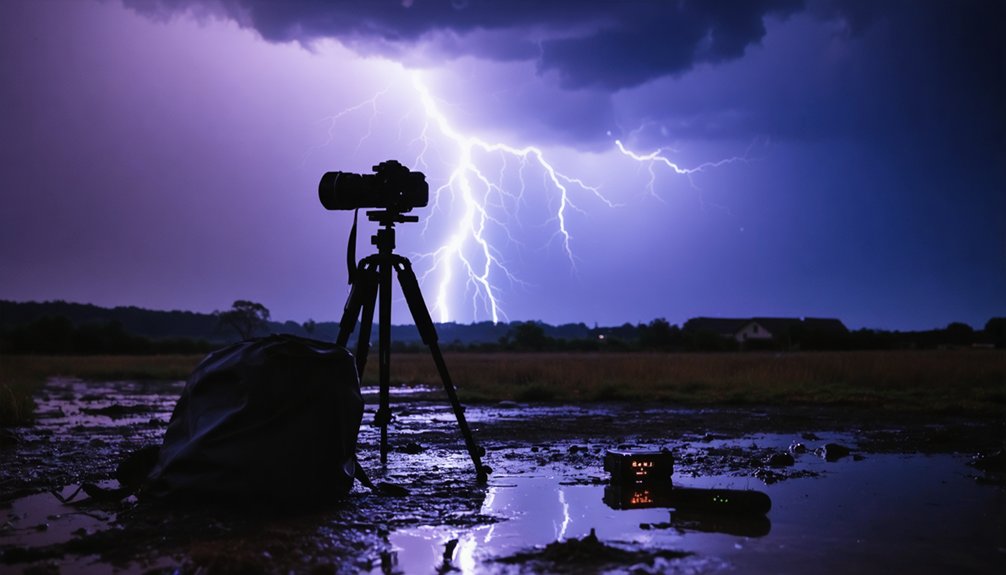
When you’re shooting in 60mph winds, your tripod’s basic stability isn’t enough—you need dedicated reinforcement systems. Most professional storm-chasing tripods include a center column hook that lets you suspend additional weight (typically your camera bag) to lower the center of gravity and anchor the entire system against lateral wind forces.
Equally critical are rigid leg lock mechanisms—twist-locks or flip-locks with metal construction—that won’t vibrate loose under sustained wind pressure, ensuring your camera stays locked in position during those vital long-exposure lightning captures.
Weight-Adding Hook Systems
Although it might seem counterintuitive to add mass to a tripod you’re hauling across muddy fields, a properly configured weight-adding hook transforms an unstable setup into a rock-solid platform that’ll hold steady through 60mph gusts.
Critical implementation factors:
- Attachment rigidity matters—bolt your S-hook directly through the center column’s base, maintaining flexure below 0.3mm to prevent vibration transmission that’ll ruin your shots.
- Weight selection starts at 1.5kg using calibrated plates, not inconsistent sandbags; verify your center-of-gravity alignment stays within 2° deviation.
- Ground-resting weights connected via taut shock cord deliver 62% better stability than dangling configurations—tension eliminates midair swinging.
- Never exceed your tripod’s rated capacity including camera gear; carbon fiber models require reinforced mounting points to avoid stress fractures.
Rigid Leg Lock Mechanisms
Your tripod’s leg locks will either hold firm against violent prairie winds or fail spectacularly at the worst possible moment—there’s no middle ground when you’re tracking a supercell. Screw clamps deliver compression-based security but slow you down during rapid repositioning. Flip levers offer faster deployment while maintaining environmental protection against dust infiltration. Twist locks excel in wet conditions with their rubber coverings, though they sacrifice long-term reliability.
Master your chosen system’s leg locking patterns before deploying in severe weather. Four-section legs with three locks provide ideal rigidity-to-setup speed ratios. Always engage the bottom-most lock first after full extension to establish your secure base. Learn proper leg lock disassembly procedures—cleaning accumulated grit maintains clamping force when 60mph gusts hit. Your freedom to chase depends on mechanical reliability, not luck.
Weight and Portability Considerations for Chase Mobility
Since storm chasing demands rapid repositioning between locations, you’ll need to weigh the tradeoff between tripod stability and chase mobility carefully. Your packability considerations should focus on folded length and total system weight during high-mileage pursuit days.
Storm chasing requires balancing tripod stability with mobility—prioritize folded length and total system weight for rapid repositioning during pursuit days.
Critical weight-to-performance ratios:
- Minimum viable weight starts around 2.85 pounds supporting 15-pound loads—adequate for mirrorless setups while maintaining hiking mobility
- Carbon fiber tripods eliminate 30-40% weight versus aluminum while reducing vibrations, though they’ll increase your budget extensively
- Four-section legs fold to 20.5 inches compared to 26.8 inches for three-section models, maximizing vehicle storage efficiency
- Load capacity should exceed double your gear weight; a 3.1-pound tripod handling 22 pounds provides substantial safety margin
Balance portability against the punishment severe weather delivers to lightweight equipment.
Setup Techniques and Best Practices for Lightning Captures
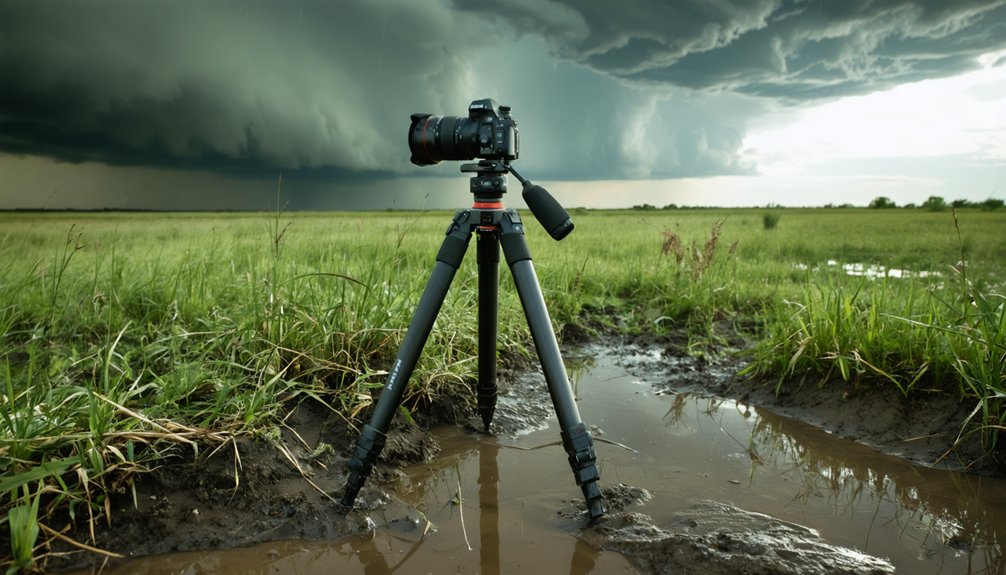
When lightning threads through storm structures, precise camera configuration separates successful captures from missed opportunities and equipment damage. Lock your tripod’s adjustable leg lengths at maximum extension for stability, then disable all image stabilization systems.
Focus once using autofocus, switch to manual, and recheck every few minutes as wind shifts your position. Deploy lightning triggers like Pluto Trigger for daytime captures—they’ll fire your shutter within 100 milliseconds.
Set shutter speeds between 2-15 seconds depending on darkness, pair narrow apertures (f/16 close, f/8 distant) with ISO 100-400 based on strike distance. Fix white balance to prevent automatic adjustments.
Monitor real time weather monitoring apps to track storm movement, positioning yourself 2-3 miles outside the core. Use wireless triggers to operate from your vehicle—your safety matters more than any photograph.
Frequently Asked Questions
How Do I Protect My Tripod From Corrosion After Storm Exposure?
Rinse your tripod immediately with fresh water after storm exposure, then apply anti-corrosion coatings like PTFE dry-film lubricant to threads and joints. Use saltwater protection techniques including water-repellent sprays and complete air-drying before storage.
Can I Use My Storm Tripod for Other Photography Genres?
Yes, your storm tripod excels across genres. Its robust portable camera support adapts to landscapes, astrophotography, and low light photography. You’ll appreciate the stability for long exposures, wildlife shots, and travel work—proven durability means versatile freedom.
What’s the Ideal Tripod Height for Shooting Lightning Strikes?
You’ll want 60-70 inches for eye-level shooting, providing a stable platform and ideal viewing angle without neck strain. This height lets you frame horizontal lightning strikes naturally while maintaining stability in high winds during long exposures.
Should I Insure My Tripod Against Storm Damage or Loss?
When Mother Nature gets unpredictable, you’ll want tripod insurance coverage protecting your gear investment. Storm proof tripod features help, but thorough/detailed/extensive protection lets you chase freely without financial worry when winds send equipment tumbling unexpectedly.
How Often Should I Maintain My Tripod After Storm Chasing?
You’ll want to inspect tripod joints and clean tripod components after every chase. High winds and debris demand immediate attention—check locks, wipe mud, and test stability before your next deployment to guarantee reliable performance.