Doppler radar predicts hail by measuring reflectivity thresholds, velocity couplets, and dual-polarization signatures that expose storm mechanics before hail hits the ground. You’ll see reflectivity values at 45 dBZ or higher flagging hail potential, while MESH estimates translate raw data into actionable size projections. VIL density filters weak storms, and lightning jumps signal rapid updraft intensification ahead of radar confirmation. Each metric sharpens threat accuracy—and there’s considerably more precision built into how these systems work together.
Key Takeaways
- Reflectivity values at 55 dBZ indicate probable large hail, while 65 dBZ+ confirms extreme hail potential often exceeding golf ball size.
- Dual-polarization radar detects hailstones through low differential reflectivity (ZDR) values, confirming spherical, tumbling hailstones distinct from rain droplets.
- VIL density thresholds exceeding 3.5 g/m³ filter weak storms and confirm severe hail development with greater accuracy than reflectivity alone.
- Lightning jumps signal rapid updraft intensification, providing early hail warnings before radar confirmation of dangerous storm conditions.
- MESH translates reflectivity data above the freezing level into actionable hail size estimates, improving warning precision and lead times.
How Doppler Radar Detects Hail Inside a Thunderstorm
When a thunderstorm develops, Doppler radar detects hail by measuring the reflectivity of precipitation particles inside the storm. High reflectivity values of 45 dBZ or greater signal large hail potential, while Doppler velocity measurements track updraft strength, indicating conditions favorable for hail growth.
You’ll find that dual-polarization data strengthens detection by analyzing particle shape and size, distinguishing hail from rain through low differential reflectivity values between 0 and 1.5 dB.
However, Doppler radar limitations create real hail detection challenges. Reflectivity alone can overestimate hail presence, requiring confirmation from hydrometeor classification algorithms using correlation coefficient and specific differential phase data.
Combining multiple radar metrics—rather than relying on a single parameter—gives you the most accurate picture of hail formation inside a developing thunderstorm.
What High Reflectivity Levels Reveal About Large Hail
When Doppler radar detects reflectivity values at or above 45 dBZ, you’re looking at a strong indicator of large hail potential within a storm cell.
You can sharpen that assessment by applying the Vertically Integrated Liquid (VIL) density method, which cross-references liquid water content across storm depth to flag severe hail more reliably.
Relying on reflectivity thresholds alone risks overestimation, so you’ll need VIL density confirmation to separate genuine large hail signatures from misleading returns.
Reflectivity Thresholds Indicate Hail
High reflectivity values serve as one of the most direct indicators of large hail in Doppler radar analysis. When you’re tracking severe storms, reflectivity analysis gives you critical data points that distinguish dangerous hail events from ordinary rainfall.
Readings at or above 45 dBZ signal significant hail potential, empowering you to act decisively.
Three key reflectivity thresholds sharpen your hail detection capabilities:
- 45 dBZ — signals possible hail formation within active storm cells
- 55 dBZ — indicates probable large hail, warranting immediate attention
- 65 dBZ+ — confirms extreme hail potential, often exceeding golf ball size
You shouldn’t rely on reflectivity alone, though. Confirming readings with supplemental data prevents overestimation and keeps your severe weather assessments accurate and trustworthy.
VIL Density Confirms Large Hail
Vertically Integrated Liquid (VIL) density takes reflectivity analysis a step further by calculating liquid water content across a storm’s vertical column, giving you a sharper confirmation of large hail presence. When VIL thresholds exceed 3.5 g/m³, you’re looking at strong evidence of severe hail development.
This metric divides total VIL by echo-top height, filtering out weak, shallow storms that might otherwise trigger false alarms from raw reflectivity alone.
You’ll find that VIL density’s hail confirmation capability outperforms standalone reflectivity readings because it accounts for storm depth. A tall storm with moderate reflectivity can still produce destructive hail when VIL density climbs into critical ranges.
Meteorologists combine this data with MESH estimates to sharpen their hail-size projections, giving you more reliable, actionable severe weather intelligence.
How Radar Uses MESH to Estimate Incoming Hail Size
Radar systems use the Maximum Expected Size of Hail (MESH) algorithm to translate raw reflectivity data into actionable hail size estimates.
MESH analyzes reflectivity values above the freezing level, converting them into probable hail diameters. Revised MESH accuracy improvements now incorporate ground-truth reports, sharpening spatiotemporal precision.
Here’s how MESH works for you:
translating raw radar data into real hail size estimates before impact.
- Reflectivity Sampling — Radar scans vertical columns, capturing intensity data above 0°C altitudes.
- Hail Size Calculation — The algorithm weights high reflectivity layers, producing estimated hail size in millimeters or inches.
- Ground Validation — Reported hail events recalibrate MESH outputs, tightening forecast reliability over time.
Understanding MESH gives you an independent, data-driven way to assess incoming threats before a single hailstone contacts the ground.
What Dual-Polarization Radar Reveals About Hailstone Shape
Dual-polarization radar’s ability to distinguish hailstone shape hinges on simultaneously transmitting horizontal and vertical microwave pulses, giving you a two-dimensional cross-section of precipitation particles.
This dual polarization benefit lets you identify hailstone morphology precisely—large hailstones tumble irregularly, producing low differential reflectivity (ZDR) values between 0 and 1.5 dB, signaling near-spherical shapes.
Raindrops, by contrast, flatten into oblate forms, returning higher ZDR values.
When you combine ZDR with correlation coefficient (CC) data, you’re cross-referencing particle consistency and shape simultaneously.
High reflectivity paired with low ZDR confirms hail rather than heavy rain.
This two-variable confirmation eliminates guesswork, giving you actionable data without relying on a single metric that risks overestimation and compromises your decision-making accuracy during severe weather events.
How Low ZDR Values Confirm Hail Instead of Rain
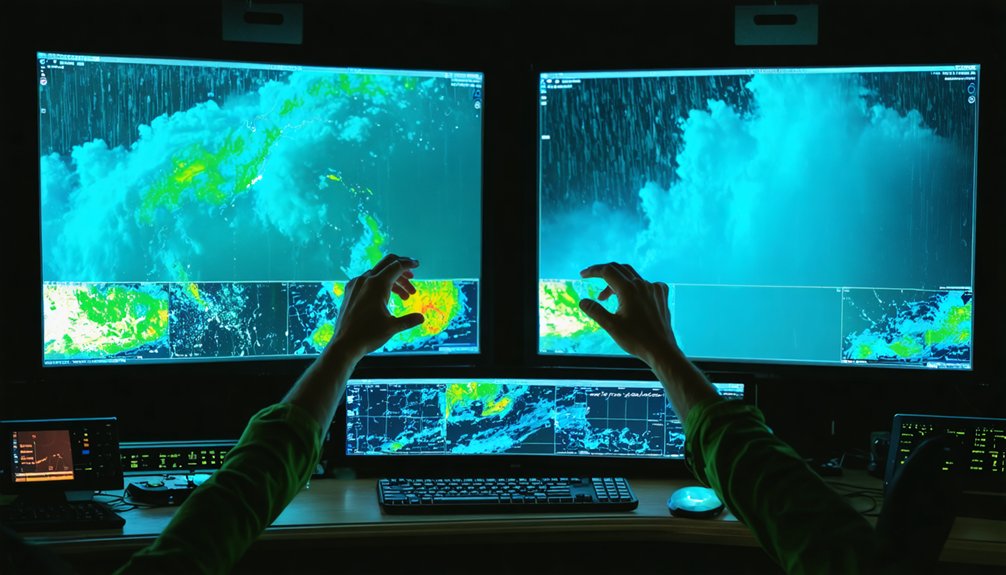
When dual-polarization radar returns low ZDR values—typically between 0 and 1.5 dB—you’re seeing a direct signature of hailstone geometry at work.
Unlike rain’s oblate, hamburger-bun shape, hailstones tumble erratically, presenting near-spherical profiles that collapse ZDR thresholds dramatically. This distinction drives accurate precipitation differentiation between rain and hail.
Three hail characteristics that low ZDR exposes:
- Spherical tumbling — irregular rotation flattens the horizontal-to-vertical signal ratio
- Size confirmation — larger hailstones register nearer to 0 dB, signaling escalating storm intensity
- Radar calibration alignment — cross-referencing CC and reflectivity above 45 dBZ validates hail presence conclusively
You’re not guessing when ZDR drops that low. The physics of hailstone motion removes ambiguity, giving you reliable, actionable severe weather intelligence.
What Doppler Velocity Readings Reveal About Hail-Producing Updrafts
When you examine Doppler velocity readings, strong updrafts exceeding 100 mph often signal active hail growth, as these currents suspend and cycle hailstones through supercooled water layers.
You can also identify rotation patterns within the storm’s mesocyclone, where tightening vorticity correlates with intensifying hail production.
Meteorologists then combine these velocity measurements with reflectivity data to project hailstone trajectories, enabling precise, location-specific severe weather warnings before impact.
Updraft Velocity Indicates Hail
Strong updrafts are the engine behind hail formation, and Doppler velocity measurements let you see exactly how powerful those updrafts are. When updraft intensity exceeds critical thresholds, hail growth accelerates rapidly.
Here’s what the velocity data reveals:
- Updrafts exceeding 100 mph suspend hailstones long enough for multiple ice-coating cycles, producing baseball-sized stones.
- Rotational velocity signatures indicate organized supercell structure, where sustained updraft intensity maximizes hail growth potential.
- Divergence patterns at storm tops confirm vigorous upward motion, signaling that large hail is actively developing.
You’re not guessing when you combine these velocity readings with reflectivity data — you’re tracking measurable atmospheric mechanics.
Doppler’s precision gives you real-time updraft profiling, turning invisible air currents into actionable hail threat intelligence.
Rotation Patterns Signal Growth
Rotation patterns within a supercell’s mesocyclone directly telegraph hail growth potential, and Doppler velocity readings make those patterns quantifiable.
When you analyze velocity data, tightening rotation characteristics signal intensifying updrafts that sustain hailstone growth patterns longer and at greater altitudes.
Doppler detects rotational wind shear by measuring inbound and outbound velocities simultaneously, letting you pinpoint mesocyclone strength with precision.
Rotational velocities exceeding 30 knots across a 3-5 km diameter consistently correlate with severe hail production.
As rotation tightens, updraft columns strengthen, pushing hailstones repeatedly through supercooled water layers where ice accumulates.
You can track these velocity couplets in real time, identifying dangerous acceleration trends before hail reaches the surface.
Combining rotational data with reflectivity measurements gives you a considerably more reliable hail size projection than either metric alone.
Trajectory Projections Guide Warnings
Doppler velocity readings don’t just confirm hail growth—they project where hailstones will travel, giving forecasters actionable data for issuing targeted warnings.
By combining updraft strength with trajectory patterns, warning systems can pinpoint threatened zones before impact.
Here’s what Doppler velocity data delivers:
- Storm motion vectors — You see precise directional movement, mapping hailstone paths miles ahead of ground contact.
- Updraft intensity thresholds — Velocities exceeding critical benchmarks confirm sustained hail growth, sharpening warning lead times.
- Multi-layer wind profiles — You track how wind shear redirects hailstone trajectories across altitude layers, revealing where stones will ultimately fall.
This data-driven approach cuts guesswork, letting you act on verified projections rather than broad estimates—protecting communities with freedom-preserving precision rather than blanket, disruptive alerts.
How Hydrometeor Classification Separates Hail From Rain on Radar
Hydrometeor classification algorithms rely on 3 key polarimetric variables—correlation coefficient (CC), differential reflectivity (ZDR), and specific differential phase (KDP)—to separate hail from rain on radar.
When you analyze particle morphology, hail presents distinct signatures: low ZDR values (0–1.5 dB) paired with high reflectivity (≥45 dBZ) indicate spherical, tumbling hailstones. Rain, by contrast, produces hamburger bun-shaped droplets with higher ZDR readings.
CC values drop noticeably in mixed-phase regions containing hail. Advanced systems integrate holographic imaging data to validate radar classifications against actual particle structure.
Combining single- and dual-polarization inputs strengthens classification skill, reducing false positives. You get a more precise precipitation-type output—including hail presence and estimated size—by merging these variables rather than relying on any single polarimetric measurement alone.
Why Forecasters Watch Lightning Jumps When Radar Hasn’t Triggered Yet
Before radar reflectivity crosses the ≥45 dBZ threshold that triggers hail alerts, lightning jumps already signal rapid updraft intensification inside a developing storm.
Lightning detection networks give you a 45-minute lead time advantage by tracking sudden rate increases tied to storm dynamics.
Watch for these three warning indicators:
- A sharp lightning rate increase of ≥8 flashes/minute within a 1-minute window signals explosive updraft growth.
- Total lightning networks detect electrical activity 5-20 minutes before reflectivity thresholds confirm hail potential.
- Sustained lightning jumps correlate directly with strengthening vertical wind speeds feeding hailstone development.
You’re not waiting on radar confirmation when lightning data already tells the story.
Combining lightning detection with Doppler measurements gives you earlier, more accurate severe weather positioning than any single-metric approach delivers.
How Storm Models Convert Radar Data Into Hail Forecasts
When numerical weather prediction models ingest radar reflectivity, dual-polarization variables, and storm velocity data, they convert raw measurements into actionable hail forecasts through layered simulation.
Storm model integration combines satellite observations, balloon soundings, and ground reports alongside radar data assimilation to reconstruct full three-dimensional storm structures.
Models simulate air currents, temperature gradients, and hail content simultaneously, letting you see how updraft strength directly influences hailstone growth trajectories.
The MESH algorithm extracts size estimates from reflectivity columns, while polarimetric variables like ZDR and CC refine particle classification within the model framework.
Balloon-borne videosondes calibrate these simulations by photographing actual hydrometeors, sharpening model accuracy.
You get forecasts that aren’t guesswork—they’re built from multi-source, continuously updated data streams that quantify hail probability with measurable precision.
Why Combining Radar Metrics Detects Hail More Accurately
Storm models give you a powerful simulation framework, but the real accuracy gains come from combining multiple radar metrics rather than relying on any single measurement.
Radar fusion integrates reflectivity, ZDR, and correlation coefficient data simultaneously, letting you cross-validate hail signatures that no standalone metric confirms alone.
Radar fusion cross-validates hail signatures by simultaneously integrating reflectivity, ZDR, and correlation coefficient—no single metric achieves this alone.
Multi-metric synergy works because each variable exposes different hail characteristics:
- High reflectivity (≥45 dBZ) flags large precipitation mass concentrations.
- Low ZDR (0–1.5 dB) confirms spherical, tumbling hailstones rather than rain.
- Reduced correlation coefficient distinguishes irregular hail shapes from uniform raindrops.
When you layer these measurements together, false positives drop sharply.
Lightning jump data adds another 45-minute lead time advantage.
You’re no longer guessing—you’re operating with converging, independent data streams that collectively outperform any single detection method.
Frequently Asked Questions
How Accurate Is Doppler Radar at Predicting Exact Hail Sizes?
Doppler radar’s hail size estimation isn’t perfect—you’re looking at MESH approximations with radar resolution limitations. It overestimates without ground truth validation, so you’ll want to combine reflectivity data with dual-polarization metrics for improved accuracy.
Can Doppler Radar Detect Hail Forming Before It Reaches the Ground?
Want to catch hail before it strikes? Yes! Radar technology tracks hail formation mid-atmosphere. You’ll see Doppler detecting strong updrafts and high reflectivity (≥45 dBZ), revealing developing hailstones before they’re ever reaching the ground.
How Far in Advance Can Doppler Radar Warn Communities About Hailstorms?
You’ll receive hail storm alerts up to 45 minutes in advance through total lightning network warning systems. This predictive technology empowers community preparedness, combining Doppler velocity measurements and lightning jump detection to provide actionable, data-driven severe weather intelligence.
Does Doppler Radar Performance Differ Between Daytime and Nighttime Hailstorms?
Yes, Doppler radar’s performance doesn’t notably change between daytime conditions and nighttime challenges. You’ll find it reliably detects reflectivity, ZDR, and rotation data continuously, since radar operates independently of sunlight, maintaining consistent hailstorm detection accuracy.
How Does Terrain Affect Doppler Radar’s Ability to Detect Incoming Hail?
Terrain features like mountains and valleys block radar beams, creating blind spots that’ll limit your hail detection accuracy. These radar limitations reduce low-level coverage, forcing you to rely on supplemental methods like lightning networks and ground reports.
References
- https://www.nssl.noaa.gov/education/svrwx101/hail/forecasting/
- https://www.battlbox.com/blogs/outdoors/how-to-predict-hailstorm-a-comprehensive-guide
- https://www.weather.gov/lmk/nws_radar_dualpol_largehail
- https://www.weathercompany.com/blog/predicting-forecasting-hail-storms/
- https://blog.aem.eco/under-the-radar-surfacing-the-hidden-threat-of-hail
- https://pmc.ncbi.nlm.nih.gov/articles/PMC8050948/
- https://haagglobal.com/articles/new-blog-footer/
- https://blog.hailtrace.com/determining-hail-size-by-using-radar/