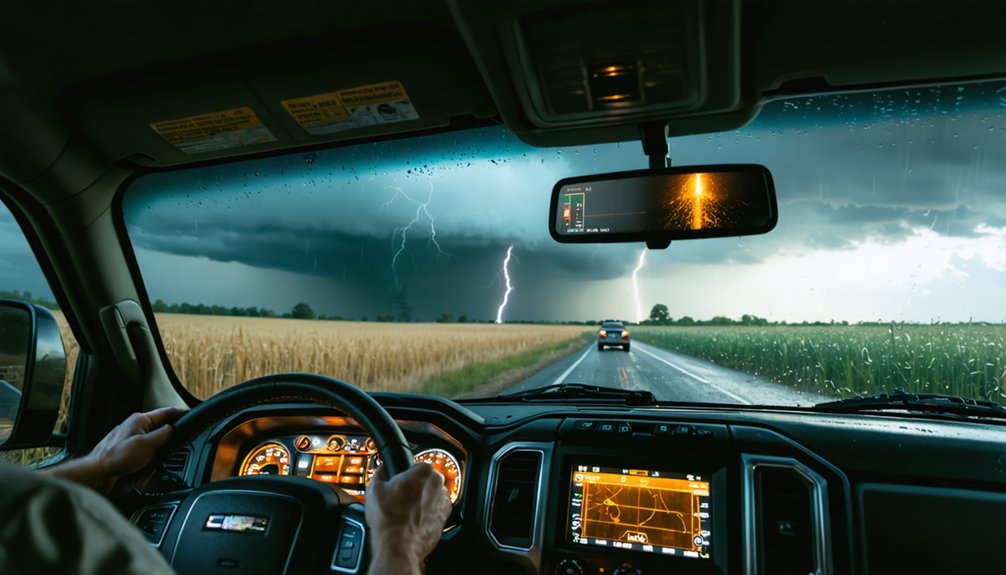
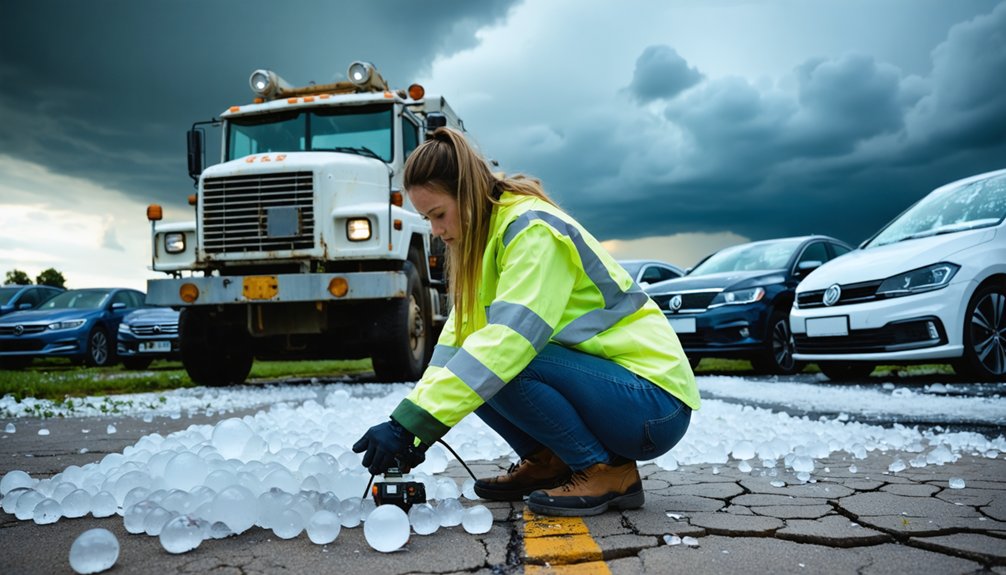
To chase waterspouts effectively, you’ll need confirmed rotation, real-time atmospheric monitoring, and strategic positioning at intersections with multiple escape routes. Target hotspots like the Great Lakes or coastal zones where warm, moist air converges with cooler water temperatures. Bring vehicle-mounted weather stations, handheld anemometers, and lens filters for precise documentation. Always recognize when a waterspout shifts to a tornado upon land contact. Every section of this guide sharpens your edge in the field.
Key Takeaways
- Confirmed rotation and association with severe thunderstorms are essential criteria for identifying chase-worthy, reportable waterspout events.
- Monitor atmospheric signals using vehicle-mounted weather stations, handheld anemometers, and NOAA Weather Radio receivers for real-time formation data.
- Prime waterspout hotspots include the Great Lakes and coastal zones with warm surface water and unstable air masses.
- Position perpendicular to the waterspout at elevated terrain intersections, using Rain-X-treated windshields and tripods for optimal, safe shots.
- When a waterspout crosses land, immediately classify it as a tornado and relay updated GPS, timestamps, and movement data to NWS.
What Makes a Waterspout Worth Chasing?
What separates a chase-worthy waterspout from background atmospheric noise? You’re looking for confirmed rotation, severe thunderstorm association, or documented formation over established hotspots like Lake Erie, Huron, or Ontario.
Without rotation, you’ve got nothing reportable — and nothing scientifically valuable.
Your chasing motivation should align with measurable outcomes. Waterspout legends like Stavros Kesedakis didn’t accumulate 200+ documented events by chasing every suspicious column of mist. They targeted conducive parameters: land-breeze convergence zones, inflow tail signatures, and high-resolution model outputs hinting at favorable shear profiles.
You’re also tracking tornadic waterspouts specifically — those that cross land transform into full tornadoes, demanding immediate NWS reporting.
Every chase decision should weigh documentation value against positional risk, keeping your escape routes and observational angles optimized from the start.
How Do You Know One Is About to Form?
Spotting a waterspout before it materializes means reading a layered set of atmospheric signals simultaneously. You’re scanning for formation indicators across multiple data streams at once. High-resolution models reveal land-breeze convergence zones where instability concentrates.
You’re cross-referencing those outputs against visual environmental cues from the storm’s structure itself.
Watch the supercell’s inflow tail—it pinpoints the updraft’s exact location. Inflow notches and kinks mark where warm, moist air‘s feeding the system most aggressively. These aren’t subtle hints; they’re diagnostic markers that demand immediate action.
You’ll also deploy vehicle-mounted weather stations to track real-time temperature and moisture gradients. When atmospheric parameters align precisely—convergence confirmed, visual cues matching model output—you’re not guessing anymore. You’re executing a data-driven intercept on your own terms.
Where Do Waterspouts Happen Most Often?
If you’re targeting prime waterspout locations, you’ll find the Great Lakes — particularly Erie, Huron, and Ontario — rank among the most productive hotspots in North America.
You can maximize your documentation opportunities by focusing on areas where warm, moist surface air converges with cooler lake temperatures, creating the instability that drives formation.
Chasers like Maryann Fekete, operating out of Ontario, and Stavros Kesedakis, who’s logged over 60 Great Lakes waterspouts in just four years, confirm that consistent geographic and meteorological patterns make these regions statistically reliable targets.
Prime Waterspout Locations
Where waterspouts form most frequently comes down to specific atmospheric and geographic conditions that consistently produce the necessary ingredients for development. The Great Lakes region stands out as a premier hotspot, with Lake Erie, Huron, and Ontario generating frequent activity due to thermal contrasts and land-breeze convergence.
You’ll want to integrate these prime locations into your chasing strategies, positioning yourself where geographic triggers reliably concentrate waterspout formation. Coastal zones with warm surface water temperatures and unstable air masses above also produce consistent activity.
Rhodes, Greece, where veteran chaser Stavros Kesedakis has documented over 200 events across 13 years, demonstrates how Mediterranean environments deliver exceptional frequency.
Understanding these location-specific dynamics lets you optimize positioning while maintaining safety protocols that protect you during active pursuit.
Great Lakes Hotspots
Few regions in North America concentrate waterspout activity as reliably as the Great Lakes, where Lake Erie, Huron, and Ontario consistently generate the thermal contrasts and land-breeze convergence that drive formation.
When you’re refining your chasing techniques here, understanding storm dynamics gives you a decisive edge.
Prioritize these four operational factors:
- Position upwind of convergence zones where land-breeze boundaries intersect warm lake surfaces.
- Monitor high-resolution models identifying moisture gradients that signal imminent rotation.
- Apply photography tips like polarizing filters to cut water glare during rapid documentation.
- Execute safety protocols by maintaining four-way intersection positioning for immediate retreat.
Veteran chasers like Maryann Fekete have documented dozens of events here, confirming the Great Lakes as North America’s premier waterspout laboratory.
Ideal Formation Conditions
Where Do Waterspouts Happen Most Often?
Waterspouts concentrate where warm water surfaces meet cooler, unstable air masses, creating the thermodynamic instability that drives convective rotation.
Understanding Formation Triggers lets you position yourself strategically before conditions peak.
Target locations where lake-effect dynamics produce sharp temperature differentials. The Great Lakes deliver consistent Atmospheric Conditions during late summer and early fall, when surface water retains heat while upper-level cold air intrudes.
You’ll find Lake Erie, Huron, and Ontario particularly productive during these windows.
Monitor land-breeze convergence zones using high-resolution models—these boundaries concentrate vorticity exactly where waterspouts initiate.
When inflow tails and notches appear in developing convection, you’re witnessing real-time Formation Triggers signaling imminent rotation.
Position early; waterspouts develop faster than most chasers anticipate.
How Should You Position for a Safe, Clear Shot?
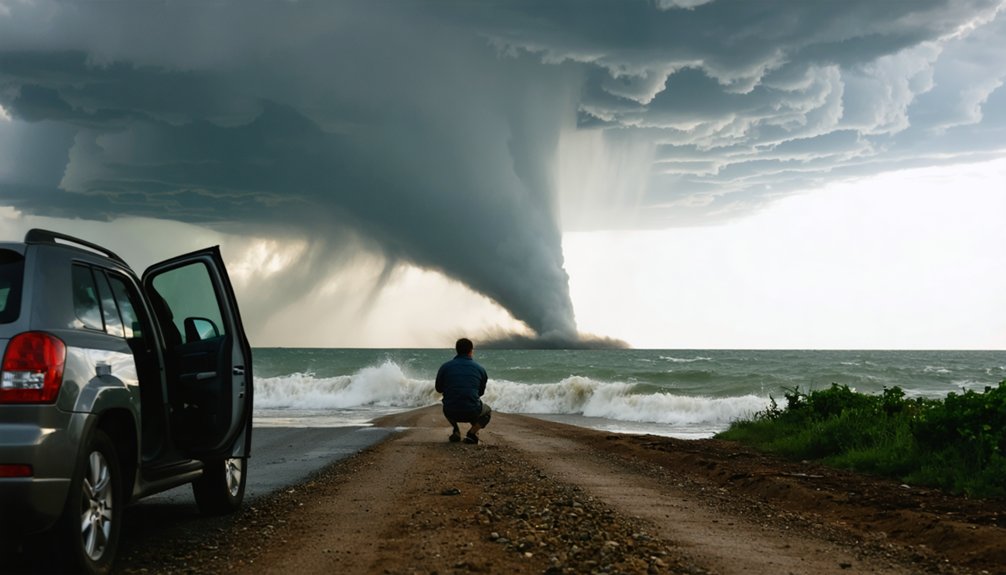
Positioning yourself for a clear, unobstructed shot of a waterspout demands both tactical awareness and situational flexibility.
Maintaining safe distance while optimizing shot composition requires deliberate decision-making. Follow these four positioning principles:
Capturing a waterspout demands more than instinct — it requires calculated choices that balance personal safety with compositional precision.
- Station at four-way intersections — multiple escape routes remain accessible if conditions shift rapidly.
- Angle perpendicular to the waterspout — eliminates atmospheric distortion and maximizes structural detail.
- Assess wind direction first — position upwind to keep spray and debris out of your lens path.
- Use elevated terrain when available — reduces foreground obstructions and improves compositional depth.
Apply Rain-X or Aquapel to your windshield beforehand.
Mount dash cameras for continuous documentation, freeing you to manage manual photography without sacrificing critical observational data.
What Gear Do Serious Waterspout Chasers Actually Bring?
When you’re serious about chasing waterspouts, you’ll need vehicle-mounted weather stations that measure temperature, moisture, and wind alongside handheld anemometers for precise, real-time data collection.
You should equip your vehicle with dash or roof cameras for continuous recording, supplemented by tripods, lightning triggers, and lens filters to capture high-quality stills under variable conditions.
If you’re operating in high-intensity environments, you’ll want to take into account armored vehicle reinforcements, including steel plating, bulletproof polycarbonate windows, and hydraulic skirts that prevent wind from destabilizing your rig’s underside.
Weather Measurement Tools
Serious waterspout chasers rely on three core measurement tools to capture accurate, reportable data in the field. Your weather sensors must deliver real-time precision across critical environmental factors.
Prioritize these monitoring tools:
- Vehicle-mounted weather stations — measure temperature, moisture, and wind simultaneously, strengthening data accuracy across multiple storm dynamics variables.
- Handheld anemometers — provide independent wind speed verification, validating your measurement techniques against vehicle-mounted readings.
- Rulers and calibrated hail gauges — produce objective precipitation analysis methods rather than subjective estimates.
- NOAA Weather Radio receivers — integrate official predictive models into your field awareness.
Cross-referencing these tools sharpens your understanding of rapidly shifting environmental factors.
Accurate sensor data directly strengthens your NWS reports, making your documentation operationally valuable beyond personal observation.
Camera And Recording Gear
Capturing a waterspout on record demands gear that performs reliably under rain, wind, and rapid repositioning.
You’ll want dash or roof-mounted cameras running continuously, eliminating missed formations during transit. Apply Rain-X or Aquapel to your windshield beforehand—it’s a simple step that directly improves optical clarity for both cameras and your own eyes.
For photography, mount your camera on a tripod and use lightning triggers and lens filters to control exposure under rapidly shifting light conditions.
Dial in your camera settings before deployment, not during. Recording techniques should prioritize continuous capture over manual triggering, since waterspout development moves fast.
If you’re running a DIY rig, an iPhone enables live streaming, keeping your footage accessible and shareable without additional broadcasting hardware.
Vehicle Protection Equipment
Recording gear keeps your footage intact, but the vehicle around you needs to handle the same environment. Serious vehicle safety demands structural upgrades before you’re anywhere near a waterspout’s path.
Equipment upgrades separate documented events from dangerous incidents.
Core protective specifications include:
- Armor plating — 1/8-inch steel combined with aluminum and Kevlar absorbs debris impact
- Polycarbonate windows — 1.63-inch bulletproof panels withstand high-velocity projectiles
- Hydraulic skirts — seal the vehicle’s underside against wind penetration
- Hydraulic spikes — anchor your rig against sustained high-wind displacement
Each upgrade addresses a specific mechanical vulnerability.
You’re not modifying for comfort; you’re engineering survivability.
Every component serves a measurable defensive function, keeping you mobile, protected, and operationally effective throughout the chase.
How Do You Capture a Waterspout on Camera Like a Pro?
What separates amateur footage from professional-grade waterspout documentation often comes down to equipment selection and positioning discipline.
Mount dash or roof cameras for continuous recording so you’re never caught unprepared. Apply Rain-X or Aquapel to your windshield beforehand—visibility directly impacts footage clarity.
For deliberate shooting techniques, stabilize your primary camera on a tripod and use lens filters to manage harsh glare over open water.
Dial in your camera settings before deployment: prioritize fast shutter speeds to freeze rotation and set continuous burst mode for sequential documentation.
Position yourself at four-way intersections, maintaining clear escape routes while maximizing unobstructed sightlines.
Only document waterspouts exhibiting confirmed rotation—precision in both your footage and your reporting keeps your data credible and operationally valuable.
How Do You File a Waterspout Report NWS Will Actually Use?
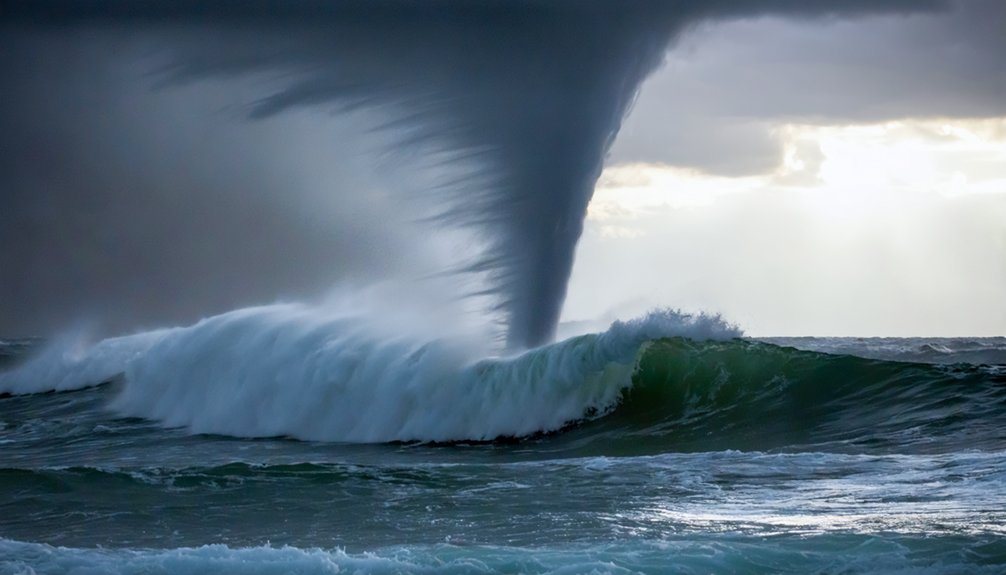
Filing a report the NWS will actually act on demands timeliness, accuracy, and structured detail—not a rough description submitted hours after the event.
Reporting accuracy and effective storm communication require disciplined field documentation. You’ll need to confirm rotation visually before submitting anything—unverified sightings dilute the data pool.
Disciplined field documentation separates credible storm reports from noise—confirm rotation visually before submitting anything.
Structure your report around four critical elements:
- Location – precise GPS coordinates or intersection reference
- Time – exact observation timestamp, not approximate
- Rotation – confirmed visual evidence only
- Intensity – estimated size, duration, and movement direction
NOAA Weather Radio keeps you updated while you’re actively documenting.
Submit immediately after the event concludes. Independent spotters who prioritize clean, verifiable data give NWS forecasters the actionable intelligence that protects communities.
When Does a Waterspout Become a Land Tornado?
Once your report’s filed and the waterspout is logged, the event isn’t necessarily over—if that spout tracks toward the shoreline, you’re now watching a potential land tornado form in real time.
Tornado classification shifts the moment the vortex crosses onto land, regardless of its waterspout lifespan over open water. NWS protocols require you to immediately update your report, reclassifying the event as a tornado.
You’ll want to track its ground contact, estimated width, and direction of movement. Tornadic waterspouts that cross land carry the same destructive potential as traditionally formed tornadoes, so don’t underestimate the threat based on its maritime origin.
Document the conversion point precisely—timestamp it, note the GPS coordinates, and relay that data to NWS without delay.
Frequently Asked Questions
Can Waterspouts Occur During Winter Months in Colder Climates?
Yes, you’ll find waterspouts can form during winter months, even over cold waters. When atmospheric instability meets winter conditions, convergence zones on the Great Lakes, like Erie and Ontario, actively trigger waterspout development year-round.
How Long Does a Typical Waterspout Last Before Dissipating?
Like a fleeting spark, waterspouts typically last 2–20 minutes. You’ll notice duration factors like storm intensity and dissipating conditions, such as cooler air or weakened updrafts, determining their lifespan. Chase freely, but act fast!
Are Waterspouts More Dangerous Than Land-Based Tornadoes for Boats?
Waterspouts can’t match land tornadoes in intensity, but their waterspout characteristics make them uniquely dangerous for boat safety. You’re facing sudden capsizing risks, reduced visibility, and unpredictable movement—don’t underestimate them when traversing open water.
Do Waterspouts Produce Sounds Similar to Traditional Tornadoes?
Like a roaring freight train, waterspout sounds mirror tornado similarities closely. You’ll hear the same low rumble and hiss as rotating winds intensify. Both phenomena share acoustic signatures, making audio cues valuable data points you can’t ignore.
Can Multiple Waterspouts Form Simultaneously in the Same Location?
Yes, you can observe multiple waterspouts forming simultaneously when turbulent conditions align with favorable formation processes. Hotspots like Lake Erie demonstrate this, where converging land-breeze patterns trigger clusters, giving you rare opportunities to document nature’s raw, unchained power.
References
- https://www.icwr.ca/top-waterspout-hunters.php
- https://www.youtube.com/watch?v=wXrbMp764EU
- https://www.youtube.com/watch?v=bq0-QXXtOro
- https://en.wikipedia.org/wiki/Storm_chasing
- https://www.severestudios.com/storms/waterspouts/
- https://www.weather.gov/media/bis/Weather_Spotter_Field_Guide.pdf
- https://makezine.com/article/science/storm-chasers-real-twister-tech/