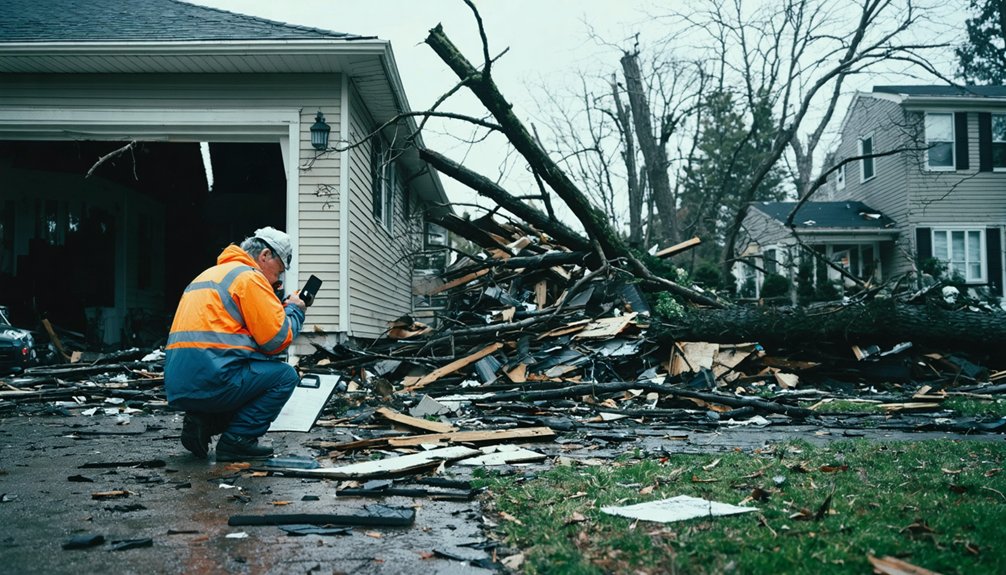
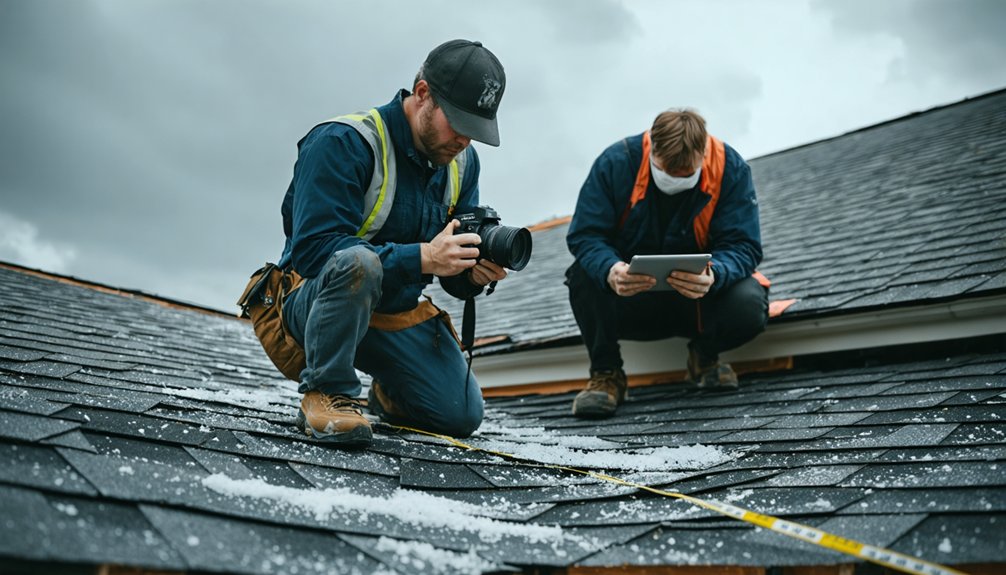
Before documenting storm damage, you’ll need to verify structural safety and utility hazards from a distance. Contact your insurer immediately while recording conversation details, then capture timestamped photographs and videos from multiple angles daily. Create an extensive room-by-room inventory with replacement values, preserve all receipts, and cross-reference your documentation with official weather reports to establish an irrefutable timeline. This systematic approach prevents claim disputes and protects your settlement rights. The following strategies will strengthen your evidence collection and maximize your compensation potential.
Key Takeaways
- Verify property safety and structural integrity before entering to document damage, wearing protective gear if necessary.
- Contact your insurance company immediately after ensuring safe access to initiate claims and understand coverage limits.
- Take comprehensive photos and videos with timestamps enabled to create verifiable evidence of all damage.
- Create a detailed room-by-room inventory including item descriptions, values, and receipts for accurate claim documentation.
- Document damage daily and cross-reference timestamps with weather reports to establish an irrefutable damage timeline.
Prioritize Safety Before Beginning Documentation
Before you photograph a single damaged shingle or document any loss, you must verify that conditions allow safe property access. Wait for official all-clear notifications from local authorities—don’t let impatience to reclaim your property override weather service warnings about lingering hazards.
Assess structural integrity by examining foundations, rooflines, and load-bearing walls from a safe distance. Look for sagging floors, shifted walls, or cracks indicating instability. Monitor utility status vigilantly: assume all downed power lines remain energized, evacuate immediately upon detecting natural gas odors, and never operate generators indoors.
Equip yourself with protective gear—gloves, boots, masks, and eye protection—before entering any compromised structure. Your documentation serves no purpose if you’re injured during the process. Safety isn’t negotiable; it’s your foundation for recovery.
Contact Your Insurance Company Immediately
Once you’ve confirmed safe access to your property, contact your insurance company within hours—not days or weeks—to initiate your claim. Standard policies mandate filing within 30-60 days, but delays compromise your position.
Contact your insurance company immediately after confirming safe property access—delays weaken your claim position and compromise settlement potential.
When you call, obtain coverage information and verify policy limits to understand your settlement boundaries. Document every conversation: record dates, times, and representative names. Expect adjuster contact within 48 hours, with property assessment following in 3-5 days.
Submit claims online, through apps, or by phone—choose your preferred method. Prepare your home inventory, damage photos, and temporary repair receipts before the adjuster arrives.
States require claim acknowledgment within 15 days, followed by 30-day acceptance decisions. Don’t surrender control: immediate action protects your rights and accelerates recovery.
Take Comprehensive Photographs and Videos
You’ll strengthen your claim by photographing damage from multiple angles each day, establishing a clear timeline of deterioration that insurers can’t dispute. Enable timestamp features and EXIF metadata on your camera or smartphone to create verifiable records that authenticate when documentation occurred—maintaining correct local timezone settings is critical for temporal accuracy.
Record narrated video walkthroughs under 90 seconds per area, describing observed damage while moving through affected spaces to provide contextual clarity that still photography can’t capture alone.
Capture Multiple Angles Daily
When documenting storm damage for insurance claims or legal proceedings, your photographic approach must systematically capture the entire scope of destruction through varied perspectives and distances. Start each location with all-encompassing panoramic shots using your wide-angle lens to establish full scene context.
Strategic camera placement from opposing room corners provides essential spatial relationships that adjusters need for accurate assessments.
You’ll need sequential documentation showing damage progression from initial conditions through restoration phases. Capture closeup, medium, and wide-angle views of each affected area—don’t let insurance companies deny claims due to insufficient evidence. Photograph hidden spaces including closets, cabinets, and ceiling areas where moisture intrusion breeds costly mold.
Document daily changes in structural components, as deterioration accelerates rapidly. Your thorough photographic record protects your rights and guarantees fair compensation.
Document Details With Timestamps
Before initiating any storm damage documentation, configure your camera or smartphone to embed accurate timestamps on every photograph and video file. These temporal markers establish irrefutable proof of when damage occurred, protecting your claim against arbitrary denials.
Timestamps document timeline sequences that correlate directly with meteorological data, creating bulletproof evidence chains. Your insurer can’t dispute structural compromises when date-stamped images align precisely with documented storm events. This technical validation prevents carriers from attributing pre-existing conditions to recent weather incidents.
Accurate time codes support damage evidence by demonstrating progressive deterioration patterns and validating immediate post-storm conditions. Cross-reference your stamped documentation with official weather service reports to construct an unassailable record. This systematic approach eliminates adjuster speculation and enforces your right to legitimate compensation.
Create Narrated Video Walkthroughs
As supplementary reinforcement to your timestamped photographs, narrated video walkthroughs deliver dynamic documentation that static images can’t replicate. Record exhaustive tours of damaged areas while explaining visible destruction, occurrence circumstances, and structural concerns in real-time.
Your smartphone serves as an effective primary tool—utilize mobile accessories like external batteries and stabilizers to combat storage limitations and battery drain. Follow narration sequence systematically: establish room context with wide shots, then shift to close-ups of specific damage while verbally describing extent, location, and suspected causes.
Capture both interior spaces and exterior elements, including roof damage, compromised flashing, and structural defects. Document from multiple angles to reveal hidden issues. Store backup copies separately to protect this critical evidence, ensuring you maintain leverage during adjuster negotiations and potential claim disputes.
Create a Detailed Inventory of All Damaged Items

After photographing the damage, you must compile a detailed, room-by-room inventory that catalogs every affected item with its pre-loss condition, age, and replacement value. Organize your list into distinct categories—structural components, personal property, and appliances—while maintaining strict separation between damaged and undamaged items to prevent claim disputes.
Attach all available purchase receipts, warranty documents, and prior appraisals to substantiate your declared values, as insurers will scrutinize unsupported claims and may apply depreciation or deny reimbursement without proof of ownership and cost.
List Every Damaged Item
When documenting storm damage, creating a detailed inventory of every affected item forms the foundation of your insurance claim and determines your potential recovery. You’ll need to discuss prioritization criteria by starting with high-value items and structural concerns, then systematically cataloging belongings room-by-room. Inspect structural integrity issues first, as they’ll impact your entire claim timeline.
Your thorough inventory must include:
- Item name, brand, model number, and age for precise identification
- Estimated replacement value with original purchase date and price
- Detailed condition assessment documenting specific damage characteristics
- Photographic evidence linking each item to your written documentation
- Room-by-room groupings ensuring nothing’s overlooked during assessment
This methodical approach protects your rights and maximizes your settlement potential without relying on adjuster estimates alone.
Include Purchase Documentation
Physical proof of ownership and value transforms your itemized damage list from estimates into documented claims your insurer can’t easily dispute. Attach receipts, invoices, and credit card statements showing original purchase dates and costs for each damaged item.
You’ll strengthen your cost estimation by gathering warranties, appraisals for high-value items, and maintenance records that establish pre-loss condition. Store digital copies in cloud storage—you can’t rely on physical documents surviving the storm.
For claim submission, professional appraisals prove the value of jewelry, art, and collectibles beyond insurance company depreciation schedules. Document brand names, model numbers, and serial numbers from appliances and electronics. This creates an evidence-backed inventory that protects your right to full compensation rather than accepting whatever settlement adjusters initially offer.
Separate Damaged From Undamaged
Before your insurance adjuster arrives, establish a clear physical separation between damaged and undamaged property—this organizational step prevents disputes about what the storm actually destroyed and protects you from inadvertent claim denials.
Implement these separation protocols:
- Designate secure storage areas exclusively for damaged contents, ensuring adjuster accessibility while preventing additional deterioration
- Apply proper labeling systems using weatherproof markers to distinguish “storm-damaged” from “intact” items on containers and zones
- Maintain original positioning of undamaged property as baseline documentation for comparative assessment
- Cover separated items with tarps or protective sheeting to prevent secondary damage during the claims process
- Document serial numbers, model identifiers, and replacement values before relocating any damaged equipment
This methodical approach establishes irrefutable evidence supporting your claim while maintaining your autonomy throughout the adjustment process.
Preserve All Receipts and Financial Records
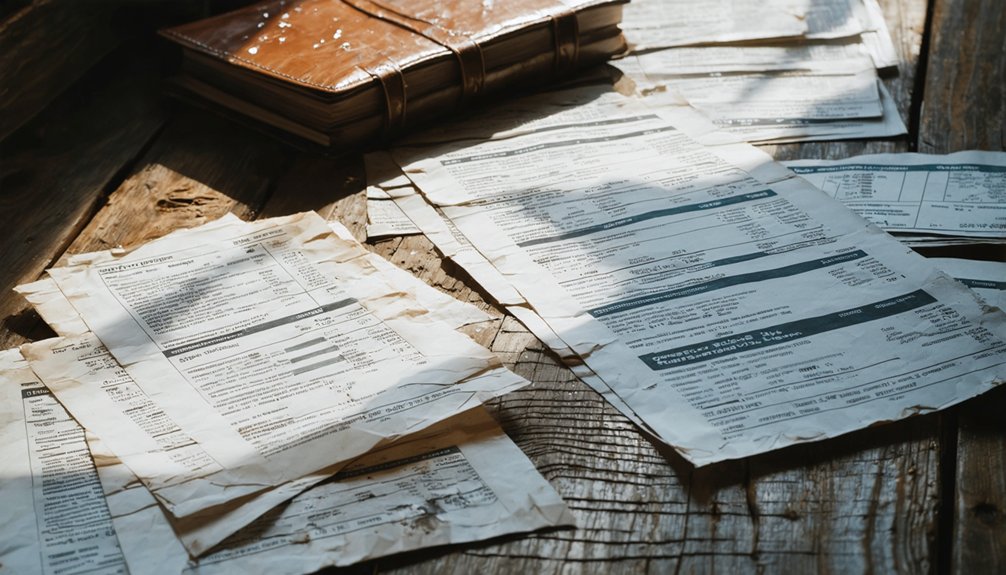
Although storm damage creates chaos and displacement, maintaining meticulous financial records separates successful recovery claims from denied or underpaid settlements. You’ll need receipts documenting emergency repairs—tarps, temporary lodging, cleanup supplies—with vendor details, dates, and amounts for verification.
Collect pre-storm bank statements, mortgage documents, and utility bills proving occupancy and ownership. For valuable items, gather receipts, appraisals, and inventory lists with model numbers to establish replacement values. Create electronic records backup through digital scans, protecting against total loss.
Include disaster declaration numbers on all submissions to FEMA. Store originals in waterproof containers while maintaining cloud-based copies. Consider professional verification services for high-value claims requiring expert authentication. Contact banks for duplicate statements if documents are destroyed. Your extensive documentation portfolio directly determines your settlement outcome.
Document Every Communication With Your Insurer
When dealing with your insurance company, you must maintain a detailed record of every interaction, whether by phone, email, text, or in-person meeting. Document each conversation’s date, time, participant names, and a thorough summary of what was discussed, requested, or promised.
Implement a systematic filing system—digital or physical—that allows you to quickly retrieve specific communications, as this organized documentation becomes critical evidence if disputes arise over claim handling or coverage decisions.
Record All Conversation Details
After you’ve reported storm damage to your insurance company, meticulous documentation of every conversation becomes your most powerful tool for protecting your claim. Record interaction timelines immediately—delays compromise accuracy.
Document claim communications systematically to establish an ironclad paper trail that insurers can’t dispute.
Your exhaustive log should include:
- Claim number and adjuster contact details from initial reporting
- Precise dates, times, and names of every representative contacted
- Inspection appointments and status updates discussed
- Policy coverage requirements and mitigation steps outlined
- Settlement offers and reimbursement discussions presented
Maintain parallel records mirroring the insurer’s documentation. This creates leverage during disputes and prevents claim denials based on “no record of conversation” tactics. Your detailed diary protects your financial recovery rights.
Organize Communication Records Systematically
A thorough communication management system transforms scattered correspondence into defensible evidence that protects your claim from insurer manipulation. Establish a dedicated cloud storage repository with redundant file naming conventions that include dates, claim numbers, and correspondence types.
You’ll streamline communication logs by creating separate sections for emails, texts, and call records—maintaining chronological order establishes your claim’s timeline. Document every adjuster interaction with names, timestamps, and meeting summaries from property inspections.
Preserve all written correspondence, confirmation receipts, and response deadlines to track insurer compliance. Your call logs must capture dates, representatives’ names, and discussion summaries immediately after conversations. Back up documentation in multiple locations—digital redundancy prevents insurance companies from claiming they never received critical evidence supporting your rightful compensation.
Capture Multiple Angles and Close-Up Details
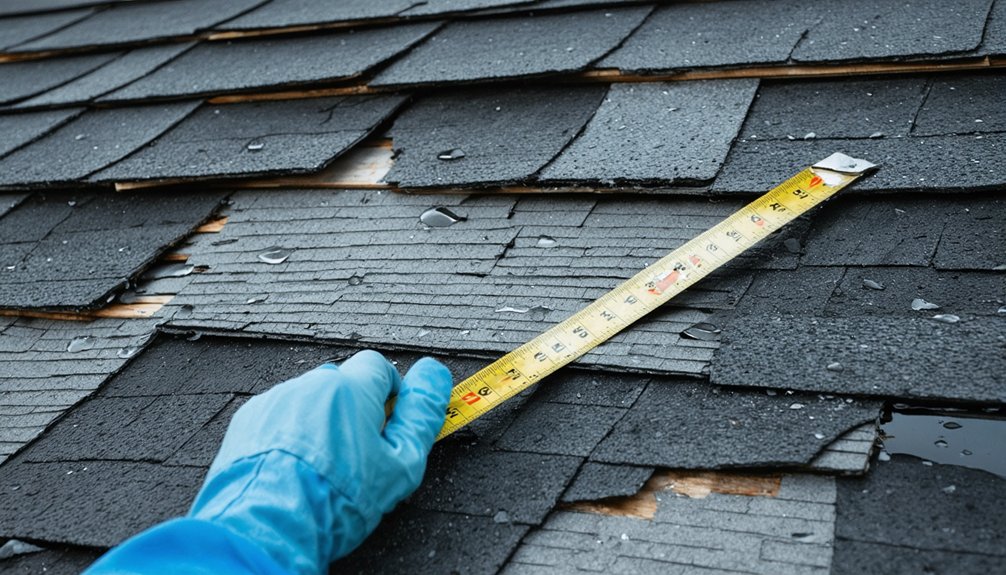
Extensive storm damage documentation requires systematic capture from multiple vantage points to establish irrefutable evidence for insurance claims and structural assessments. You’ll need to photograph each affected area using wide-angle shots that capture the entire scene, then move closer for detailed documentation of specific damage points.
Your meticulous documentation strategy should include:
- Eye-level shots from opposing corners to provide complete spatial context and damage scope
- Close-up images of damage sources followed by wider contextual frames showing surrounding areas
- Sequential pathway photography through doorways, corners, and stairs documenting storm exposure distance
- Detailed captures of structural components, water damage, and hidden issues behind accessible walls
- Annotated photos with timestamps, room identifications, and damage descriptions for storm intensity tracking
This multi-perspective approach guarantees you’ve captured irrefutable documentation protecting your recovery rights.
Keep a Daily Log of Events and Observations
While photographic evidence captures visible damage at specific moments, systematic written documentation creates the continuous narrative that insurance adjusters and contractors need to validate your claim’s timeline. Record precipitation to the nearest 1/100 inch daily at consistent times, using “T” for trace amounts below 0.01 inch.
Log exact dates, times (AM/PM), and weather conditions for each storm event. Document specific locations, damage extent, water sources, and categorize contamination as clean, gray, or black water. Track your actions step-by-step, including emergency communications availability and shelter locations used.
Compare previous logs to maintain detailed chronology showing damage progression. Include work order numbers, contractor ETAs, and priority levels. Reference NOAA Storm Events Database for official corroboration. Your independent documentation protects your property rights.
Consider Hiring Professional Damage Assessors
When property damage exceeds your expertise or insurance companies challenge your claim’s validity, certified professional damage assessors provide the technical documentation and independent analysis necessary to substantiate full compensation. These experts deliver reliable service recommendations through extensive inspections of roofs, structural components, and exterior elements while remaining independent of insurance adjusters’ biased evaluations.
Independent damage assessors provide technical expertise and documentation to counter insurance company challenges and secure full compensation for your property claim.
Expert team guidance includes:
- Licensed engineers conducting structural, electrical, and plumbing integrity assessments
- Drone imaging and AI-powered analytics for precise damage quantification
- Complete pre- and post-damage property valuations with exact dollar amounts
- Detailed engineer certifications that enhance claim approval rates
- Rapid response capabilities using cutting-edge technology to expedite assessments
Their thorough reports identify hidden damage invisible to untrained observers, ensuring you’re not shortchanged on settlements while supporting maximum insurance claim payouts.
Organize and Back Up All Documentation
After gathering extensive storm damage evidence, you’ll need a systematic organization strategy that preserves your documentation’s integrity and accessibility throughout the claims process. Create digital folders categorized by damage type—roof, siding, interior—with subfolders for dates and locations. Label files descriptively: “roof_hail_2026-03-23.jpg” with activated timestamps proving your timeline.
Implement robust file backup strategies using external drives, cloud platforms, and USB storage. You’ll protect yourself from evidence loss by maintaining three separate backup locations, syncing daily during documentation phases.
Compile thorough written inventories detailing damaged items, serial numbers, and storm specifics. Remote document storage guarantees you’ll retain originals before insurer submission. Log all communications, receipts, and repair expenses systematically. These preserved records safeguard your rights during disputes and future claim validations.
Frequently Asked Questions
How Long Do I Have to File a Storm Damage Claim?
You’ll typically have 30-90 days per your policy’s claim submission timeline, though state laws vary. Don’t delay—complete your damage assessment process immediately to preserve evidence and protect your rights against insurer denials or valuation disputes.
Will Documenting Damage Affect My Insurance Premium Rates?
Documentation itself won’t trigger increased premiums—filing claims does. However, thorough documentation actually protects you from claim rejection risks, ensuring you’re not financially trapped by underpayment. It’s your evidence arsenal for securing fair compensation.
Can I Start Repairs Before the Insurance Adjuster Inspects the Damage?
You shouldn’t start repairs without getting written authorization from your insurer first. Consult contract provisions regarding emergency procedures, as premature alterations can jeopardize your claim. Document everything thoroughly, then wait for adjuster approval to protect your coverage rights.
What if My Insurance Company Denies or Undervalues My Storm Damage Claim?
You’re maneuvering challenging waters, but you’ve got options. Immediately initiate the dispute resolution process through your policy’s appeals procedure, then explore legal representation options. Attorneys specializing in bad faith claims can secure settlements insurers initially denied.
Should I Document Damage to Landscaping and Outdoor Structures?
Yes, you’ll need thorough documentation for garden cleanup and landscaping restoration claims. Photograph damaged trees, erosion, and outdoor structures from multiple angles with measurements. This evidence safeguards your rights and guarantees fair compensation for all storm-related landscape damage.