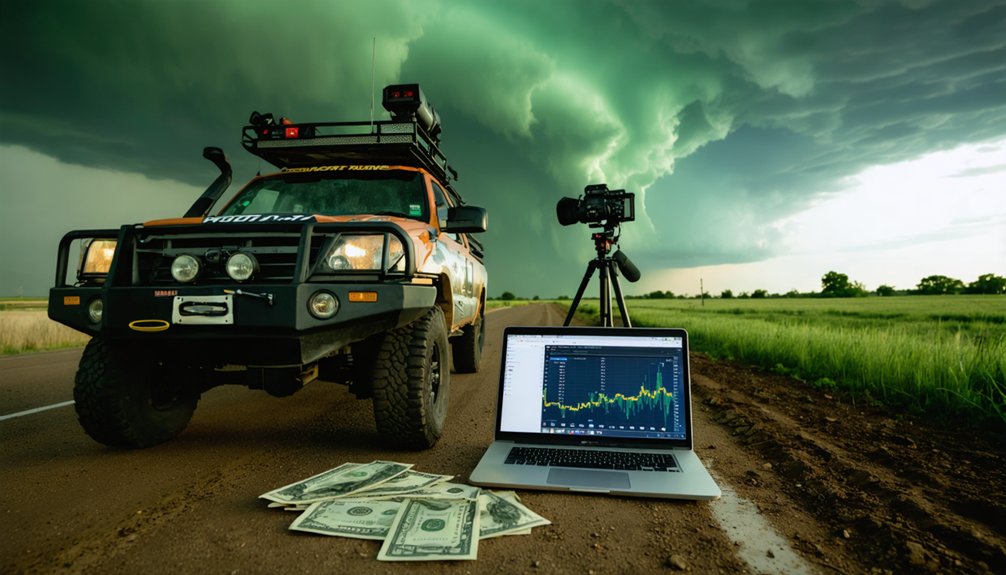
Yes, you’ll receive payment from TV networks for storm footage, though rates are disappointingly low. Generic weather clips typically fetch $150 or less through brokers, while premium tornado videos leading broadcasts might earn you $400. Local stations usually pay around $100, and competition from viewer cell phone footage has further suppressed prices. Most successful chasers don’t rely solely on network payments—they’ve diversified into corporate sponsorships, storm tours, and content licensing to build sustainable careers around their passion.
Key Takeaways
- Yes, TV networks pay storm chasers for footage, but rates are low: $150 or less for generic weather content through brokers.
- Premium tornado videos leading nightly broadcasts can earn up to $400, while local outlets typically pay around $100 per clip.
- Competition from free cell phone videos submitted by viewers has significantly worsened pricing for professional storm chasers.
- Many chasers rely on alternative income like corporate sponsorships ($20,000-$50,000 annually), tours, and merchandise rather than TV payments alone.
- Full-time employment with TV stations offers more stability at $74,000 average salary compared to sporadic freelance footage payments.
Television Network Compensation for Storm Footage
Storm chasers face challenging economics when selling footage to television networks, with payment rates varying dramatically based on video quality and market conditions. You’ll find networks paying $150 or less through brokers for generic weather footage—rates many consider criminally low given operational costs.
Premium tornado videos leading nightly broadcasts can fetch up to $400 if you’re first to satellite uplink, while local outlets typically pay around $100. Competition from viewer cell phone videos has worsened pricing despite your superior quality.
Social media royalties and international footage sales provide supplemental income, but they’re insufficient for sustainable living. Networks could afford ten times current broker rates, yet low payments subsidize corporate profits while you shoulder all risks and expenses pursuing dangerous storms.
Average Annual Earnings and Hourly Rates
Compensation for storm chasing varies wildly depending on your experience level, location, and revenue streams. You’ll face significant seasonal income variations since severe weather peaks during specific months, affecting your annual earnings potential.
Storm chasing income fluctuates dramatically based on expertise, geography, and how you monetize your work during peak severe weather seasons.
Income breakdown across experience levels:
- Entry-level chasers start around $63,000 annually ($24 per hour), though some Kansas positions report as low as $16,000 when factoring in personal equipment costs
- Mid-career professionals average $50,000-$90,000 yearly, with Missouri-based chasers earning approximately $44,076 ($22 hourly)
- Top-tier veterans in high-demand markets like San Jose command up to $177,000 annually ($44-$53 per hour), particularly those with established media connections
Your actual take-home pay depends heavily on whether you’re monetizing footage through television networks versus relying solely on meteorological employment.
How Experience Level Affects Storm Chaser Income
Your earning potential as a storm chaser directly correlates with your skill level, with junior professionals starting around $40,000-$45,000 annually while expert-level chasers command $115,000-$120,000 or more.
Entry-level positions often involve volunteer work or basic spotting tasks at roughly $16,000 in places like Kansas. As you advance to mid-level work, you’ll access media opportunities ($60,000-$120,000) or research positions ($50,000-$90,000).
Senior chasers earning $80,000-$85,000 leverage advanced observation skills and high-profile projects. Lead-level professionals managing teams reach $100,000-$105,000 through specialized expertise. Expert status brings exceptional compensation, particularly with government agency contracts and weather service partnerships.
Celebrity chasers like Reed Timmer substantially exceed these ranges, while atmospheric scientists average $92,070 annually. Your progression path determines whether you’ll remain a stipend-earning hobbyist or achieve six-figure professional status.
Alternative Revenue Streams Beyond TV Payments
While television contracts grab headlines, most storm chasers sustain their careers through multiple income channels that often prove more reliable than sporadic network deals.
You’ll find financial independence through diverse revenue streams:
- Corporate sponsorships deliver consistent annual income ranging from $20,000 to $50,000, with equipment stipends and hazard pay for chasers demonstrating specialized meteorology skills and strong portfolios.
- Supplemental tour income generates significant returns when citizens pay $3,500 per storm chasing experience, far exceeding the typical $500 per footage payment while offsetting operational costs through multiple participants.
- Affiliate marketing produces passive income by promoting survival gear, emergency food storage, and outdoor equipment—products your audience already needs, with commissions on high-value items plus personal purchase discounts.
Content licensing, research grants, and merchandise sales create additional stability beyond unpredictable storm events.
Financial Realities of Making Storm Chasing a Career
Full-time employment with television stations offers stability, with average salaries reaching $74,000 annually. However, novice freelancers earn roughly $16,000 yearly.
If you’re pursuing storm chasing as your primary income without established media connections or supplementary revenue streams, you’re fundamentally funding an expensive passion project rather than building a sustainable career.
Frequently Asked Questions
What Equipment Costs Do Storm Chasers Face When Starting Out?
Like chasing freedom across endless plains, you’ll face around $5,000 in startup costs for specialized weather equipment, plus $6,200 annually for vehicle maintenance costs covering 20,000 miles, alongside communication tech and lodging expenses.
Do Storm Chasers Need Special Licenses or Certifications?
You don’t need special licenses for storm chasing, but storm chase training requirements like SKYWARN certification help develop severe weather detection skills. First aid training and ham radio licenses are recommended for safety, though they’re not mandatory.
Which Geographic Regions Offer the Most Storm Chasing Opportunities?
You’ll find prime storm chasing areas in the Great Plains, particularly Kansas, Nebraska, and Oklahoma during May-June. These regions offer ideal severe weather patterns, gridded roads for safe navigation, and highest tornado probabilities for successful chases.
How Dangerous Is Storm Chasing Compared to Other Extreme Professions?
Storm chasing’s less dangerous than logging or fishing careers, with 1.71 deaths per 10 million miles driven. You’ll face weather-related risks like hydroplaning, but personal safety concerns remain manageable through proper training and equipment choices.
Can Storm Chasers Claim Tax Deductions for Their Expenses?
You’ll find professional storm chasers can deduct six-figure cumulative expenses over their careers. Your deductible travel expenses include hotels and fuel, while tax write-offs for equipment cover cameras and computers—provided you maintain thorough documentation for IRS scrutiny.