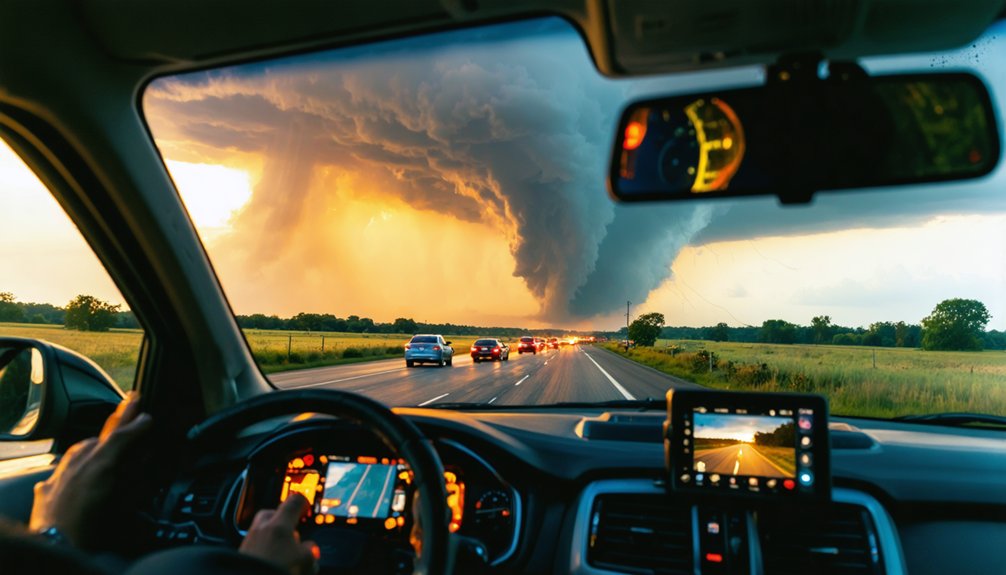
You’ll enhance storm chasing operations through push-to-talk systems that maintain voice coordination across dispersed vehicle networks, while dual-polarization radar transmits horizontal and vertical pulses for instant ground-truth verification. Your team’s satellite-based GPS alerts transmit precise coordinates during emergencies, and two-way radios on designated frequencies achieve 99% uptime when cellular networks fail completely. Multi-network SIM provisioning automatically switches between LTE-M, NB-IoT, and LTE Cat 1 bis networks when signal degradation breaches operational thresholds, ensuring continuous communication through infrastructure-destroying conditions that compromise individual carriers.
Key Takeaways
- Push-to-Talk systems enable instant voice coordination across dispersed chase vehicles with carrier-independent architecture ensuring uninterrupted team communication.
- Dual-polarization radar integration allows real-time ground-truth verification of storm features, enhancing situational awareness through rapid phased array scanning.
- Satellite-based GPS panic buttons transmit precise distress coordinates instantly, maintaining critical emergency response capabilities when cellular networks fail.
- Multi-network SIM technology autonomously switches between carriers during severe weather, maintaining 99% uptime when cellular infrastructure degrades to zero.
- Amateur radio repeaters and two-way radios provide network-independent communication extending beyond 30 miles for reliable coordination in remote areas.
Push-to-Talk Technology for Real-Time Team Coordination
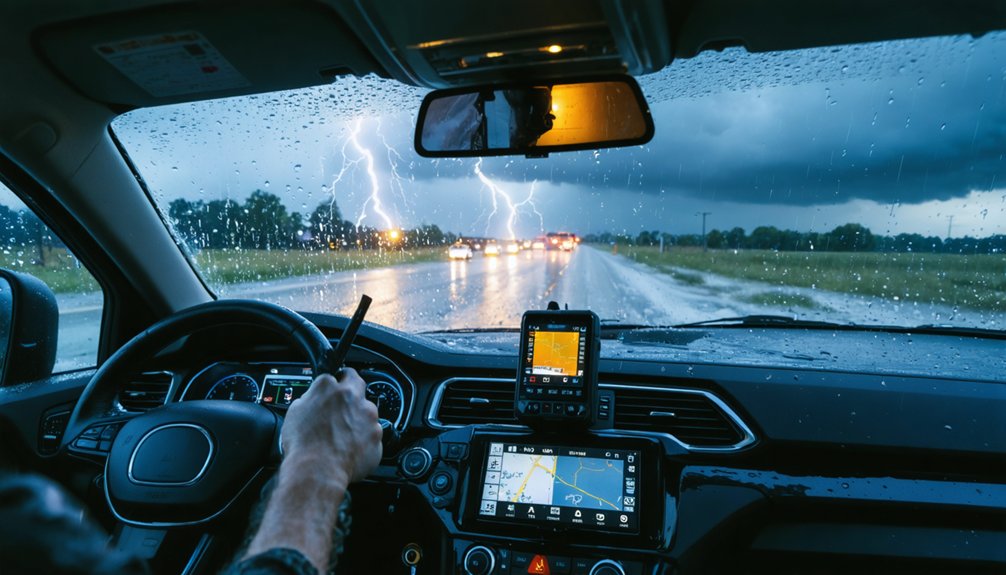
Push-to-talk radio systems fundamentally transform storm chasing operations by enabling instantaneous voice communication across dispersed vehicle networks without the manual dialing or screen interaction that conventional cellular phones require. You’ll maintain tactical awareness through button-activated transmissions that eliminate cognitive distractions during high-speed navigation.
The technology’s mobile app integration delivers real-time GPS positioning across your entire pursuit team, creating dynamic situational awareness as storm systems evolve. Secure fleet management capabilities enable both group broadcasts for coordinated intercept strategies and private channels for specialized communication needs.
PTToC infrastructure automatically shifts between 2G through 5G networks, delivering voice transmission in under 0.5 seconds with 99.999 percent system availability. This carrier-independent architecture guarantees operational continuity when severe weather compromises traditional communication infrastructure, giving you unrestricted mobility across plains territories.
Instant Reporting and Verification of Weather Phenomena
Real-time verification protocols zero in on meteorological phenomena through integrated radar analysis and ground-truth reporting systems that compress detection-to-confirmation cycles from hours to minutes. You’ll leverage dual-polarization technology transmitting horizontal and vertical pulses for target identification, while phased array systems complete storm scans in under sixty seconds to capture tornado genesis.
Enhanced sensor visualization comes through Super Resolution and mobile Doppler units positioned near developing circulations. The New Tornado Detection Algorithm processes dual-pol statistics via machine learning, delivering probability assessments to your display within moments.
Real time phenomena validation requires coordinate-precise spotter reports flowing through centralized EOCs, eliminating relay errors. Interactive composites from 130+ radars update continuously, while instrumented pods and vehicle-mounted sensors capture ground-level atmospheric parameters for exhaustive storm documentation.
Critical Emergency Response and Distress Signaling
When cellular infrastructure collapses during severe weather events, your distress signaling capability depends on satellite-based GPS alert systems that transmit precise coordinates to rescue coordination centers. Devices like the Garmin inReach Mini 2 enable one-touch SOS activation with real-time location tracking, ensuring emergency responders can pinpoint your position within damaged or remote terrain.
You’ll maintain critical communication links through SATCOM and satellite messengers when terrestrial networks fail—typically within the first 24 hours post-disaster when response timing proves most vital.
Panic Button GPS Alerts
Storm chasers operating beyond cellular coverage zones require dedicated panic button systems that transmit GPS coordinates and SOS signals through satellite networks when standard communication infrastructure fails. You’ll find devices like the Garmin inReach Mini 2 and ZOLEO Satellite Communicator essential for distress signaling when pursuing storms in remote territories.
These portable coverage extensions integrate seamlessly with your vehicle diagnostics and tactical equipment, enabling real-time transmission of pivotal location data to rescue coordination centers. When cellular towers collapse post-disaster or terrain blocks radio signals, satellite-based panic alerts maintain operational continuity.
Systems like DataStorm on the EM-COMM 1 trailer demonstrate high-speed emergency management capabilities after events like Hurricane Irma. Your freedom to chase severe weather safely depends on redundant communication layers—satellite beacons provide that indispensable backup when primary channels fail during rapidly evolving storm conditions.
Location Tracking During Emergencies
Emergency response coordination depends on three critical positioning technologies—GPS satellite networks, cellular triangulation systems, and Wi-Fi proximity mapping—that collectively maintain location awareness when storm chasers encounter equipment failure or environmental hazards.
You’ll gain asset management capabilities through devices like the Garmin inReach Mini 2, which transmits SOS signals with 15-second monitoring center response times. Remote monitoring systems generate ShareSpot Live Links that provide first-responders with continuous position data during whiteout conditions or dust storms.
The LL02 tracker’s IP67 waterproof rating guarantees signal integrity when flooding compromises vehicle electronics. On-demand ping boost adjusts refresh rates to 3-30 second intervals during active emergencies, while Panic Mode delivers 10-second updates flagged as high-priority alerts for immediate intervention coordination.
Communication When Networks Fail
GPS coordinates and live tracking feeds become worthless when atmospheric interference or equipment damage severs the digital infrastructure connecting storm chasers to emergency response networks. You’ll need redundant communication pathways that bypass system interoperability challenges during mass casualty communications scenarios.
Critical backup communication systems:
- Satellite phones transmit distress signals through orbital networks, ensuring global coverage when terrestrial infrastructure fails completely
- Emergency beacons equipped with GPS enable rescue teams to trace your exact location without relying on cellular towers
- Two-way radios on designated frequencies maintain team coordination within several miles, independent of network saturation
- Amateur radio repeaters extend communication range beyond 30 miles through SKYWARN networks operated by licensed personnel
- SMS protocols consume minimal bandwidth, allowing brief status confirmations like “SAFE” or “NEED HELP” when voice calls overload networks
Superior Reliability in Network-Compromised Environments
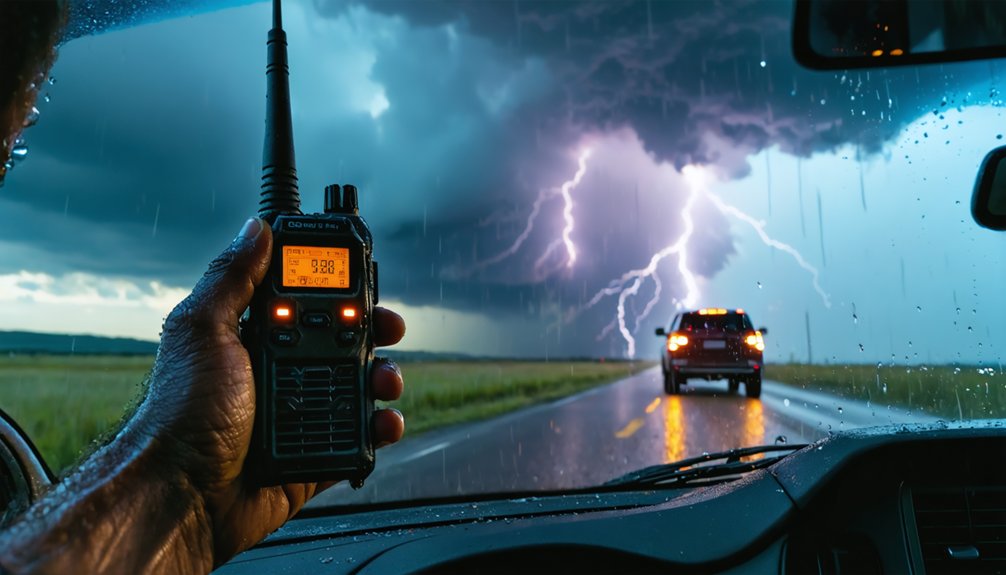
When you’re operating inside wedge tornadoes with 160-170 mph winds, network reliability becomes critical as Hurricane Sandy demonstrated—U.S. network outages doubled from 0.2% to 0.43% within 24 hours of landfall, concentrated along infrastructure-dense regions.
Direct radio communication maintains point-to-point connectivity independent of cellular infrastructure, while multi-network signal switching like Dejero’s EnGo technology aggregates multiple carrier connections to sustain data transmission when individual networks fail.
Your choice between these technologies depends on whether you’re prioritizing infrastructure-independent operation or maximizing bandwidth through redundant cellular pathways during partial network degradation.
Direct Radio vs. Cellular
Cellular networks exhibit catastrophic failure rates during severe weather events, with documented tornado incidents producing multi-day blackouts across entire coverage zones. Your mobile infrastructure access collapses precisely when operational demands peak, forcing reliance on autonomous communication systems. Direct radio frequencies operate independently of compromised cellular network resiliency, delivering uninterrupted coordination capabilities.
Critical operational advantages of radio over cellular:
- Zero network dependency: 2-meter ham frequencies function without towers, switches, or internet backbones
- Instantaneous push-to-talk: No connection delays or bandwidth throttling during high-traffic storm events
- Nationwide range: Direct repeater access enables coordination across chase territories without roaming limitations
- Storm-proof reliability: Maintains 99% uptime under conditions that reduce cellular to zero functionality
- Autonomous operation: Complete freedom from carrier infrastructure vulnerabilities and centralized failure points
Multi-Network Signal Switching
Continuous monitoring evaluates RSSI, RSRP, and SINR metrics in real-time, triggering adaptive network selection when degradation thresholds breach operational parameters. You’ll experience enhanced service continuity as devices autonomously shift between LTE-M, NB-IoT, or LTE Cat 1 bis networks based on signal quality hierarchies rather than manual intervention.
This dynamic switching proves critical during severe weather events where tower damage, power failures, or capacity overload compromise individual carriers. Your equipment remains operational by leveraging pre-negotiated MNO/MVNO relationships embedded within multi-network SIM provisioning, ensuring communication resilience when infrastructure faces maximum stress.
Essential Equipment Models for Storm Chasing Teams
While cellular networks consistently fail during severe weather events, storm chasing teams rely on specialized two-way communication equipment to maintain operational connectivity in remote and extreme conditions. Multi-band transceivers like the Yaesu FT-991A enable HF/VHF/UHF operations for coordinated pursuits, while voice activated radio control systems minimize driver distraction during high-speed intercepts.
Advanced setups integrate telemetry data visualization through mobile workstations featuring touchscreen monitors and distributed WiFi networks.
Critical equipment configurations include:
- Midland MXT575 MicroMobile for reliable primary communication when infrastructure collapses
- Garmin inReach Mini 2 transmitting GPS coordinates and emergency SOS signals beyond cellular range
- WeBoost Drive Reach amplifying weak signals on isolated rural roads
- Starlink Mini providing high-speed redundancy for real-time radar analysis
- Police scanners monitoring emergency response traffic during tornado touchdowns
Integrated Weather Monitoring and Data Systems
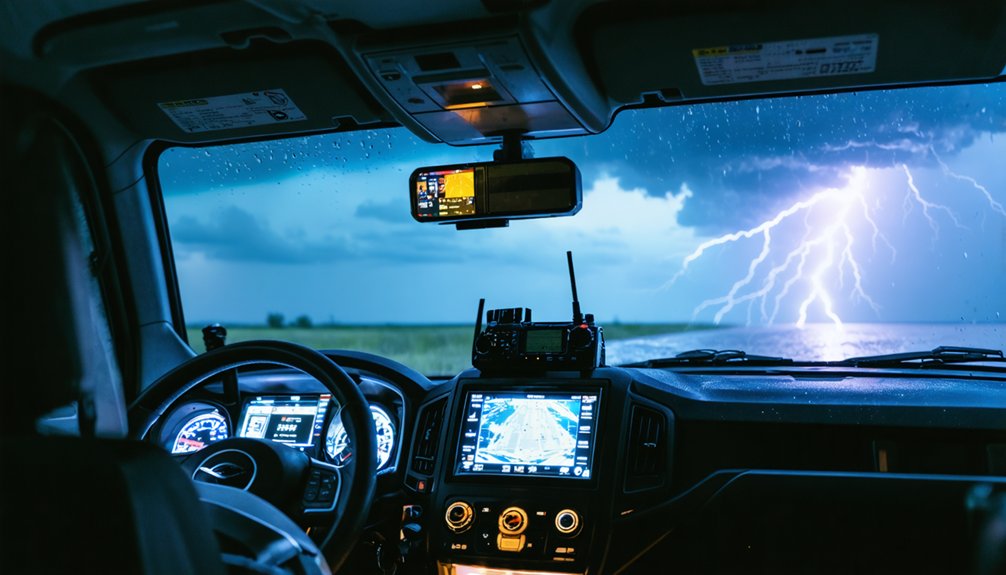
Effective storm interception requires more than reliable communication infrastructure—chasers must continuously sample atmospheric conditions to validate forecast models and identify mesoscale features invisible to remote sensing networks. Your vehicle-mounted AcuRite sensors deliver real-time dew point, wind speed, and temperature data while withstanding Category 5-equivalent conditions.
Advanced Doppler lidar deployment through systems like CLAMPS profiles boundary layer winds and humidity with precision unattainable through conventional instruments. FT752-PM ultrasonic anemometers certified to 90 m/s eliminate mechanical failure risks during close tornado encounters.
Mobile radar integration synthesizes XM Weather feeds, GPS positioning, and custom GEMPAK modeling servers to refine interception trajectories. Kestrel handheld meters provide backup surface measurements when primary systems face debris threats. This multi-sensor approach transforms raw observations into actionable intelligence, enabling autonomous decision-making without institutional constraints.
Life-Saving Communication During Severe Weather Events
When atmospheric conditions deteriorate beyond operational thresholds, your communication architecture shifts from data acquisition to life-preservation protocols. Decentralized communication networks prevent single-point failures when cellular infrastructure collapses during tornado events.
When infrastructure fails, decentralized networks become your lifeline—ensuring critical communications persist through the most catastrophic atmospheric events.
Your 24/7 weather surveillance system combines satellite uplinks, multi-provider cellular switching, and VHF radio arrays to maintain operational autonomy.
Critical life-saving capabilities include:
- Mass notification triggers that activate evacuation protocols when VESTA NXT detects spotter-confirmed rotation
- Unified radio channels coordinating rescue teams through debris fields without infrastructure dependency
- Real-time video feeds from PTZ cameras providing situational intelligence to first responders
- Spotter Network relay systems transmitting consolidated field reports directly to NWS, eliminating communication bottlenecks
- Emergency Operations Center integration bridging forecast data with actionable response directives for government entities
Your communication redundancy determines survival margins during high-threat scenarios.
Practical Applications Beyond Storm Chasing Operations
The communication infrastructure developed for high-threat meteorological operations translates directly into mission-critical applications across seven distinct operational sectors.
Field service operations leverage PTT technology for construction coordination—Moss Construction deploys two-way systems across Hawaii, California, Texas, and Florida sites during hurricane preparation.
Enterprise business continuity solutions enable FOX Weather’s studio-field integration and Greyhound’s driver-dispatch protocols.
Emergency responders utilize CB and HAM radio networks to bypass congested cellular infrastructure, while toll authorities coordinate storm response through dedicated channels.
Outdoor recreation participants maintain contact in zero-coverage wilderness zones using Midland MXT115 systems with integrated weather alerts.
Conference call capability through PTT networks sustained executive operations during Hurricane Harvey’s power grid failures, demonstrating autonomous communication architecture independent of traditional telecommunications dependencies.
Frequently Asked Questions
What Is the Typical Range of Two-Way Radios Used in Storm Chasing?
VHF mobile radios typically reach 10-25km in open terrain during storm chasing. You’ll maximize radio signal strength through ideal antenna placement on your vehicle’s roof, achieving freedom to track storms across extended distances with reliable 50W transmission power.
How Do Storm Chasers Obtain Proper FCC Licensing for Radio Equipment?
You’ll obtain FCC licensing by registering for an FRN, submitting Form 601 with your radio frequency allocation preference (UHF/VHF), paying applicable fees, and meeting commercial licensing requirements—ensuring you’re authorized to operate within allocated spectrum bands legally.
What Are the Average Costs for Complete Radio Setup per Vehicle?
You’ll spend $800-1,500 per vehicle for complete setups including portable radio options, antennas, and mounts. Factor in ongoing radio equipment maintenance costs of $100-200 annually for ideal performance and reliable communications during critical chase operations.
How Long Do Radio Batteries Last During Extended Chase Operations?
You’ll get 1-2 days from handheld transceivers on low power settings during chases. Battery life optimization through radio power management extends your operational freedom considerably—emergency radios like the Stormchaser deliver 10 hours at 50% volume per charge cycle.
Can Multiple Storm Chasing Teams Communicate Across Different Radio Brands?
Yes, you’ll achieve cross-brand communication when teams tune to identical frequencies like 146.550 MHz, though interoperability challenges arise from differing CTCSS tones. Signal interference mitigation requires coordinated channel selection and proper repeater programming across manufacturers.