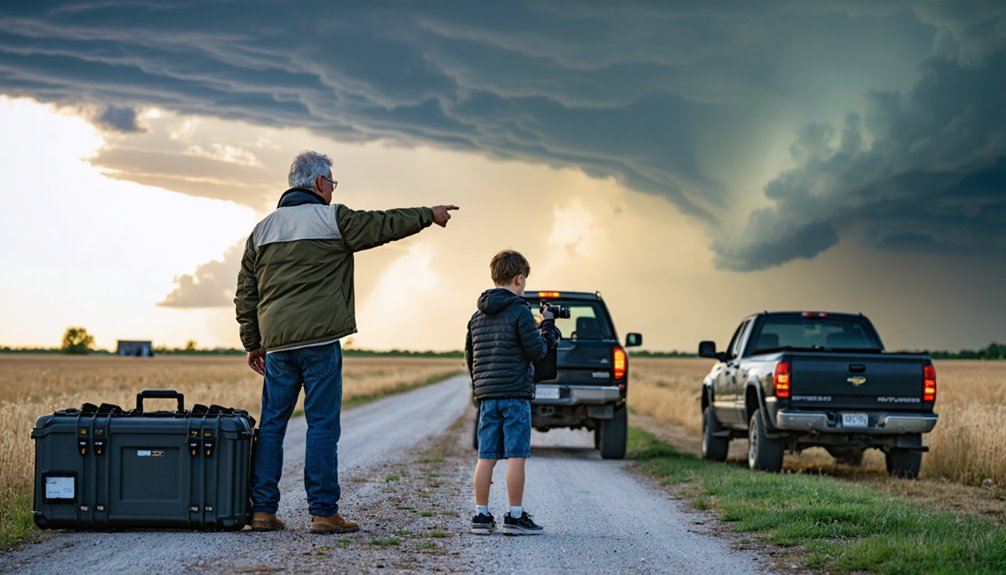
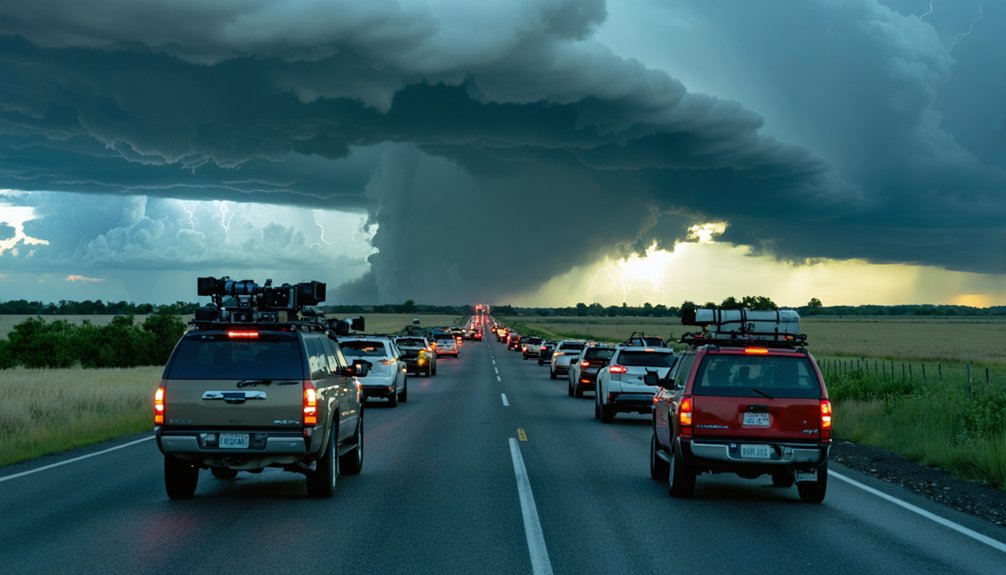
You’ll guarantee accountability in storm chasing through Oklahoma’s Senate Bill 158 licensing framework, which grants professional credentials to fewer than 5% of active chasers, while the remaining 95% operate under standard traffic laws and voluntary SKYWARN protocols. You’re required to complete National Weather Service spotter training, maintain liability insurance per NCOIL Model Act standards, and submit activity logs within 24 hours to your county Emergency Management Agency. The thorough framework below examines legal obligations, safety protocols, and ethical standards governing this specialized field.
Key Takeaways
- Obtain professional licensing through state programs like Oklahoma’s SB 158 to gain legal privileges and demonstrate qualified status.
- Secure landowner permission before entering private property and respect posted boundaries to avoid trespass violations.
- Complete National Weather Service SKYWARN training and submit activity logs within 24 hours to county Emergency Management Agencies.
- Maintain liability insurance coverage and establish formal content licensing agreements with broadcast networks for commercial operations.
- Deploy in pairs with proper equipment including NOAA radios and HAM systems while avoiding emergency responder interference.
Legislative Framework and Industry Access Controls
While storm chasing remains largely unregulated across most of the United States, recent legislative initiatives in Oklahoma have introduced formal licensing frameworks that distinguish professional media chasers from amateur enthusiasts. Senate Bill 158 establishes the Severe Weather Tracker License exclusively for TV media and university-affiliated personnel, preserving your freedom to chase storms without mandatory registration.
You’ll find that accredited certifications grant specific privileges—emergency light displays and closed road access—while House Bill 2426 permits licensed professionals to proceed through traffic controls during active pursuits. The NCOIL Model Act emphasizes contractor regulation through liability insurance considerations, requiring workers’ compensation and property damage coverage.
These bipartisan measures counter misinformation about universal licensing fees, maintaining accessible storm observation while addressing legitimate safety concerns through targeted professional standards.
Self-Policing Versus Government Oversight
Although government regulation remains minimal in storm chasing, the community has increasingly turned to self-imposed ethical frameworks as its primary accountability mechanism. You’ll find that experienced chasers advocate deliberative self-policing over regulatory enforcement, emphasizing community incentives rather than governmental oversight. This approach preserves your autonomy while addressing behavioral concerns before authorities intervene.
Key self-regulation strategies include:
- Private communication with individuals exhibiting dangerous behavior instead of public shaming
- Mentor-based guidance where experienced chasers train newcomers in safe practices
- First aid and first responder training to increase community value during disasters
- Educational focus on severe weather science and pattern recognition
- Setting positive behavioral examples to shape emerging participant conduct
However, enforcement mechanisms face challenges without universal buy-in across the dispersed chasing community, particularly when media misidentification complicates accountability.
Essential Safety Protocols for Storm Chasers
Storm chasing’s technical complexity demands systematic safety protocols that address multiple simultaneous hazards operating across different temporal and spatial scales. You’ll need specialized driver training that emphasizes distraction-free operation during radar monitoring and filming—designate dedicated drivers to maintain situational awareness.
Weather briefing requirements include analyzing spotter networks and radar data before entering warned areas, logging GPS coordinates with your team, and maintaining continuous escape route identification. Your equipment loadout must include NOAA Weather Radios and HAM communication systems as mobile data backups.
Critical positioning protocols mandate avoiding precipitation cores, rotating wall clouds, and terrain that limits visibility like wooded areas. Emergency response competency requires knowing exact 911 reporting procedures with GPS coordinates and appropriate shelter-seeking behavior that rejects dangerous myths about highway overpasses.
Core Ethical Standards and Community Codes
Three foundational pillars establish the ethical framework governing storm chasing operations: safety protocols, courtesy standards, and scientific objectivity. These behavioral norms shape community expectations without formal enforcement mechanisms. You’ll navigate this self-regulated environment through collective standards rather than institutional oversight.
Your ethical responsibilities include:
- Prioritizing safety by parking off right-of-way and avoiding speeding in populated areas
- Maintaining courtesy through non-interference with emergency responders and disaster zones
- Pursuing scientific objectives via National Weather Service spotter training
- Exercising situational awareness to distinguish safe observation from reckless behavior
- Assisting victims when first aid-trained before official response arrives
Social sanctioning mechanisms operate through community reflection and peer accountability. You’ll find offending chasers contacted privately before public exposure. Documentation of dangerous behavior occurs only as final recourse, preserving freedom while maintaining professional standards.
Learning From Fatal Incidents and Accidents
Road accidents have claimed 14 storm chaser lives while tornadoes themselves have killed only 5, establishing vehicular travel as the predominant mortality risk in this pursuit. The 2013 Texas collision that killed Kelley Williamson, Randy Yarnall, and Lee Jaeger exemplifies how stop sign violations strain rural enforcement resources with limited deputies.
Since 2005, you’ll find 13 total fatalities averaging under one annually across 35,175 to 502,500 estimated person-days—rates lower than skiing’s 1 in 944,444. These data points drive insurance coverage implications, requiring actuarial analysis of road-based risks versus atmospheric hazards.
Lightning, flash floods, and hail show zero recorded chaser deaths through 2023. Continuing education requirements should emphasize defensive driving protocols and traffic law compliance rather than tornado proximity dangers.
Emergency Response and First Aid Responsibilities
You must guarantee at least one team member maintains current CPR certification, as lightning strikes can cause immediate cardiac or respiratory arrest requiring immediate intervention.
Your chase team should integrate into SKYWARN networks through amateur radio and coordinate directly with emergency managers by submitting detailed, time-stamped storm reports that influence warning issuance and extension decisions.
Pursue standardized training through CERT or Red Cross programs to establish recognized credentials that facilitate official coordination during severe weather events and post-storm response operations.
First Responder Training Requirements
Storm chasers who encounter severe weather events must understand that approximately 350,000 to 400,000 trained SKYWARN spotters nationwide maintain baseline certification through a 90-minute foundational course administered by the National Weather Service.
First responder training requirements operate through multiple pathways beyond basic certification:
- SKYWARN certification via NWS online platforms (COMET/MetEd) establishes national storm spotter registry credentials
- FEMA CERT programs accessible through local emergency managers provide cross jurisdictional regulations expertise
- SpotterNetwork.org courses deliver technical weather science vocabulary and disaster event analysis
- American Red Cross training covers localized disaster response protocols
- Hazardous weather preparedness classes teach community alert systems and pre-disaster planning
Post-certification integration requires contacting local Emergency Managers or NWS meteorologists to align with regional coordination structures and operational protocols.
Coordinating With Official Agencies
Building competency through certification programs establishes foundational knowledge, yet operational effectiveness depends on structured coordination with authorized emergency management systems.
You’ll interface directly with National Weather Service protocols when officials activate spotter networks during probable severe weather events. Your reports flow through centralized Emergency Operations Centers, eliminating duplicate communications and preventing conflicting public messaging.
This coordination impact extends beyond individual observations—you’re contributing to a standardized data collection framework utilized by 350,000-400,000 SKYWARN volunteers nationwide.
Multi stakeholder engagement requires adherence to established radio procedures and National Weather Service reporting criteria. You’ll submit activity logs within 24 hours post-event to county Emergency Management Agency for official archiving.
Deploy in pairs minimum, maintain predetermined shelter locations, and retain authority to decline participation when conditions compromise personal safety.
Contributing to Scientific Research and Data Collection
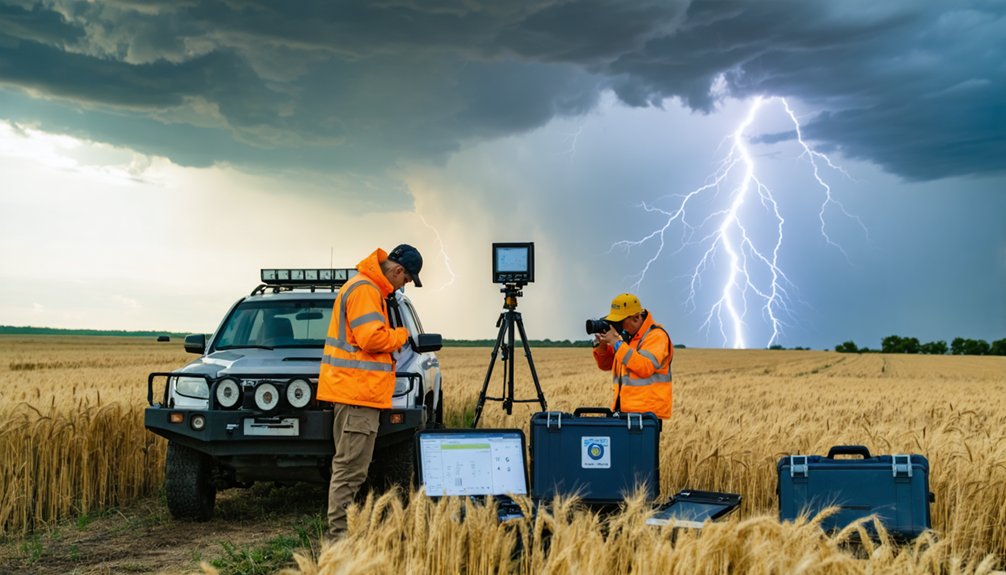
While recreational storm chasers often pursue dramatic imagery, scientifically-oriented intercepts generate critical atmospheric data that traditional weather stations can’t capture. Your probe deployments—using 13-gram instruments launched via helium balloons—collect thermodynamic measurements previously limited to computer estimates.
Lightweight balloon-borne probes transform storm chasing from spectacle into science, capturing real atmospheric data where ground stations cannot reach.
Through rigorous data quality assurance and equipment testing protocols, you’ll contribute meaningfully to tornado formation research.
Effective scientific contributions include:
- Deploying biodegradable probes that transmit temperature patterns for 90+ minutes of drift time
- Correlating thermodynamic data with radar wind measurements to identify mesocyclone rotation patterns
- Targeting surface-based supercells in regions with elevated storm relative helicity below 1 kilometer
- Documenting intercepts through calibrated video, images, and atmospheric measurements
- Validating forecast methodologies by testing prediction models against observed storm behavior
Your independence enables flexible positioning within storm environments where fixed stations can’t reach.
Professional Content Licensing and Media Relations
Your storm chasing documentation generates measurable value when properly licensed to media outlets, weather services, and research institutions. Establishing formal content licensing agreements guarantees your footage reaches broadcast networks and meteorological organizations while maintaining attribution and compensation standards.
Systematic video documentation with embedded metadata—including GPS coordinates, timestamps, and atmospheric conditions—transforms raw footage into scientifically viable datasets that support both commercial distribution and peer-reviewed research applications.
Licensing Content to Media
Storm chasers cash in on their footage through licensing agreements with television networks, documentary productions, and news agencies that pay directly for exclusive or non-exclusive rights. This revenue model sustains operational costs—equipment, gas, and insurance—that aerial video footage licensing demands.
Major networks including Discovery, National Geographic, and History Channel actively purchase storm content, enabling monetizing storm chasing clips as viable career paths.
Licensed footage generates income through:
- Direct payments from TV productions replacing ad revenue lost to copyright infringement
- Freelance supply contracts with news agencies for breaking weather events
- Documentary rights purchases funding long-term chasing operations
- Exclusive licensing deals commanding premium rates for unique tornado footage
- Non-exclusive agreements providing recurring revenue streams from archived content
Unauthorized use by platforms or productions directly competes with these licensing markets, undermining sustainability.
Collaboration With Weather Services
Beyond commercial licensing agreements, professional storm chasers maintain structured partnerships with meteorological agencies that enhance forecast accuracy and public safety outcomes. You’ll find organizations like NSSL collaborating with university and private partners through initiatives such as TORUS, deploying drones and mobile units to gather supercell data that traditional networks can’t access.
These partnerships address technological innovations including Warn-on-Forecast systems and radar techniques detecting downburst precursors. Partnership challenges emerge when coordinating consolidated reporting—you must specify precise locations and minimize duplicate submissions to prevent communication errors during multi-step relays.
The American Meteorological Society’s collaboration with Tornado Titans demonstrates how professional chasers contribute safety resources while maintaining data integrity. Your real-time observations enable decision-makers to interpret radar signatures accurately, bridging gaps between automated detection and ground-truth verification.
Video Documentation for Research
Professional documentation of severe convective phenomena requires adherence to rigorous technical standards that maximize research utility while preserving commercial value. Your stationary observer position enables accurate wind speed computation, while video metadata enhancement provides essential context for licensing platforms and meteorological analysis.
Core Documentation Requirements:
- Maintain fixed position with unobstructed funnel view for several continuous minutes
- Mount cameras on ground-based tripods using global shutter sensors to eliminate artifacts
- Capture audio with windows open—tornado roar aids post-analysis despite challenging conditions
- Record at ideal frame rates: 10,000 ips for lightning analysis, 60p for debris tracking
- Implement sensor calibration protocols before deployment to guarantee measurement accuracy
Sequential stationary positions after funnel traverse, combined with professional editing in Adobe Premiere Pro CC, transforms raw footage into research-grade documentation while maintaining monetization potential through exclusive licensing agreements.
Contractor Verification and Post-Storm Services
Approximately 40% of storm-damaged homeowners encounter unlicensed contractors within 72 hours of a weather event, according to the National Association of Insurance Commissioners. You’ll need rigorous contract review processes to identify red flags: door-to-door solicitation, out-of-state credentials, and pressure tactics demanding immediate signatures.
Verify contractor licenses through state boards, confirm insurance directly with providers, and examine BBB complaint histories. Legitimate operators respond to your inquiries rather than initiating contact, provide itemized estimates with specific dollar amounts, and allow adequate review time. Consumer advocacy programs recommend obtaining multiple references and avoiding “per insurance proceeds” language in agreements.
If you’ve encountered fraud, document everything—contracts, photographs, receipts—and report to local authorities, the Attorney General, and FTC. Your vigilance protects both financial resources and property integrity.
Property Rights and Legal Boundaries
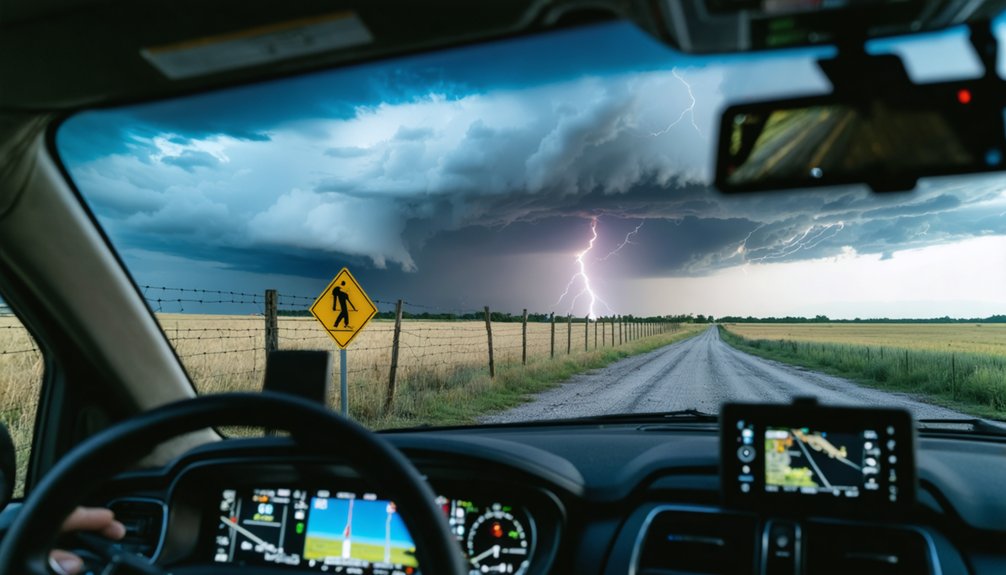
When pursuing storm activity, you must recognize that property access laws prohibit entering private land without explicit owner permission, as trespass violations carry civil and criminal penalties regardless of research intent.
Public roadways impose strict parking limitations—you can’t obstruct rights-of-way, park under Interstate overpasses during severe weather, or use limited-access highways except during genuine emergencies, which storm chasing doesn’t constitute.
Before accessing any property for data collection or observation, you’re legally required to obtain advance consent from landowners, with verbal or written authorization serving as your only protection against prosecution.
Respecting Private Land Access
The legal framework governing property access in storm chasing operations centers on Nevada Revised Statutes 207.200, which defines criminal trespass as entering another’s land with intent to vex or annoy the owner, or willfully remaining after receiving notice to depart.
Landowner rights protection requires you to:
- Verify boundary markers posted at 500-foot intervals with direct line-of-sight visibility
- Obtain voluntary agreements before crossing private property to access public lands
- Recognize that fencing (walls, hedges, chain link, wire mesh) establishes legal boundaries
- Understand that warnings within 36 months trigger misdemeanor charges for repeat violations
- Accept zero duty of care from landowners under NRS 41.515 for injuries on their property
Trespass liability mitigation demands adherence to posted signage at corners, gates, and cattle guards, protecting your pursuit of atmospheric phenomena without compromising property owner autonomy.
Public Road Limitations
While private property boundaries establish one set of constraints for storm chasers, public roadways impose equally stringent legal limitations that demand strict compliance. You’ll encounter restricted speedlimits that require adherence, particularly in school zones where violations carry severe penalties.
Research demonstrates high-speed driving on rain-covered surfaces increases accident risk exponentially—ironically, highway dangers exceed storm-related threats. You must implement mandatory off roadparking protocols, positioning vehicles completely beyond right-of-way boundaries where doors won’t swing into traffic lanes.
Oklahoma Senate Bill 158 and House Bill 2426 establish specific licensing frameworks, granting media affiliates privileges like closed road access while imposing fines on unauthorized entrants. Interstate chasing remains acceptable only when alternatives don’t exist.
Distracted driving while repositioning causes most fatal chaser accidents—your laptop navigation creates greater danger than tornadoes themselves.
Permission Before Entry
Storm chasers attempting property access without explicit authorization face criminal trespass charges under state statutes that carry penalties ranging from $500 fines to 90-day incarceration periods. You’ll need documented consent before contractors enter your property, particularly for residential roofing inspections following severe weather events. Entry prerequisites protect your constitutional rights while establishing legal accountability frameworks.
Essential Verification Protocols:
- Confirm door-to-door sales permits through municipal officials before granting access
- Demand written contracts specifying work scope, materials, and completion timelines
- Verify contractor licensing status with state regulatory databases
- Document all interactions with traveling repair crews through dated correspondence
- Request lien waivers before authorizing any payment disbursements
Seek recommendations from trusted networks—friends, neighbors, insurance agents—rather than accommodating unsolicited service providers. Contact local building inspectors to validate permit requirements and guarantee compliance verification.
Frequently Asked Questions
What Insurance Coverage Should Storm Chasers Carry for Liability and Vehicle Damage?
You’ll need extensive liability coverage meeting Texas’s $100,000 minimum per occurrence and vehicle damage policies with hail protection. Consider older vehicles with existing damage to minimize claim scrutiny, as insurers flag high-frequency broad claims from storm chasers.
How Do Chasers Coordinate With Emergency Services to Avoid Hindering Rescue Operations?
You’re not compromising your independence—you’ll coordinate through established communication protocols and weather service liaison channels. Report your GPS location to Net Control, avoid blocking access routes, and relay observations through EOC to prevent duplicate emergency calls.
What Mental Health Resources Exist for Chasers Experiencing Trauma After Witnessing Disasters?
You’ll find mental health counseling services through SAMHSA’s Disaster Distress Helpline (1-877-726-4727) and trauma informed support groups via Storm Sky Resilience Collective. Evidence-based resources include Give an Hour’s free services and NCTSN’s specialized disaster recovery programs.
Can Storm Chasers Be Held Legally Liable for Injuries Sustained by Followers?
You could face tort liability if your reckless driving injures followers, though precedents remain limited. Courts examine foreseeability and proximate cause. Your best defense? Prioritize personal safety precautions—avoiding traffic violations protects both you and others pursuing storm-chasing freedom.
What Tax Implications Apply When Monetizing Storm Footage or Operating Tours?
You’ll face income reporting requirements for all footage sales and tour revenue under Section 162. Business licensing considerations vary by state, but maintaining meticulous records proves profit intent, enabling deductions for vehicle costs and equipment while avoiding hobby-loss limitations.