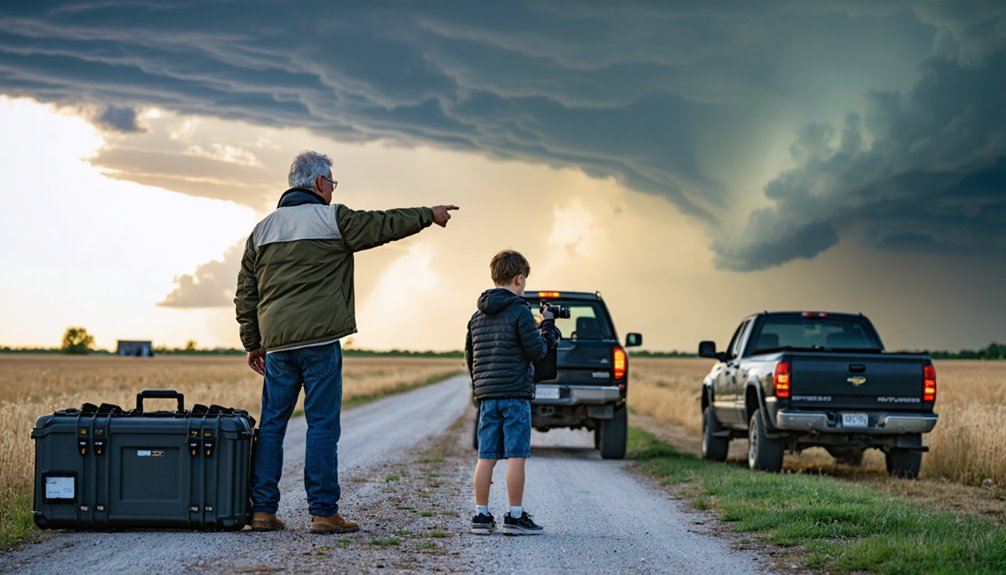
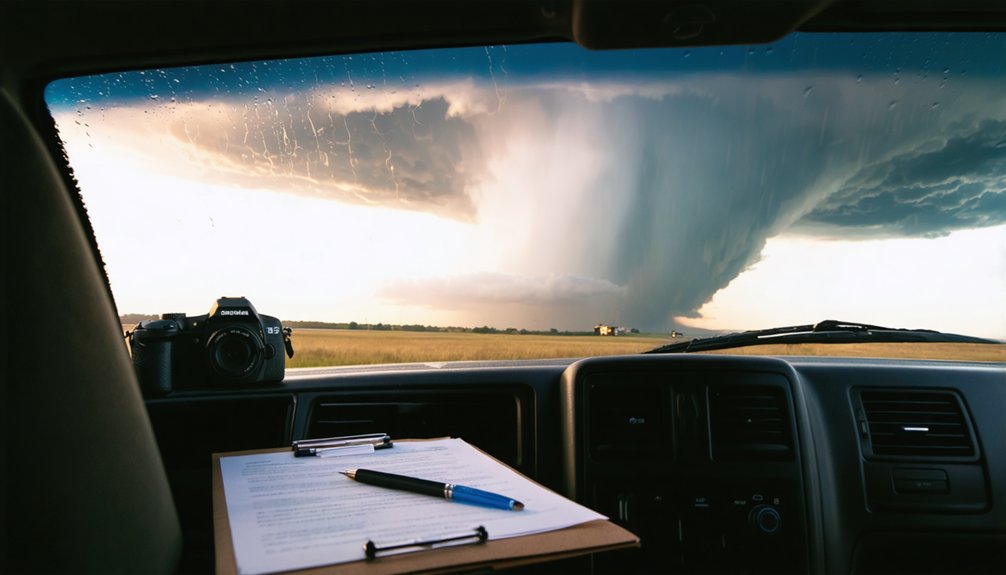
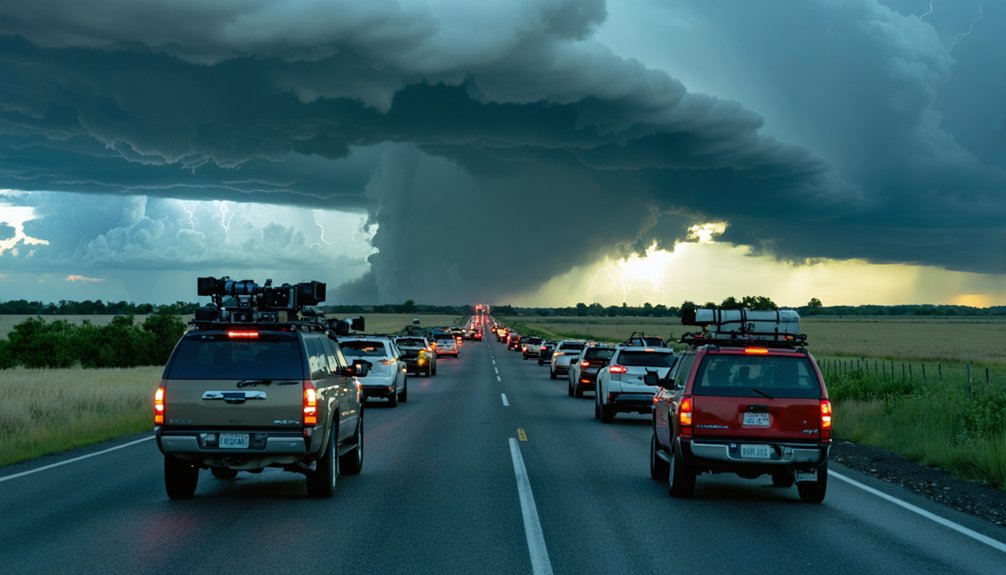
You’ll guarantee ethical storm chasing by prioritizing traffic safety over storm proximity—vehicular accidents have killed fourteen chasers since 2005, far exceeding tornado-related fatalities. Maintain appropriate speeds, watch for other vehicles rather than just the sky, and respect stop signs during pursuits. You must also recognize lightning’s 100km strike range and avoid false shelter under trees. Since there’s no federal oversight, experienced chasers have developed voluntary codes emphasizing safety protocols, objective documentation, and first responder responsibilities that distinguish professional operations from amateur recklessness.
Key Takeaways
- Follow voluntary ethical frameworks prioritizing safety, courtesy, and objective documentation developed by experienced storm chasers.
- Maintain traffic vigilance over storm proximity, as car accidents cause more chaser deaths than tornadoes.
- Contact affected individuals privately before publicly posting documentation, respecting privacy and reducing sensationalism.
- Engage with educational platforms to discuss safety protocols and first responder responsibilities within the community.
- Preserve scientific foundations by avoiding sensationalist coverage that misrepresents storm chasing’s meteorological purpose.
Understanding the Core Safety Threats in Storm Chasing
While tornadoes command public attention as the primary threat in storm chasing, statistical evidence reveals a different reality: vehicular accidents constitute the leading cause of death in this activity. Over fourteen years, car accidents claimed fourteen lives compared to five tornado-related deaths.
You’re facing compounded dangers when severe weather reduces visibility through heavy rain, hail, and blowing dust—conditions that transform routine driving into life-threatening scenarios.
Your survival depends on hazard recognition capabilities that distinguish professionals from amateurs. Trained meteorologists understand storm dynamics and implement effective risk mitigation strategies, while inexperienced chasers lack critical knowledge for determining safe retreat timing. You’ll navigate these dangers successfully only through proper meteorological training and mentorship, not through instinct alone.
Traffic Accidents: The Primary Risk Factor
The statistical reality contradicts popular perception: car accidents, not tornadoes, represent the leading cause of death among storm chasers. Since 2005, 14 chasers have died in vehicle collisions compared to just 5 from tornadoes.
You’re facing distracted driving as your primary threat—chasers prioritizing sky-watching over traffic awareness, running stop signs, and creating highway congestion on rural roads during pursuits. Notable incidents include the March 28 Texas collision that killed three chasers and the El Reno tornado’s rare direct fatalities.
Rural areas lack sufficient law enforcement presence to monitor dangerous behaviors. Your safeguard lies in maintaining appropriate speeds and treating road safety as paramount. With chaser numbers increasing, these preventable fatalities will continue unless you prioritize traffic vigilance over storm proximity.
Lightning Strike Dangers and False Shelter Misconceptions
Although storm chasers often focus on tornado proximity as their primary hazard, lightning presents a statistically greater and more unpredictable threat during pursuit operations. You’re facing 8 million global strikes daily, with clear air lightning reaching 100km from storm cores—often striking when you believe you’re at safe distance. Don’t assume your vehicle provides absolute protection; aircraft experience strikes annually despite altitude advantages.
Trees account for 23% of lightning fatalities, making roadside pullouts beneath branches particularly dangerous portable shelter risks. Direct strikes cause only 5% of incidents, but indirect mechanisms—ground currents, side flashes, and blast effects—prove equally lethal. With 10% mortality rates and 75% of survivors suffering permanent injuries, maintaining proper standoff distances and hardened shelter access becomes non-negotiable during electrical storm activity.
The Absence of Regulatory Oversight in Storm Chasing
Unlike aviation, commercial trucking, or hazardous materials transport, storm chasing operates in a regulatory void with no federal oversight governing pursuit activities across the United States. You’re free to track severe weather without licenses or certifications, yet this autonomy creates challenges when 1,200 annual tornadoes generate roadway congestion and safety hazards.
Oklahoma’s Senate Bill 158 represents a rare state-level attempt at media regulatory oversight, targeting professional trackers through optional licensing rather than mandatory restrictions. The proposal establishes data collection standards by requiring media outlet endorsements or academic affiliations, distinguishing credentialed professionals from casual observers.
While you’ll retain operational freedoms without licensing, the eastward shift in Tornado Alley underscores how this regulatory vacuum leaves critical safety and traffic management questions unanswered during significant weather events.
Community-Based Ethical Codes and Self-Governance
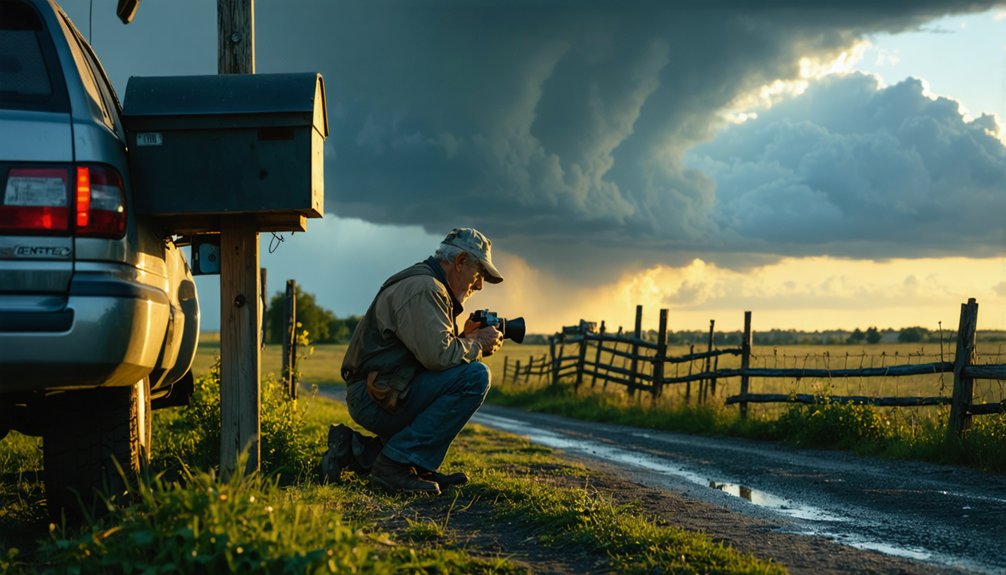
Experienced storm chasers have developed voluntary ethical frameworks centered on safety, courtesy, and objective documentation as self-governance mechanisms in the absence of formal regulation. These codes address concerns about sensationalist broadcast media coverage that can misrepresent storm chasing’s scientific foundations. You’re encouraged to participate in community reflection by reviewing shared ethical guidelines and realigning your priorities accordingly.
When you observe dangerous behavior, contact individuals privately first—public posting of video evidence serves as a last resort. Tour operators particularly influence future chasers’ standards through example-setting. Chaser reputation management depends on collective adherence to voluntary principles rather than external enforcement.
You’ll find educational platforms facilitate discussion on safety protocols and first responder responsibilities, since you’re often first on disaster scenes. This self-regulatory approach preserves your operational freedom while maintaining professional standards.
Respecting Emergency Response Operations During Disasters
When operating in severe weather environments, you must maintain strict boundaries between storm observation and emergency response zones. Your presence in disaster areas can obstruct first responders, compromise evacuation routes, and divert critical resources from life-saving operations.
Adherence to all traffic laws, road closures, and official safety perimeters isn’t merely recommended—it’s an ethical and legal obligation that directly impacts community welfare during crisis events.
Avoid Disaster Area Driving
Storm chasers bear a critical responsibility to avoid impeding disaster response operations, particularly when pursuing severe weather into areas where emergency personnel are actively working to save lives and protect property. Your hazardous road hazard avoidance practices must include respecting closure signs and alternate routes directed by officers—these indicate genuine dangers ahead.
Weather condition considerations demand you assess visibility limits and flooding risks before proceeding. Remember that twelve inches of rushing water can carry away most vehicles, while flash flooding occurs without warning. When barriers block roads or conditions severely compromise visibility, you’re obligated to turn around.
All fifty states enforce slow-down-and-move-over laws protecting first responders working within feet of traffic. Sometimes the most responsible decision means postponing your chase until dangerous systems pass completely through.
Stay Clear of Operational Zones
Emergency response operations establish defined perimeters where only authorized personnel should operate, and you must recognize these zones as strictly off-limits during active storm chasing activities. Practicing operational distancing means maintaining buffer zones between your position and the storm core, preserving escape routes that won’t conflict with responder paths.
You’ll need to monitor storm movement continuously to prevent encroachment on these operational perimeters. Hazard avoidance extends beyond tornado damage paths—stay clear of areas where emergency teams conduct damage surveys or coordinate rescue operations. When reporting hazards, communicate your GPS coordinates to authorities, then vacate immediately for professional handling.
Use four-way intersections for observation rather than congesting response staging areas. Your freedom to chase depends on respecting these boundaries without interference.
Follow All Public Laws
Beyond maintaining physical distance from operational zones, your storm chasing activities must comply with all applicable federal, state, and local statutes that govern conduct during declared disasters. The National Response Framework and Emergency Support Functions establish legal boundaries during federally activated emergencies, defining restricted areas and coordination protocols.
State-level preparedness legislation increasingly mandates regulatory compliance for public safety operations, affecting access permissions and movement restrictions.
You’re responsible for understanding these jurisdictional requirements before pursuing severe weather events. Policy transparency remains essential—knowing which laws apply protects both your activities and emergency responders’ effectiveness.
Recent federal funding disputes and decommissioned disaster databases demonstrate how quickly operational landscapes shift. Your ethical obligation extends beyond personal safety to supporting, not hindering, official response capabilities through informed legal adherence during crisis situations.
First Responder Responsibilities of Storm Chasers
As a storm chaser, you’ll often arrive at disaster scenes before official emergency personnel, placing you in a position where immediate victim assistance becomes necessary. Your first responder training—if you’ve obtained it—enables you to provide critical aid while maintaining clear boundaries that prevent interference with professional rescue operations.
You must recognize the distinction between offering help when no one else is present and stepping back once trained emergency responders establish their command zones.
Arriving First at Disasters
Due to their proximity to developing storms and high mobility during severe weather events, storm chasers frequently arrive at tornado disaster scenes before traditional emergency responders can reach the affected areas. Your advanced positioning means you’ll often be the first with operational vehicles and communication equipment at ground zero.
This reality demands chaser accountability—you must maintain CPR and first aid certifications, carry extensive emergency supplies, and pursue FEMA CERT training. If you encounter injured victims, you’re ethically obligated to render assistance immediately.
However, follow official communications protocols by integrating into SKYWARN networks and contacting local emergency managers beforehand. You’ll provide critical ground truth to authorities while avoiding self-appointment as a hero. Your role supports professional responders without overstepping operational boundaries.
Providing Immediate Victim Aid
Your presence at a disaster scene creates immediate medical responsibilities that demand honest assessment of your capabilities. If you possess off-duty medical training through programs like CERT or American Red Cross certification, you’re equipped to provide appropriate aid while awaiting professional responders.
Critical injury assessment becomes your primary function—stabilizing victims rather than attempting interventions beyond your skill level.
The universal rule remains clear: render aid to injured persons you encounter. However, reject romanticized “gallant hero” delusions that create dangerous overreach. Your first aid training exists to sustain victims until professional emergency teams arrive, not replace them.
Maintain heavy first aid kits, but recognize your limitations. Professional responders must handle complex medical situations. Your role focuses on immediate stabilization—nothing more, nothing less.
Avoiding Responder Zone Interference
When storms strike and devastation follows, the line between helpful observer and obstructive presence becomes critically thin. You’ll serve the situation best by maintaining defensive distances from disaster zones, ensuring emergency vehicles access unimpeded routes.
Plan perpendicular escape paths from storm motion to exit rapidly when professionals arrive. Your coordinated communication through proper channels—NWS, law enforcement, or Net Control Stations—provides valuable intelligence without physical interference.
Avoid the romantic hero delusion that compels unauthorized access to damaged areas. Unless you’ve completed FEMA CERT or integrated with Red Cross operations beforehand, you’re untrained for disaster response. Pull over completely for non-driving tasks, keeping roadways clear.
Your freedom to chase carries responsibility: observe, report accurately, then withdraw when professional responders assume control of affected zones.
Proper Pursuit Techniques and Decision-Making Protocols
Storm chasing demands rigorous adherence to safety protocols that balance scientific observation with personal protection. You’ll maintain escape routes by understanding terrain considerations and local roadways, guaranteeing backup plans exist for storm circumvention.
Weather forecasting accuracy through Storm Prediction Center outlooks and real-time radar apps enables informed positioning decisions before departure. You must avoid radar fixation by balancing data with visual observations of critical features like RFD gust fronts and inflow tails.
Don’t attempt outrunning tornadoes—their speeds and direction changes remain unpredictable. Instead, drive perpendicular to their paths when feasible. Exercise caution in notch regions near tornado positions, and monitor deviant storm motions indicating unexpected shifts.
Your team requires developed safety plans that all members understand and practice. Keep seatbelts fastened during extended chases, and ensure someone’s CPR-trained for lightning-related emergencies.
Educational Standards for Training Future Chasers
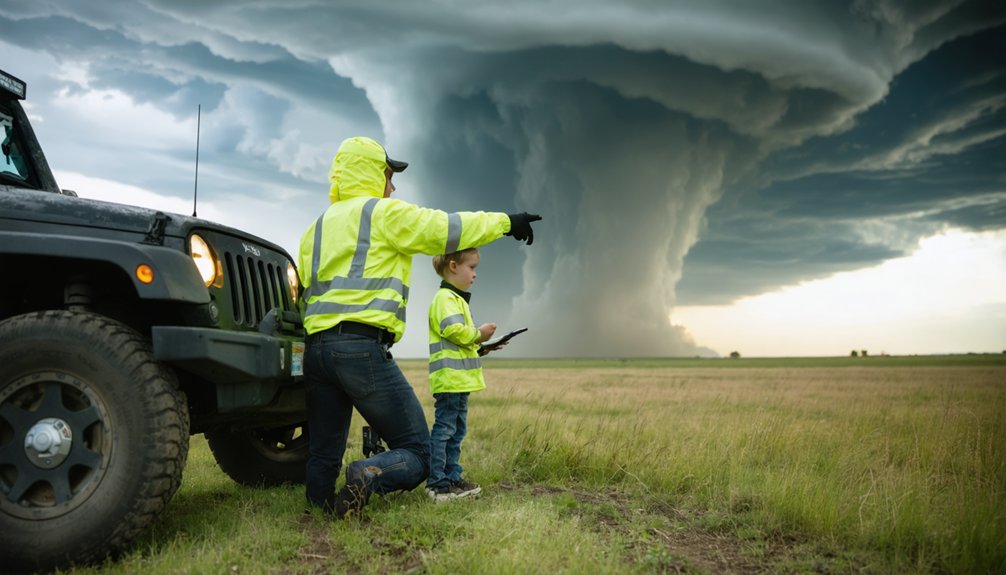
Tour groups serve as practical training environments where you’ll learn ethical storm chasing protocols alongside experienced meteorologists who integrate research objectives into chase operations. These structured programs establish standardized safety procedures and professional conduct expectations that translate classroom meteorological theory into field applications.
You’ll gain hands-on experience with real-time forecasting, positioning strategies, and data collection methods that prioritize both scientific value and public safety.
Tour Groups Teach Ethics
Each storm chasing tour operator bears responsibility for establishing rigorous educational standards that prioritize both safety protocols and ethical conduct. You’ll find that tour groups serve as incubators for future chasers, where leadership by example shapes the community’s trajectory.
Operators undergo constant scrutiny for modeling safe behavior—whether it’s maintaining proper distance from emergency responders or adhering to traffic laws during pursuit operations.
Your tour leader’s actions demonstrate ethical decision making in real-time scenarios: choosing scientific observation over sensationalism, avoiding disaster areas, and exercising restraint when conditions demand it. When dangerous conduct occurs, leaders address issues privately first, reserving public accountability as a final measure. This self-regulatory approach respects your autonomy while maintaining community standards that protect both participants and affected populations.
Build Knowledge Through Research
Beyond the practical lessons learned on tour expeditions, you’ll need formal meteorological training to develop competence as a storm chaser. A bachelor’s degree in meteorology or atmospheric science provides essential knowledge in radar interpretation, mesoscale analysis, and storm dynamics. You’ll master NEXRAD and Dual-Pol Radar systems to detect mesocyclones and forecast tornado genesis accurately.
Building video archives of your field observations creates valuable documentation for analysis and continuous improvement. Leveraging social media responsibly allows you to share real-time data with meteorological networks while maintaining scientific integrity. Research-oriented chasers pursuing master’s or doctoral degrees contribute to atmospheric science through systematic data collection and peer-reviewed publications. This educational foundation guarantees you operate with professional standards, prioritizing safety protocols over thrill-seeking while advancing severe weather understanding.
Correcting Dangerous Behavior Through Community Accountability
You’ll find that most chasers don’t block emergency vehicles or excessively break laws—contrary to sensational media portrayals. Local chasers often cause traffic problems more than out-of-state visitors.
Simple actions work: pull off roads, yield to responders, follow traffic regulations. When the community collectively reinforces these standards through dialogue and example, dangerous behavior decreases without sacrificing the autonomy that defines storm chasing culture.
Frequently Asked Questions
What Insurance Coverage Should Storm Chasers Obtain for Vehicle and Liability Protection?
You’ll need all-encompassing and collision coverage for your chase vehicle, plus liability insurance with $1 million minimum limits. Don’t overlook vehicle maintenance requirements and personal safety precautions—they’re essential for protecting yourself and managing risks while pursuing storms independently.
How Do Chasers Coordinate With National Weather Service During Active Pursuits?
Like ancient messengers bridging kingdoms, you’ll coordinate through established communication protocols via amateur radio or phone networks, following operational guidelines that route reports through organized spotter networks to National Weather Service forecast offices, never directly interfering with operations.
What Communication Equipment Is Essential for Maintaining Contact During Severe Weather?
You’ll need two-way radios and satellite communicators for reliable communication channels when cellular networks fail. Combine these with XM Weather systems for continuous weather monitoring, ensuring you maintain contact and receive critical radar updates throughout your chase.
Are There Legal Consequences for Trespassing on Private Property While Chasing?
Don’t let storm excitement land you in hot water—you’ll face serious liability risks if you trespass. Trespassing laws vary by state, imposing fines from $75 to $10,000 and potential jail time, restricting your freedom to chase safely.
How Should Chasers Document and Report Scientific Data They Collect?
You’ll maintain scientific integrity by following proper data storage protocols with timestamped, geotagged observations and metadata. Share findings through appropriate data sharing practices with research institutions and NWS databases, ensuring your measurements contribute meaningfully to storm science advancement.