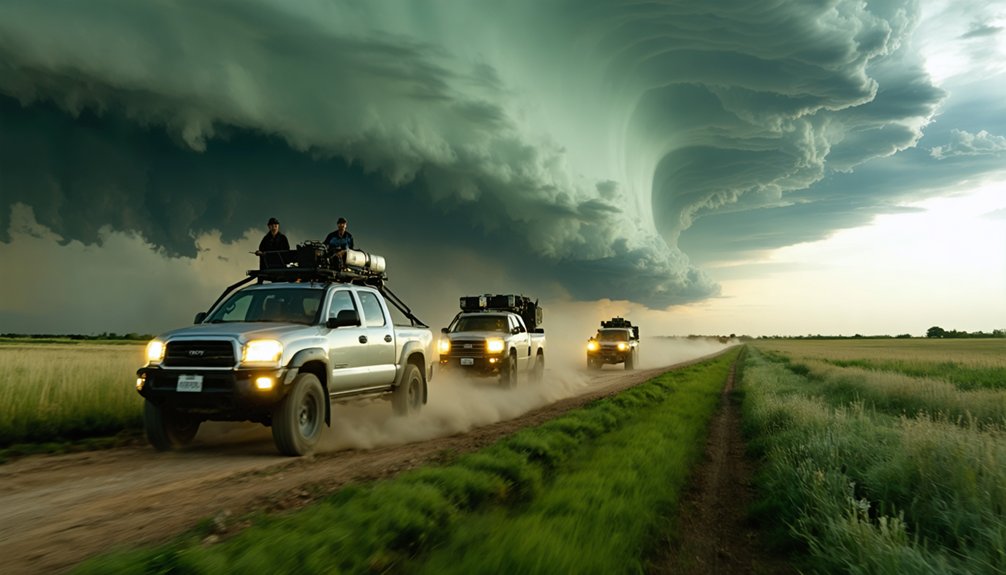
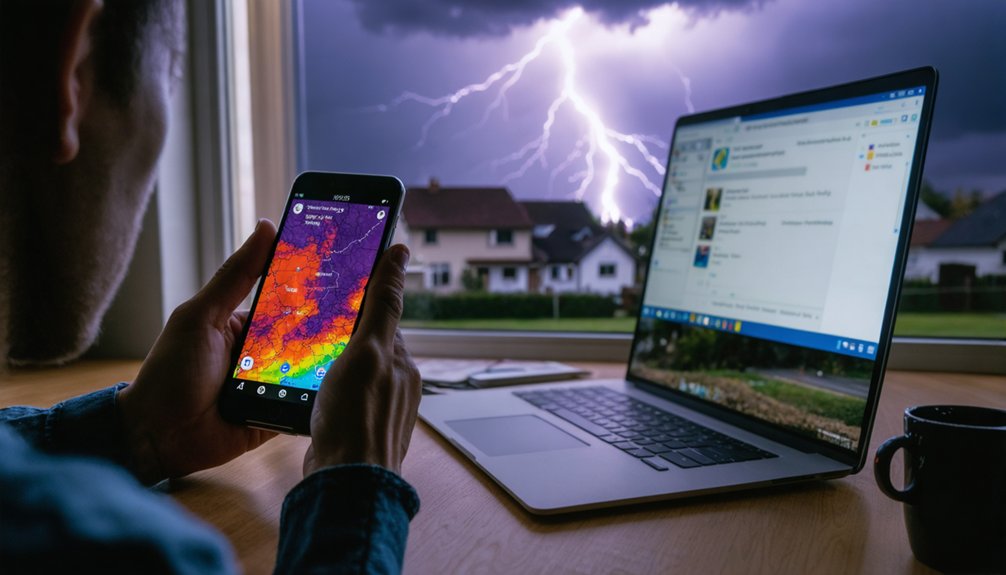
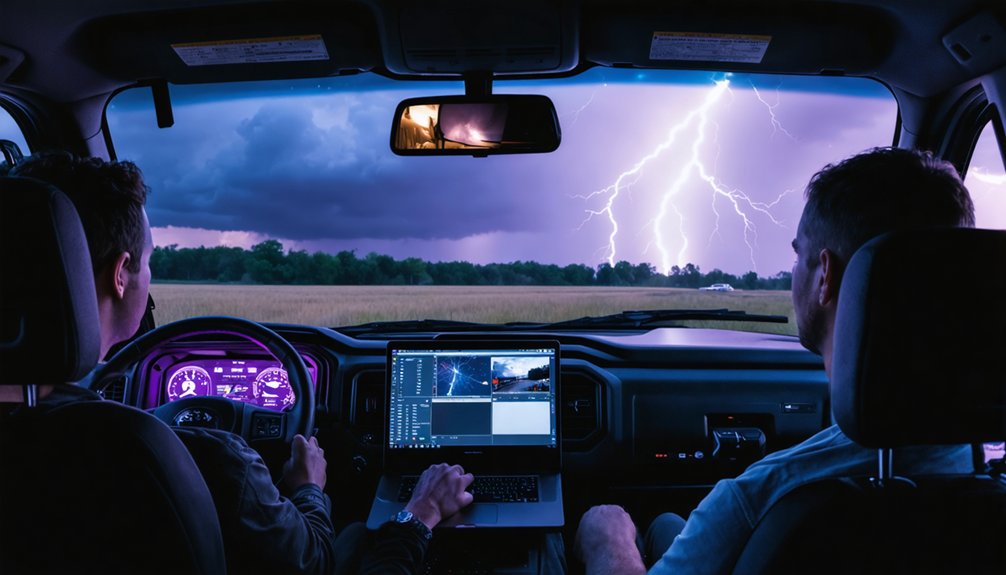
You’ll need ANSI Z87+ certified eyewear and weather-resistant clothing with GORE-TEX outer shells as your foundational protection. Equip yourself with redundant communication systems including two-way radios and satellite communicators, plus offline GPS navigation tools like Garmin Overlander. Don’t forget recovery equipment—snatch straps rated for 2-3 times your vehicle’s weight, traction boards, and portable winches are essential when you’re exploring treacherous terrain. RadarScope Pro and handheld anemometers help you track conditions in real-time. The detailed breakdown below covers everything from power solutions to emergency medical supplies you’ll rely on.
Key Takeaways
- ANSI Z87+ certified protective eyewear and helmets provide crucial head and eye protection against high-velocity debris during severe storms.
- Weather-resistant layered clothing with waterproof outer shells and ASTM certified boots protect against extreme conditions and physical hazards.
- Redundant communication systems including two-way radios, satellite communicators, and GPS devices ensure connectivity when cellular networks fail.
- Real-time weather monitoring tools like RadarScope Pro, anemometers, and lightning detectors enable informed decision-making during storm encounters.
- Vehicle recovery equipment including snatch straps, traction boards, and portable winches prevent dangerous entrapment in severe weather conditions.
Protective Eyewear and Head Protection for Storm Chasers
When debris becomes airborne during severe weather events, your eyes and head face immediate threats from flying objects traveling at hurricane-force velocities. You’ll need eyewear meeting ANSI Z87+ certification, which passes high-velocity impact tests that basic Z87 ratings don’t address.
Military-grade options like MIL-PRF-31013 provide superior ballistic protection against fragmentation and projectiles. Anti fog coatings prevent vision obstruction during rapid temperature changes and high humidity conditions typical in storm environments.
Optical clarity standards ensure minimal distortion when you’re tracking rotating wall clouds or maneuvering through hail cores. Look for D4 dust protection markings and UV shielding ratings. Your eyewear must integrate with helmets without compromising the 160° field of vision required for situational awareness during rapidly evolving weather scenarios.
Weather-Resistant Clothing to Keep You Safe and Dry
Effective storm chasing demands a systematic approach to clothing layers that balance waterproof protection with thermal regulation and electrical safety. Your base layer should wick moisture away from skin, while mid-layers provide insulation without restricting movement over protective coveralls or FR gear.
Complete your weather defense with waterproof boots featuring slip-resistant treads and face coverings that shield against wind-driven debris while maintaining clear visibility through reflective storm conditions.
Layering for Storm Protection
Storm chasing demands a systematic approach to clothing, and the three-layer system provides the foundation for protection against severe weather conditions. You’ll need a breathable base layer that wicks moisture directly from your skin using polyester or merino wool, preventing hypothermia during extended pursuits.
Your thermally efficient mid layer traps insulating air through fleece or synthetic materials while allowing sweat vapor to escape—critical when you’re moving between vehicle and field observations.
The outer shell protects against wind and precipitation using DWR-coated or GORE-TEX fabrics. You’ll want waterproof-breathable options for heavy storms, water-resistant types for lighter conditions. This modular system lets you adapt quickly: strip layers during active chasing, add insulation during stationary monitoring.
For extreme conditions, extended systems like ECWCS provide protection to -60°F, ensuring you’re prepared when severe weather strikes unexpectedly.
Footwear and Face Coverage
Your survival during severe weather chasing depends on footwear that performs under extreme conditions. Select boots meeting ASTM F2413-18 standards with steel or composite toe caps providing 75 ft-lb impact resistance and reinforced midsoles for boot puncture protection against sharp debris. Prioritize boot traction through rubber soles with high Coefficient of Friction scores—ASTM F3445 compliance guarantees slip resistance on wet, muddy terrain where hydroplaning risks escalate.
For electrical hazards in lightning-prone zones, you’ll need composite toe construction using Kevlar or fiberglass—metal components conduct electricity. Pair waterproof boots with face coverage: impact-rated goggles deflect wind-driven hail, while balaclavas block moisture without restricting breathing. High-cut designs prevent debris entry at ankles. Apply protective coatings and inspect regularly—damaged gear compromises your mobility when conditions deteriorate rapidly.
Communication Devices for Staying Connected in Remote Areas
When you’re chasing storms in remote areas where cellular networks fail or become overloaded, reliable communication equipment becomes essential for both safety and operational effectiveness.
You’ll need redundant systems spanning two-way radios for team coordination, GPS navigation tools that function independently of internet connectivity, and dedicated weather data receivers that pull radar and forecast information through satellite or radio frequencies.
These backup communication methods guarantee you maintain situational awareness and can request assistance even when conventional networks go dark during severe weather events.
Two-Way Radio Systems
While smartphones have become ubiquitous in modern life, they’re fundamentally unreliable tools for storm chasing in remote terrain. Two-way radio systems offer independence from cellular infrastructure that fails during severe weather events. You’ll get instant push-to-talk communication without busy signals, extended battery life, and coverage spanning 30+ miles in open areas.
Modern PTT radios provide network redundancy by hopping between multiple systems when one fails. Built-in emergency functions like SOS buttons can mean the difference between life and death when conditions deteriorate rapidly. Dashboard-mounted units with hands-free operation keep your eyes on developing storms while maintaining contact with your team.
These systems enable real-time coordination across multiple vehicles, weather phenomenon confirmation, and critical public safety reporting when cellular networks collapse under emergency load.
Communication hardware means little if you can’t pinpoint your location or navigate toward intercept positions. You’ll need redundant navigation systems that function when cellular networks fail across remote plains.
Essential GPS and navigation tools include:
- Garmin Overlander 2025 Edition with dual-frequency receivers compensating for ionosphere delays during severe space weather
- Satellite communicators like inReach Mini 2 for GPS coordinate sharing and SOS signals, despite 15-minute satellite lock times
- weBoost Drive Reach Overland cellular boosters acting as miniature towers through dead zones
- Offline mapping apps (Google Maps, TomTom) distinguishing paved versus unpaved roads when connectivity drops
- RadarScope Pro integration displaying live GPS position alongside high-resolution radar data
DataStorm mobile systems provide high-speed internet for Doppler-on-Wheels vehicles, though wind-induced realignments disrupt connectivity during active pursuits.
Weather Data Reception Equipment
Storm chasers operating beyond cellular range depend on specialized communication hardware that functions when conventional networks collapse. You’ll need satellite communicators like the Garmin inReach Mini 2 for GPS coordinate sharing and emergency SOS signals when cellular fails.
DataStorm and Starlink Mini deliver high-speed mobile internet data bandwidth for satellite image integration and live streaming from rural locations. WeBoost Drive Reach Overland cellular boosters amplify weak signals, acting as miniature cell towers to counter rain fade and distant tower issues.
Deploy multi-provider hotspots—Verizon Jetpack MiFi 8800L combined with AT&T devices—that automatically switch to the fastest available tower. Mount GMRS radios like the Midland MXT575 under your dashboard for convoy coordination.
Amateur radio monitors storm spotter networks, while weatherband receivers provide NWS warnings independent of data connections.
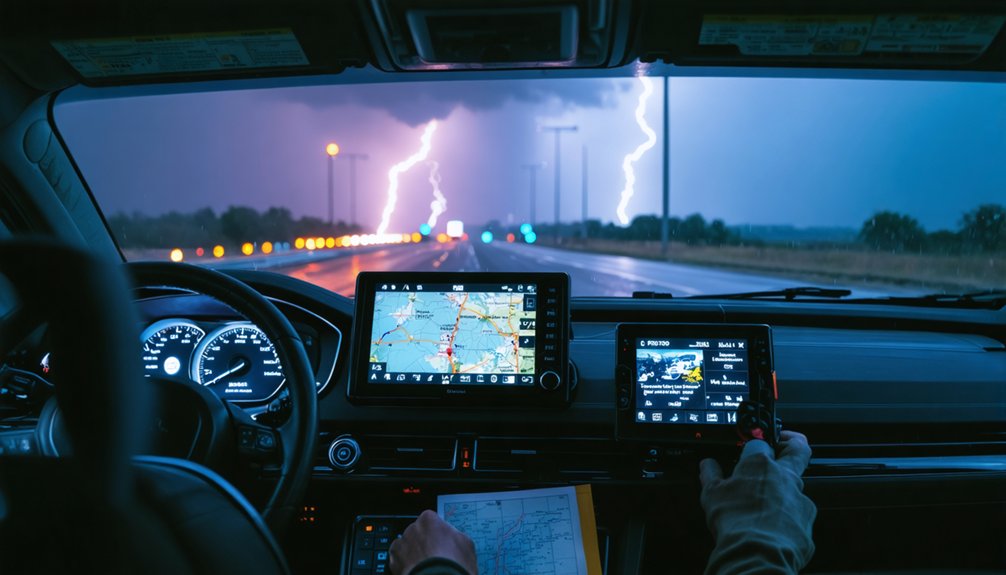
Setting out across the Great Plains without reliable navigation tools puts storm chasers at serious risk of missing critical escape routes or driving into dangerous situations. You’ll need layered systems combining GPS units, radar apps, and offline mapping for effective off road navigation techniques.
Essential navigation components include:
- Dedicated GPS devices like Garmin Overlander 2025 Edition for real-time position plotting
- RadarScope Pro displaying high-resolution radar data with spotter network integration
- Cellular boosters (Weboost Drive Reach) amplifying signal across rural territories
- Offline mapping tools including Google Maps and Street Atlas for network outages
- Traditional paper atlases serving as final backup when digital systems fail
Deploy robust data backup systems through multi-network devices that automatically switch towers. Mount laptops securely using RAM mounts for stable route planning during active pursuits.
Power Solutions and Electronics Management
How will your electronics survive hours of continuous operation when you’re 200 miles from the nearest power outlet? Your power infrastructure demands careful planning. Start with inverter wattage selection—400-watt units handle basic laptop and camera needs, while extended operations require high-capacity solutions like EcoFlow Delta Pro.
Install dual 8-gauge wiring with 20-amp inline fuses connecting battery to inverter.
Battery maintenance protocols prevent system failures during critical documentation. Implement dual battery configurations with isolation switches, protecting your primary battery from depletion. Carry 24,000 mAh power banks for device independence. Mount surge-protected power strips for safe AC distribution, and organize cigarette lighter splitters for backup connections. Keep jump boxes accessible—inverter drain happens fast. Your electronics won’t fail when proper power management becomes second nature.
Vehicle Recovery Equipment for Challenging Terrain
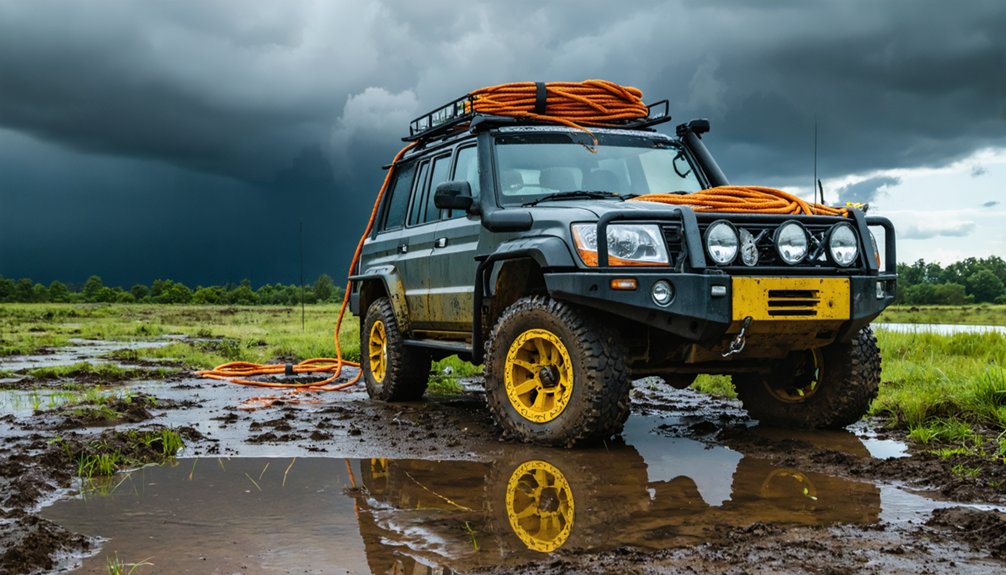
Your vehicle will get stuck during storm chasing—it’s a question of when, not if. Mastering vehicle recovery techniques guarantees you’ll escape mud, sand, and waterlogged roads without calling for rescue. Extreme terrain traversal demands equipment that performs when conditions deteriorate.
Essential recovery gear includes:
- Snatch straps (25-30 ft) with breaking strength 2-3 times your vehicle’s GVM for kinetic energy recovery
- Recovery shackles (steel D-rings or soft shackles) to connect straps to rated recovery points
- Traction boards like TJM Tred for immediate grip in sand, mud, or snow
- Portable winch with fairlead and extensions for self-recovery from deep bogs
- Survival shovel to clear paths and dig out buried tires
Pre-built recovery kits under $300 include straps, shackles, and gloves—compact assurance for remote operations.
Emergency Medical Supplies Every Chaser Needs
Storm chasing exposes you to hazards most first aid kits never anticipate—flying debris lacerations, lightning strike trauma, and vehicle collision injuries miles from hospitals. Your medical kit must exceed basic standards with advanced wound care supplies: tourniquets, compress dressings, blood clotting bandages, and multiple gauze sizes for severe bleeding control. Pack pain relievers, antihistamines, and hydrocortisone for immediate symptom management.
Maintain a 90-day supply of chronic condition medications—insulin requires cooling packs in summer heat. Include prescription essentials: EpiPens, rescue inhalers, glucose monitors with backup strips. Don’t overlook nitrile gloves, antiseptic wipes, and instant cold packs. Remote chasing demands self-reliance. Your kit isn’t just recommended equipment—it’s your lifeline when emergency services can’t reach you through washed-out roads and debris fields.
Documentation Tools for Capturing Storm Data
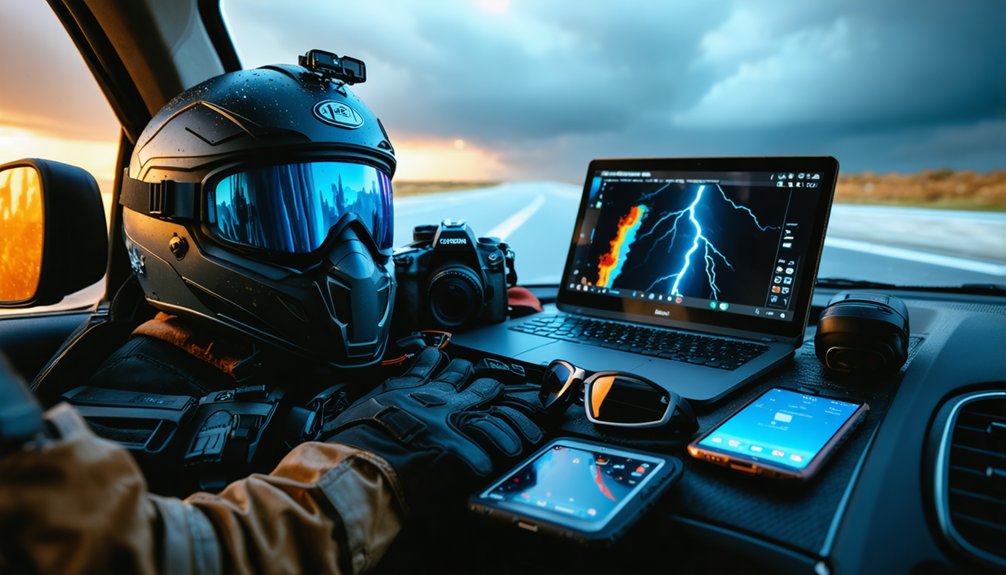
When conditions align and supercells develop, capturing storm data requires more than pointing a camera—you’ll need specialized documentation tools that survive extreme conditions while recording critical meteorological information.
Your storm observation equipment arsenal should include:
- Kestrel 5500 Weather Meter – Monitors temperature, pressure, humidity, wind, and solar radiation with wireless data logging capabilities
- Handheld anemometers – Measure wind speeds directly in the field for accurate surface observations
- Baron Mobile Threat Net and RadarScope Pro – Provide real-time storm tracking and positioning data
- Portable lightning detectors like Thor Guard – Keep you aware of electrical hazards in your immediate vicinity
- D3 DROP data loggers – Record environmental conditions throughout your chase for post-storm analysis
These waterproof, drop-tested instruments withstand the punishing conditions you’ll encounter while documenting nature’s most powerful phenomena.
Miscellaneous Safety Essentials for the Road
Documentation equipment means nothing if you can’t reach the storm or extract yourself when conditions deteriorate. Your vehicle maintenance determines survival—pack tow ropes for unsticking from ditches, spare tires, fix-a-flat, and air pumps. Carry extra fuel; remote areas don’t offer second chances.
Work gloves enable debris cleanup procedures safely, while road flares signal your position during breakdowns. Rain-X treatments maintain windshield visibility in torrential conditions. Pack clear plastic film and tape for emergency window repairs.
Navigation demands redundancy—keep paper maps when electronics fail. Power inverters with surge protection keep devices charged. A 4G wireless booster extends connectivity where towers fade. Store extra socks and shoes for wet terrain encounters. ANSI reflective vests guarantee visibility during roadside emergencies. Flashlights prove essential for night operations and search scenarios.
Frequently Asked Questions
What Insurance Coverage Is Recommended for Storm Chasers and Their Vehicles?
Texas hail claims average over $10,000 per vehicle—you’ll need thorough vehicle insurance for storm damage and robust liability insurance coverage. Don’t chase without them. Consider gap protection and travel insurance with hazardous sports riders for complete protection.
How Do You Safely Exit a Vehicle During a Tornado Emergency?
If you can’t reach sturdy shelter immediately, abandon your vehicle and stay low in a ditch or ravine. Lie face-down, cover your head with your hands, and seek shelter immediately once the tornado passes.
What Training or Certifications Should Beginner Storm Chasers Pursue?
Start with free SKYWARN certification to build weather observation skills and reporting protocols. You’ll benefit from meteorology coursework through MetEd or university programs, then gain field-tested knowledge by riding with experienced chasers before pursuing independent operations.
How Far Should You Maintain Distance From a Tornado Funnel?
You’ll want 0.5-2 miles as your ideal safe distance from funnel for filming, though pushing closer than half a mile courts disaster. Tornado proximity precautions demand 2-3 miles when escape routes vanish, prioritizing your freedom to retreat over trophy shots.
What Are Legal Considerations When Chasing Storms Across State Lines?
Interstate regulations vary remarkably between states. You’ll find permit requirements differ—Oklahoma’s SB 158 only applies within state boundaries, treating out-of-state chasers as hobbyists. Research each state’s specific laws before crossing borders to maintain your freedom.