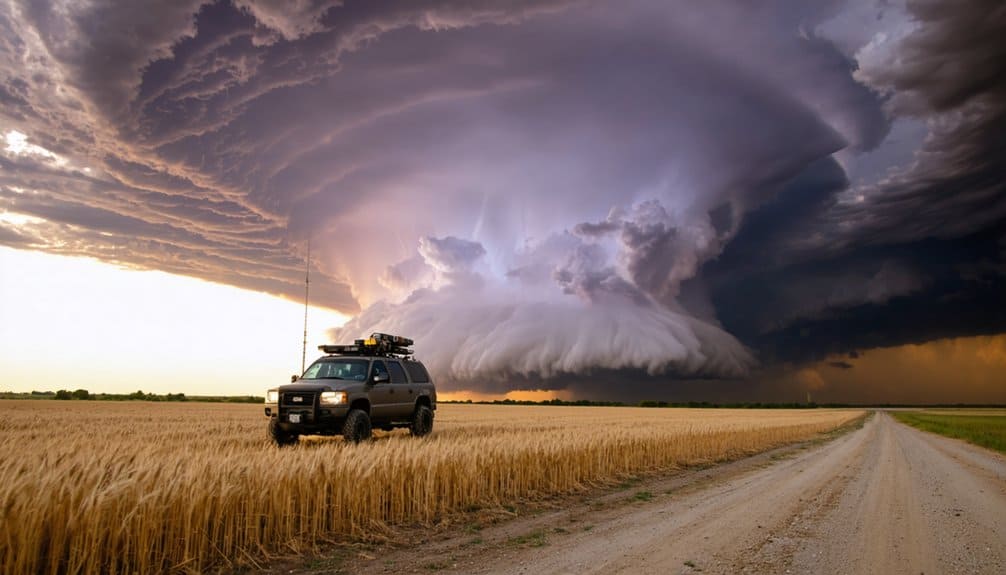
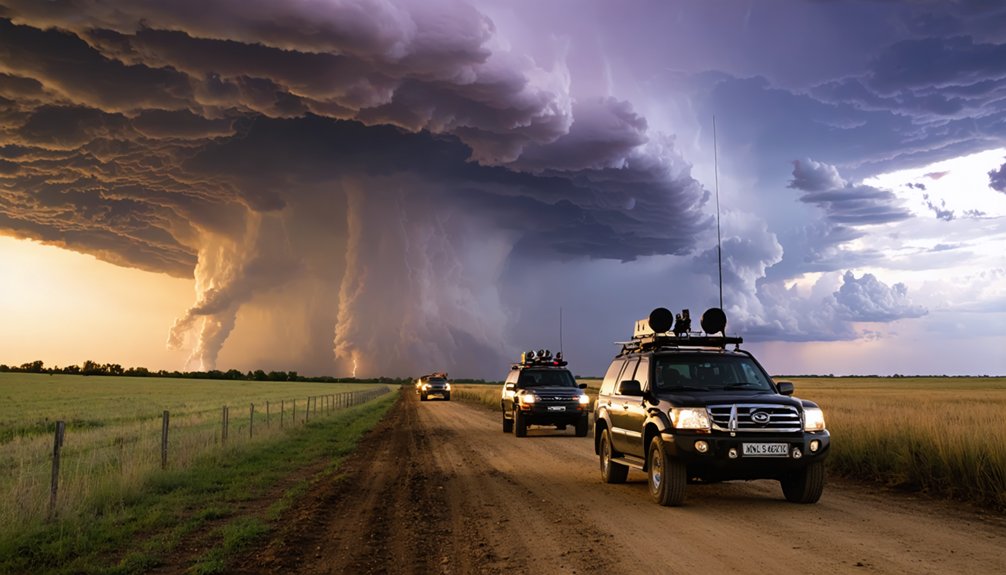
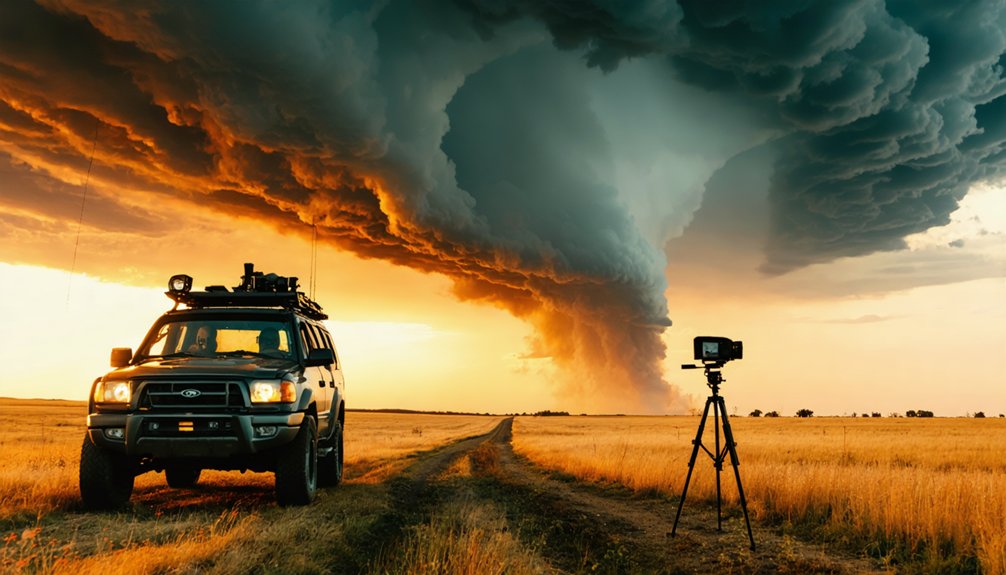
You’ll need tour guides with meteorology degrees, SKYWARN certification, and over 100 documented tornado encounters. Verify they’re proficient in Doppler radar interpretation and hold First Aid/CPR credentials. Choose operators using Ford E350 vans with 6-7 passenger limits, emergency supplies, NOAA weather radios, and communication redundancy. Attend mandatory safety briefings covering lightning protocols, flood dangers, and tornado positioning. Always keep seatbelts fastened, trust your guide’s real-time routing decisions, and maintain 100 yards from isolated objects during electrical activity. The following sections detail critical protocols that’ll keep you protected throughout your chase experience.
Key Takeaways
- Choose guides with meteorology degrees, SKYWARN certification, and over 100 documented tornado encounters for expert-led tours.
- Verify chase vehicles contain emergency supplies, NOAA weather radios, communication devices, and maintain strict 6-7 guest capacity limits.
- Participate in pre-tour safety briefings covering thunderstorm dynamics, tornado protocols, evacuation procedures, and in-vehicle safety measures.
- Maintain safe positioning at four-way intersections with buffer zones from storms while avoiding rain-wrapped areas and flooded roadways.
- Follow lightning safety protocols by staying in vehicles with closed windows and squatting low if caught outside during storms.
Verify Your Tour Guides Have Extensive Storm Chasing Experience and Meteorological Training
When evaluating storm chasing tour operators, you’ll find that guide experience and meteorological training serve as the primary indicators of both safety and tour quality. Prioritize guides with undergraduate meteorology degrees and storm tracking qualifications like SKYWARN Spotter Certification. Verify they’ve documented over 100 tornado encounters—this threshold demonstrates substantial field capability.
You’ll want professionals proficient in Doppler radar interpretation, GRLevelX, and RadarScope for real-time analysis. Essential certifications include First Aid/CPR and HAZMAT Awareness for emergency response. Examine their commitment to continuing education programs through AMS or National Weather Service workshops.
Seasoned chasers leverage years of specialization to position you safely while maximizing storm visibility. Their technical proficiency with mobile meteorological stations and satellite communication systems maintains ideal positioning away from dangerous wind fields, hail cores, and lightning strikes.
Understand the Safety Protocols Before Your First Chase Day
How thoroughly should you prepare for the inherent dangers of storm chasing? Before your first chase day, you’ll need extensive meteorology knowledge and weather pattern monitoring skills to recognize threat indicators.
Storm chasing demands serious meteorological expertise and pattern recognition abilities—casual interest isn’t enough preparation for life-threatening weather conditions.
Your guide should brief you on lightning protocols—kneeling rather than lying prone, maintaining distance from tall objects, and ensuring someone’s CPR-trained since lightning often stops breathing. You’ll learn hydroplaning prevention, why you can’t outrun tornadoes, and the critical dangers of core-punching through hail and violent winds.
Verify your vehicle contains emergency supplies: food, water, NOAA weather radio, and charged communication devices. Understanding rotating wall cloud risks, deviant storm motions, and RFD positioning empowers you to make split-second decisions.
Remember: lightning and hail pose greater statistical risks than tornadoes themselves.
Choose Tours That Prioritize Proper Vehicle Equipment and Maintenance Standards
Your survival during severe weather encounters depends directly on your tour operator’s vehicle specifications and maintenance discipline. Verify they’re running Ford E350 vans—selected for structural integrity and visibility—with strict capacity limits of 6-7 guests despite 15-passenger ratings.
Demand operators who execute vehicle maintenance requirements including seasonal tire rotations (Michelin all-season changed every 25,000 miles) and thorough pre-departure safety checks covering brake systems, fluid levels, and tire integrity.
Your chase vehicle should carry essential redundancy: tire-changing equipment, mechanics toolkits, spare fuses, and roadside safety boxes. Communication infrastructure matters—top-tier GMRS radios, cellphone boosters, and amateur radio systems hardwired into vehicle power guarantee you’re never isolated.
Operators maintaining fire extinguishers, OSHA-certified first aid kits, recovery straps, and dashcams demonstrate genuine commitment to your safety beyond marketing promises.
Learn the Emergency Procedures for Different Tornado Scenarios
Understanding tornado emergency procedures separates informed storm chasers from liability risks—and your tour operator must drill you on scenario-specific protocols before departure. Thorough safety inspections verify shelter locations, communication systems, and vehicle readiness before each chase.
You’ll learn equipment failure protocols: if GPS malfunctions mid-chase, you’ll navigate using physical maps and radio coordination. Vehicle encounters require staying belted with your head below windows, covering yourself with blankets, or abandoning to nearby structures within walking distance.
Outdoor exposure demands immediate shelter in basements or lying flat in ditches, protecting your head and neck. Post-tornado accountability uses roster checklists for head counts while avoiding downed power lines. Your operator should provide CERT-certified training and maintain stocked emergency kits with three-day supplies, ensuring you’re prepared beyond basic watch-and-warning responses.
Keep Seatbelts Fastened and Follow All In-Vehicle Safety Guidelines
When tour vehicles accelerate toward rotating supercells at highway speeds, seatbelt compliance becomes your primary defense against injury from sudden evasive maneuvers, hail-induced swerves, and emergency braking scenarios. Guides verify proper seatbelt positioning during pre-departure protocols—lap belts sit low across your hips, shoulder straps cross your chest without slack. Seatbelt adjustment guidelines require checking fit before each departure and maintaining restraint throughout pursuit operations.
Your waiver mandates continuous use while vehicles navigate turbulence-prone terrain where electronic traction control may activate unexpected braking. Large hail penetrating windows or accumulating on roadways creates hydroplaning risks that excellent tire maintenance alone can’t eliminate. Drivers trained in defensive storm-chasing techniques rely on your secured position to execute split-second maneuvers.
Unless tornadoes approach your stationary position, remaining belted inside professionally-maintained vans with hazard lighting provides ideal protection throughout dynamic weather encounters.
Maintain Awareness of Escape Routes When Viewing Storms
Strategic positioning during storm observation requires maintaining at least two viable escape routes that diverge from the tornado’s projected path rather than intersecting it. You’ll need continuous route reevaluation as supercells frequently shift direction within seconds due to boundary interactions.
Position yourself at four-way intersections enabling multi-directional movement, while implementing real time storm monitoring to track your position relative to the storm’s movement vector. Avoid rain-wrapped areas and the rear flank downdraft zone where visibility drops dangerously. Never cross a tornado’s future path, especially with large or fast-moving systems.
Monitor infrastructure hazards like flooded roadways—two feet of moving water will sweep most vehicles away. Maintain buffer zones between your position and the storm, allowing reaction time when conditions deteriorate unexpectedly.
Trust Your Tour Director’s Real-Time Route Decisions
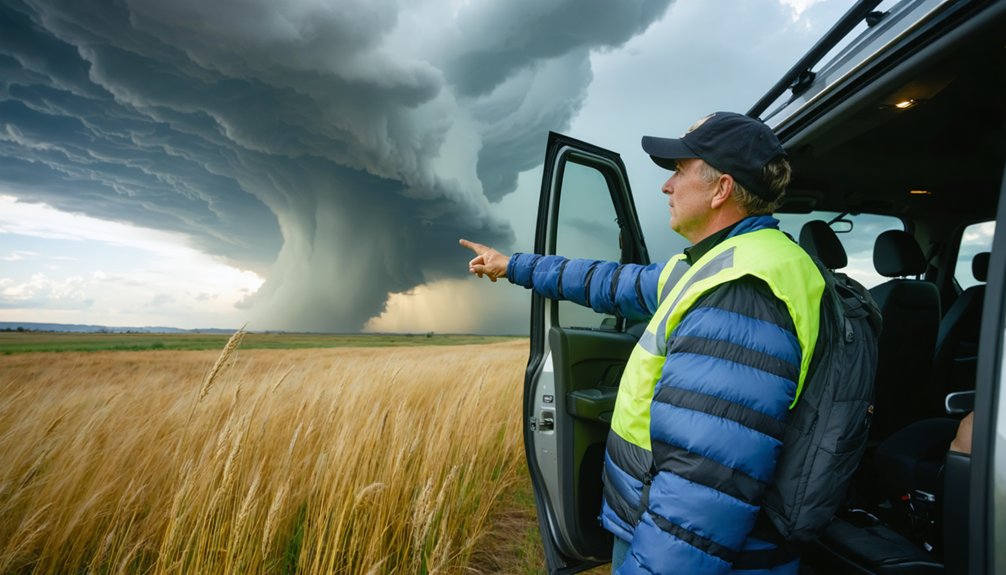
How quickly can storm conditions deteriorate from photogenic to life-threatening? Your tour director’s real-time route decisions stem from years of meteorological training and emergency response protocols. They’re monitoring surface observations, NWS data, radar TVS marks, and storm velocities—often tracking systems moving at 45 mph while calculating intercept windows.
When they abort a chase due to MCS formation or redirect based on outflow dominance, trust guides’ real time expertise over personal instincts.
You’ll receive updates every 30 minutes during active phases, with explanations for each tactical shift. Their laptop forecasting systems and mobile Doppler access provide situational awareness you can’t replicate.
When directors make rapid positioning changes—whether green-light quick stops or red-alert evacuations—follow directors’ route decisions immediately. Your freedom to experience nature’s fury depends on their split-second judgment calls.
Know What to Do During Lightning Storms and Severe Weather Events
Lightning strikes claim an average of 20 lives annually in the United States, with hundreds more suffering permanent injuries—risks that intensify dramatically when you’re positioned in open terrain for ideal storm observation. Effective lightning strike avoidance measures require maintaining 100 yards from isolated trees, power lines, and conductive fencing during active cloud-to-ground activity.
If caught outside, squat low with feet together—never lie prone. Your chase vehicle provides superior protection when windows remain closed. Indoor shelter procedures demand avoiding plumbing, electrical outlets, and windows during active storms.
Wait 30 minutes post-thunder before resuming outdoor activities. Your tour director monitors real-time lightning data to balance favorable viewing positions against strike proximity, but understanding these protocols guarantees you’re prepared when conditions escalate unexpectedly.
Stay Alert to Flood Risks and Water Crossing Dangers
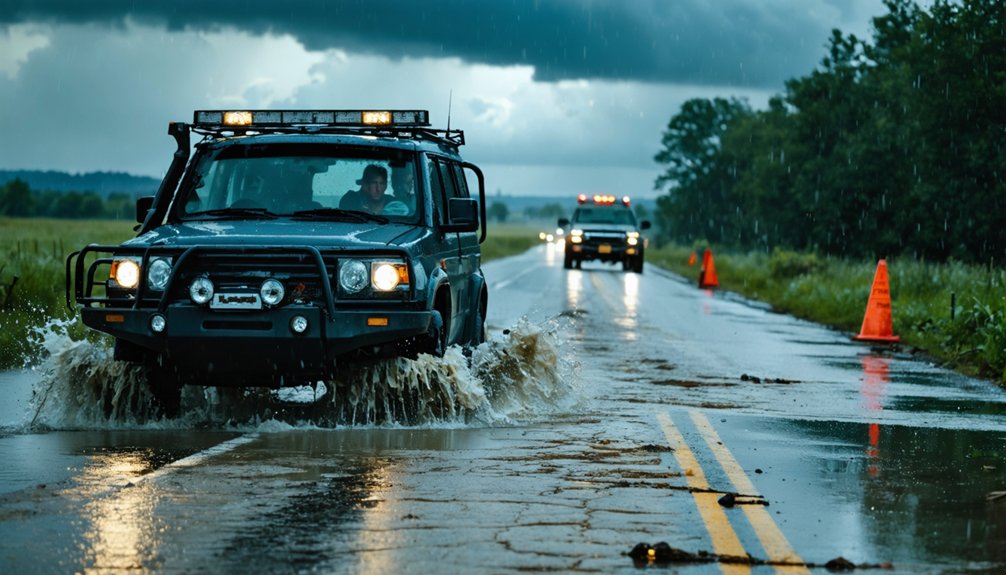
Never attempt to cross flooded roadways, as flash floods generate flow rates powerful enough to sweep vehicles away even in shallow water. If your vehicle stalls in rising water, abandon it immediately and move to higher ground—remaining inside dramatically increases your risk of being trapped.
Storm chasers face legitimate flash flood dangers during pursuits, though proper avoidance of water crossings has prevented any recorded chaser fatalities from flooding as of 2023.
Avoid Low Water Crossings
Flooding claims more lives than any other thunderstorm-related hazard each year, with over half of these drownings occurring when drivers make the fatal decision to enter hazardous flood waters. You’ll face critical risks at low-water crossings where just six inches of fast-moving water can knock you down, while twelve inches will carry away most small cars. Two feet of rushing water sweeps away SUVs and trucks.
Road beds wash away beneath flood waters, creating invisible collapse zones you can’t detect. To maintain your independence while chasing storms safely, avoid nighttime driving when over half of crossing deaths occur. Monitor water levels at marked crossings, never drive around barricades, and heed National Weather Service warnings. Remember: no forecast is worth your life.
Abandon Stalled Vehicles Immediately
Your vehicle becomes a liability the moment it stalls during a storm chase. Exit immediately and activate hazard lights for visibility. If you’re tumbling or unable to escape the tornado’s path, abandon the vehicle and move well away—it could roll over your position.
Monitor hydroplaning risk by watching water collect in tire paths; splashing under your car signals imminent loss of control.
Assess flash flood threats continuously. Ditches fill rapidly post-tornado, creating drowning hazards in low-lying areas. Rain-wrapped tornadoes conceal inflow dangers while flooding intensifies. Don’t shelter in your vehicle—debris proves lethal. Seek culverts or low spots away from flood zones.
Report abandoned vehicles: *HP for interstates, 311 for city roads. Check your state’s towed vehicle database if you can’t locate your car upon return.
Participate in Orientation Meetings and Safety Briefings
You’re required to attend mandatory safety orientation meetings where tour operators distribute pre-tour safety materials and conduct thorough briefings on emergency protocols. These sessions equip you with critical knowledge about in-vehicle safety, evacuation procedures, and hazard response techniques that directly reduce injury risk during chase operations.
Tour guides provide explicit instructions on operational procedures, including seat belt requirements, roadside safety protocols, and proper behavior during severe weather encounters.
Pre-Tour Safety Materials Distribution
The materials detail risk mitigation measures for in-van, out-of-van, and downtime scenarios. You’ll review severe weather hazards, thunderstorm dynamics, and tornado safety protocols.
Handouts emphasize mandatory seatbelt usage, maintaining safe viewing distances with escape routes, and avoiding unnecessary risks. The materials stress one fundamental rule: listen to your instructors—they’re trained professionals implementing a safety plan curated by OSHA specialists.
Emergency Procedures and Protocols
Everyone attending a storm chasing tour must complete thorough orientation meetings before deployment. These sessions cover critical safety protocols including in-van procedures, field guidelines, and real-time decision-making frameworks.
You’ll work alongside degreed meteorologists who maintain safe distances from storm centers using Doppler radar and satellite technology. Emergency communication protocols guarantee constant GPS tracking through mobile internet and advanced data streams.
Each tour maintains at least one Red Cross First Aid/CPR certified guide, while drivers complete specialized storm chasing traffic courses. Post tornado accountability procedures verify all personnel safety immediately following events.
Escape routes never cross tornado paths—they’re continuously reevaluated as conditions shift. You’ll learn data-driven responses rather than emotional reactions, with contingencies for vehicle breakdowns and nighttime chase targets that maximize both adventure and survival.
Guest Safety Training Requirements
Before stepping into a chase vehicle, guests must complete mandatory orientation meetings that establish life-saving protocols and operational expectations. You’ll participate in thorough safety briefings led by degreed meteorologists who’ll review weather-related decision-making procedures and real-time forecast interpretation.
Pre tour medical screenings guarantee you’re physically prepared for extended vehicle operations and rapid deployment scenarios. Written safety documentation outlines conduct guidelines you’ll acknowledge before chase activities commence.
Storm monitoring training sessions teach you to interpret Doppler radar data and atmospheric indicators while understanding your positioning requirements during active pursuit. You’ll receive SKYWARN spotter training recommendations for official certification.
These orientation sessions include seatbelt enforcement policies, out-of-vehicle safety protocols, and emergency communication procedures. Your guides maintain Red Cross First Aid certification, ensuring immediate medical response capability throughout operations.
Frequently Asked Questions
What Insurance Coverage Is Provided for Guests During Storm Chasing Tours?
Operators provide $1-2 million liability coverage and $30,000 personal injury protection, but you’ll need separate travel insurance since standard policies exclude storm chasing. Verify safety precautions with your operator and purchase adventure-specific coverage before departure.
How Many Guests Typically Join Each Tour Vehicle?
You’ll join a maximum group size of six guests per vehicle, plus two guides. This vehicle capacity limit guarantees you’ve got a captain-style window seat and ample space during those long 6-8 hour chase days across the plains.
Are Meals and Accommodation Included in the Tour Package Price?
Lodging’s included in your package price, but you’ll cover your own meals—giving you freedom to choose dining options. Check tour itinerary details for specific inclusions, and inform operators about dietary accommodations needed during multi-day expeditions.
What Photography Equipment Do You Recommend Bringing on the Tour?
You’ll need everything but the kitchen sink! Bring a weather-sealed DSLR or mirrorless camera, wide-angle and telephoto lenses for varied lens selection, sturdy tripod, extra batteries, and master your camera settings before departure for ideal storm captures.
Can Tours Be Rescheduled if Severe Weather Is Forecasted?
Tours can’t be rescheduled based on forecasts—that’s precisely when you’ll chase! Weather monitoring procedures guide daily operations, but tour cancellation policies don’t accommodate forecast-based changes. You’re committed to fixed dates during peak season regardless of predictions.