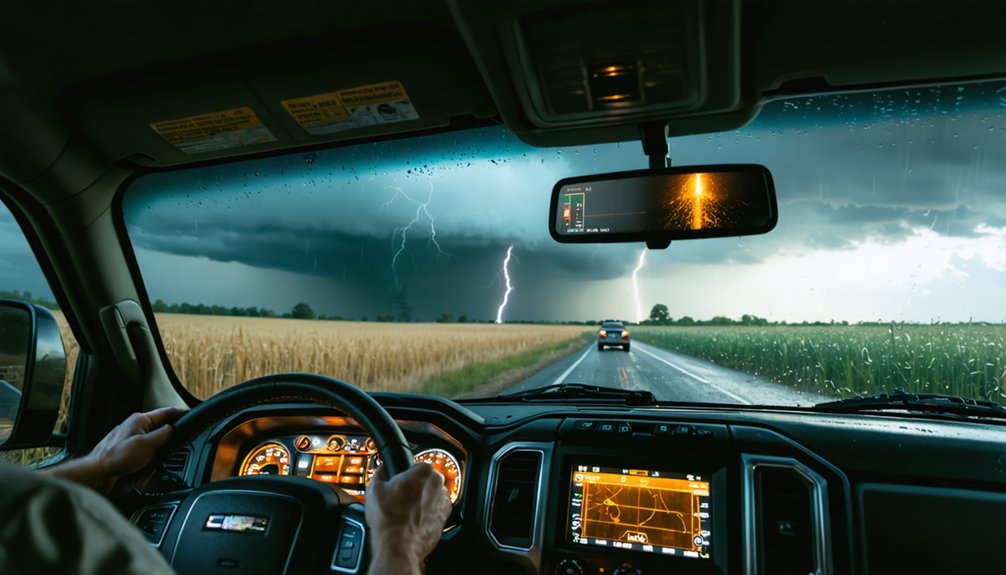
Hailstorms don’t have to cripple your solar assets if you’re proactive. You can reduce exposure by selecting IEC 61215-certified, impact-resistant modules, activating tracker stow modes at 60°–75° angles, and automating real-time weather-triggered responses. Pair those hardware defenses with performance monitoring to capture post-storm degradation data, then layer in geographic portfolio diversification and structured insurance to absorb localized losses. The strategies ahead break down exactly how to execute each layer of protection.
Key Takeaways
- Deploy automated stow mode, rotating panels to 60°–75° angles, to deflect hailstones and minimize surface damage during storms.
- Select IEC 61215 or FM 4473-certified modules with tempered glass and nano-coatings to reduce catastrophic failure risk.
- Integrate real-time radar feeds into tracker controls to trigger automated hail responses before storms arrive.
- Diversify solar assets across low and high hail-risk zones to prevent localized storms from causing systemic portfolio losses.
- Monitor post-storm performance metrics to pinpoint faults, measure degradation, and enable data-driven recovery decisions.
Why Hailstorms Threaten Solar Energy Output
Hailstorms don’t just damage solar panels — they systematically undermine energy output at every stage of impact. When hail strikes, you’re dealing with more than broken glass. Surface abrasions scatter incoming light, cracked cells create resistive losses, and compromised encapsulants accelerate moisture ingress. Each failure mode compounds the next.
Hail forms inside cumulonimbus clouds where powerful updrafts suspend supercooled water droplets until they freeze, accumulate mass, and fall with destructive kinetic force. For utility-scale solar installations in hail-prone regions like Texas, that force translates directly into degraded capacity and elevated maintenance costs.
Building storm resilience starts with understanding how hail impact progressively erodes system performance — not just during the storm, but across the entire operational lifespan of your array.
Assess Hail Risk Before You Site Your Next Project
Protecting your array from hail damage begins long before installation — it starts at site selection. Your regional climate determines exposure, and ignoring hail frequency data before committing capital is a costly mistake. Analyze historical storm records, insurance loss data, and high-resolution atmospheric models to quantify actual risk.
Before finalizing your site, evaluate these four critical factors:
- Hail frequency maps — identify how often severe hail strikes your target region annually
- Hailstone size distribution — larger stones exponentially increase kinetic impact energy
- Storm seasonality — concentrated hail seasons compress your exposure window dangerously
- Insurer risk classifications — lenders and underwriters already price what you might overlook
Your siting decision directly controls your long-term maintenance burden, insurance premiums, and energy output reliability.
Choose Solar Panels Built to Withstand Hail Impact
Once you’ve assessed your site’s hail exposure, your next line of defense is selecting modules engineered to absorb impact without failing.
Industry testing protocols stress panels under simulated hail conditions to identify which component breaks first, giving you a measurable threshold for evaluating module durability.
Impact-resistant designs reduce the probability of catastrophic breakage, so you’re protecting both your generation capacity and your long-term maintenance budget.
Panel Durability Testing Standards
When selecting solar panels for hail-prone installations, you’ll want to prioritize modules that have passed rigorous durability testing. Advanced durability testing and innovative material development now give you measurable benchmarks to compare before committing capital.
Key standards to evaluate:
- IEC 61215 – Confirms modules endure repeated 25mm ice ball impacts without structural failure.
- FM 4473 – Tests larger hailstone sizes, up to 50mm, at real-world velocities.
- UL 61730 – Validates electrical and mechanical safety post-impact.
- MCS 005 – Certifies modules against regional hail intensity thresholds specific to installation zones.
Each standard targets a different failure threshold, letting you match panel selection directly to your site’s documented hail risk. You’re not guessing—you’re making data-driven decisions that protect your energy independence.
Impact-Resistant Module Design
Standards only tell part of the story—what matters equally is how manufacturers engineer modules to meet and exceed those benchmarks. When you’re selecting panels for hail-prone installations, you need to look beyond certification labels and examine actual design choices.
Impact-resistant modules typically combine tempered glass with reinforced framing to distribute kinetic energy across the module surface rather than concentrating stress at single points. Nanostructure coatings add a critical layer of protection by hardening the glass surface and reducing micro-fracture propagation on impact.
You should also evaluate how manufacturers address material fatigue, since repeated hail exposure causes cumulative structural weakening even without visible breakage. Choosing modules engineered for long-term resilience—not just single-impact survival—gives you greater operational independence and reduces your exposure to costly post-storm repairs.
Use Tracker Stow Modes to Reduce Hail Damage
When hail threatens your solar installation, you can activate tracker stow mode to rotate panels to a near-vertical position, minimizing the surface area exposed to falling ice.
You’ll achieve maximum protection by angling the panel normal as perpendicular as possible to the hail’s trajectory, which Soltec data confirms can substantially reduce damage risk for hailstones in the 50–75 mm range.
To make stow mode effective, you must integrate real-time weather alerts with automated control systems, cutting response time before the storm front arrives.
How Stow Modes Work
How does a tracker stow mode actually protect your panels during a hailstorm? It repositions your modules to minimize hail impact by rotating them toward vertical, reducing the exposed surface area and deflecting kinetic energy away from the glass face.
Storm adaptation follows a precise sequence:
- Weather detection triggers an automated stow command when hail probability exceeds defined thresholds.
- Tracker motors rotate panels to 60–90 degrees, aligning the module edge toward incoming hailstones.
- Impact angle decreases, causing hailstones to glance off rather than strike flat surfaces directly.
- System monitors confirm stow position, logging timestamps and angles for post-event performance analysis.
You’re not surrendering to the storm — you’re outmaneuvering it with precision engineering and real-time responsiveness.
Optimal Stow Angles
Choosing the right stow angle determines how effectively your tracker system deflects hail before it reaches the module surface. Your goal is to orient the panel so its normal vector sits as perpendicular as possible to the hail’s trajectory, minimizing direct hail impact force.
Most hail falls between 0° and 20° from vertical, so positioning modules near 60°–75° from horizontal significantly reduces effective impact area.
Soltec’s data confirms this approach cuts damage risk for 50–75 mm hailstones substantially.
For maximum storm mitigation, you’ll want your control system pre-programmed with angle thresholds matched to local hail climatology.
Don’t rely on a single fixed stow angle—use adjustable parameters so operators can refine positioning as storm data improves and field performance records accumulate.
Timing Storm Response
Getting the angle right means nothing if your tracker doesn’t reach that position before hail arrives. Timing is everything. Weather prediction systems must trigger stow commands early enough for motors to complete rotation before impact begins.
Prioritize these four actions to protect your asset:
- Integrate real-time radar feeds directly into your SCADA system to eliminate manual delays.
- Set automated stow thresholds based on hail probability, not just wind speed.
- Test response latency quarterly — know exactly how long full rotation takes.
- Audit your weather prediction data sources for accuracy in your specific geographic zone.
Storm preparedness isn’t passive. Every second between alert and stow completion is exposure you can’t recover. Own your response window before the storm does.
Automate Your Hail Response Before the Storm Arrives
When hail is imminent, every second of delayed response translates directly into panel exposure and potential damage. Manual intervention can’t match the speed that modern hail storm forecasting and automated response systems now deliver. You should integrate real-time weather data feeds directly into your tracker control infrastructure, enabling automatic stow commands the moment storm thresholds are detected.
Configure your system to trigger stow protocols based on specific parameters: hail probability percentage, storm cell proximity, and projected impact velocity. Automated response eliminates human reaction lag, which typically ranges from several minutes to hours depending on staffing conditions.
You retain operational freedom by setting your own threshold logic while the system executes decisions autonomously. This architecture protects assets without requiring constant manual oversight, keeping your array responsive regardless of when storms arrive.
Monitor Panel Performance and Losses During Hail Events
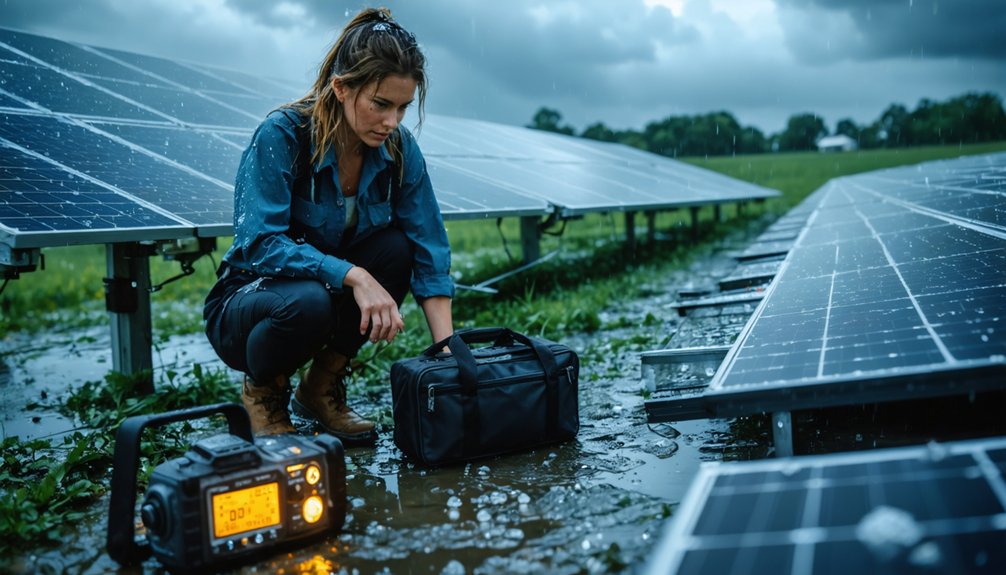
Real-time performance monitoring transforms hail events from blind spots into measurable, actionable data points. Advanced diagnostic tools let you track exactly where losses occur, giving you operational control instead of uncertainty.
Deploy real-time monitoring to capture:
- Instantaneous output drops — identify which strings or inverters lose production the moment hail impacts your array
- Degradation curves — measure efficiency loss over hours post-storm, quantifying long-term damage before it compounds
- Localized fault signatures — pinpoint damaged modules precisely, reducing inspection time and labor costs
- Recovery benchmarks — compare pre- and post-storm performance data to assess whether output fully restores
You’re not guessing anymore. Advanced diagnostic tools eliminate the information gap that forces reactive, expensive decisions.
Real-time monitoring puts the data directly in your hands, where it belongs.
Combine Hail-Resistant Hardware With Portfolio-Level Resilience
Hardware-level protection only goes so far—your broader portfolio strategy determines whether a single hail event becomes an isolated setback or a cascading operational failure.
Hardware-level protection only goes so far—portfolio strategy determines whether hail becomes a setback or a systemic failure.
Hail mitigation works best when module-level durability combines with site diversification, insurance structuring, and adaptive operational protocols. Material innovation in panel construction—tempered glass, reinforced polymer backsheets, impact-absorbing coatings—reduces per-unit vulnerability, but no single material advance eliminates systemic exposure across a geographically concentrated fleet.
You need generation assets distributed across varying hail-risk zones, ensuring that storm damage at one site doesn’t collapse total portfolio output. Layer that geographic diversification with automated stow capability, real-time performance monitoring, and actuarially sound insurance coverage.
Together, these measures convert hail from an unpredictable financial threat into a quantifiable, manageable operational variable within your renewable energy strategy.
Frequently Asked Questions
Can Hailstorms Ever Be Directly Harvested as a Renewable Energy Source?
You can’t practically harvest hail energy yet. Storm harvesting remains technically limited due to hail’s unpredictability, transient nature, and energy storage challenges, though experimental lightning and droplet-capture systems demonstrate theoretical potential for future development.
How Does Hail Damage Affect Solar Energy Insurance Premiums Long-Term?
Cracked panels, rising costs—it’s no coincidence. Repeated hail damage drives insurance claims upward, triggering premium adjustments that compound long-term. You’ll face higher coverage costs, stricter policy terms, and reduced financial freedom unless you invest in hail-resistant systems proactively.
What Government Incentives Exist for Installing Hail-Resistant Solar Infrastructure?
You’ll find government grants and subsidy programs through the ITC federal tax credit, USDA REAP grants, and state-level incentives that reward hail-resistant solar installations, reducing your upfront costs while strengthening long-term asset protection and energy independence.
How Do Hailstorms Impact Wind Turbines Compared to Solar Panels?
Hail damage affects your wind turbine differently than solar panels—it erodes blade leading edges, reduces aerodynamic efficiency, and increases fatigue stress, whereas panels suffer surface fractures and output loss from direct impact fragmentation.
Can Machine Learning Accurately Predict Hail Size Before a Storm Arrives?
Yes, you can leverage machine learning to refine hail prediction before nature’s icy messengers arrive. It’ll combine historical data and real-time inputs, sharpening storm forecasting accuracy—though perfect precision remains an evolving frontier you’re actively pushing forward.
References
- https://www.amperon.co/blog/hailstorms-how-they-can-impact-your-solar-farm
- https://insideclimatenews.org/news/11092025/inside-clean-energy-utility-scale-solar-hailstorms/
- https://soltec.com/en/innovation/lab/harnessing-smart-solar-tracking-advanced-algorithms-hail-protection/
- https://en.reset.org/harnessing-storms-could-power-our-cities-years-10032017/
- https://pmc.ncbi.nlm.nih.gov/articles/PMC12811466/
- https://www.linkedin.com/pulse/how-hailstorms-can-affect-energy-transition-alexander-andrianov
- https://energiesmedia.com/china-floats-device-turn-storms-into-electricity/
- https://ywamsanpedro.org/evaluating-the-big-win-potential-of-lightning-storms-in-renewable-energy-generation/