You’ll earn money as a storm chaser through five primary channels: selling footage to brokerage agencies at $50-$400 per clip (minus 25-50% commission), live streaming for viewer donations averaging $2 hourly net profit, securing media partnerships worth up to $198K annually, leading guided tours at $2,200-$3,500 per participant, and providing damage assessment services. Beginners typically earn $20,000-$30,000 annually while veterans exceed $100,000. The sections below break down each revenue stream’s profitability, startup costs, and timeline expectations for reaching sustainable income.
Key Takeaways
- Storm chasers sell raw footage through brokerage agencies that take 25-50% commissions, with brokers bundling clips into packages for buyers.
- Live streaming generates immediate income through viewer donations, platform subscriptions, and ad revenue, averaging $2 hourly profit after expenses.
- Media partnerships pay $400 per clip for first-to-uplink national footage, with local networks offering $100 and remaining content selling at $50.
- Guided storm chasing expeditions charge $2,200-$3,500 per participant, with established operators earning approximately $70,000 annually from tours.
- Storm damage assessment services and atmospheric data collection for research institutions provide project-based funding plus hazard pay as supplementary income.
Understanding Storm Chaser Salary Ranges and Industry Averages
Storm chasing as a profession defies simple salary categorization, with income data scattered across multiple occupational classifications. You’ll find beginner chasers earning $20,000-$30,000 annually, while exceptional veterans exceed $100,000. The general professional range spans $30,000-$70,000, though atmospheric scientists—a broader category encompassing storm tracking—report median wages of $97,450 nationally. The average annual salary stands at $90,210 per year, or $43 per hour, with professionals at the lower end earning approximately $66,200 or $32 per hour.
Regional variations greatly impact earnings. Ontario averages $59,721, with top performers reaching $100,000. However, many chasers pursuing their passion for meteorology receive no salary, treating it as a hobby rather than career.
Unlike stable broadcast meteorology positions, storm chasing income fluctuates wildly. Active seasons boost demand for footage and weather risk mitigation services, while quiet periods slash opportunities. You’ll face operational costs potentially exceeding low-season earnings of $16,000, demanding financial resilience and entrepreneurial adaptability. For those seeking storm chasing opportunities, millions of jobs across various meteorology and atmospheric science fields are available to search through specialized employment platforms.
Selling Raw Storm Footage Through Brokerage Agencies
The brokerage model dominates storm footage monetization, functioning as an intermediary system where you—operating as a “stringer”—capture raw weather video and transfer licensing rights to specialized agencies. These brokers extract 25-50% commissions from your sales, with firms like Live Storms Media claiming 40% cuts.
Video licensing negotiations heavily favor brokers who purchase social media content at minimal upfront rates, then resell at premium prices. Broker pricing structures capitalize on bundling—combining multiple chasers’ clips into single packages that news outlets purchase. You’ll receive residual payments only after broker fees.
The model’s fundamental flaw: brokers profit substantially while you assume all field risks and equipment costs. Market saturation has created downward price pressure, forcing you to capture increasingly dangerous footage for diminishing returns. Many chasers begin by photographing lightning strikes before transitioning to video footage that commands higher licensing fees. Networks achieve significant cost and time savings by relying on stringer video rather than deploying their own camera crews to storm locations.
Generating Income From Live Streaming Storm Coverage
Live streaming transforms storm chasing into real-time monetization through viewer donations, platform subscriptions, and limited ad revenue—creating immediate cash flow that bypasses brokerage delays entirely. You’ll generate income through super chats and direct tips during 11-13 hour chase operations, while multi-platform broadcasting expands your earning potential.
Platform monetization strategies require consistent content creation, with late-night editing sessions producing supplementary revenue streams beyond live coverage.
Your viewer retention tactics center on high-quality footage from close storm encounters and active chat interaction. Entry costs run $340-$360 monthly for streaming equipment, plus $1,000 seasonal cellular data expenses. Net profit averages $2 hourly after fuel and maintenance—20,000 miles at $0.31 per mile totals $6,200 seasonally. Most chasers pursuing this model end up losing money rather than achieving sustainable profitability, making financial discipline critical. The gold rush days of easily earning high income from storm chasing have passed, replaced by more modest returns. This grinding approach demands financial tolerance but offers scalable income independent of traditional media gatekeepers.
Securing Media Partnerships and Content Deals
Beyond platform subscriptions and viewer donations, professional storm chasers leverage media partnerships to convert raw footage into structured revenue streams through brokerage contracts and direct network sales.
You’ll navigate contract negotiations with agencies like LiveTorms Media, who pitch your clips to broadcasters while you maintain autonomy in the field. First-to-uplink national footage commands $400 per clip, local networks pay $100, with remaining content selling at $50.
Revenue licensing through brokerage portals delays payouts by months but scales your income beyond individual sales efforts. However, saturation has intensified competition since 2010, making early relationship-building critical.
Corporate sponsorships offer supplementary revenue—tour operations generate $198K seller’s discretionary earnings through strategic partnerships. Major retailers like Casey’s have partnered with storm chasers to produce documentaries that align with brand messaging while providing chasers with production funding. You’re selling one-time rights, maintaining ownership while monetizing each capture across multiple buyers simultaneously.
Success requires mastering the algorithm to ensure your content reaches buyers before competitors flood the market with similar footage.
Revenue From On-Ground Field Operations
Field operations generate direct revenue through multiple channels that convert your real-time storm positioning into immediate income. You’ll capitalize on guided expeditions charging $2,200-$3,500 per participant, with established operators earning $70,000 annually during April-June peak seasons.
Storm damage assessment services create substantial opportunities—roofing companies generate up to $25 million from single-event repairs through rapid deployment to affected zones. Your specialized atmospheric data collection commands project-based funding plus hazard pay from research institutions requiring field intercepts.
The rental of field equipment to media crews and fellow chasers supplements core income streams. Live streaming provides real-time monetization, though competition limits returns for non-exclusive content. Television stations typically pay around $500 for compelling footage that captures dramatic storm developments.
You’ll maximize profitability by combining tour operations with immediate post-storm assessment contracts, leveraging your positioning advantage over delayed responders. Success requires aggressive accounts receivable management to ensure payment collection doesn’t compromise your operational cash flow.
Equipment Investments and Monthly Operating Costs
Your operational budget demands careful allocation across vehicle maintenance, specialized equipment, and connectivity infrastructure that collectively determine field viability. Initial gear investments start at $5,000, covering dual camcorders, Kestrel barometers, and ruggedized electronics for rough terrain operations.
First-year operating costs hit $13,700 before equipment purchases, with vehicle maintenance costs averaging $6,200 annually at $0.31 per mile across 20,000 miles. Communication systems require $1,000 yearly for cellular data and weather radio access. Fuel expenses consume $1,500-$1,600 per season, while lodging and food add another $1,500-$5,000 depending on chase frequency.
Gear replacement schedules factor into long-term budgeting, as cumulative six-figure expenses over two decades reflect continuous equipment upgrades and recovery tools essential for sustained field operations.
Breaking Down Net Profit After Expenses and Taxes
Most storm chasers discover that revenue rarely covers operational expenses when calculating actual net profit. Your $5,500 in video sales against $13,700 in first-year costs creates an $8,200 deficit that demands offsetting losses through alternative income streams.
The math reveals harsh realities:
- Net profit averages $2 per hour after expenses for top performers
- Brokers claim 40% commissions, drastically reducing your media sales
- Tax implications further diminish minimal earnings to negligible hourly rates
- Initial years produce zero compensation despite full-time commitment
You’ll find storm chasing returns less than part-time fast food work. Cutthroat competition through social media undercuts traditional video pricing. Profitable seasons require multiple tornado captures, rapid uplinks, and diversified revenue from documentaries or photography—not chasing alone.
Building Multiple Income Streams for Financial Stability
Financial survival in storm chasing demands strategic diversification across five core revenue categories that transform unprofitable passion into sustainable enterprise. You’ll need video licensing revenue from national outlets ($400 per clip) and local stations ($100 per clip), though success requires beating competitors to uplink facilities.
Educational consulting services generate six-figure potential for meteorologists with proven track records, while supplemental income opportunities emerge through training workshops and forecast contracting. Documentary partnerships and insurance assessment work provide contracted income during peak seasons, with streaming platform agreements creating passive revenue from archive footage.
Research contracts from academic institutions and government agencies offer critical diversifying revenue streams, combining data collection payments with professional credibility that attracts consulting work. Technology infrastructure investments—$1,000 annually for cellular alone—necessitate multiple revenue channels for financial sustainability.
Timeline Expectations for Reaching Full-Time Profitability
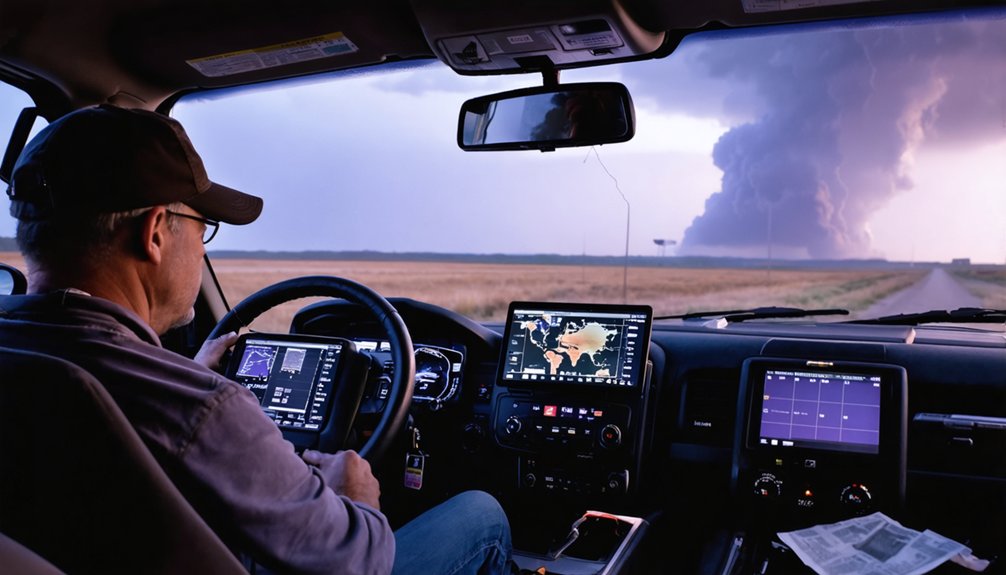
You’ll face significant financial losses during your first 3-5 years of storm chasing, with initial season deficits averaging $8,200 after expenses exceed footage sales revenue.
Breaking even requires developing reliable storm interception skills, establishing media contacts, and diversifying income through tour operations or content licensing deals. Most chasers need 5-10 years of documented severe weather footage and proven forecasting accuracy before generating consistent revenue that approaches full-time income levels.
Initial Years: Minimal Returns
When you launch a storm chasing career, expect to hemorrhage money for years before seeing returns. The gear demands alone crush your budget immediately, with initial equipment and chase costs hitting $13,700 in year one. Revenue limitations become painfully clear when your best season generates only $5,500 gross, leaving you $8,200 in the red.
Your first-year financial reality includes:
- $5,000 in camera equipment and chase gear upfront
- $6,200 in vehicle costs from 20,000 miles at $0.31 per mile
- $1,500 for hotels and food during chase deployments
- $1,000 in cellular and data expenses for positioning
Even successful seasons yield net profits around $2 per hour after expenses—ten times less than part-time fast food work. You’ll need a decade of dedication before approaching viability.
Building Sustainable Revenue Streams
Breaking into full-time storm chasing profitability demands 7-10 years of sustained losses before revenue streams converge into viable income. You’ll invest six figures across two decades while implementing diversification strategies that extend beyond seasonal pursuit windows. Most chasers abandon operations by year three without aggressive expense management tactics and supplemental income sources.
Your timeline accelerates when combining chase tours, media licensing, retail roofing contracts, and maintenance services into a cohesive business model. Tax-deductible mileage offsets operational hemorrhaging during the grinding phase. Technology advances since the mid-2000s enable broader storm targeting, but profitability hinges on daily commitment over years.
Survival past the initial decade grants access to industry opportunities—single events generating $25 million in company revenue, streaming deals, and consistent media partnerships that finally justify your substantial capital investment.
Comparing Historical Earnings to Modern Storm Chasing Income
Although storm chasing has existed for decades, the financial landscape has transformed dramatically between the 1990s-2000s era and today’s opportunities.
Back in 2005, you’d earn roughly $2 per hour after expenses—barely enough to justify the seasonal employment. Today’s chasers average $45,374 annually, with top earners reaching $68,000 through diversified income streams.
Modern revenue sources include:
- Television media positions offering structured compensation in select markets
- Content licensing through digital platforms unavailable in previous decades
- Chase tour operations capitalizing on growing public interest
- Research positions backed by government funding and academic institutions
Despite improved earnings potential, you’ll still face substantial expense-to-revenue challenges. Most semi-professional chasers spend more than they earn, requiring supplementary income sources to maintain financial independence while pursuing severe weather.
Frequently Asked Questions
Do Storm Chasers Need Special Licenses or Certifications to Operate Legally?
You don’t need special licenses to chase storms legally, though specialized training requirements like SKYWARN certification enhance safety and credibility. Equipment maintenance costs remain your responsibility, and you’ll benefit from voluntary spotter programs offering free, accessible training nationwide.
Can Storm Chasers Earn Income From Insurance Companies or Research Institutions?
You can’t earn directly from insurers due to fraud concerns, but you’ll generate income through contract research with meteorological institutions and media appearances selling footage to networks—legitimate revenue streams that preserve your independence.
What Happens if a Storm Chaser’s Vehicle Gets Damaged During a Chase?
You’ll face full vehicle repair costs if extensive coverage doesn’t apply. Storm damage liability falls on you—rental agencies deny claims for deliberate high-risk exposure, while personal insurers may flag repeated hail damage, potentially dropping your coverage entirely.
Are There Seasonal Income Fluctuations That Affect Storm Chaser Annual Earnings?
Yes, you’ll experience dramatic income variability between April-June peak season and off-season months. Your employment patterns shift from $500-per-footage earnings during active chasing to reliance on secondary meteorological work averaging $92,070 annually for stability.
Do Storm Chasers Pay for Their Own Liability Insurance Coverage?
Yes, you’ll cover your own liability insurance as an independent storm chaser. Liability policy requirements vary by state, but you’re responsible for incurred expenses coverage, typically ranging from $500,000 to $1 million in professional liability protection.
References
- https://stormtrack.org/threads/article-claims-storm-chasers-average-annual-income-is-74-000.30435/
- https://www.youtube.com/watch?v=K1gkje3ic2Q
- https://www.ziprecruiter.com/Salaries/Storm-Chasers-Salary
- https://www.onlinedegree.com/careers/life-physical-science/storm-chaser/
- https://ccgit.crown.edu/cyber-reels/storm-chaser-salaries-how-much-do-they-really-earn-1764809222
- https://ccgit.crown.edu/cyber-reels/storm-chaser-salaries-how-much-do-they-really-make-1764809223
- https://www.ziprecruiter.com/Salaries/Storm-Chasers-Salary–in-Ontario
- https://www.ziprecruiter.com/Salaries/Storm-Chasers-Salary–in-Alberta
- https://www.oreateai.com/blog/the-financial-landscape-of-storm-chasing-how-do-chasers-get-paid/0130eca3ada955ee0c931c8c8c49868d
- https://secure.ruready.nd.gov/Career_Planning/Career_Profile/Career_Profile.aspx?id=JPdLmXAP2BPAXSRqQAxw8oleqa76wXAP3DPAXXAP3DPAX&screen=9