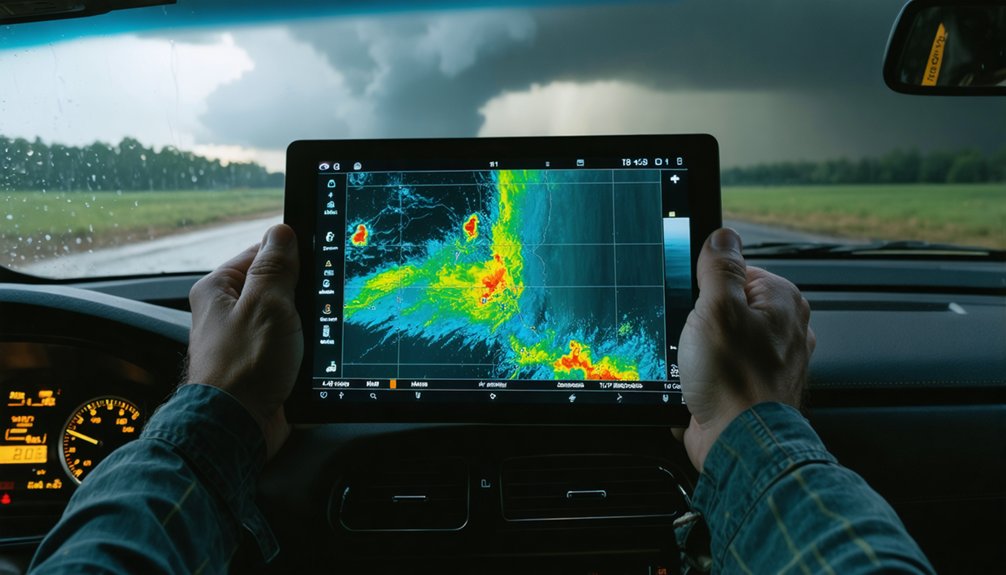
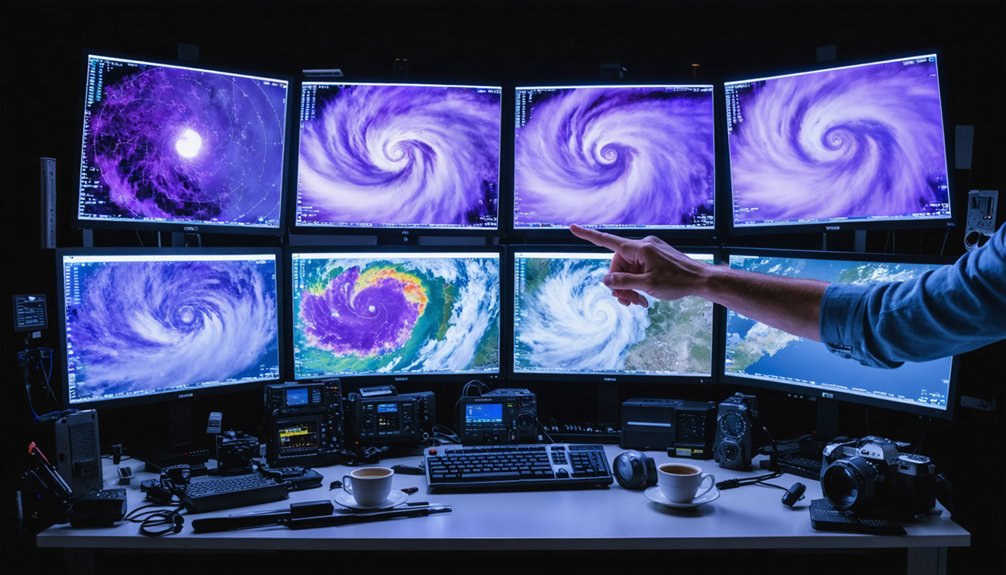
Tornadoes form when you’ve got extreme atmospheric instability, moisture-laden warm air at the surface, and cool dry air aloft—all combined with significant wind shear. Wind speed variations create horizontal vortices that updrafts tilt vertically, forming a mesocyclone within supercell thunderstorms. Through conservation of angular momentum, this rotation intensifies 100-fold as rear flank downdrafts and convergence concentrate the vorticity. The funnel cloud descends as pressure drops, and when it touches ground with visible debris circulation, you’ve witnessed tornadogenesis—a process where each atmospheric component plays a critical role worth understanding.
Key Takeaways
- Tornadoes require extreme instability, warm moist surface air, cool dry mid-level air, and significant wind shear synchronized together.
- Wind shear creates horizontal spinning air that updrafts tilt vertically, forming a mesocyclone inside supercell thunderstorms.
- Conservation of angular momentum amplifies rotation 100-fold as the spinning column narrows and stretches downward.
- Rear flank downdrafts and strong updrafts generate additional vorticity, rapidly intensifying winds to tornado strength.
- A visible funnel descends from the cloud base and touches ground, marked by debris whirls confirming tornado formation.
The Essential Atmospheric Ingredients That Set the Stage
When conditions align for tornado formation, four critical atmospheric ingredients must converge simultaneously: extreme instability, warm moisture-laden surface air, cool dry mid-level air, and significant wind shear.
Tornado genesis demands precise convergence: atmospheric instability, moisture-rich air, dry mid-levels, and wind shear aligning in rare synchronization.
You’ll find temperatures plummeting 30°F per mile vertically, creating violently unstable conditions. Destabilized surface air—heated by solar radiation and enriched with Gulf moisture—rises beneath rapidly cooling upper layers.
Blocking midlevel dry air from the Rockies caps this volatile arrangement, preventing premature release of atmospheric energy. Wind speeds shift over 50 mph between ground level and cloud base, generating the rotational dynamics supercells require.
These components rarely coincide, but when they do, particularly across America’s Great Plains where geography permits unobstructed air mass collisions, you’re witnessing nature’s perfect storm recipe materialize.
From Supercells to Mesocyclones: Understanding the Rotating Foundation
Among the thousands of thunderstorms that develop annually across North America, supercells represent less than 1% yet account for nearly all violent tornadoes. These rotating thunderstorms develop mesocyclones—vertical columns of spinning air that form when wind shear creates horizontal vorticity patterns. The convective updraft tilts this rotation upright, establishing thunderstorm rotation dynamics between 4-8 km altitude.
The mesocyclone’s evolution follows precise physical mechanisms:
- Mid-level balance forms first, creating a dynamic pipe that intensifies rotation below
- Convergence stretches the vortex vertically, contracting diameter from 20 km to 2-6 km
- Rear flank downdraft wraps precipitation around the updraft, forming the characteristic hook echo
- Low pressure pulls the cloud base downward, potentially generating wall clouds
This rotating foundation provides the necessary—though insufficient—parent circulation for tornadogenesis.
How Wind Shear Creates Spinning Motion Near the Ground
While mesocyclones provide the rotating foundation for tornadoes aloft, wind shear generates the critical spinning motion within the lowest kilometer of atmosphere where tornadoes actually touch down. You’ll observe wind speed variations up to 50 mph between ground level and cloud base creating horizontal vortices.
These tube-like spinning currents form as warmer air rises while cooler air descends. The influence of precipitation driven downdrafts acquires this horizontal spin, then carries it earthward. Factors impacting vortex tilting include the updraft’s intensity and directional shear—typically 90 degrees between surface and mid-levels.
As the powerful updraft intercepts these horizontal vortices, it rotates them vertical. Conservation of angular momentum concentrates this rotation, accelerating wind speeds. Enhanced low-level moisture lowers cloud bases to couple thousand feet, strengthening the coupling between mesocyclone and surface circulation.
The Intensification Process: When Rotation Becomes a Tornado
The shift from rotating air to an actual tornado requires vorticity to amplify by a factor of 100 through the conservation of angular momentum—the same principle that accelerates a figure skater’s spin when pulling in their arms. As parcels converge toward the rotation axis, upward acceleration triggers rapid intensification.
The rear flank downdraft surge generates additional vorticity through surface friction, creating a third vorticity maximum that merges with the preexisting tornadic vortex.
Critical intensification factors include:
- Strong updraft suction generating pressure-gradient forces that pull air upward
- Convergence mechanisms concentrating spin into tighter circulation patterns
- Baroclinic vorticity generation from temperature contrasts near the surface
- Adequate warmth preventing cold air from spreading horizontally and disrupting rotation
This systematic amplification transforms weak near-ground rotation into destructive tornado-strength winds.
Tornadogenesis: the Final Steps From Funnel Cloud to Touchdown
Once intensification concentrates rotation to destructive velocities, the visible manifestation of tornadogenesis begins with the descent of a condensation funnel from the cloud base. You’ll observe this tapered column forming as rapidly dropping pressure pulls moisture into the vortex, creating the characteristic spinning structure. Condensation timing depends critically on atmospheric moisture content—drier conditions may produce invisible tornadoes despite violent rotation aloft.
The transformation from funnel cloud to official tornado occurs at touchdown, marked by debris and dust whirls at ground level. Touchdown signals include visible ground contact, rotating debris patterns, and confirmed connection to the cloud base. This entire sequence—from mesocyclone contraction through funnel descent to surface contact—can unfold within minutes, demanding your immediate recognition of these observable indicators.
Frequently Asked Questions
What Time of Year Do Tornadoes Occur Most Frequently?
You’ll see tornadoes most frequently from April through June, when seasonal weather patterns create ideal conditions. Tornado Alley geography determines regional timing—southern states peak earlier (March-May), while northern areas experience maximum activity during summer months.
How Long Does a Typical Tornado Last on the Ground?
How brief is nature’s fury? You’ll find the average tornado duration on ground lasts under 10 minutes. Tornado lifespan duration varies markedly—weak ones persist mere minutes, while violent storms can rage over an hour, covering expansive paths.
Can Tornadoes Be Accurately Predicted Hours in Advance?
You can’t get precise tornado predictions hours ahead yet. Reliable forecast models identify favorable conditions, and advanced detection technology like Warn-on-Forecast extends warnings to one hour, but exact location and timing remain uncertain until formation.
What Is the Difference Between a Tornado Watch and Warning?
A tornado watch means weather alert systems detect favorable conditions; you’ll monitor storm monitoring systems. A warning means radar confirms a tornado—you must take immediate shelter. Watches give you preparation time; warnings demand instant action for survival.
How Are Tornadoes Rated in Terms of Strength and Damage?
You’ll find tornadoes rated EF0-EF5 using tornado damage assessment criteria examining 28 structural indicators. Tornado wind speed classification ranges from 65 mph to 200+ mph, empowering you with knowledge to independently evaluate severe weather risks in your area.