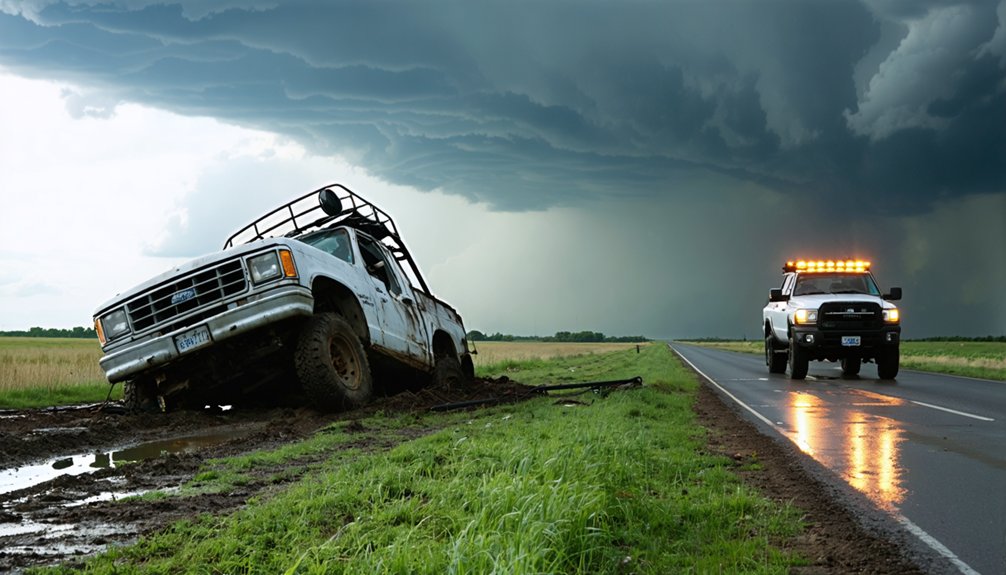
At least 12 documented storm chaser fatalities have occurred since Christopher Phillips became the first recorded victim on April 26, 1984. You’ll find that vehicle accidents claim more lives than direct tornado encounters, with the May 31, 2013, El Reno tornado standing as the deadliest single event, killing four chasers. Human error and situational awareness drive most of these outcomes. The complete year-by-year breakdown reveals patterns you can use to understand exactly where these risks converge.
Key Takeaways
- At least 5 storm chasers have died in direct tornado encounters, with the May 31, 2013, El Reno tornado being the deadliest single event.
- Tim Samaras, Paul Samaras, Carl Young, and Richard Henderson were among those killed during the catastrophic El Reno tornado.
- Vehicle accidents account for more storm chaser fatalities than tornado encounters, including hydroplaning, collisions, and loss of vehicle control.
- The first documented storm chaser fatality was Christopher Phillips, who died on April 26, 1984, in Logan County, Oklahoma.
- Reckless chasing behavior has also caused civilian deaths, such as a July 12, 2015, Minnesota incident killing two uninvolved bystanders.
How Many Storm Chasers Have Died in Total?
You’ll find that these deaths weren’t random — they followed identifiable patterns across vehicle accidents, direct tornado encounters, and collisions involving non-chasers.
Understanding these patterns matters for chaser safety, since each fatality offers measurable data about what kills chasers in the field.
The causes range from hydroplaning in heavy rain to being overtaken by rapidly expanding tornadoes.
Proper driving education tailored to severe weather conditions could’ve prevented several of these incidents.
The record demonstrates that operational decisions — not just unpredictable weather — frequently determined outcomes.
You’re looking at a dataset where human error and situational awareness directly influenced survival rates.
The First Storm Chaser Death on Record
On April 26, 1984, you’d encounter the first documented “in the field” storm chaser fatality in recorded history.
Christopher Phillips, a 21-year-old University of Oklahoma meteorology student, died after swerving to avoid a rabbit, rolling his vehicle into a ditch in Logan County, Oklahoma.
His death wasn’t the result of a tornado encounter but rather the dangerous road conditions that make storm chasing a multi-hazard activity extending well beyond the storms themselves.
The 1984 Fatal Incident
Although storm chasing had been practiced for decades before 1984, the first documented in-field fatality didn’t occur until April 26th of that year, when Christopher Phillips, a 21-year-old University of Oklahoma meteorology student, died in Logan County, Oklahoma.
Swerving to avoid a rabbit, Phillips lost control, rolling his vehicle into a ditch—a stark reminder that chasing safety extends beyond storm prediction.
This incident reshaped weather education programs, reinforcing that driving awareness carries equal weight to meteorological expertise.
You might assume tornado encounters cause most deaths, but this case proves ordinary road hazards are equally lethal.
Accident prevention requires acknowledging that chasers bear public responsibility for their conduct behind the wheel, regardless of atmospheric conditions surrounding them.
Christopher Phillips’ Tragic Death
April 26, 1984, marks the first documented in-field storm chaser fatality—Christopher Phillips, a 21-year-old University of Oklahoma meteorology student, died in Logan County, Oklahoma, after swerving to avoid a rabbit and rolling his vehicle into a ditch.
His death wasn’t tornado-related; it was a mundane road hazard that ended his life.
This distinction matters for your understanding of risk awareness in the field. Weather education programs hadn’t yet formalized chasing ethics or safety protocols that modern chasers follow today.
Phillips’ death demonstrated that danger doesn’t always come from the storm itself—it comes from the road, your decisions, and unpredictable variables you can’t control.
His tragedy ultimately pushed the chasing community toward developing structured safety standards that continue evolving decades later.
Dangerous Road Conditions
Storm chasing’s first documented in-field fatality didn’t involve a tornado—it involved a rabbit. On April 26, 1984, Christopher Phillips, a 21-year-old OU meteorology student, swerved to avoid one and rolled into a Logan County ditch, dying instantly.
Storm tracking demands rigorous risk assessment and road awareness, yet even mundane hazards can prove fatal. You can’t separate chaser education from driving techniques—both are non-negotiable components of weather preparedness.
Phillips’ death exposed a critical gap: emergency protocols and accident prevention strategies weren’t integrated into chase operations. Visibility challenges compound split-second decisions, turning ordinary roads into high-risk environments.
Safety measures must extend beyond tornado proximity. Understanding this fatality means recognizing that freedom in the field requires disciplined judgment, not recklessness.
Storm Chasers Who Died in Tornado Encounters
Tornado encounters have claimed the lives of at least 5 storm chasers, making direct contact with twisters one of the deadliest risks in the field.
The May 31, 2013, El Reno tornado stands as the deadliest single event in storm chasing history. Tim Samaras, Paul Samaras, and Carl Young—all experienced chasers—died when the tornado overtook their vehicle on Reuter Road. A fourth victim, Richard Henderson, was observing the storm near his home.
Researchers later identified a fifth, previously unknown chaser connected to the same event. These deaths exposed critical gaps in tornado safety protocols and storm preparedness strategies.
Even seasoned professionals couldn’t outmaneuver a rapidly expanding, erratic tornado, demonstrating that direct exposure remains an unforgiving variable no amount of expertise can fully neutralize.
The El Reno Tornado: Storm Chasing’s Deadliest Day
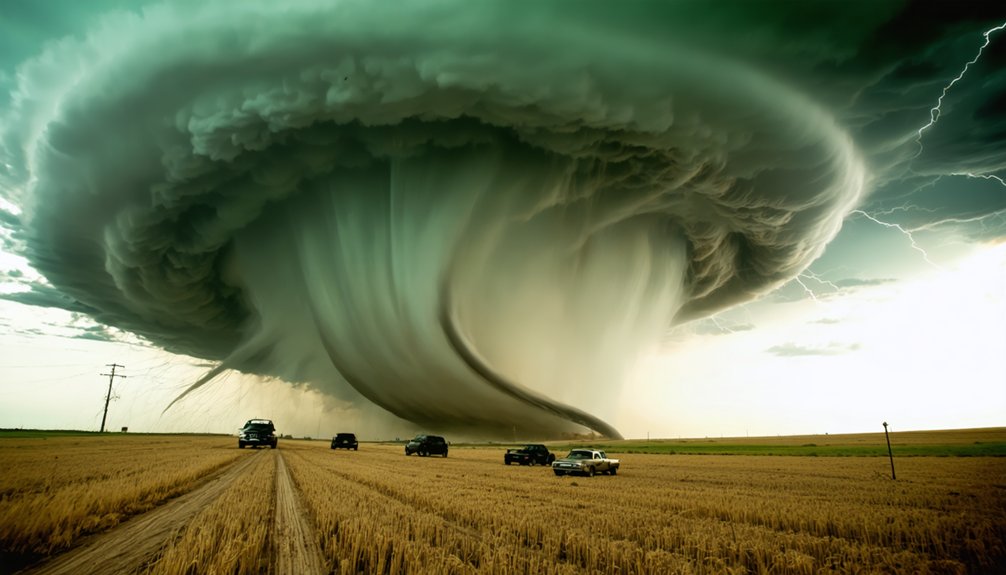
On May 31, 2013, the El Reno tornado delivered storm chasing’s single deadliest event, killing Tim Samaras, Paul Samaras, and Carl Young when the tornado overtook their vehicle on Reuter Road.
You’d be hard-pressed to find more experienced chasers among the victims—Tim Samaras in particular had spent decades refining data-collection techniques in the field.
What made El Reno especially lethal wasn’t just its violence but its unprecedented size, expanding rapidly in ways that outpaced even expert-level situational awareness.
El Reno’s Deadly Path
May 31, 2013, stands as storm chasing’s deadliest single day, when the El Reno tornado killed five people connected to chasing activity. Tim Samaras, Paul Samaras, and Carl Young died when the tornado overtook their vehicle on Reuter Road. Richard Henderson, observing near his home, also perished. Researchers later identified a fifth previously unknown chaser fatality linked to the same event.
El Reno’s aftermath fundamentally shifted how chasers evaluate positioning decisions and risk tolerance. The tornado’s unprecedented rapid expansion made escape routes disappear within seconds, exposing even experienced professionals to unsurvivable conditions.
You can’t outrun unpredictability at that scale.
The tragedy intensified debates around chasing ethics, particularly whether aggressive positioning near violent tornadoes justifies scientific gain when experienced veterans can’t guarantee their own survival.
Victims and Their Expertise
The five people killed by the El Reno tornado ranged from veteran researchers to casual observers, a mix that reveals how broadly the storm’s lethality extended beyond reckless or inexperienced chasers.
Tim Samaras had spent decades refining storm chasing safety protocols and deploying scientific probes near tornadoes. His son Paul and colleague Carl Young brought comparable field experience. Yet the tornado’s rapid expansion overwhelmed their expertise levels entirely.
Richard Henderson wasn’t chasing at all—he was simply watching from near his home. A fifth victim, identified through post-event research, remains less documented.
El Reno’s data forces you to reconsider the assumption that skill and preparation guarantee survival. When a tornado doubles in size within minutes, experience becomes insufficient protection against raw atmospheric physics.
Tornado’s Unprecedented Size
At 2.6 miles wide, the El Reno tornado set a verified record as the widest tornado ever measured in the United States, a statistic that reframes every assumption about safe positioning distances chasers had previously calculated.
Its rapid width expansion caught even veteran teams off guard, demonstrating that tornado impacts can outpace any pre-established escape buffer.
You can’t apply conventional storm preparedness frameworks to a tornado that more than doubled its width within minutes.
El Reno’s violent, erratic track shifts eliminated predictable movement patterns chasers historically relied upon.
Standard positioning protocols assumed measurable, linear behavior—El Reno destroyed that assumption entirely.
Understanding this event forces you to recalibrate risk thresholds, recognizing that unprecedented atmospheric events can render even expert-level preparation insufficient against a tornado operating outside documented behavioral norms.
Storm Chasers Who Died in Vehicle Accidents
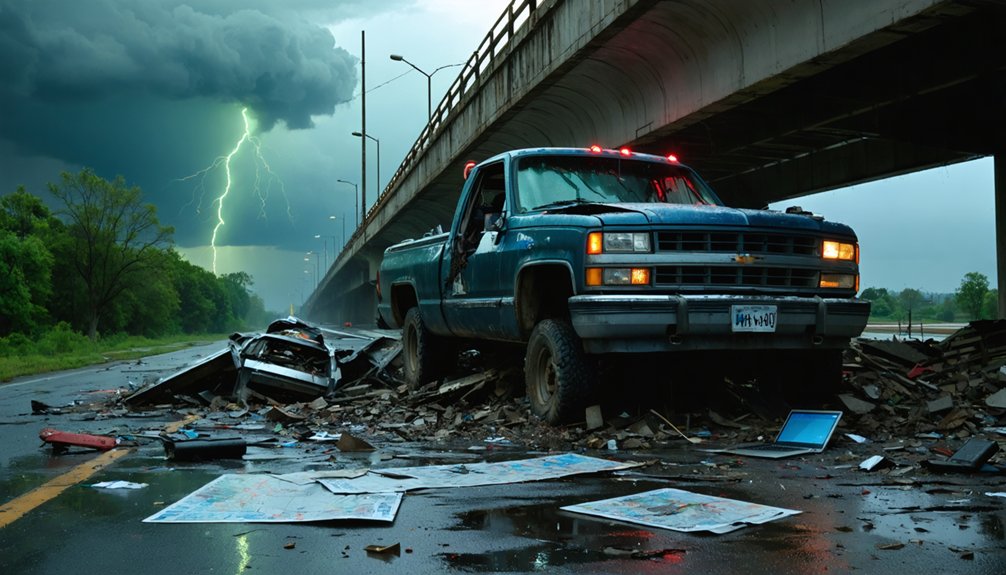
While tornado encounters often dominate public perception of storm chasing risks, vehicle accidents have claimed more lives across the activity’s recorded history. Understanding storm chasing safety requires examining these incidents objectively.
Christopher Phillips died on April 26, 1984, after losing vehicle handling control while swerving to avoid a rabbit, rolling into a ditch in Logan County, Oklahoma.
Jeff Wear hydroplaned on Interstate 20 near Kilgore, Texas, on July 11, 2005, striking a flatbed truck head-on.
More recently, three University of Oklahoma students died after hydroplaning near Tonkawa, Kansas, and Martha Llanos Rodriguez was struck from behind by a semitrailer on Interstate 90.
These incidents collectively demonstrate that road conditions and driver behavior represent statistically significant threats independent of atmospheric hazards.
When Storm Chasers Put Civilians in Danger
Storm chasing doesn’t only endanger the chasers themselves—reckless behavior on public roads has killed uninvolved civilians.
On July 12, 2015, a storm chaser ran a stop sign in Pennock, Minnesota, colliding with David and Mildred Frank’s vehicle and killing both residents instantly. They weren’t chasing anything. They were simply driving in their own community.
This incident directly implicates storm chaser responsibility. When you operate a vehicle aggressively through rural intersections during active chase operations, you’re transferring risk onto civilians who never consented to it.
Civilians’ safety depends entirely on chasers exercising disciplined, lawful driving behavior. Increased chaser traffic on back roads compounds these dangers greatly.
The freedom to pursue severe weather carries a real obligation: your chase activity shouldn’t become a death sentence for someone else.
Every Recorded Storm Chaser Death, Year by Year

Tracking storm chaser fatalities chronologically reveals how the risks have evolved and diversified over decades.
You’ll notice distinct patterns when examining the documented deaths:
- 1984 – Christopher Phillips dies after swerving to avoid a rabbit, rolling into a ditch in Logan County, Oklahoma.
- 2005 – Jeff Wear hydroplanes on I-20 near Kilgore, Texas, striking a flatbed truck fatally.
- 2013 – Tim Samaras, Paul Samaras, and Carl Young are overtaken by the El Reno tornado.
- 2015 – David and Frank Mildred are killed when a chaser runs a stop sign in Minnesota.
Each death sharpened public awareness around storm chasing ethics.
The data confirms that fatalities don’t exclusively involve tornadoes — reckless driving kills too.
The Risk Factors That Made These Deaths Preventable
Each death in the chronological record points to something more unsettling than bad luck — most of these fatalities share identifiable, preventable risks.
Driving safety failures, including hydroplaning, stop sign violations, and high-speed pursuits, appear repeatedly across cases. Storm awareness gaps left chasers unprepared for rapid weather shifts, like El Reno’s unprecedented expansion. Poor emergency preparedness meant vehicles had no viable escape routes when conditions changed instantly.
Weather education and chaser accountability directly influence survival odds. When you’re operating in severe weather zones, risk assessment isn’t optional — it’s the difference between documentation and a fatality statistic.
Traffic management on congested back roads compounded dangers for both chasers and uninvolved civilians. You can’t reclaim freedom from preventable consequences without first acknowledging which decisions consistently preceded each recorded death.
Frequently Asked Questions
Are Storm Chasers Required to Carry Special Insurance for Their Activities?
No universal mandate requires special insurance, but you’d be wise to secure tailored insurance policies with extensive liability coverage, as standard auto plans often exclude high-risk storm chasing activities, leaving you financially exposed.
Do Professional Storm Chasers Receive Formal Safety Training Before Chasing?
Like a soldier entering battle without armor, you’d be vulnerable without preparation. Formal safety protocols and training programs aren’t universally required, but experienced chasers actively pursue structured education covering meteorology, vehicle dynamics, and situational awareness.
Have Any Storm Chasers Survived Direct Tornado Encounters During Chases?
Yes, you’ll find survival stories exist, though they’re rare. Chasers who’ve implemented strict safety measures—maintaining escape routes and monitoring tornado paths—have escaped direct encounters, proving that disciplined, data-driven decision-making greatly improves your odds of surviving extreme proximity events.
What Legal Consequences Have Reckless Storm Chasers Faced After Causing Deaths?
Like Icarus flying too close to the sun, you’ll face serious legal repercussions when reckless behavior causes deaths. The 2015 Frank fatality case demonstrates chasers can face criminal charges, civil liability, and vehicular manslaughter prosecutions.
How Do Storm Chasing Fatality Rates Compare to Other Dangerous Professions?
You’ll find storm chaser risks relatively low compared to fishing, logging, or roofing profession comparisons—with only 15 documented fatalities spanning decades. However, concentrated multi-fatality events suggest episodic danger spikes that skew traditional occupational mortality calculations considerably.
References
- https://stormtrack.org/threads/storm-chasing-fatalities-a-look-back.30662/
- https://pmc.ncbi.nlm.nih.gov/articles/PMC7262986/
- https://www.cbsnews.com/minnesota/news/4-storm-chasers-have-died-in-last-2-weeks/
- https://www.weather.gov/hazstat