When a thunderstorm’s updraft weakens, its core collapses, forcing dense, cold air downward at destructive speeds. Evaporational cooling, hydrometeor loading, and negative buoyancy amplify each other in a self-reinforcing feedback loop, accelerating the downdraft toward the surface. Once it strikes, air explodes outward horizontally, generating winds exceeding 100 mph within a localized zone under 4 km wide. Wet microbursts arrive with heavy rain, while dry microbursts strike without visible warning. There’s much more to uncover about how these violent events develop and behave.
Key Takeaways
- Microbursts form when thunderstorm updrafts weaken, causing a rapid core collapse that triggers powerful downdrafts reaching the ground.
- Evaporational cooling and ice-melt absorption increase air density, creating negative buoyancy that accelerates descending air into destructive downbursts.
- Wet microbursts accompany heavy rainfall, while dry microbursts occur in low humidity where raindrops fully evaporate before reaching the ground.
- Hydrometeor loading, evaporational cooling, and negative buoyancy create a self-reinforcing feedback loop that intensifies the collapsing thunderstorm core.
- Upon ground impact, air races outward horizontally, producing extreme wind shear exceeding 100 mph, posing severe hazards to aircraft.
What Are Downbursts and Microbursts?
Within storm dynamics, you’ll encounter two classifications: microbursts, spanning less than 4 km with winds exceeding 40 m/s, and macrobursts, extending beyond 4 km.
Changes in air density, atmospheric pressure, and precipitation types directly influence downdraft intensity. Wind shear produced during outburst stages creates severe turbulence effects hazardous to aircraft.
Radar technology identifies divergent velocity signatures, helping you anticipate these short-lived severe weather events that can reshape a storm’s lifecycle within minutes.
Wet vs. Dry Microbursts: What’s the Difference?
Although both wet and dry microbursts share the same fundamental downdraft mechanics, their environmental triggers and surface signatures differ sharply.
Wet microbursts accompany significant precipitation, so you’ll observe heavy rainfall reaching the surface alongside destructive winds. They’re most common during Southeast summers, where high surface moisture fuels intense convective cores.
Dry microbursts operate differently. You’re dealing with low relative humidity beneath the cloud base, causing raindrops to evaporate completely before reaching the ground.
That evaporational cooling concentrates rapidly, driving a powerful downdraft despite no visible precipitation at the surface. This makes dry microbursts particularly deceptive and dangerous.
The key distinction you must recognize: wet microbursts announce themselves with rain, while dry microbursts deliver devastating winds with little visual warning, demanding heightened situational awareness in arid or semi-arid environments.
How Thunderstorms Create the Conditions for a Microburst
When a thunderstorm’s updraft weakens, it can no longer suspend the accumulated load of rain and hail, triggering a rapid core collapse that drives a powerful downdraft toward the surface.
As that descending air passes through the sub-cloud layer, evaporational cooling and ice-melt absorption of latent heat intensify its negative buoyancy, accelerating its descent.
You can think of this feedback loop as self-reinforcing: the colder and denser the air becomes, the faster it plummets, ultimately striking the ground and spreading outward as a microburst.
Updraft Collapse Triggers Downdraft
Thunderstorms build their destructive potential through a self-defeating cycle: the same powerful updraft that fuels storm growth ultimately sets the stage for a microburst. Updraft dynamics sustain suspended hydrometeors—rain, hail, and ice—high within the storm’s core.
As precipitation mass accumulates, the load exceeds what the updraft can support. The column weakens, loses buoyancy, and reverses direction entirely.
Downdraft initiation occurs rapidly once this structural failure begins. Evaporational cooling below the cloud base, combined with melting ice particles, generates negatively buoyant air that accelerates the descending core.
You’re watching a system collapse under its own weight. Within minutes, what was a vigorous updraft becomes a concentrated downdraft driving toward the surface—primed to release damaging winds upon impact.
Cooling Air Accelerates Descent
Once the updraft collapses and the precipitation core begins its descent, cooling mechanisms take over as the primary driver of the downdraft’s acceleration.
As raindrops and hail evaporate or melt below the cloud base, they absorb latent heat directly from the surrounding air. This extraction drops air temperature rapidly, increasing air density and generating powerful negative buoyancy. That denser air sinks faster than the environment around it, creating a self-reinforcing acceleration cycle.
Evaporational cooling concentrates this effect within a narrow column, focusing the descent rather than dispersing it. In low-humidity environments, dry microbursts exploit this process most aggressively, since precipitation fully evaporates before reaching the ground.
The result is a concentrated, rapidly accelerating downdraft capable of delivering destructive surface winds within minutes of initiation.
Hydrometeor Loading, Evaporational Cooling, and Negative Buoyancy Explained
Three distinct but interconnected mechanisms drive the violent downdrafts behind microbursts and downbursts: hydrometeor loading, evaporational cooling, and negative buoyancy.
Understanding hydrometeor dynamics reveals how suspended rain and hail physically weigh down the air column, forcing it earthward once the updraft weakens.
Suspended rain and hail don’t just fall — they actively drag the air column downward, triggering collapse.
Simultaneously, cooling processes activate below the cloud base, where falling precipitation evaporates into dry ambient air, rapidly extracting heat and chilling the surrounding atmosphere.
This evaporational cooling produces air that’s measurably denser and colder than its environment. That temperature differential generates negative buoyancy, accelerating the descending column with increasing force.
Each mechanism amplifies the others: heavier hydrometeors enhance evaporation, evaporation intensifies cooling, and intensified cooling strengthens negative buoyancy.
You’re fundamentally watching a self-reinforcing collapse that transforms a thunderstorm’s core into a destructive ground-level outburst.
When the Updraft Fails and the Core Collapses

When a thunderstorm’s updraft can no longer counteract the combined weight of hydrometeors and the cooling effects of evaporation, the storm’s core undergoes rapid structural failure.
Updraft failure triggers an immediate reversal of vertical motion — what once rose now plummets. The precipitation core collapse accelerates as negatively buoyant air, chilled by evaporation and ice melting, drives a powerful downdraft toward the surface.
You’re watching a system that built itself on instability now consuming itself from within.
Within minutes, the descending core reaches the ground in the contact stage, forcing air outward with explosive force. The speed of this shift gives you little warning — updraft failure and core collapse can evolve faster than standard radar scans can reliably capture.
What Actually Happens When a Downburst Hits the Ground
The moment a downburst contacts the ground, two distinct stages unfold in rapid succession.
During the contact stage, the descending core strikes the surface, generating intense ground impact and forcing air outward in every direction. You’re now looking at wind patterns that mirror an explosion — radially divergent, symmetrical, and capable of exceeding 100 mph.
The outburst stage follows immediately. Air races horizontally across the surface, producing a vortex ring hovering 30–50 meters above ground.
This ring carries the highest wind speeds and migrates outward before fragmenting into discrete, localized bursts. The entire sequence lasts only 5–10 minutes.
What makes it particularly dangerous isn’t just the speed — it’s the directional complexity of those wind patterns, which can simultaneously push aircraft forward, then violently drag them backward.
How Weather Radar Detects Microburst Signatures
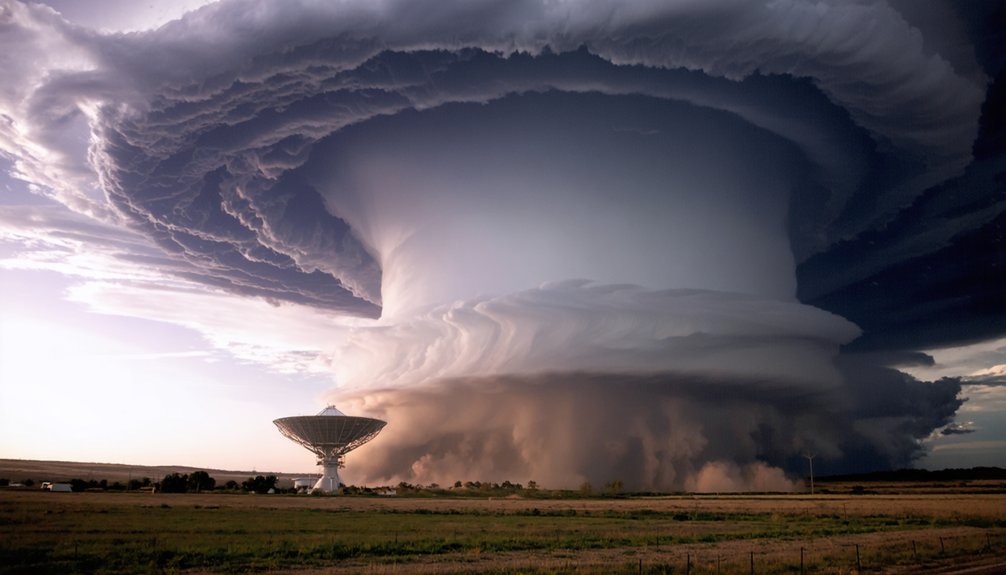
When you analyze Doppler radar data during a microburst event, you’ll identify a divergent velocity pattern—winds moving away from a central point in opposite directions—confirming outward airflow at the surface.
You can also recognize a bow echo signature in the reflectivity field, where the radar return bends outward in a curved arc, indicating strong winds pushing the precipitation core forward.
These two signatures together give you the clearest radar-based evidence that a microburst is occurring or has recently impacted the surface.
Divergent Velocity Radar Patterns
Detecting a microburst on Doppler radar relies on identifying a divergent velocity signature—a pattern where winds move away from a central point in opposite directions simultaneously.
When you examine velocity data, you’ll see inbound winds on one side and outbound winds on the other, confirming surface divergence beneath a collapsing storm core. These divergent patterns appear as contrasting color fields on radar displays, typically spanning less than 4 km for microbursts.
Meteorologists analyze radar signatures by measuring the velocity differential between opposing wind fields—values exceeding 40 m/s indicate a potentially dangerous event.
You must account for scan timing gaps, since microbursts evolve within minutes, meaning radar may capture only a single scan before the event dissipates entirely.
Bow Echo Reflectivity Signatures
Beyond velocity divergence, reflectivity data offers another diagnostic tool—the bow echo signature—that can indicate microburst potential before winds reach the surface.
When you examine radar returns, a bow echo appears as a forward-bulging arc of high reflectivity, typically driven by a powerful rear-inflow jet that accelerates the storm’s core downward.
You’ll notice the apex of the bow concentrates the heaviest precipitation, where hydrometeor loading and evaporational cooling combine to intensify downdraft strength.
Reflectivity signatures exceeding 55–65 dBZ within this apex region suggest significant microburst potential.
Bookend vortices flanking the bow’s ends further confirm organized rear-inflow acceleration.
Recognizing these reflectivity signatures early gives you critical lead time—often several minutes—before damaging surface winds develop, enabling more effective warnings and protective action.
Why the Vortex Ring Is Where Winds Hit Their Hardest
As the downdraft slams into the ground and spreads radially outward, it doesn’t dissipate uniformly—instead, it curls upward at its leading edge, forming a rotating vortex ring that hovers roughly 30 to 50 meters above the surface.
Vortex dynamics concentrate momentum within this tight rotating structure, amplifying wind speeds beyond what the downdraft alone produces. You’re fundamentally watching wind intensification occur through mechanical focusing—the ring compresses kinetic energy into a narrow band rather than distributing it across the full outflow.
As the ring migrates outward from the burst center, it fractures into discrete, localized wind maxima that strike the surface unpredictably. This fragmentation explains why damage surveys reveal isolated destruction zones separated by relatively undamaged ground, a pattern that distinguishes microburst impacts from the continuous damage path of a tornado.
Why Microbursts Are So Dangerous to Aircraft
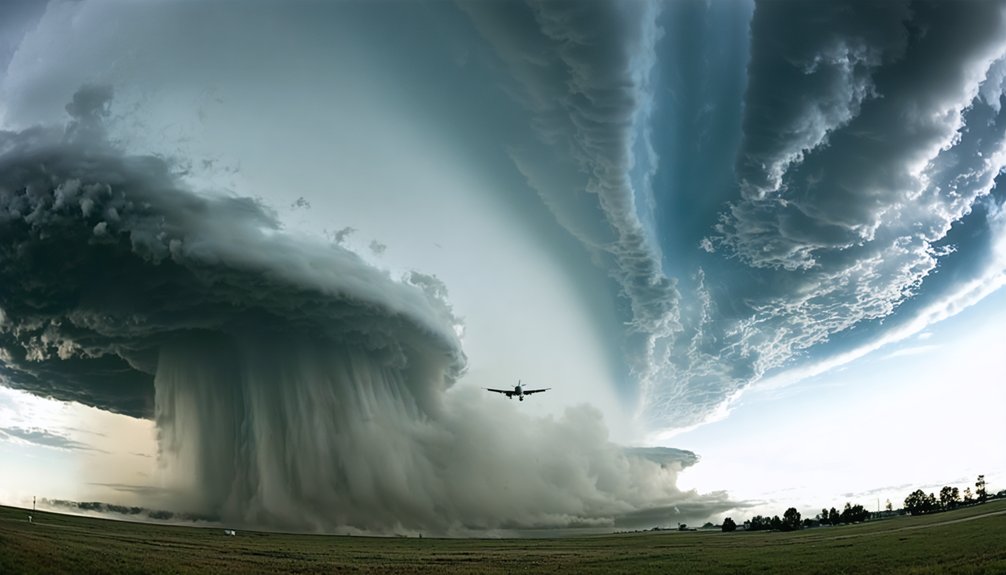
Few atmospheric hazards threaten aviation as acutely as microbursts, and the danger stems directly from how they interact with an aircraft’s aerodynamics during its most vulnerable phases of flight.
When you’re climbing after takeoff or descending on approach, you’re operating at low airspeed and minimal altitude margins. A microburst first delivers a headwind, temporarily boosting lift and masking the threat. Then it shifts abruptly to a tailwind, reducing lift precisely when you can’t afford to lose it. That rapid wind shear change, occurring within seconds, can exceed an aircraft’s climb capability entirely.
Aircraft safety demands pilots recognize microburst indicators before committing to an approach. Storm preparedness protocols, including Doppler radar monitoring and wind shear alert systems, exist precisely because microbursts strike fast, last only five to ten minutes, and leave little recovery margin.
Frequently Asked Questions
Can Microbursts Occur During Winter Storms or Only Summer Thunderstorms?
You’ll find microburst phenomena aren’t exclusive to summer thunderstorms. Winter storm characteristics can also trigger them when sufficient instability, hydrometeor loading, and evaporational cooling align, though they’re considerably less frequent during cold-season convective events.
How Long Does a Microburst Typically Last Before Winds Dissipate?
“Lightning never strikes twice” — you’d better act fast. Microburst duration typically runs 5–10 minutes before wind dissipation occurs. You’re witnessing rapid atmospheric collapse; recognize divergent radar signatures immediately, as these violent, short-lived events demand swift, decisive response.
Are Microbursts More Common in Certain Geographic Regions of the World?
You’ll find microbursts concentrated in tropical climates and mountainous regions where atmospheric instability peaks. Coastal areas and urban environments also experience elevated frequency due to moisture convergence and heat island effects driving intense convective activity.
Can a Single Thunderstorm Produce Multiple Microbursts Simultaneously?
Like a storm with multiple fists, yes, you’ll find a single thunderstorm’s dynamics can trigger simultaneous occurrence of several microbursts, as independent precipitation cores collapse separately, each releasing its own dangerous downdraft across different storm sectors.
What Is the Difference Between Macroburst and Microburst Damage Patterns?
You’ll notice microburst wind damage concentrates in localized zones under 4 km, with intense storm intensity creating erratic, explosive patterns, while macroburst wind damage spreads across broader areas, producing more uniform, sweeping destruction over greater distances.
References
- https://abc3340.com/news/local/when-downdrafts-become-destructive-the-science-behind-a-microburst
- https://www.faa.gov/sites/faa.gov/files/2022-11/MET4300_SWX_LEC34.pdf
- https://courses.ems.psu.edu/meteo3/node/2232
- https://www.weather.gov/bmx/outreach_microbursts
- https://instantweatherinc.com/iwpro-blog/2025/6/24/tornadoes-downbursts-microbursts
- https://www.germaniainsurance.com/about/blogs-and-news/blogs/what-is-a-microburst-downbursts-and-damaging-winds
- https://www.youtube.com/watch?v=RY_U_J4UfTs