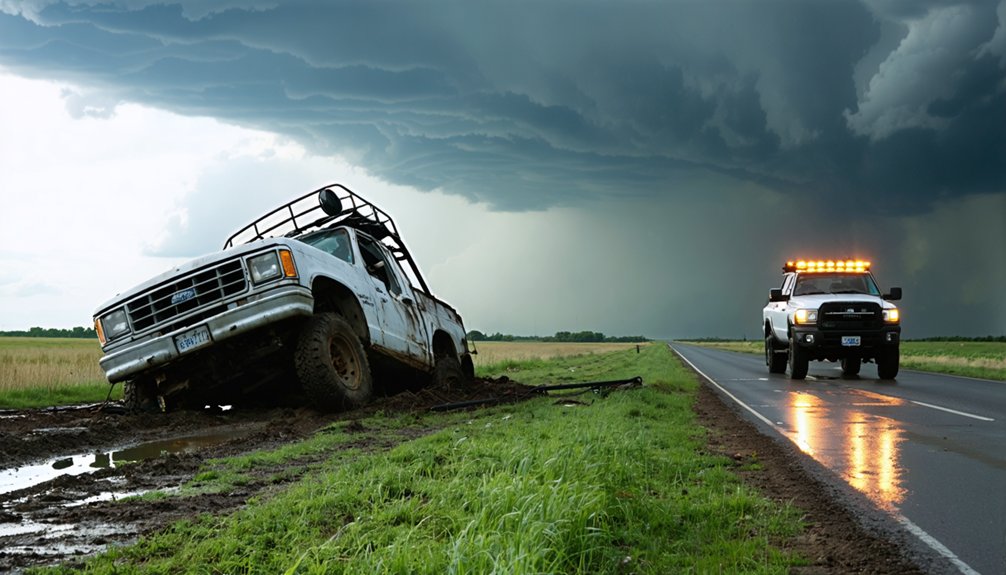
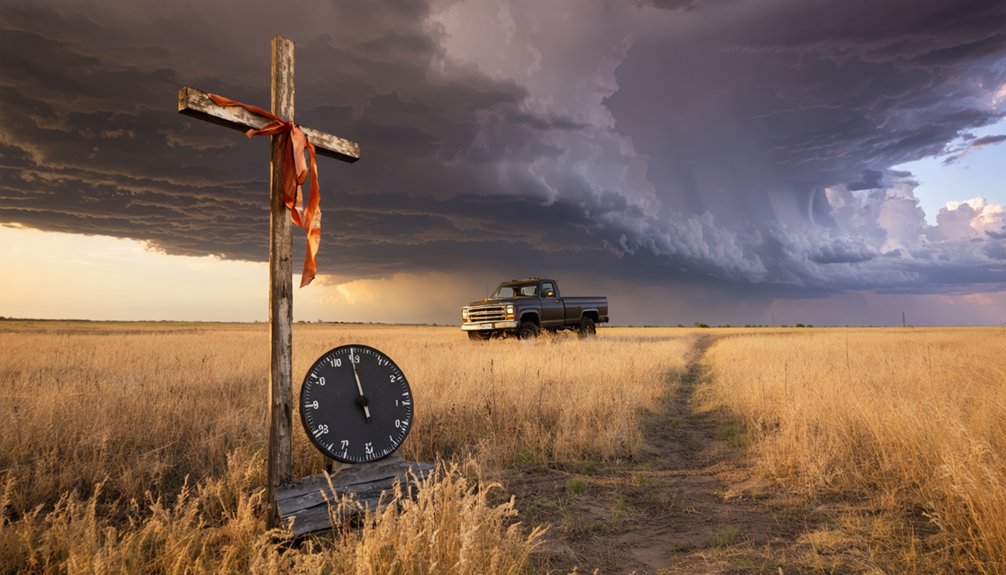
When the El Reno tornado killed Tim Samaras, Paul Samaras, and Carl Young on May 31, 2013, it exposed fatal gaps in storm chasing safety. Its rain-wrapped structure concealed a 2.6-mile width, erratic shifts eliminated escape routes, and congested roads blocked egress. These compounding failures forced the chasing community to codify ten operational rules covering risk assessment, gear requirements, and peer accountability. What those rules require—and how chasers enforce them—goes deeper than you’d expect.
Key Takeaways
- The 2013 El Reno tornado killed Tim Samaras, Paul Samaras, and Carl Young, marking the first professional storm chaser fatalities ever recorded.
- Rain-wrapping, erratic shifts, and road congestion created compounding failures that overwhelmed even the most experienced chasers on May 31, 2013.
- El Reno’s devastation prompted the storm chasing community to codify ten core operational safety rules addressing its most critical vulnerabilities.
- New protocols mandated expanded risk assessments accounting for tornado size, rain-wrapping, and required safety gear including first aid and CPR certification.
- Despite improved protocols, chaser fatalities persist, proving experience reduces risk incrementally but never eliminates the need for perpetual discipline.
How Three Deaths Reshaped Storm Chasing Safety Culture
When the El Reno tornado killed Tim Samaras, his son Paul, and partner Carl Young on May 31, 2013, it marked the first documented fatalities among professional storm chasers.
The EF3 tornado’s rain-wrapped, ill-defined structure made it nearly impossible to track, exposing critical vulnerabilities even experienced chasers couldn’t fully anticipate.
Rain-wrapped and structurally ambiguous, the El Reno tornado exposed vulnerabilities no amount of experience could fully prepare even seasoned chasers to navigate.
These deaths forced a direct reckoning with chaser ethics across the community. Colleagues acknowledged complacency had crept into decision-making, prompting urgent reinforcement of core safety protocols.
Community resilience emerged not through regulation but through self-policing, private corrections, and deliberate promotion of responsible conduct.
You’re now operating in a chasing culture that treats these three deaths as a measurable data point, one that reshaped training standards, escape route planning, and situational awareness requirements for every pursuit you undertake.
What Went Wrong on May 31, 2013
The El Reno tornado of May 31, 2013, defied standard behavioral models in ways that compressed every safety margin Tim Samaras and his team had built into their methodology.
Tornado unpredictability combined with traffic delays created a fatal convergence nobody could fully anticipate.
Four critical failures compounded simultaneously:
- Rain-wrapped concealment masked the tornado’s true width, exceeding 2.6 miles at peak intensity.
- Erratic directional shifts deviated sharply from projected paths, eliminating calculated escape corridors.
- Congested roadways from proliferating chasers blocked vehicle egress during critical seconds.
- EF3 classification understated actual destructive potential within localized debris fields.
You can understand how even disciplined, experienced professionals applying proven methodologies couldn’t overcome simultaneous system failures.
Experience doesn’t guarantee immunity when atmospheric mechanics rewrite operational parameters mid-pursuit.
The Storm Chasing Safety Rules That Emerged After El Reno
After El Reno killed three seasoned professionals in 2013, the storm chasing community codified a set of hard operational rules designed to eliminate the compounding failures that proved fatal.
You now operate under ten core directives, where each violation compounds your demise risk exponentially.
Your risk assessment must account for tornado size exceeding visual estimates, rain-wrapping obscuring actual position, and traffic density blocking escape corridors. You don’t stay where escape routes are compromised.
Tornadoes are always larger than they look. Rain-wrapping hides their true position. Blocked escape routes mean you leave immediately.
Safety gear requirements expanded beyond vehicle reinforcement to include first aid kits, CPR certification, and triage capability, since chasers frequently arrive at disaster sites before emergency responders.
You self-police. Dangerous behavior draws private correction within the community, not public spectacle. Reckless novices and complacent veterans receive identical scrutiny.
Discipline preserves your operational freedom to chase at all.
How Chasers Hold Each Other Accountable Now
Accountability within storm chasing operates through private, peer-driven correction rather than public condemnation. When you witness unsafe behavior, you address it directly, quietly, and immediately. This peer accountability structure preserves dignity while reinforcing critical standards.
Safety mentorship follows four operational principles:
- Correct privately: Pull reckless chasers aside after the event, never broadcast failures publicly.
- Model escape routes: Demonstrate real-time route selection so newer chasers internalize the decision-making process.
- Identify task saturation: Flag when a teammate’s attention splits dangerously between equipment, communication, and navigation.
- Reinforce distance discipline: Challenge anyone closing within debris-field range without measurable scientific justification.
You’re not policing freedom — you’re protecting it. Reckless behavior invites regulations that restrict everyone. Self-governance keeps government intervention out of storm chasing entirely.
Storm Chasing Deaths and Close Calls Since El Reno
Peer accountability frameworks reduce risk, but they don’t eliminate it — and the data since El Reno confirms that storm chasing remains a statistically dangerous pursuit even among experienced practitioners.
Storm chaser fatalities haven’t disappeared post-2013. The 2023 Rolling Fork EF4 tornado struck two chasers amid 17 civilian deaths, demonstrating that unexpected tornadoes continue overwhelming even disciplined field operators.
You’re never fully insulated from rapid intensification, erratic track shifts, or compromised escape corridors — variables no protocol completely neutralizes.
What the post-El Reno era has clarified is that experience reduces risk incrementally, not absolutely. Each pursuit requires fresh situational assessment.
Complacency among veterans statistically increases exposure. The chasing community acknowledges this openly: surviving the field long-term demands perpetual discipline, not accumulated confidence.
Frequently Asked Questions
What Equipment Do Storm Chasers Typically Use to Measure Tornado Data?
Like a scientist’s Swiss Army knife, you’ll deploy tornado instruments such as probes measuring temperature, humidity, and wind speed for precise data collection, ensuring you’re never in harm’s way during active pursuit operations.
How Do Storm Chasing Tour Companies Screen and Train Their Guides?
Tour companies vet guides through rigorous guide training, requiring years of field experience and meteorological knowledge. You’ll find safety measures include mandatory CPR certification, first aid proficiency, and protocol adherence, ensuring competent leadership before you’re ever in the field.
Are Storm Chasers Required to Have Any Official Licenses or Certifications?
You don’t face mandatory storm chaser regulations or licensing requirements to pursue tornadoes. The field remains largely self-governed, though you’ll find professional certifications in meteorology, first aid, and CPR strengthen your credibility and operational safety.
How Do Chasers Communicate Weather Data to National Meteorological Agencies?
Ironically, you’re not stuck in a storm — you’re the storm’s voice. You transmit real-time updates via mobile networks, GPS apps, and radio, feeding data accuracy directly to agencies like NOAA, empowering free-flowing meteorological intelligence.
What Psychological Effects Does Storm Chasing Have on Long-Term Chasers?
You’ll develop adrenaline addiction through repeated high-risk pursuits, neurologically reinforcing thrill-seeking behavior. Simultaneously, you’ll build trauma resilience by processing extreme weather events, though cumulative psychological stress requires active mental health monitoring to maintain operational effectiveness.
References
- https://gregladen.com/blog/2013/06/03/how-three-storm-chasers-died-and-what-to-do-about-it/
- https://www.youtube.com/watch?v=fxz71XIBCLM
- https://www.stormchasingusa.com/storm-chasing-and-safety/
- https://www.youtube.com/watch?v=nxPSFg2R8YY
- https://stormtrack.org/threads/storm-chasing-ethics-and-safety.26831/
- https://www.atms.unca.edu/cgodfrey/courses/swfex/pdf/ChasingSafety.pdf
- https://www.weather.gov/bmx/sps_torsafetyrules