Storm chasing safety has improved dramatically since the 2013 deaths of Tim Samaras, Paul Samaras, and Carl Young exposed dangerous gaps in operational standards. You’ll now find mandatory multi-vehicle teams, predetermined abort procedures, real-time GPS data sharing, and formal certification requirements shaping how chasers operate. Warning times have jumped from 4 to 14 minutes, directly saving lives. Yet fatalities still occur, proving no protocol is foolproof. Keep going to understand what’s changed—and what hasn’t.
Key Takeaways
- The 2013 El Reno deaths of Tim Samaras and colleagues exposed critical operational gaps, prompting immediate and widespread safety reforms.
- Solo chasing bans were implemented, requiring multi-vehicle teams to ensure backup, redundancy, and physical extraction capabilities.
- Predetermined abort procedures were introduced, preventing chasers from continuing reckless pursuits during rapidly escalating storm conditions.
- Real-time GPS data sharing and communication protocols now allow teams to track positions and respond faster to shifting storms.
- Certification programs now require training in storm mechanics, radar interpretation, escape routing, and supervised field hours before independent chasing.
The Deaths That Forced Storm Chasing to Change Its Rules
When Tim Samaras, Paul Samaras, and Carl Young died in 2013, storm chasing’s research community faced its first-ever fatalities from direct storm path interception—and it forced a hard reckoning with how the field operated. These historical fatalities exposed critical gaps: solo operations, inadequate escape routes, and poor communication protocols had created unnecessary vulnerabilities.
The deaths of Tim Samaras, Paul Samaras, and Carl Young forced storm chasing’s first honest reckoning with fatal operational gaps.
The El Reno tornado’s unprecedented size and unpredictable movement overwhelmed even experienced researchers. You can’t outrun what you can’t anticipate—and that reality demanded immediate safety reforms.
Organizations responded by banning solo chasing, mandating multi-vehicle teams, and requiring predetermined abort procedures.
Then in 2024, Gene Williamson, Randall Delane Yarnall, and Corbin Lee Jaeger died in a high-speed collision near Spur, confirming that driving conditions—not just storms—remain equally deadly threats demanding your full respect.
Why Solo Chasing Gets Chasers Killed
Solo chasing strips away every safety buffer that keeps chasers alive. When you’re alone, there’s nobody to catch your blind spots during risk assessment, nobody to monitor radar while you drive, and nobody to pull you out if something goes wrong.
The El Reno disaster proved that even experienced researchers died when conditions outpaced their ability to respond independently.
Equipment maintenance failures become lethal when you’re solo. A dead radio, a blown tire, or a failed GPS leaves you completely isolated during a rapidly evolving storm.
Organizations have banned solo chasing entirely because the data is unambiguous — paired teams survive situations that kill individuals.
You might value your independence, but chasing alone doesn’t protect your freedom. It eliminates it permanently.
Always bring a second vehicle and a second set of eyes.
What the Two-Vehicle Rule Prevents That Solo Chasers Cannot
The two-vehicle rule doesn’t just add a safety net — it closes the specific gaps that get solo chasers killed. When your single vehicle fails mechanically or gets blocked by debris, you’re stranded inside an active storm environment with zero options. Vehicle redundancy solves that instantly. Your second unit becomes a mobile backup system — carrying additional navigation tools, communication equipment, and personnel who can physically extract you when conditions deteriorate faster than forecasts predicted.
Solo chasers can’t replicate this. No app or radio substitutes for a second crew watching your position in real time. The El Reno disaster confirmed what data already suggested: unpredictable storm direction changes demand immediate escape execution.
With backup systems in place, you preserve your freedom to chase another day rather than becoming a cautionary statistic.
How Storm Chasers Pushed Public Warning Times From 4 to 14 Minutes
Before 1987, tornado warnings gave the public an average of just four minutes to react — barely enough time to reach shelter, let alone make informed decisions. Storm chasers changed that.
Through decades of field research and meteorological advancements, they helped push average warning times to fourteen minutes — a threefold increase that’s saved countless lives.
You can credit improved radar systems and better storm data collection for much of this progress. Chasers positioned their vehicles strategically, prioritizing vehicle safety while gathering critical rotation data that ground-based sensors couldn’t capture alone.
That information fed directly into forecasting models, sharpening prediction accuracy and extending the window communities have to respond. The freedom to act on a warning depends entirely on having enough time — and storm chasers helped earn that time.
The Road Dangers That Remain the Leading Cause of Chaser Deaths
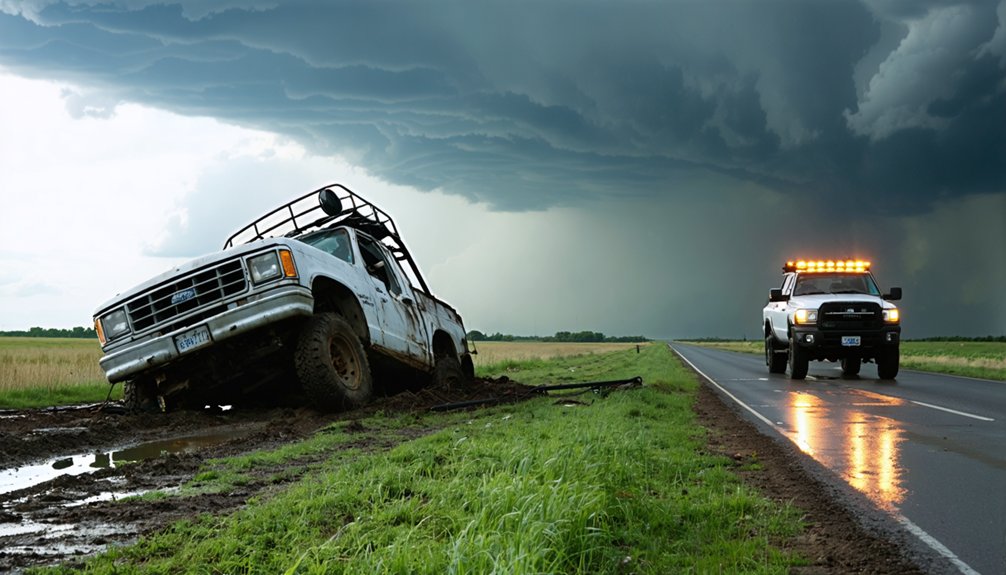
Even with improved forecasting and communication systems, vehicle accidents from flooding and dangerous driving conditions remain the leading cause of storm chaser deaths.
When you’re steering rain-soaked roads, you must actively avoid puddles running parallel to your path, since hydroplaning can cause you to lose control instantly.
You’ll also need to stay clear of tornado damage zones, where debris scattered across roadways creates serious secondary injury risks that no amount of storm expertise can protect you from.
Hydroplaning and Wet Roads
While tornadoes dominate storm chasing‘s public image, vehicle accidents caused by flooding, heavy rain, and dangerous driving conditions remain the leading killer of chasers. Hydroplaning hazards spike dramatically when you’re repositioning quickly on rain-soaked roads, and you can lose control without warning.
Wet road cautions aren’t optional — they’re survival tactics. You must actively avoid puddles running parallel to your path, since striking them at speed pulls your vehicle sideways instantly.
Slow down during heavy precipitation, even when storm positioning feels urgent. That urgency is exactly what kills chasers — the pressure to move fast overrides basic driving judgment.
Your vehicle is your primary safety tool. If you lose it to a ditch on a flooded county road, no tornado forecast or escape route matters anymore.
Avoiding Tornado Damage Zones
Tornado damage zones carry hidden road dangers that kill chasers just as efficiently as the storm itself. Once a tornado passes, shredded metal, broken glass, and structural debris litter roadways unpredictably. You can’t always see what’s embedded in standing water or scattered across asphalt.
Driving through these zones puts your tires, undercarriage, and escape options at serious risk. Debris avoidance isn’t optional—it’s a survival strategy. Stay out of the damage path entirely unless you’re responding with emergency personnel.
If you’re caught without adequate storm shelter and debris becomes airborne again, get as low as possible in a culvert. Overpasses offer zero protection. Your freedom to chase depends on making disciplined decisions that keep you operational for the next storm, not sidelined by preventable injuries.
Escape Route Planning That Storm Chasers Must Complete Before Departure
Before you ever get close to an active storm system, you’ve got to map out and verify multiple escape routes. Navigation accuracy isn’t optional—it’s what keeps you alive when a storm shifts direction without warning. Route optimization means identifying multiple exits before you’re committed to a position, not scrambling once conditions deteriorate.
Failed maintenance of escape routes has directly contributed to past fatal accidents. You must avoid positioning your vehicle near rotating wall clouds, which blocks clear exit paths when seconds matter.
Advanced forecasting technology helps you anticipate storm movement changes, letting you select smarter routes ahead of time.
Freedom in the field comes from preparation, not improvisation. Lock in your abort procedures before departure, and you’ll have real choices when the storm stops cooperating.
How Real-Time Communication Systems Are Keeping Chasers Alive
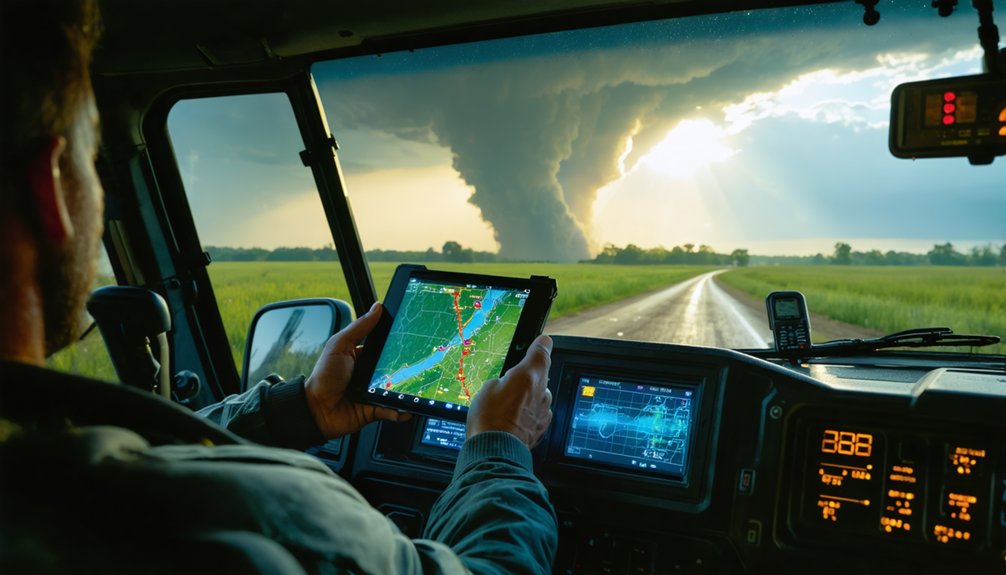
When you’re out in the field, real-time communication systems let you instantly share your GPS location with your entire team, eliminating the dangerous information gaps that have contributed to past fatalities.
You must maintain active communication links throughout every chase, as failed connectivity remains a primary cause of deadly accidents.
These systems also push live storm updates directly to you, giving your team the critical seconds needed to react when a tornado unexpectedly shifts direction.
Instant Location Data Sharing
Real-time communication systems have fundamentally changed how storm chasers stay alive in the field. You’re no longer operating blind — instant location data sharing lets your entire team track each other’s positions against shifting weather patterns and escalating storm intensity simultaneously.
If a tornado changes direction unexpectedly, your team knows your coordinates immediately, not minutes later when it’s too late.
These systems eliminate dangerous information gaps that have historically cost lives. You can broadcast your GPS position, road conditions, and escape route status to every team member in seconds.
That shared awareness isn’t just convenient — it’s what separates calculated risk from reckless exposure. Solo decisions made without team visibility contributed directly to past fatalities.
Don’t underestimate how much your survival depends on others knowing exactly where you are.
Communication Links Save Lives
Maintaining active communication links throughout a chase isn’t optional — it’s what keeps your team from becoming another cautionary statistic. Failed communication links have directly contributed to past fatal accidents, leaving chasers isolated when storms shifted unexpectedly.
Modern communication technology lets you share real-time location data and storm updates instantly, giving your entire team situational awareness that no solo effort can replicate.
But technology alone won’t save you — discipline will. You’ve got to run regular safety drills before heading out, ensuring every team member knows communication protocols when conditions deteriorate fast.
Constant check-ins aren’t bureaucratic formalities; they’re lifelines. When a tornado changes direction in seconds, your ability to warn teammates instantly is the difference between escaping cleanly and becoming another name cited in future safety reforms.
Real-Time Storm Updates
Beyond keeping your team connected, real-time communication systems have fundamentally changed what storm chasers can actually do with the data they’re collecting. Meteorological sensors mounted on chase vehicles now transmit live readings directly into shared data modeling platforms, giving every team member an updated picture of storm behavior as it evolves.
That matters because tornadoes don’t follow scripts. When a storm suddenly shifts direction, you need that information before it reaches you, not after. Real-time systems let chasers instantly share location data and storm updates across teams, enabling faster repositioning decisions.
These tools also feed verified reports directly to emergency services, extending public warning times. You’re not just protecting yourself — you’re contributing to a broader safety network that saves lives far beyond the chase corridor.
The Certifications and Field Requirements Professional Chasers Must Meet
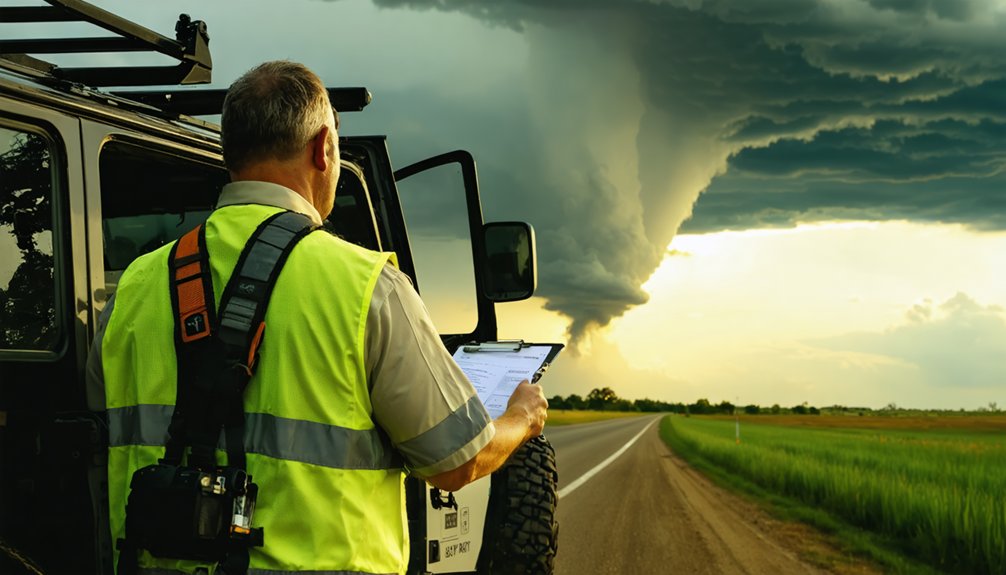
Professional storm chasing organizations have established rigorous certifications and field requirements following high-profile fatalities like those of Tim Samaras, Paul Samaras, and Carl Young in 2013.
If you’re serious about chasing, you’ll need to complete mandatory training modules covering storm mechanics, escape routing, and vehicle positioning before you ever enter the field.
Certification standards now require you to demonstrate competency in real-time radar interpretation and communication protocols.
You can’t simply drive toward a tornado without verified credentials from a recognized program.
Organizations also require you to chase alongside experienced partners until you’ve logged sufficient supervised field hours.
These requirements aren’t bureaucratic obstacles — they’re direct responses to preventable deaths.
Meeting them doesn’t guarantee your safety, but ignoring them dramatically increases your risk.
Why No Safety Protocol Can Fully Tame an Unpredictable Storm
Even with every protocol followed perfectly, you can’t engineer your way out of a storm’s fundamental unpredictability. Storm behavior shifts in seconds — direction, speed, and intensity can change faster than any escape route allows.
That reality claimed Tim Samaras, Paul Samaras, and Carl Young in 2013, all experienced researchers following established procedures. In 2024, Gene Williamson, Randall Delane Yarnall, and Corbin Lee Jaeger died in a high-speed collision near Spur, proving danger extends beyond the storm itself.
Safety protocols reduce risk perception gaps and improve survival odds, but they don’t neutralize what you can’t control. You can map routes, maintain communication, and train extensively — yet the storm answers to nothing you’ve built.
Respecting that truth isn’t defeatism; it’s the foundation of every sound decision you’ll make in the field.
What the 2024 Spur Collision Reveals About Remaining Risks
The 2024 Spur collision strips away any assumption that the storm itself is the only threat you face. Gene Williamson, Randall Delane Yarnall, and Corbin Lee Jaeger died not from a tornado’s direct strike but from a high-speed vehicle collision near Spur. No storm prediction algorithm or weather modeling system anticipated that outcome.
Road congestion, high speeds, and chaotic positioning created a fatal combination entirely separate from atmospheric conditions. You can execute perfect storm analysis and still lose control of the variables on the ground.
This tragedy confirms that your driving environment demands the same disciplined attention you give to radar interpretation. Safety protocols reduce exposure, but they don’t override human error. Staying alive requires vigilance on every front, not just the one overhead.
Frequently Asked Questions
What Specific Training Courses Are Recommended Before Someone Begins Storm Chasing?
Like Icarus flying too close to the sun, you’ll crash without preparation. Take mandatory storm safety spotting classes, study weather forecasting through recommended books, and you’ve got to chase alongside experienced partners first.
How Do Chasers Safely Position Vehicles Relative to Rotating Wall Clouds?
You must never position your vehicle in the path of rotating wall clouds. Follow strict vehicle positioning safety protocols, keep escape routes clear, and you’ll maintain the freedom to retreat when storm behavior suddenly changes.
What Should Chasers Do When No Shelter Is Available During a Tornado?
Like Odysseus facing unavoidable peril, you should get as low as possible in a culvert. Monitor weather alerts, activate emergency signaling, and stay flat to minimize debris impact when you’ve got no substantial shelter available.
Why Are Interstate Overpasses Considered Dangerous Locations During Tornado Events?
You shouldn’t treat overpasses as tornado refuge because they’re deadly overpass hazards — wind accelerates beneath them, launching debris at lethal speeds. You’re actually more exposed there than on open ground. Avoid them entirely.
How Is Video Footage From Storm Chasers Used in Spotter Training Programs?
Like Prometheus sharing fire, storm chasers’ video footage teaches you to identify tornado signatures accurately. You’ll use drone surveillance insights and safety gear knowledge, transforming raw footage into evidence-based spotter training that’s kept fatalities remarkably low.
References
- https://mashable.com/article/tornado-chasers-killed-texas-safety-questions
- https://www.kansas.com/news/article1116635.html
- https://www.cbsnews.com/minnesota/news/good-question-are-storm-chasers-making-us-safer/
- https://apnews.com/general-news-dde68b65461840b68f7f0881926a88ea
- https://www.facebook.com/groups/toledoweathernews/posts/974019185467993/
- https://www.foxweather.com/extreme-weather/el-reno-tornado-10-year-anniversary-storm-chaser-deaths
- https://gregladen.com/blog/2013/06/03/how-three-storm-chasers-died-and-what-to-do-about-it/
- https://www.atms.unca.edu/cgodfrey/courses/swfex/pdf/ChasingSafety.pdf
- https://www.rrstar.com/story/news/2013/06/08/my-view-it-s-time/44712265007/
- https://www.cnn.com/2017/03/29/us/storm-chaser-dangers