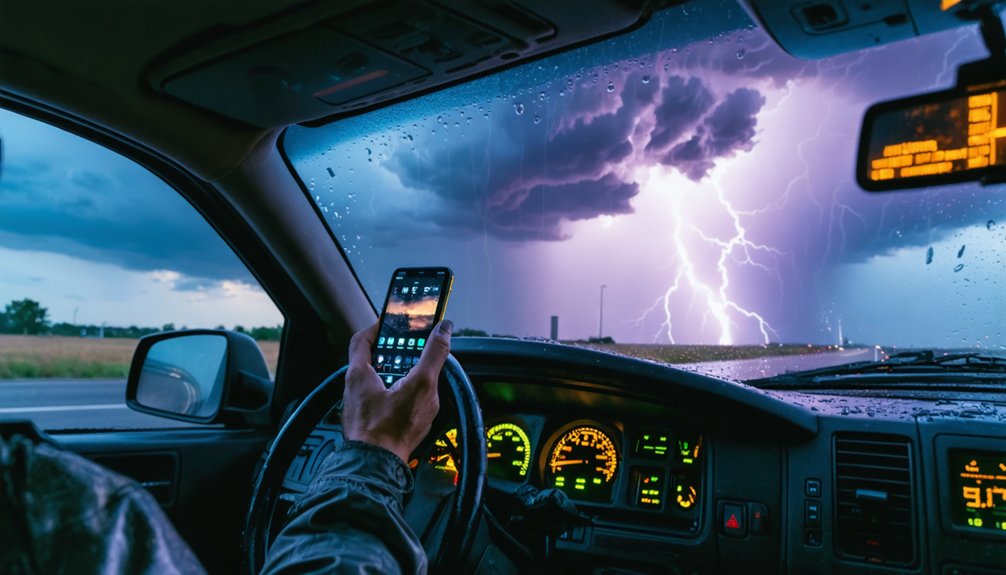
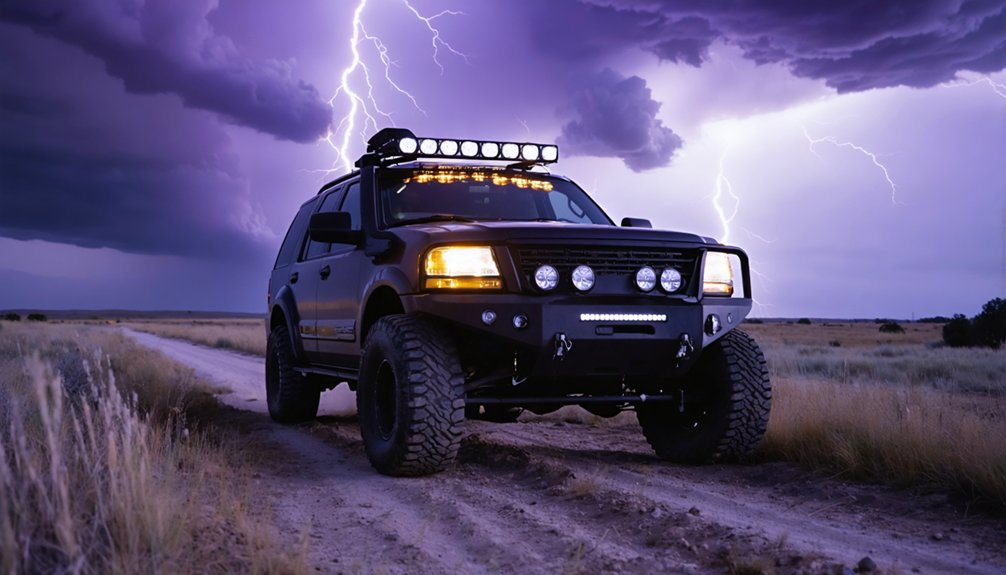
The TIV intercepts tornadoes using a steel-plated chassis with 1/8-inch armor, powered by a 625-horsepower Cummins turbodiesel that propels you into position at speeds exceeding 100 mph. You’ll deploy hydraulic spikes and metal skirts that anchor the 14,000-pound vehicle against 200 mph winds while simultaneously lowering the chassis to ground level. Inside, IMAX cameras and reinforced anemometers capture high-resolution footage and measure wind velocities up to 175 mph, while pressure sensors document barometric drops that reveal the tornado’s internal dynamics and advance prediction models through data you can’t obtain remotely.
Key Takeaways
- Reinforced steel frame with multi-layer armor plating protects against EF0-EF3 tornadoes and flying debris during intercepts.
- Hydraulic deployment system lowers chassis and extends metal spikes into ground to anchor against 200 mph winds.
- Powerful diesel engines (215-625 horsepower) enable rapid positioning based on real-time Doppler radar analysis of tornado paths.
- IMAX cameras and high-speed digital units capture unprecedented footage from inside tornado vortices for scientific study.
- Integrated anemometers and pressure sensors collect wind velocity and barometric data to improve tornado prediction models.
Built to Survive: The TIV’s Reinforced Construction and Armor System
The TIV’s survival capability begins with its steel skeleton framework, where 2-inch square steel tubing forms the primary load-bearing structure supporting 1/8-inch steel plating across both TIV-1 and TIV-2 variants. This welded steel frame provides structural integrity against EF0-EF3 tornadoes while accommodating a 48-inch turret for IMAX documentation.
You’ll find multi-layer wall construction incorporating aluminum, Kevlar, 16-gauge steel, polycarbonate, and rubber composites for protection from debris. The windshield utilizes 1.5-inch thick bullet-resistant polycarbonate capable of withstanding extreme conditions at 250 mph wind velocities. Hinged 1/8-inch steel flaps shield wheel wells, while hydraulic spikes and reinforced anchors prevent vehicle displacement.
At 14,300 pounds, TIV-2 balances armor integrity with operational mobility through strategic aluminum implementation in non-critical zones.
Power Under the Hood: Engine Specifications Across TIV Models
The TIV’s evolution required substantial powertrain upgrades to meet increasingly demanding storm intercept operations. TIV1’s factory 7.3-liter Ford Power Stroke diesel generates 215 horsepower (160 kW), whereas TIV2’s heavily modified 6.7-liter Cummins turbodiesel produces 625 horsepower (466 kW) through propane and water injection systems.
This nearly three-fold power increase directly addresses the performance limitations imposed by armor plating that brings total vehicle weight to 14,000-16,500 pounds.
TIV-1 Power Stroke Engine
Buried beneath TIV-1’s reinforced armor sits a 7.3-liter Ford Power Stroke turbodiesel engine, generating 215 horsepower (160 kW) to propel this 14,000-15,000 pound fortress through severe weather conditions. Built on a 1997 Ford F-450 Super Duty chassis, you’ll find this powerplant delivers remarkable durability despite power stroke limitations when hauling extreme weight.
The engine maintains a top speed of 100 mph while returning 8.3 miles per gallon—practical metrics for autonomous storm intercept operations.
You’ll appreciate the 60-gallon fuel capacity providing 500-mile range, essential for extended chase sequences without refueling dependencies. Air-ride suspension complements the turbodiesel’s torque delivery, though engine maintenance requirements increase considerably under continuous heavy-load operations.
This $81,000 eight-month modification prioritized reliability over raw performance, establishing baseline capabilities for tornado research missions.
TIV-2 Cummins Upgrade
Learning from TIV-1’s operational constraints, engineers selected a 6.7-liter Cummins turbocharged diesel engine for TIV-2, mounting it in a 2007 Dodge Ram 3500 4×4 chassis that would undergo extensive modifications by ATS Diesel Performance.
You’ll find propane injection advantages through enhanced combustion efficiency, while water injection performance delivers cooled intake charge temperatures and reduced detonation risk. These combined systems pushed output to 625 horsepower (466 kW) during early 2012 upgrades at Cummins facilities.
The drivetrain evolved from initial 6×6 configuration with three axles to a simplified 6×4 setup after season 2, maintaining all-wheel drive capability. You’re equipped with 92-95 US gallons (348 L) fuel capacity, enabling approximately 750 miles (1,210 km) operational range—critical for extended storm intercept missions requiring sustained chase capabilities.
Performance and Speed Comparison
Under TIV-1’s armored shell, you’ll discover a 7.3-liter Powerstroke Diesel engine extracted from a 1997 Ford F-450 Super Duty platform, producing approximately 400 horsepower through tuning modifications while constrained by a ZF 5-speed manual transmission and two-wheel drive (4×2) configuration that limited maximum velocity to 80 mph (130 km/h).
TIV-2’s evolution brought substantial performance gains: a 6.7-liter Cummins turbocharged inline-six delivering 625 horsepower through propane injection, water cooling, and ATS Diesel Performance retrofitting. You’ll achieve speeds exceeding 100 mph with four-wheel drive replacing the original six-wheel configuration. Enhanced fuel efficiency extended chase duration from 500 to 750 miles through a 92-gallon tank versus TIV-1’s 60-gallon capacity. Weight reduction from 17,000 to 14,300 pounds liberated acceleration while Dana 80 differentials with lockers maximized traction freedom across unpredictable terrain.
Anchoring Against Nature’s Fury: Hydraulic Deployment Systems
When tornado winds exceed 150 mph, the TIV’s survival depends on a precisely sequenced hydraulic deployment system that transforms the vehicle from a high-clearance chase platform into a ground-anchored observation pod.
You’ll initiate the process by releasing air from the suspension’s airbags through dump valves, lowering the chassis to ground level. Once stabilized, you’ll activate the hydraulic pump via safety switch, drawing power from the engine’s throttle. Sequential lever controls deploy metal skirts to seal the vehicle’s underside against wind lift, followed by hydraulic spikes that penetrate several feet into substrate.
This anchoring mechanism durability withstands horizontal forces from 200 mph winds, securing the TIV against displacement. The system’s autonomous deployment optimization guarantees each component activates in proper sequence, preventing catastrophic failure during intercept operations.
Capturing the Impossible: IMAX and Multi-Camera Filming Technology
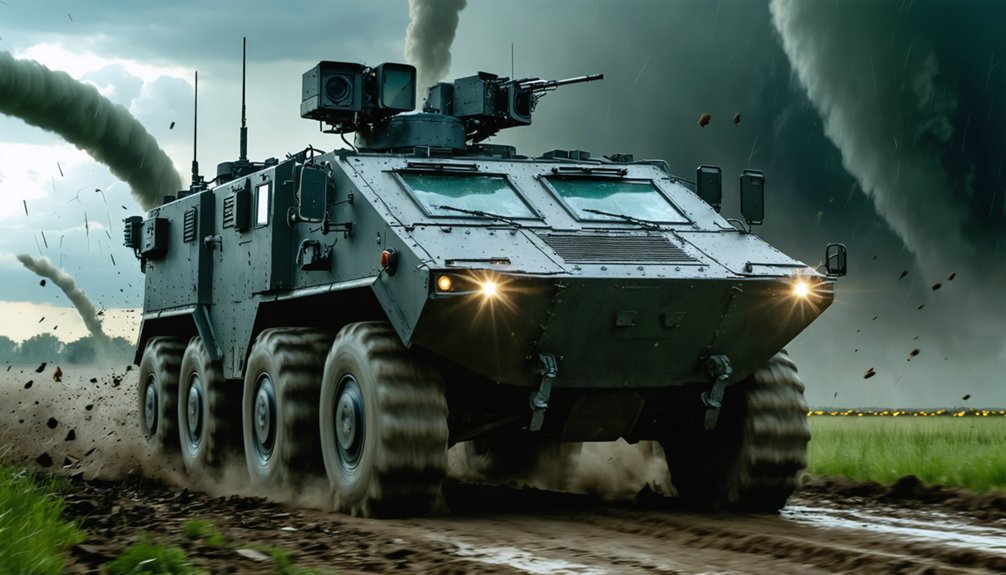
Multiple camera systems aboard the TIV simultaneously capture tornado dynamics from unprecedented proximity, combining specialized IMAX film cameras with high-speed digital units and scientific instrumentation.
You’ll find large-format 65mm IMAX cameras mounted in reinforced housings, delivering unparalleled image resolution enhancement that reveals intricate vortex structures invisible to standard equipment. Advanced sensor stabilization compensates for extreme vehicle movement and wind forces, maintaining optical integrity during violent atmospheric conditions.
The multi-camera array operates synchronously, providing stereoscopic depth perception and multiple vantage points for thorough documentation. High-speed digital units capture 1000+ frames per second, enabling slow-motion analysis of debris trajectories and structural evolution.
This integrated filming architecture transforms raw meteorological phenomena into quantifiable visual data, empowering researchers and audiences to understand tornado mechanics without institutional gatekeeping of critical atmospheric knowledge.
Weather Data Collection and Scientific Instrumentation Suite
The TIV’s instrumentation suite transforms the vehicle into a mobile meteorological laboratory, capturing critical parameters that ground-based stations can’t obtain from within tornadic vortices. You’ll find an integrated array of blade and sonic anemometers mounted on roof masts, recording wind velocities up to 175 mph before debris-induced failure, while synchronized atmospheric pressure sensors document the characteristic barometric drops associated with mesocyclone passage.
These real-time measurements, combined with multi-directional Doppler radar data from companion trucks like DOW units, generate high-resolution datasets that refine numerical prediction models and enhance understanding of internal tornado dynamics.
Real-Time Wind Speed Monitoring
Real-time wind speed monitoring aboard TIV relies on an integrated mobile weather station that captures meteorological data directly from tornado intercepts. You’ll find reinforced anemometers engineered to withstand winds exceeding 300 mph, mounted on hydraulic platforms that elevate sensors to 14 feet for unobstructed atmospheric sampling. The system’s sensor insulation protects instrumentation from debris impacts while maintaining measurement accuracy in extreme conditions.
During deployments, you’re capturing continuous wind profiles through stabilized sensors anchored by hydraulic spikes. Storm condition monitoring integrates visual tracking from the IMAX turret with radar interval data, transmitting real-time measurements to onboard computers.
The TIV has successfully logged wind speeds from 110-130 mph tornadoes, with sensor arrays engineered for direct core penetration. This autonomous data collection eliminates reliance on remote stations, delivering immediate scientific analysis.
Atmospheric Pressure Drop Measurements
At the core of TIV’s scientific mission, atmospheric pressure drop measurements provide critical data for understanding tornado dynamics through specialized instrumentation that captures barometric changes during storm intercepts. You’ll find the Hardened In-Situ Tornado Pressure Recorder (HITPR) delivering pressure drop detection through its conical, debris-resistant design that survives 90+ mph winds without moving parts.
This probe enables in situ pressure measurements directly within tornado cores, recording free-field static barometric pressure alongside temperature and humidity. The system’s captured significant drops during documented intercepts—like the 2013 Kansas tornado—where readings showed rapid pressure decreases and temperature plunges from 80°F to 74°F. These high-resolution datasets, validated through video confirmation, advance prediction models by revealing pressure signatures from the 75% of tornadoes traditionally unmeasured.
Multi-Sensor Doppler Radar Systems
Building upon atmospheric pressure measurements, multi-sensor Doppler radar systems transform TIV’s intercept capabilities by integrating WSR-88D networks, TDWR arrays, and commercial radar feeds into unified analysis platforms that detect tornado signatures through phase-shift velocity measurements and azimuthal shear calculations.
You’ll leverage radar integration techniques that combine multiple data streams, filling coverage gaps while applying evaporation corrections for enhanced precipitation accuracy. The system employs dual polarization products generating 4D reflectivity mosaics and hydrometeor classification across your operational theater.
Through WDSS-II software, you’ll analyze 0-2 km AGL azimuth shear parameters, gaining critical time advantages for positioning decisions. Mobile radar configurations detect differential velocities exceeding fixed WSR-88D capabilities, enabling real-time correlation between low-level rotation velocity and tornado intensity within your intercept zone.
Storm Chasing Strategy: How the TIV Intercepts Tornadoes
When intercepting a tornado, the TIV’s crew positions the vehicle in low-lying, structurally stable areas directly in the storm’s projected path—a calculated deployment that maximizes both data collection potential and crew survival.
You’ll find securing positioning requires real-time Doppler radar analysis to predict the funnel’s trajectory within minutes. The crew avoids mobile homes and vehicles, selecting interior zones with natural wind breaks.
Maneuvering in weather demands split-second decisions: TIV-2’s 625-horsepower Cummins engine propels the 14-ton vehicle to 100 mph for rapid repositioning. Once stationed, you’ll deploy hydraulic spikes penetrating 3 feet deep, activate six hydraulic skirts, and raise the platform to 14 feet. This anchors against 250 mph winds while the 360° turret captures unobstructed scientific footage from inside the vortex.
Frequently Asked Questions
How Much Does It Cost to Build and Maintain a TIV?
You’ll invest $81,000-$500,000 building a TIV, depending on specifications. Vehicle maintenance costs exceed fuel expenses substantially, with frequent $1,000-$5,000 repairs. Insurance requirements aren’t publicly documented, though specialized coverage’s essential for storm-chasing operations.
Can the TIV Crew Survive a Direct Hit From an EF5 Tornado?
You’ll survive EF5 winds up to 250 mph through multi-layer armor protection. The TIV withstands debris impact via Kevlar-polycarbonate composites and steel plating. During intercepts, you’ll maneuver using hydraulic stabilizers and ground anchors for operational security.
How Many People Can Fit Inside the TIV During an Intercept?
While you’d think more bodies mean better coverage, vehicle dimensions strictly limit the TIV to six occupants maximum. Crew safety protocols mandate each person requires dedicated restraints, exit access, and protective equipment—non-negotiable parameters for tornado intercepts.
What Happens if the Vehicle Tips Over During Tornado Intercept?
The TIV’s hydraulic stabilizing spikes and 14,000-pound weight distribution minimize rollover risks during intercepts. However, if structural integrity concerns arise from tipping, you’ll access multiple exit points at every seat position, ensuring crew evacuation regardless of vehicle orientation.
How Does the Crew Communicate With Other Chasers While Inside?
You’re connected to the entire storm-chasing network through the TIV’s interior communication systems. The radio stack enables real-time weather monitoring while coordinating with external teams, Doppler trucks, and research partners until atmospheric interference disrupts contact.