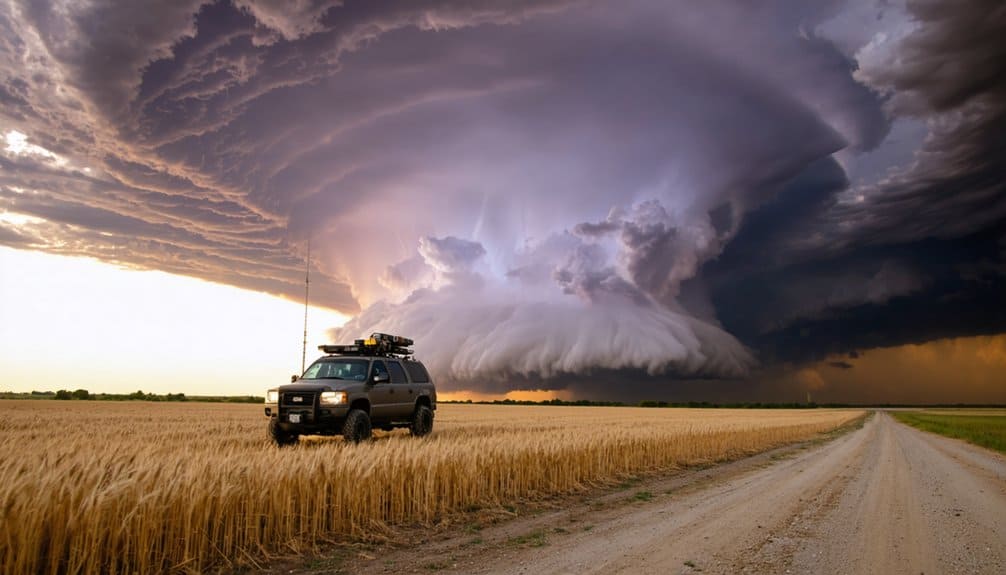
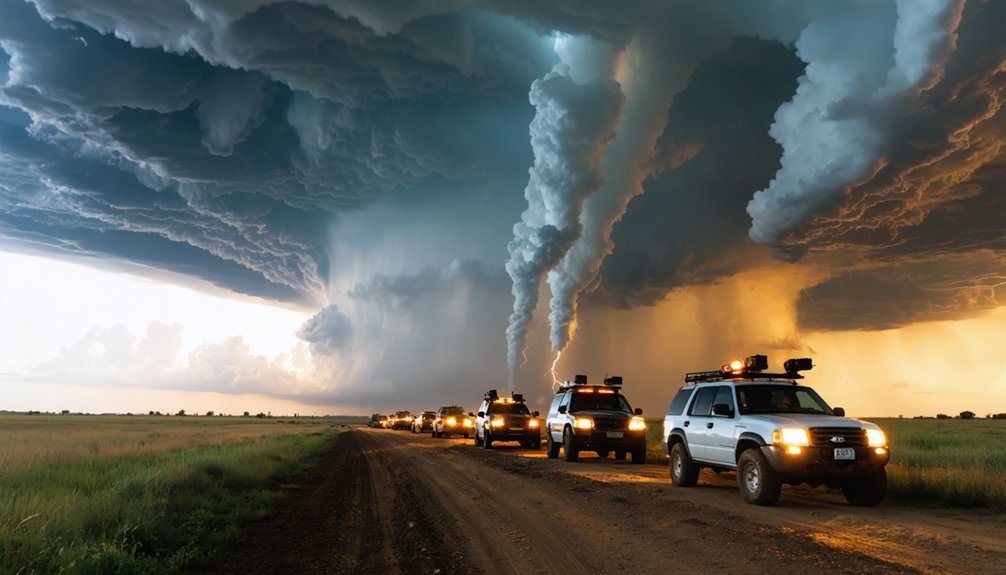
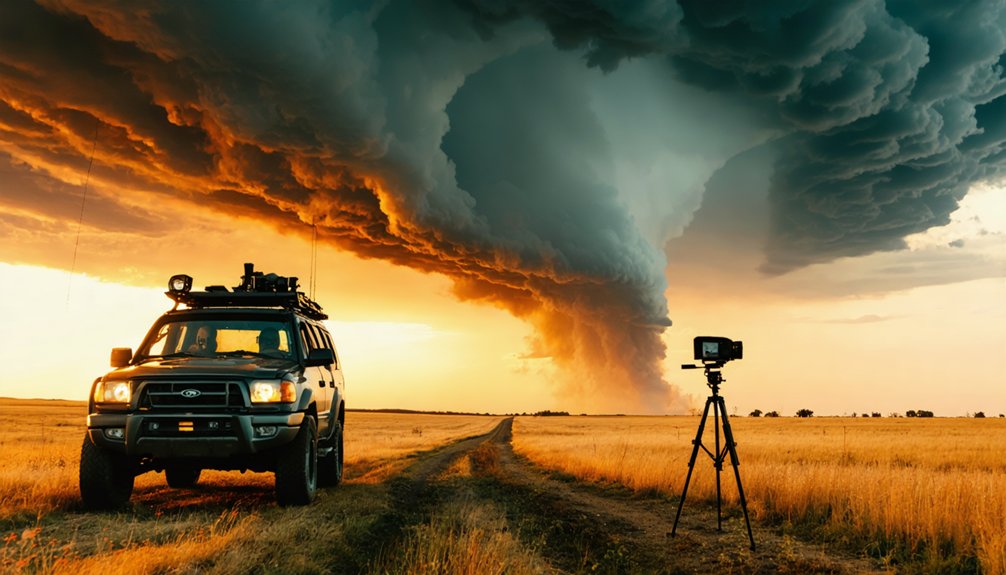
Choose a storm chasing tour by verifying the operator’s safety protocols, including weather radar systems, emergency procedures, and perfect safety records. You’ll want guides with meteorology degrees who’ve intercepted 100+ tornadoes and hold CPR certifications. Compare pricing across tour lengths—6-day packages typically cost $2,000-$2,900—while considering group size, as smaller operations (4-6 guests) offer personalized instruction versus larger convoys. Research customer testimonials and look for companies operating since 2008 with documented intercept records. The following breakdown examines each criterion in detail.
Key Takeaways
- Verify guides have meteorology degrees, 100+ tornado intercepts, and safety certifications like CPR and Emergency First Aid.
- Compare group sizes: smaller operations (4-6 guests) offer personalization while larger convoys (25-30) provide structured protocols.
- Check safety records including zero-fatality histories, weather radar systems, emergency protocols, and insurance-approved drivers.
- Review pricing for your trip length: 6-day tours cost $2,000-$2,900, while 10-day expeditions range $3,680-$4,900.
- Research verified customer testimonials, industry endorsements, and consistent tornado intercept records across independent review platforms.
Evaluate the Company’s Safety Record and Protocols
Your first priority when selecting a storm chasing tour company should be examining their documented safety record and operational protocols. Look for operators maintaining zero-incident histories over multiple seasons—several established companies have achieved 100% safety records since 1997.
Verify their risk mitigation procedures include cutting-edge weather radar, real-time data monitoring, and emergency escape route planning. You’ll want drivers approved by insurance carriers and positioned by trained meteorologists who understand storm movement patterns.
Compare their protocols against industry safety standards: limited passenger counts (6-7 per vehicle), two-van maximums for enhanced mobility, and safe distance positioning. Remember, storm chasing averages less than one fatality annually—significantly lower than skiing’s 51 deaths per year—but only when you’re operating under expert supervision with proven safety frameworks.
Consider the Experience and Credentials of Tour Guides
While detailed safety protocols provide the foundation for secure storm chasing, the expertise of your tour guides ultimately determines whether those protocols translate into effective protection and successful storm interceptions.
Tour guide expertise transforms written safety protocols into real-world protection during critical storm interception moments.
You’ll want guides with meteorology degrees who’ve intercepted 100+ tornadoes—these credentials directly impact storm positioning decisions. Look for teams holding safety certifications like CPR and Emergency First Aid, with some operators employing former EMTs for enhanced medical response capability.
Experience matters beyond forecasting ability. Veteran guides use visual cues—cloud structure, wind direction indicators, atmospheric reactions—to position vehicles ideally while tracking escape routes. Operations running since 2008 demonstrate proven track records, with established companies maintaining perfect safety records through quick decision-making amid changing conditions.
Their meteorology expertise enables proactive chasing rather than reactive positioning when conditions intensify.
Compare Pricing Across Different Tour Lengths
Storm chasing tour pricing varies noticeably across duration categories, with costs directly correlating to chase days and peak tornado season timing. You’ll find 5-day “shorty” tours ranging from $1,900 to $5,050, designed for those who can’t commit to extended expeditions during prime chase windows.
Six-day packages typically cost $2,000-$2,900, while 7-day tours hover around $3,100-$3,275. Ten-day expeditions command $3,680-$4,900, reflecting maximum storm intercept opportunities.
Inclusive pricing models cover lodging and transportation, though you’ll encounter single supplements adding $200-$350 to base rates. Diverse tour packages offer couple discounts ($100-$300) and consecutive tour savings. Budget-conscious chasers can access $1,900 minitours, while peak-season offerings reach $5,050. Evaluate per-day costs against included amenities and guide expertise for best value.
Assess Group Size and Vehicle Capacity
Group size directly impacts your storm chasing experience through mobility, safety margins, and access to your guide. You’ll find tour operators running single-van operations with 4-6 guests or multi-vehicle convoys carrying 25-30 participants, each configuration presenting distinct operational advantages and constraints.
The vehicle capacity, guest-to-guide ratio, and fleet size you select will determine your chase flexibility, stop duration, and personalized instruction throughout severe weather events.
Optimal Tour Group Sizes
The group dynamics impact becomes evident during forecasting sessions and daily briefings—intimate groups guarantee you’ll receive personalized instruction rather than getting lost among thirty participants. You’ll want operators who limit vans to six passengers despite twelve-passenger capacity, prioritizing your comfort during extended travel days.
Smaller configurations maintain close vehicle proximity during severe weather, securing both your safety and storm documentation opportunities.
Vehicle Types and Capacity
Budget operators might substitute minivans or SUVs—minivans deliver smoother rides and 20 mpg efficiency, while four-wheel-drive SUVs handle off-road positioning but cost $5,000-7,000 additional.
Guest-to-Guide Ratios
Passenger count per vehicle directly impacts your storm intercept success and overall tour experience. Large companies running multiple vans with dozens of guests maximize operations through professional debriefings and structured safety protocols, but you’ll navigate stricter discipline requirements to prevent delays that cost indispensable intercept minutes.
Small operations maintain single-van setups with fewer guests, delivering faster repositioning and constant guide access—your questions get immediate answers without PA systems or screen-sharing technology.
The impact on personalized experience separates these models: intimate groups foster direct interactions versus controlled “herd” management. Effect on communication channels proves essential when back-seat passengers miss radar updates in larger vehicles. Both ratios demand First Aid-certified guides and mandatory safety training.
Choose based on whether you value professional scale with established forecasters or flexible, close-quarters chasing with proven guides you’ve researched personally.
Research Customer Reviews and Industry Recommendations
You’ll find the most reliable performance data by examining verified customer testimonials across multiple platforms and cross-referencing them with professional meteorological organizations’ endorsements. Safety track records require specific investigation—look for documented incident reports, emergency response protocols, and whether companies employ certified meteorologists versus self-taught guides.
Industry recognition from organizations like the National Storm Chasers Association and meteorological societies provides objective validation that separates proven operators from those with compromised standards.
Check Independent Testing Organizations
Before committing to a storm chasing tour, verify the company’s reputation through independent review platforms and industry rankings. Storm Chasing USA offers unbiased comparisons of tour operators, enabling you to evaluate prices and authentic user feedback without company-filtered content.
Third party oversight from sites like Midland USA’s rankings provides objective assessments of guide credentials and operational standards.
Seek independent verification through multiple sources rather than relying solely on operator testimonials. Rankings that cite specific qualifications—like Extreme Tornado Tours’ OU meteorologist or Tempest Tours’ 200 years combined experience—demonstrate measurable expertise.
Media features on Discovery Channel and National Geographic indicate industry recognition beyond self-promotion.
Cross-reference customer experiences across platforms to identify consistent safety practices and successful chase records before booking your adventure.
Verify Safety Track Records
Safety records distinguish reputable storm chasing operators from high-risk ventures. You’ll want to verify companies maintain zero-fatality histories—the commercial tour industry has achieved this benchmark across 30 years of operations. Cross-reference customer reviews on independent platforms for specific mentions of crew safety protocols and severe weather safeguards in action. Look for patterns: experienced guides with documented tornado sightings, real-time radar positioning, and pre-tour safety briefings.
Compare fatality rates against amateur chasing statistics, which average less than one death annually since 2005. Investigate any legal actions involving operators—the 2017 Weather Channel contractor incident resulted from alleged reckless driving, highlighting why you should scrutinize driving practices specifically. Request details about guide qualifications, insurance coverage, and collaboration with meteorological professionals before committing to any expedition.
Compare Expert Industry Recognition
Evaluate operators using these criteria:
- Documented intercept records – Verify specific tornado counts and dates from actual tours, not vague promotional claims
- Independent platform reviews – Check TripAdvisor and Stormtrack forums for unfiltered experiences, including negative patterns
- Repeat customer indicators – Companies earning return bookings demonstrate consistent delivery
Ultimate Storm Chasing Tours’ mixed reviews highlight why you shouldn’t rely solely on cherry-picked testimonials. Cross-reference multiple sources to identify operators with proven track records rather than elaborate promises.
Examine the Company’s Years in Operation
When evaluating storm chasing tour operators, you’ll find that longevity directly correlates with operational expertise and safety protocols. Examine the company’s industry presence by checking their founding dates—pioneers like Storm Chasing Adventure Tours (1994) and StormTours.com (1999) demonstrate proven track records you can trust.
Explore the company’s operational longevity through tangible metrics: Tempest Tours expanded from one van to three vehicles and scaled from 20 to 200 guests since 2000, while Silver Lining Tours maintains its position as the second-oldest operator. Companies with decades of Tornado Alley experience have refined forecasting methods, established safety systems, and built infrastructure that newer operations lack.
Veterans maintain consistent tornado intercept rates and 100% safety records—critical factors when you’re investing in both adventure and personal security.
Understand the Technology and Equipment Used for Storm Tracking
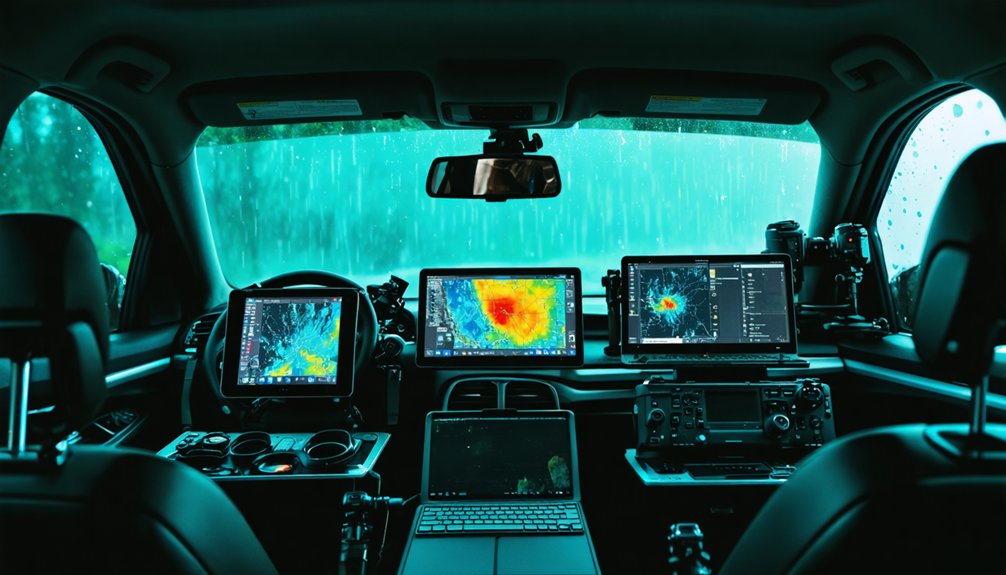
A storm chasing company’s technological arsenal separates professional operations from amateur ventures—and directly impacts your safety margin when severe weather develops. You’ll want tour operators equipped with professional-grade radar systems like RadarScope Pro or Baron Mobile Threat Net, not consumer apps. Weather sensor deployment matters—companies using Kestrel meters, anemometers, and portable stations like Tempest demonstrate commitment to real-time data analytics integration.
Essential technology indicators:
- Multi-source communication systems including satellite communicators (Garmin inReach Mini 2), ham radios, and cell boosters like WeBoost Drive Reach Overland for constant connectivity
- Advanced tracking capabilities through GPS-enabled radar apps and mesoscale analysis integration from Storm Prediction Center
- Redundant data streams combining mobile hotspots, two-way radios, and live radar for uninterrupted storm intelligence
Operators investing in research-grade equipment prioritize your experience and survival equally.
Review the Tour Duration and Scheduling Flexibility
Tour duration directly determines your storm interception probability—6-day minimum bookings provide statistically viable chase opportunities, while 10+ day expeditions maximize severe weather encounters. You’ll experience 8-12 hour field days with extended drives to target zones, requiring physical endurance and commitment to unpredictable schedules.
Seasonal timing critically affects success rates: May peaks at 242 tornadoes despite increased chaser traffic, while June’s 185 events offer balanced conditions. April provides 146 tornadoes with reduced competition.
Scheduling flexibility becomes essential since forecasts remain reliable only 48 hours out—12-hour predictions shift constantly. Companies must pivot daily based on real-time atmospheric data and jet stream positioning. You’re trading rigid itineraries for adaptive routing that follows developing convection. Most operators offer 6-10 day formats, though 7-day tours dominate industry scheduling.
Check for Professional Meteorologist Support on Tours
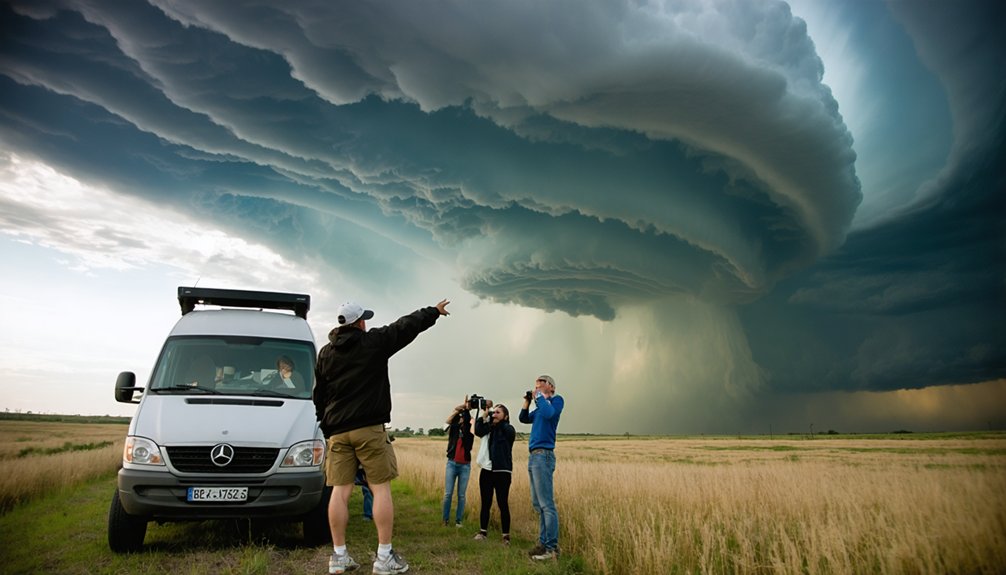
Professional meteorologist support separates legitimate storm chasing operations from amateur ventures that rely on luck rather than atmospheric science. You’ll want guides holding meteorology degrees with documented tornado intercepts—not hobbyists gambling with your safety.
Look for teams achieving measurable forecast accuracy metrics like 100% severe warning rates and 70% tornado intercept rates through numerical weather prediction models.
Essential meteorologist qualifications to verify:
- Credentials – Broadcast meteorology degrees, National Weather Service experience, or severe weather research backgrounds with hundreds of documented tornado encounters
- On-site forecasting demonstrations – Daily laptop setups explaining model interpretation, satellite imagery analysis, and real-time radar navigation decisions
- Educational integration – Morning weather briefings outlining atmospheric conditions while encouraging questions about forecasting tactics and storm structure identification
This expertise guarantees you’re chasing science, not chaos.
Frequently Asked Questions
What Happens if No Storms Occur During My Tour?
You’ll reposition strategically during dry periods, leveraging storm tracking expertise to intercept developing systems. Tour length matters—longer expeditions increase severe weather probability. You’ll still receive daily briefings, lodging, and meteorological guidance while pursuing ideal chase conditions ahead.
Are Meals and Accommodation Included in the Tour Price?
All operators include accommodation details with lodging covered nightly, but meal options vary considerably—only some provide breakfast while you’ll fund most dining independently. You’re free to choose restaurants matching your preferences and dietary requirements during chases.
What Is the Cancellation and Refund Policy?
You’ll find flexible cancellation terms vary by operator—typically non-refundable deposits ($800-$1,000) secure your spot, with refunds available 60+ days out. Thorough weather monitoring guarantees company-initiated cancellations receive full refunds, safeguarding your investment while maintaining chase freedom.
Do I Need Special Photography Equipment or Training?
You don’t need special training—just weather-sealed gear and practice. Master camera settings like aperture priority (f/5.6, ISO 400) beforehand. Tours provide weather forecasting expertise and experienced guides, letting you focus on capturing storms safely while chasing your adventure.
What Physical Fitness Level Is Required for Storm Chasing Tours?
You’ll need endurance for 6-8 hour vehicle days and quick mobility during deployments. No extreme fitness required, but you must handle weather safety precautions and meet appropriate clothing requirements while adapting to rapidly changing conditions.