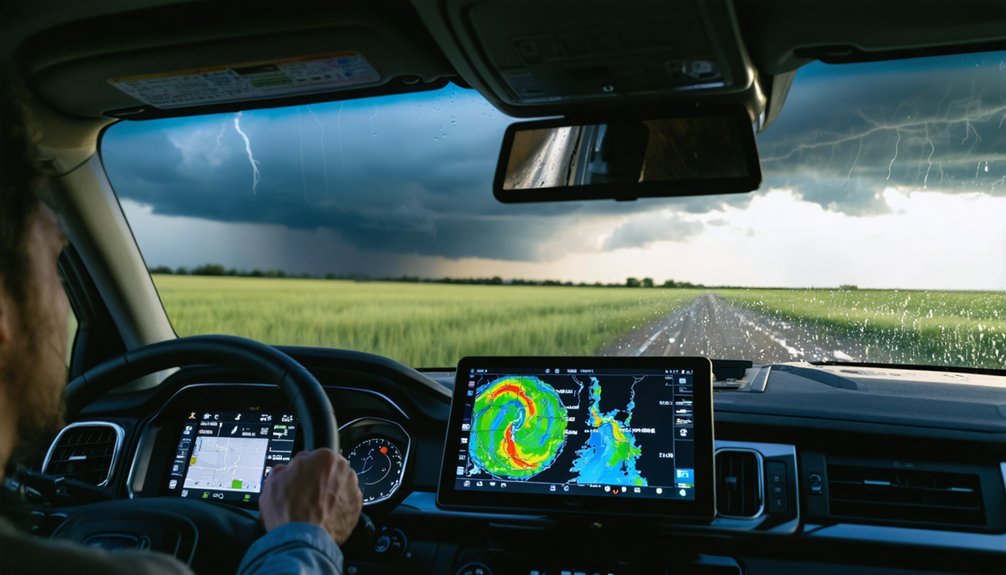
You’re witnessing a paradigm shift in meteorological science as AI-driven forecasting systems now generate sixteen-day predictions in forty minutes using just 0.3% of traditional computational resources. NOAA’s operational AIGFS and Hybrid-GEFS models combine machine learning with physics-based approaches, while low-Earth TROPICS CubeSats deliver microwave imagery every few hours at 1/100th the cost of Hurricane Hunter flights. These ensemble prediction systems achieve 10-20% smaller tropical cyclone track errors, transforming raw sensor data into impact-based forecasts that trigger automated emergency response protocols and forecast-based financing mechanisms across critical infrastructure sectors.
Key Takeaways
- AI-powered systems like AIGFS complete sixteen-day storm forecasts in forty minutes using only 0.3% of traditional computing resources.
- Low-Earth TROPICS CubeSats deliver microwave imagery every few hours, penetrating cloud tops to reveal hurricane inner core dynamics.
- Ensemble prediction models like FuXi-ENS achieve 10-20% smaller tropical cyclone track errors compared to previous forecasting systems.
- Impact-based forecasting integrates vulnerability data with meteorological predictions to automatically trigger emergency response actions and financing mechanisms.
- NOAA partnerships with technology leaders enable drone-based imaging, IoT sensor networks, and AI-enhanced storm intelligence without expanding federal infrastructure.
AI-Powered Forecasting Systems Revolutionizing Weather Prediction
The deployment of AI-driven weather models represents a fundamental shift in meteorological forecasting capabilities, with NOAA’s December 2025 launch of three operational systems demonstrating unprecedented efficiency gains. You’ll find AIGFS completing sixteen-day forecasts in forty minutes using just 0.3 percent of traditional computing resources.
The hybrid-GEFS system combines physics-based modeling with AI architectures, outperforming standalone approaches across verification metrics. Systems like Aardvark process raw sensor data directly, eliminating supercomputer dependencies.
You can now access weather predictions through open source forecasting toolkits and cloud hosted forecasting services—capabilities previously requiring hundreds of millions in infrastructure investment. This democratization enables small research groups to generate predictions on commodity hardware, while nations develop sovereign forecasting capabilities without expensive local data archives or specialized personnel.
Next-Generation Hurricane Hunter Satellites Transform Early Warning Capabilities
While traditional weather satellites orbit at altitudes exceeding 35,000 kilometers, NOAA’s TROPICS constellation operates as low-Earth CubeSats delivering microwave imagery every few hours—a temporal resolution that transforms hurricane monitoring from periodic snapshots into near-continuous observation.
The $30 million mission’s 12-channel 205 GHz imaging penetrates cloud tops, revealing inner core dynamics previously accessible only through manned aircraft reconnaissance.
STARS satellites complement this capability with observations every 2.5 hours at 1/100th the operational cost of Hurricane Hunter flights. You’ll benefit from automation of data ingestion systems processing multiple satellite feeds simultaneously, while resilient data infrastructure guarantees uninterrupted forecasts despite aging DMSP constellation retirement between 2023-2026.
These swarms enable 12-hour earlier predictions with double the accuracy—critical advantages for emergency response in countries lacking dedicated reconnaissance fleets.
Ensemble Prediction Models Delivering Unprecedented Accuracy
Modern ensemble prediction systems leverage multiple simulations with perturbed initial conditions to capture atmospheric uncertainty—a fundamental advancement over single-trajectory deterministic models that amplify minor input errors across forecast horizons. You’ll find FuXi-ENS outperforming ECMWF-ENS through advanced ensemble perturbation techniques, delivering 10-20% smaller tropical cyclone track errors and superior CRPS scores.
Key performance breakthroughs include:
- Lower RMSE across 70% of grid points at day-5 forecasts for six critical variables
- Enhanced Brier scores quantifying probabilistic event accuracy
- Improved model visualization via plume charts and percentile bands revealing forecast distributions
- Reliable uncertainty estimates enabling risk-based decision frameworks
These systems run 51-member ensembles at 9 km resolution, providing probabilistic outcomes that empower you to assess confidence levels—80% member agreement signals actionable intelligence for high-impact weather events.
Impact-Based Forecasting for Actionable Emergency Response
Modern storm monitoring systems now integrate vulnerability and exposure data with meteorological forecasts to generate impact-based predictions that quantify specific risks to infrastructure, flooding extent, and population safety.
You’ll receive actionable intelligence on pre-identified critical thresholds—such as when bridge load capacities will be exceeded or which neighborhoods require mandatory evacuation—enabling precise resource deployment before hazards materialize.
These systems automatically trigger forecast-based financing mechanisms and update emergency operation protocols, transforming probabilistic weather data into predetermined response actions calibrated to predicted severity levels.
Predicting Infrastructure and Flooding Risks
Impact-based forecasting transforms raw meteorological data into actionable intelligence by integrating real-time satellite monitoring, radar observations, and IoT sensor networks with historical storm patterns and infrastructure vulnerability assessments.
You’ll access predictive infrastructure analytics that evaluate critical sectors independently:
- Transportation networks undergo disruption modeling to identify road closures and transit interruptions before storms arrive
- Energy infrastructure receives vulnerability assessments predicting service interruption risks and grid failures
- Healthcare facilities gain continuity planning insights through dependency analysis
- Emergency services obtain operational capacity evaluations for resource positioning
Machine learning algorithms continuously refine predictions as conditions evolve, while geographic data analyzes terrain, population density, and urban development patterns. This enables urban flood mitigation strategies based on localized risk profiles rather than broad regional forecasts, empowering communities to make independent preparedness decisions.
Evacuation and Resource Allocation
When atmospheric models detect an intensifying tropical cyclone, displacement risk forecasting systems translate meteorological probabilities into quantified human impacts by integrating population exposure data with vulnerability assessments.
You’ll receive actionable forecasts specifying expected infrastructure damage—number of houses affected, population displacement estimates—enabling autonomous decision-making before landfall.
These probabilistic impact forecasts trigger forecast-based financing mechanisms, empowering Red Cross teams, UN agencies, and NGOs to position resources strategically while weather windows permit safe deployment.
Community emergency preparedness improves dramatically when warnings shift from wind speeds to severity-specific protective measures.
Humanitarian response effectiveness increases through extensive uncertainty analysis: weather forecast variability dominates at extended lead times, while vulnerability uncertainty becomes critical near impact zones.
This open-source framework democratizes advanced risk assessment globally, ensuring resource-limited regions access sophisticated anticipatory action capabilities previously unavailable.
Integration With Warning Systems
Traditional warning systems communicate meteorological parameters—rainfall totals, wind speeds, atmospheric pressure—but impact-based forecasting fundamentally reframes emergency alerts by translating these hazard metrics into anticipated consequences for lives, infrastructure, and economic systems. You’ll receive actionable intelligence about expected power outages, road closures, and structural damage rather than abstract weather data.
Multi hazard risk analysis integrates four critical components:
- Ensemble forecasting probability calculations for hazard severity and duration
- Exposure mapping of population centers and critical infrastructure
- Vulnerability assessments across built environments and economic sectors
- Emergency operations coordination protocols linking meteorological agencies with disaster management authorities
This approach enables you to implement anticipatory actions—pre-positioning resources, activating backup systems, initiating evacuations—before conditions deteriorate, maximizing your response autonomy and minimizing constraints on decision-making freedom.
Strategic Collaborations Between NOAA and Technology Leaders
Recognizing that advancing storm monitoring capabilities requires expertise beyond federal resources alone, NOAA has established five strategic Cooperative Research and Development Agreements (CRADAs) with technology leaders since 2024.
NOAA’s five strategic partnerships with private technology leaders bring critical innovation to storm monitoring beyond traditional federal capabilities.
You’ll find these partnerships addressing critical gaps in meteorological data aggregation through drone-based imaging (Disaster Imaging Inc.), AI-enhanced tropical cyclone forecasting (RenaissanceRe), and vertical atmospheric profiling via Meteomatics’ operational weather drones.
The National Hurricane Center’s collaboration with Google LLC integrates machine learning directly into storm impact prediction models, while Telops USA delivers advanced sensor measurements of the lower atmosphere.
These agreements leverage private-sector innovation—from uncrewed aircraft systems collecting post-storm damage assessments to superensemble models extending forecasts to seven days—transforming how you receive real-time storm intelligence without expanding federal infrastructure.
Real-Time Tropical Cyclone Tracking With Machine Learning
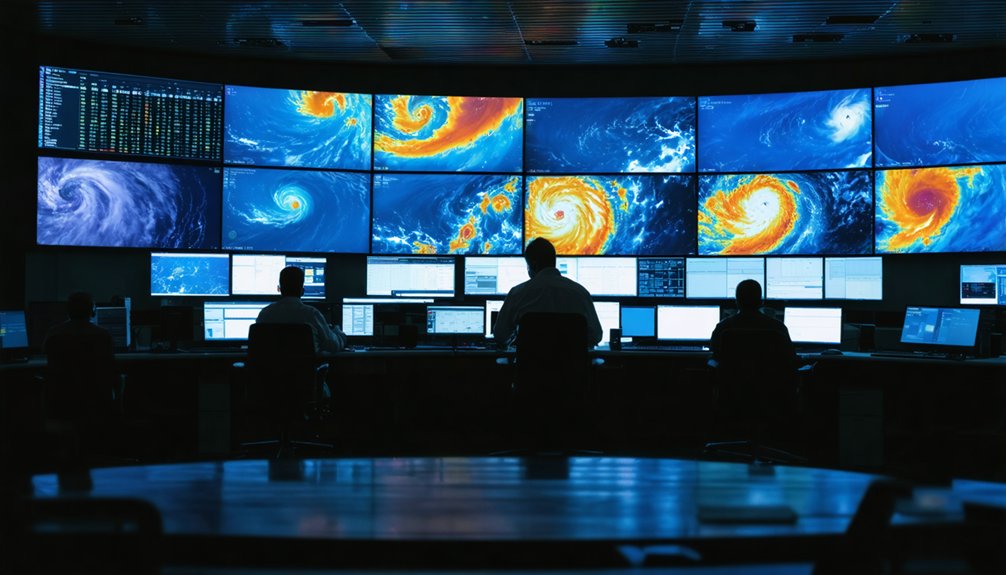
Machine learning algorithms are fundamentally reshaping how meteorologists detect and track tropical cyclones, with NOAA’s Global Systems Laboratory deploying the TCycl algorithm to process satellite imagery through pixel clustering techniques that identify storm regions of interest in real time.
Deep learning networks now deliver 24-hour forecasts in seconds by fusing trajectory data with atmospheric reanalysis fields, trained on 90,000+ time steps from 3,000 storms since 1979.
Key operational advantages you’ll observe:
- Detection speed through distributed computing architectures processes massive datasets faster than manual identification methods
- Prediction accuracy within 2.2 mb for pressure and 2.4 knots for wind speed
- Track forecasting averaging 140 km closer to actual positions in 5-day predictions
- Model interpretability enables random forest classifiers achieving 93% accuracy in categorical status predictions
Hyperspectral Satellite Constellations Providing Minute-by-Minute Storm Updates
While conventional geostationary satellites revisit storm systems hourly, emerging CubeSat constellations equipped with miniaturized microwave sounders now deliver atmospheric measurements every 15-30 minutes—a temporal resolution that captures the critical early stages of rapid intensification.
MIT Lincoln Laboratory’s technology, licensed through Tomorrow.io’s TROPICS program, has compressed traditional instruments to 1/100th their original size. These shoebox-sized satellites penetrate cloud cover to measure temperature, moisture, and atmospheric chemistry composition continuously.
Combined with NOAA’s Advanced Baseline Imager scanning targeted areas every 30 seconds and hyperspectral infrared sounders providing enhanced spectral detail, you’ll access unprecedented data density.
Spire Global’s HyMS constellation extends this coverage globally, enabling real time damage assessment and hyperlocal forecasts for aviation, logistics, and emergency management—particularly across data-sparse oceanic regions where traditional monitoring fails.
Industry Applications Across Energy, Insurance, and Risk Management Sectors

- Energy Operations: NOAA models deliver 18-24 hours additional lead time for tropical cyclones, enabling preemptive infrastructure hardening
- Insurance Underwriting: AXA generates thousands of hurricane scenarios through FourCastNet for catastrophe model benchmarking
- Risk Mitigation: GraphCast produces 10-day forecasts in 60 seconds for rapid scenario planning
- Cross-Sector Intelligence: Public-private data sharing through NOAA-Google partnerships provides NHC with near-real-time hazard forecasts
Case Studies Demonstrating AI-Human Collaboration in Recent Storm Events
Beyond theoretical capabilities and sector-wide adoption, recent hurricane seasons have validated AI forecasting systems through direct operational deployment. WeatherMesh’s Hurricane Ian predictions demonstrated 200-kilometer accuracy improvements over National Weather Service forecasts at 70-hour lead times, while Pangu-Weather and Aurora models successfully tracked eight 2022 global storms including typhoons Hinnamnor, Muifa, and Nanmadol across both Atlantic and Pacific basins.
Colorado State University’s CIRA researchers developed satellite imagery decision support systems that enhanced National Hurricane Center communications, exemplifying productive human-AI collaboration. These validations occurred despite intensity prediction challenges—though Google DeepMind’s tropical cyclone model shows promising progress.
Open source forecasting algorithms and global data sharing initiatives now enable communities with limited meteorological resources to access sophisticated prediction capabilities, reducing traditional barriers to advanced storm monitoring technology.
Frequently Asked Questions
How Much Does It Cost to Deploy Ai-Powered Forecasting Systems?
Initial deployment costs you mere cents per forecast after training, with operational expenses dramatically lower than supercomputers. However, you’ll face increased maintenance requirements from tariffs on data center components, though cloud solutions offset these burdens considerably.
What Happens When AI Predictions Conflict With Traditional Forecaster Assessments?
Walking a tightrope between algorithms and expertise, you’ll find forecasting collaboration becomes essential—meteorologists examine model transparency, cross-validate predictions against physical constraints, and ultimately retain decision authority since AI lacks understanding of unprecedented extremes beyond training data.
Can Developing Countries Access These Advanced Satellite and AI Technologies?
Yes, you’ll find affordable satellite access through CubeSat constellations and Tomorrow.io’s commercial licensing. Capacity building initiatives like UKCEH-ANACIM partnerships in Senegal provide training, nowcasting tools, and data integration—empowering underserved regions with independent forecasting capabilities.
How Is Public Data Privacy Protected in Impact-Based Forecasting Systems?
Your personal information stays shielded through robust data anonymization techniques that aggregate population-level insights rather than tracking individuals. Systems employ cybersecurity best practices with controlled access protocols, ensuring forecasts deliver life-saving warnings without compromising your fundamental privacy rights.
What Backup Systems Exist if AI Models Fail During Emergencies?
You’ll find backup power supplies maintain critical infrastructure while human forecaster oversight guarantees continuity through traditional methods: manual crew dispatch, phone-based coordination, historical data analysis, ground inspections, and standard emergency alert systems operating independently of AI dependencies.