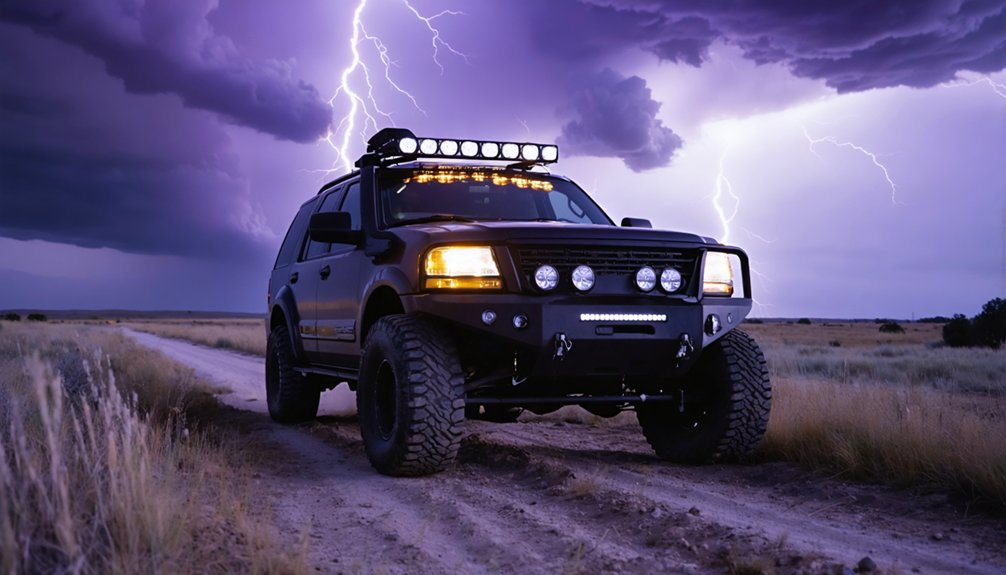
You’ll maximize storm chasing SUV seating by choosing three-row platforms like the Suburban or Expedition, then implementing fold-down configurations that preserve equipment access. Mount essential gear to dashboards and center consoles using modular systems like BuiltRight Mounts, keeping sightlines clear for all observers. Install Luno Seatback Organizers and cargo hammocks to eliminate floor clutter while maintaining rapid egress capability. Your crew benefits from cost-sharing fuel expenses and observation coverage, though you’ll need suspension upgrades to handle the additional weight. Guaranteeing platform-specific modifications certifies every passenger contributes effectively to your chase operations.
Key Takeaways
- SUVs with fold-down seat systems provide flexible passenger capacity while maintaining storage space for essential storm chasing equipment.
- Modular seating configurations with removable or split-folding rear seats allow quick adaptation between crew transport and gear storage modes.
- Third-row seating options in full-size SUVs maximize passenger capacity without compromising front-seat access to mounted equipment and controls.
- Vertical storage solutions like cargo hammocks and seatback organizers preserve seating while keeping emergency gear accessible during active chases.
- Full-size vans offer superior seating comfort and capacity compared to SUVs when extreme off-road capability isn’t required for terrain.
Choosing the Right SUV Platform for Multi-Passenger Storm Chasing
When selecting a multi-passenger vehicle for storm chasing operations, you’ll face a fundamental choice between full-size vans, minivans, and SUVs—each offering distinct trade-offs in capacity, terrain capability, and operational costs.
SUVs deliver superior off-road performance with four-wheel-drive systems and ground clearance for traversing debris-strewn roads. Models like the Suburban or Tahoe provide safety advantages while maintaining long distance dependability. However, you’ll pay $5,000-7,000 more than comparable minivans and sacrifice fuel efficiency—critical when maximizing your chase range. Interior adaptability suffers too, as SUVs can’t match minivans’ removable seating configurations.
For tours capping at six passengers per vehicle, full-size vans offer ideal comfort without crowding, ensuring two passengers per row. Your terrain expectations ultimately determine whether SUV capability justifies the premium over more economical alternatives.
Configuring Interior Layouts to Accommodate Full Crews
When you’re outfitting your storm chase SUV for a full crew, you’ll need fold-down seat systems that maximize passenger capacity while preserving critical equipment access. Install removable or split-folding rear seats that drop flat to create storage zones for cameras, radios, and weather instruments without forcing team members into cramped conditions.
Mount your essential gear—radios, displays, and camera controls—to the center console and dashboard using velcro or quick-release brackets, positioning monitors and gadgets high enough to maintain forward visibility while keeping them within arm’s reach of all crew positions.
Fold-Down Seat Systems
How do storm chasers balance maximum crew capacity with the equipment demands of mobile meteorology? Your fold-down seat systems provide the answer through modular seating configurations that adapt to mission requirements. Standard chase SUVs feature 60/40 split-folding rear seats with quick-release levers, allowing one-person reconfiguration between crew transport and equipment hauling modes.
Strategic rear hatch organization transforms your vehicle within seconds:
- Seats upright: Full 5-person crew capacity with harnesses secured
- Single side folded: Three crew members plus weather instrumentation access
- Both sides down: Two-person operation with expanded sensor array deployment
- Fold-flat configuration: Emergency sleeping quarters during extended pursuits
You’ll maintain storm visibility from front positions while optimizing rear space for your specific chase objectives. This flexibility guarantees you’re never choosing between crew experience and operational capability.
Equipment Mounting Solutions
Your interior mounting strategy directly impacts crew safety and operational efficiency during high-speed storm intercepts. BuiltRight Dash Mounts deliver modular organization solutions through vehicle-specific engineering, securing phones, GPS units, and radar detectors within your line of sight during rough roads.
You’ll maintain hands-free device durability with RAM Mounts IntelliSkin cases featuring drop-proof quick-release charging that withstands abuse. Position laptop trays at arms-reach alongside radar displays without obstructing crew space in your SUV’s compact setup. No-drill stands and twist-lock suction cups provide detachable access while preserving your vehicle’s resale value.
Mount hard-wired dashcams like Blackvue DR750X-2CH units to windshields for continuous documentation. This configuration maximizes seating capacity by eliminating loose equipment while ensuring critical devices remain accessible during chase maneuvers.
Balancing Gear Storage With Additional Seating Positions
The fundamental challenge of storm chasing vehicle configuration lies in maintaining passenger capacity while maximizing equipment accessibility. You’ll need strategic solutions that don’t sacrifice seating positions for gear storage.
Raised platform systems let you keep rear seats functional while creating storage underneath for bins containing medical supplies, food, and water. The platform doubles as a sleeping surface when you’ve pulled an all-nighter tracking supercells.
Consider these space-efficient mounting options:
- Wall-mounted rail systems with clips securing equipment without floor space consumption
- Luno Seatback Organizers providing water bottle holders and headlamp compartments at eye level
- Cargo Hammocks creating collapsible overhead storage that won’t block passenger entry
- Mesh Gear Duffels offering see-through organization beneath seats
Interior lighting upgrades and onboard power management complete your configuration, ensuring you’re chase-ready without compromising crew capacity.
Fuel Capacity Requirements for Extended Range With Multiple Occupants
Once you’ve optimized your interior layout for both passengers and equipment, fuel capacity becomes your limiting factor for sustained pursuit operations. You’ll need 60-92 gallons to achieve 500-750 mile ranges that match TIV-proven specifications. Each additional occupant reduces MPG through added weight, making diesel engines like the 6.7L turbo Cummins essential for maintaining efficiency under load.
When you’re covering 3,500 miles weekly across Plains states with 20-50 mile station spacing, modifying suspension for range prevents fuel slosh while supporting heavier tanks. Optimizing aerodynamic efficiency through streamlined cargo placement counteracts headwind penalties during extended pursuits.
Calculate your requirements by multiplying realistic highway MPG by tank capacity—20 MPG with 25 gallons outperforms 25 MPG with 15 gallons when you’re running 10-12 hour operations in extreme conditions.
Visibility and Safety Features for All Passenger Positions
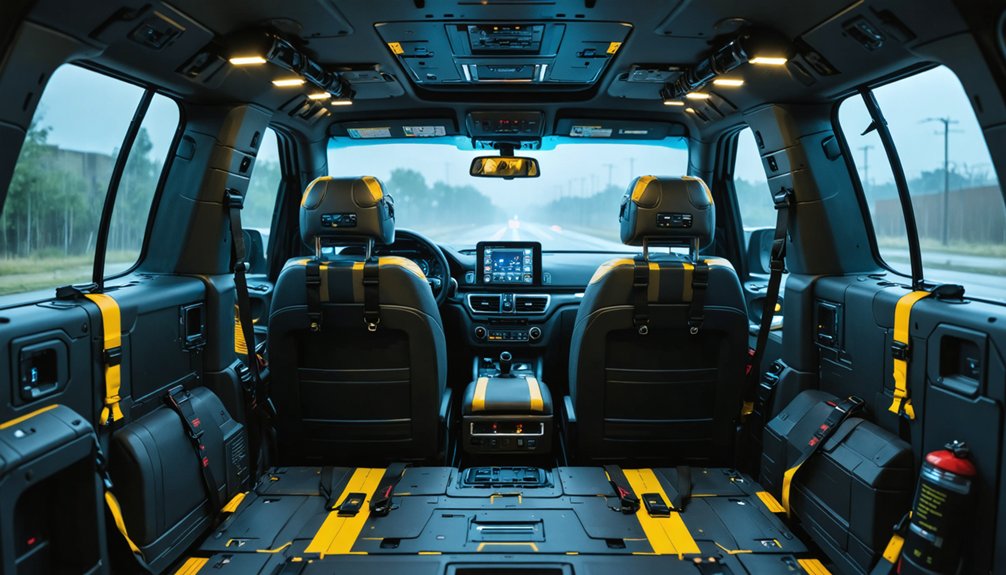
When you’re carrying multiple passengers in storm chasing operations, each occupant position must provide adequate visual access to storm features and surrounding hazards while maintaining protection from hail impact. Elevated seating configurations inherent to SUV platforms offer improved sky visibility for all occupants, though strategic seat assignments should prioritize experienced observers in positions with ideal sight lines for critical decision-making.
You’ll need to verify that reinforced window protection systems don’t compromise visibility from second and third-row positions, and that multiple exit points remain accessible and functional regardless of which side faces the approaching storm core.
Elevated Seating for Observation
Elevated seating positions in storm chasing SUVs provide every passenger with unobstructed sightlines to developing weather phenomena while preserving critical safety standards. You’ll experience superior observation angles compared to sedan-based platforms, where elevated camera mounts capture storm features from ideal heights while meeting driver visibility requirements without forward obstruction.
Your chase team benefits from:
- Panoramic roof installations allowing simultaneous sky observation across all seating positions during supercell development
- Raised SUV chassis positioning occupants above roadway debris and improving sight angles to wall clouds and mesocyclones
- Strategically mounted overhead displays mirroring primary storm data without blocking windshield views
- Rear-positioned observer seats maximizing south-southeast visibility where rotation typically develops
This configuration guarantees you’re capturing critical atmospheric data while maintaining mobility and escape readiness when conditions intensify rapidly.
Multiple Exit Point Access
Storm chasing SUVs incorporate redundant exit configurations that guarantee you’ll maintain safe egress options regardless of vehicle orientation relative to approaching weather systems. TIV’s 1.63-inch polycarbonate windows on multiple sides let you visually assess exterior egress routes before deployment, while Dominator 3’s 360-degree Lexan windows enable thorough threat evaluation from any passenger position.
You’ll coordinate emergency exit deployment through noise-controlled intercom headsets, ensuring synchronized evacuation when conditions permit. Hydraulic anchoring spikes stabilize the platform during 250-mph winds, preventing vehicle displacement that’d compromise your planned escape routes.
The six-wheel drive configuration with front hub lockers guarantees you’ll reach alternative exit points through mud or debris fields. Front and rear winches provide self-recovery capability, maintaining your operational autonomy when traditional egress paths become obstructed by terrain obstacles.
Reinforced Window Protection Systems
Because your survival depends on maintaining situational awareness while protected from projectile debris, reinforced window systems in storm chasing SUVs must balance optical clarity with structural integrity across all passenger positions. Multi-ply laminate performance determines whether you’ll maintain visual tracking capabilities during hail bombardment without compromising occupant safety.
Critical protection elements include:
- Polycarbonate-glass hybrid layers maintaining 92% optical transmission while absorbing kinetic energy from debris impacts
- Edge-to-edge bonding systems preventing catastrophic delamination when hailstones strike peripheral vision zones
- Quick-release mechanisms on reinforced windows enabling emergency egress from any seating position
- UV-stable interlayer films preserving clarity through repeated thermal cycling during multi-day deployments
Window durability testing protocols should verify resistance to 2-inch diameter hail at terminal velocity. Your rear passengers need identical protection standards—compromised visibility anywhere creates tactical blindspots during critical maneuvering.
Off-Road Capability Modifications That Preserve Seating
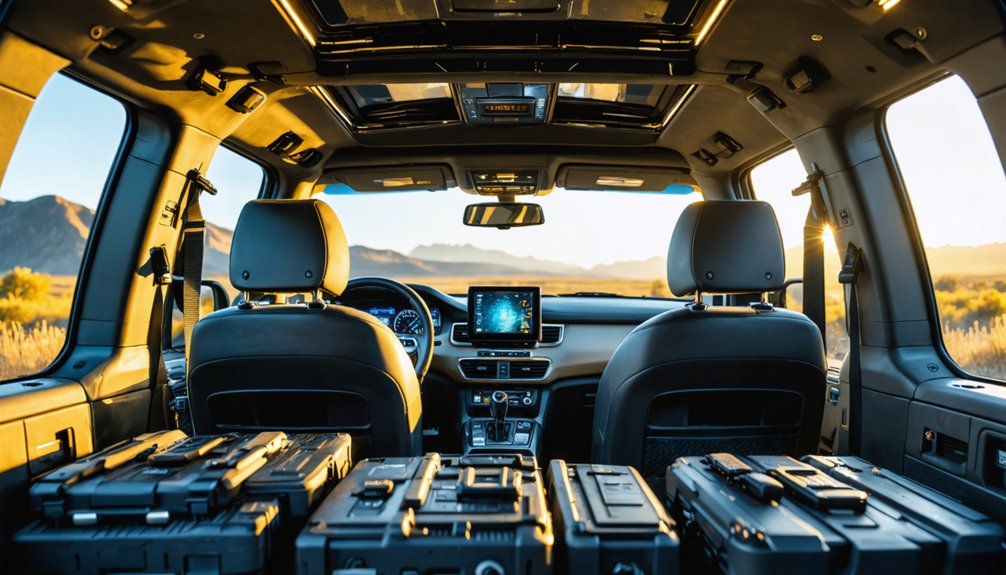
Most off-road modifications for storm chasing SUVs install externally or beneath the chassis, allowing you to maintain full seating capacity while gaining critical terrain capability. Lightweight suspension kits like Cognito’s 4-6″ lift increase ground clearance without compromising your crew cab configuration. You’ll fit 35×12.5×17 all-terrain tires underneath while preserving passenger agility for rapid deployment.
Custom brush guard fabrication replaces plastic bumpers with welded steel protection that accommodates a 12,000 lb winch—1.5 times your GVWR for self-recovery situations. Underbody armor including 1/4″ AR500 skid plates prevents oil pan damage during aggressive terrain navigation.
Your drivetrain modifications—440HP Duramax tuning, traction bars, and on-board air systems—install without invading cabin space. Every upgrade prioritizes exterior mounting, ensuring you won’t sacrifice a single seat when conditions demand full team deployment.
Equipment Integration Without Sacrificing Passenger Space
While exterior upgrades protect your SUV from terrain hazards, interior equipment integration demands equally strategic planning to guarantee passenger capacity. You’ll need compact, modular solutions that consolidate technology without consuming valuable seating space.
Strategic equipment placement maintains full passenger access:
- Dashboard-mounted laptops with RAM bases enable quick setup for single-operator broadcasting while keeping rear seats clear
- Custom center consoles house computers, touchscreens, and radio equipment in pre-installed configurations requiring only face plates
- Overhead flip-down LCD screens mirror primary monitors for passengers without dashboard obstruction
- Integrated wireless routers and cellular boosters eliminate bulky external components
Power source redundancy certifies continuous operation during extended chases. Specialized cooling solutions like upgraded rear A/C blowers counteract heat from multiple electronics. Your freedom depends on efficient integration—technology that enhances capability without compromising the human element of storm pursuit.
Cost-Sharing Benefits of Higher Capacity Storm Chasing Vehicles
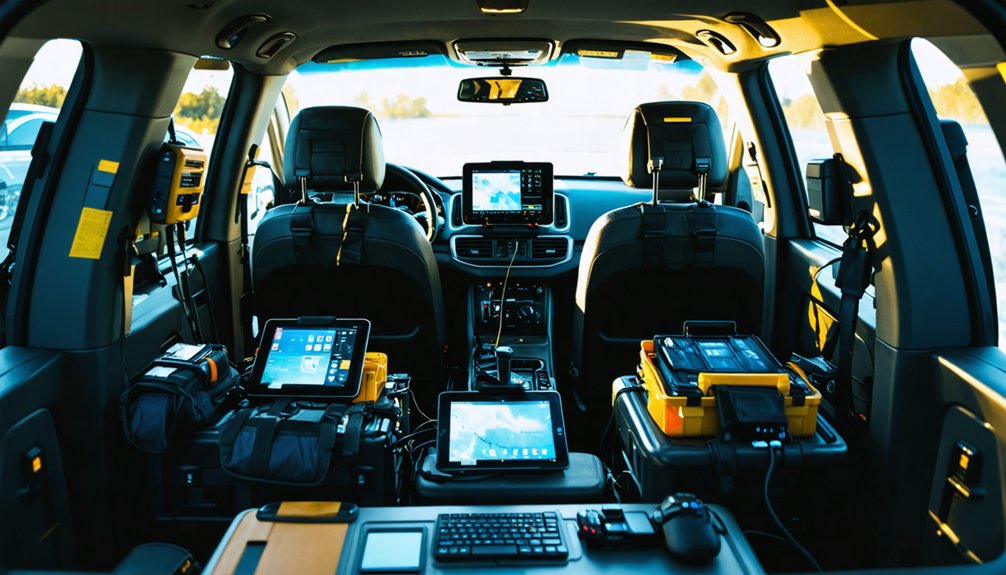
Storm chasing economics shift dramatically when you distribute operational expenses across multiple crew members. A minivan achieving 23-25 MPG highway becomes cost-effective when four occupants split fuel expenses on 500-mile pursuits.
You’ll offset higher initial vehicle costs under $28K by sharing customization investments—all-terrain tires, reinforced suspension, and communication equipment. SUVs seating 4+ people transform expensive interstate travel into affordable adventures through shared refueling and maintenance contributions.
Tour operators leverage this model by equipping vehicles with passenger safety features like stability control and side-curtain airbags, then distributing operational costs across paying participants. Your chase team benefits from multi modal transportation options—sleeping platforms eliminate hotel splits, while cargo capacity reduces rental needs.
Large-capacity vehicles with 60-92 gallon tanks provide 500-750 mile range, letting groups chase efficiently without frequent fuel stops that drain budgets.
Frequently Asked Questions
What Insurance Considerations Apply When Adding Extra Passengers to Storm Chasing Vehicles?
You’ll need higher liability coverage limits since extra passengers increase injury exposure during chases. Implement strict passenger safety protocols, ensuring everyone’s secured properly. Standard policies don’t restrict capacity, but you’re risking premium hikes if claims mount from overloaded pursuit vehicles.
How Do Multiple Occupants Affect Vehicle Weight Distribution During Severe Weather?
Multiple occupants shift your vehicle’s center of gravity forward, requiring weight distribution sensors and tire pressure monitoring to maintain stability. You’ll need balanced passenger placement, proper suspension adjustment, and real-time monitoring systems for ideal traction during severe weather pursuits.
Are There Legal Passenger Limits for Modified Storm Chasing SUVS?
You’ll follow your vehicle registration requirements specifying manufacturer-rated capacity. Beyond that, there aren’t storm-specific passenger limits, but you’re responsible for implementing passenger safety precautions. Commercial operators self-regulate below maximum capacity for liability protection and operational effectiveness.
What Communication Systems Work Best for Coordinating Between Multiple Crew Members?
You’ll get ideal crew coordination using two-way radios with intercom headsets for emergency communication protocols, plus 4G LTE cellular boosters enabling wireless data streaming of radar feeds—giving your team real-time freedom to respond independently yet stay connected.
How Often Should Suspension Components Be Inspected With Increased Passenger Loads?
When you’re pushing your rig’s limits with extra crew, you’ll want suspension maintenance intervals every 6,000-8,000 miles. Don’t skip tire tread depth inspections either—they’ll reveal hidden wear patterns before component failure compromises your storm-chasing independence.