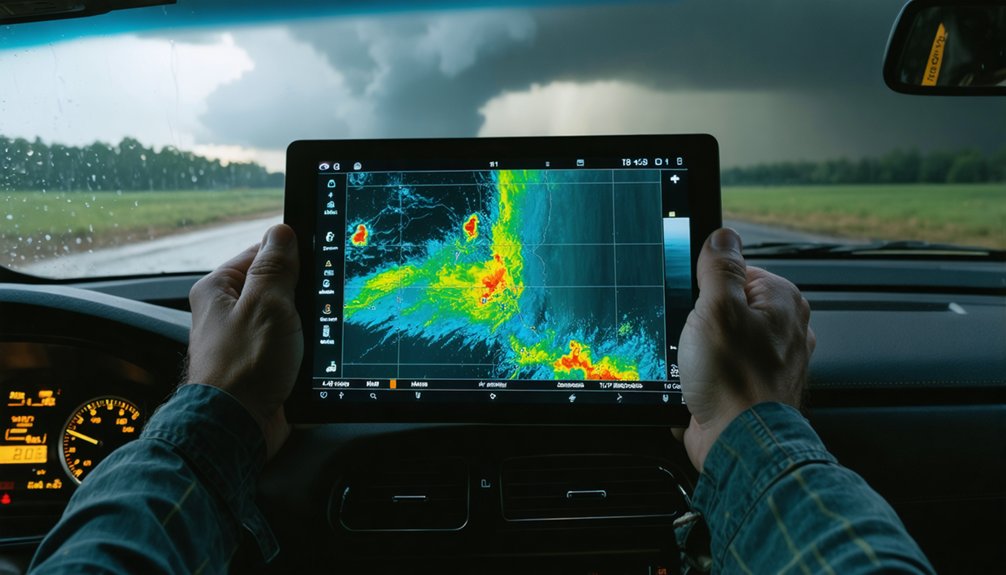
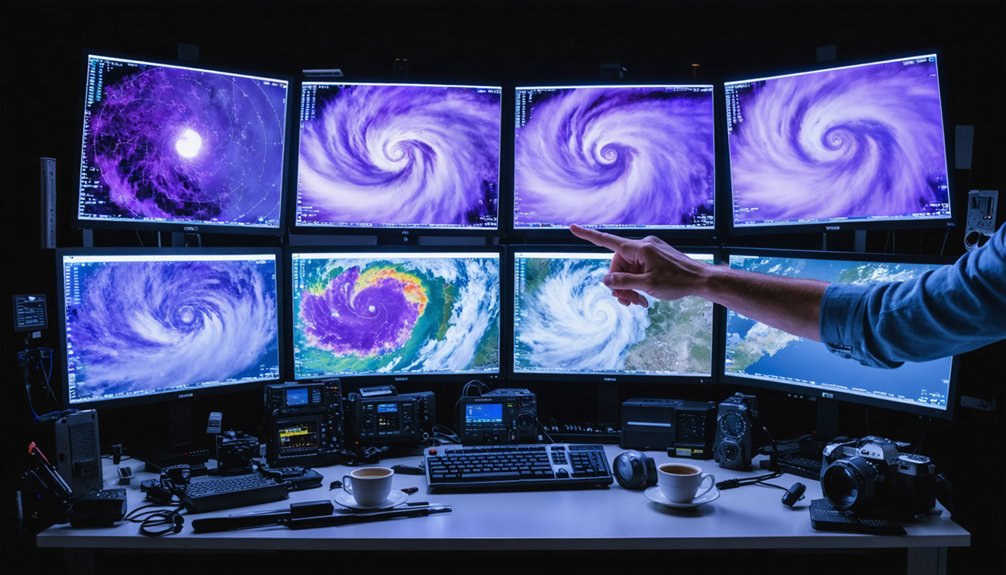
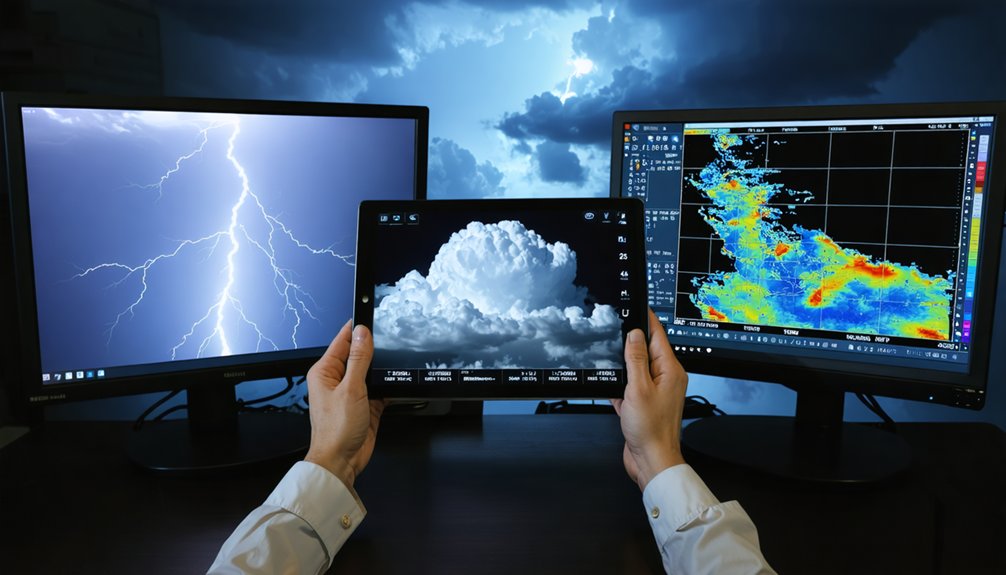
You’ll analyze lightning for storm prediction through five proven methods: ground and space-based detection networks that triangulate electromagnetic pulses, Lightning Potential Index models quantifying updraft electrification using CAPE and instability parameters, data assimilation techniques that inject real-time observations into forecast systems, lightning jump algorithms detecting flash rate changes with 75-81% accuracy and 20-minute lead times, and machine learning frameworks achieving 76% prediction accuracy. These complementary approaches transform raw lightning data into actionable severe weather intelligence that enhances your forecasting capabilities beyond traditional radar-only methods.
Key Takeaways
- Lightning Detection Networks use ground and space sensors to monitor electromagnetic pulses, employing triangulation to pinpoint strikes and track total flash activity.
- Lightning Potential Index quantifies storm electrical charging using atmospheric instability metrics like CAPE, Lifted Index, and temperature profiles for prediction.
- Data Assimilation injects real-time lightning observations into forecast models, adjusting humidity and convection parameters to improve storm timing and location accuracy.
- Lightning Jump Analysis detects rapid flash rate increases, providing 20-23 minute severe weather warnings with 75-81% detection probability.
- Machine Learning models predict lightning location and intensity using neural networks and random forests, achieving over 75% accuracy for short-term forecasts.
Lightning Detection Networks And Total Flash Monitoring
Modern lightning detection relies on complementary ground-based and space-based networks that collectively monitor electromagnetic pulses across multiple frequency ranges. Ground systems employ ELF sensors for wide-area coverage and higher-frequency networks for enhanced in-cloud detection, using triangulation to pinpoint strike locations.
Proprietary networks deliver 20 times standard frequency ranges, advancing lightning energy analysis capabilities. Space-based instruments like the Geostationary Lightning Mapper operate at near-infrared wavelengths, detecting total lightning activity without infrastructure constraints. These systems distinguish between cloud-to-ground and in-cloud discharges—the latter comprising over 80% of all events.
Combined datasets enable lightning climatology modeling and decadal tracking databases, providing you thorough storm characterization tools. This dual-approach architecture delivers continuous monitoring across remote regions where traditional radar coverage remains limited.
Computer Model Integration Using The Lightning Potential Index
Computer models transform raw lightning detection data into actionable forecasts through the Lightning Potential Index (LPI), a diagnostic tool that quantifies electrical charging within thunderstorm updrafts. You’ll leverage CAPE, Lifted Index, and theta-e lapse rates as core instability measurements, while 850 mb temperature provides seasonal adjustments to prevent cold-month over-prediction.
The Weather Research and Forecasting (WRF) model enables your operational forecast workflow through improved microphysics parameterizations—Purdue Lin, WSM6, WDM6, and Goddard schemes each handle six hydrometeor classes differently, requiring validation for specific applications.
ECMWF’s Integrated Forecasting System delivers global lightning predictions with ensemble skill extending to day 3, achieving accuracy on temporal scales above 6 hours and spatial scales exceeding 50 kilometers. Python tools streamline data manipulation, empowering you to generate independent forecasts without institutional constraints.
Data Assimilation Techniques For Enhanced Forecast Accuracy
Real-time lightning observations sharpen numerical weather predictions through data assimilation algorithms that inject convective information directly into model initial conditions. You’ll leverage 3DVAR methodology and Ensemble Kalman Filter techniques to assimilate flash rate data from networks like BrasilDAT and NLDN.
These systems enable humidity adjustments in the atmospheric column where lightning indicates active convection, modifying model physics to force or suppress convective schemes accordingly. You can control Kain-Fritsch parameterization based on lightning presence, improving convection representation by 40% in 24-hour forecasts.
Lightning-nudging functions work particularly well for large-scale systems and squall lines, refining both timing and positioning. This approach proves invaluable where traditional radar coverage remains sparse, giving you autonomous forecast capability without infrastructure dependence.
Lightning Jump Analysis For Severe Weather Warnings
While data assimilation refines forecast models through continuous lightning observations, you’ll find that abrupt changes in flash rates provide immediate tactical warnings for imminent severe weather. Lightning jump algorithms detect when total flash rates exceed two standard deviations above baseline trends—signaling intensified updrafts and storm electrification characteristics that precede hail, damaging winds, or tornadoes.
You’ll achieve 75-81% probability of detection with 20-23 minute lead times by tracking spatial temporal flash trends through ground-based networks or satellite sensors. The 2-sigma configuration requires minimum thresholds of five flashes per minute, validating jumps against severe reports within 45-minute windows. Though false alarm ratios reach 36-55%, you’re gaining critical decision autonomy when integrating this methodology with radar analysis for real-time operational forecasting.
Machine Learning Applications In Lightning Prediction Systems
How can forecasters anticipate lightning activity before storm electrification becomes detectable? Machine learning systems now deliver thunderstorm intensity estimation two days earlier than conventional methods by processing satellite based lightning climatology alongside meteorological variables.
You’ll find Conv-GRU networks with attention mechanisms excel at predicting lightning location and frequency trends, while LSTM and GRU models achieve 75%+ accuracy for short-term forecasts. Random forest classifiers reach 76.9% accuracy using geometric cloud thickness, rain rate, and CAPE as top predictors.
Hybrid approaches combine dynamical weather forecasts with ML algorithms, enabling autonomous prediction without traditional electrification signatures. Tree classifiers processing optical flow error from satellite imagery deliver 96% accuracy for 15-minute to 5-hour forecasts, empowering you to make independent decisions during severe weather events.
Frequently Asked Questions
How Does Lightning Activity Indicate Rapid Hurricane Intensification?
You’ll observe lightning activity bursts preceding maximum winds by approximately one day, with 0.95 correlation explaining 90% of wind variability. These inner-core flashes reliably forecast hurricane intensity trends through enhanced convection and vorticity generation mechanisms.
What Atmospheric Conditions Trigger Eyewall Lightning Bursts in Tropical Systems?
Extraordinarily unstable atmospheric static charge builds when intense moisture flux patterns converge in the eyewall, releasing massive latent heat. You’ll observe convective bursts driven by high CAPE values, warm sea surfaces, and vertical instabilities fueling explosive updrafts.
How Far in Advance Can ECMWF Models Skillfully Predict Lightning Occurrence?
You’ll find ECMWF ensemble forecast skills reliably predict lightning occurrence up to three days ahead, with excellent accuracy on 6-hour temporal scales. These models effectively capture seasonal lightning trends across continental domains, though resolution degrades below 50-km spatial averaging.
What Spatial and Temporal Scales Provide Accurate Deterministic Lightning Forecasts?
You’ll achieve accurate deterministic lightning forecasts at spatial scales above 50 km and temporal scales beyond 6 hours, where charge separation processes and microphysical factors impacting lightning become statistically significant, enabling reliable prediction of thunderstorm electrification dynamics.
How Do Ice Particles and Graupel Contribute to Charge Formation Regions?
Electrostatic charge separation occurs when you observe ice crystals gaining positive charge and graupel formation processes creating negatively charged particles through collisions. You’ll find updrafts transport lighter crystals upward while denser graupel descends, establishing distinct charge regions.