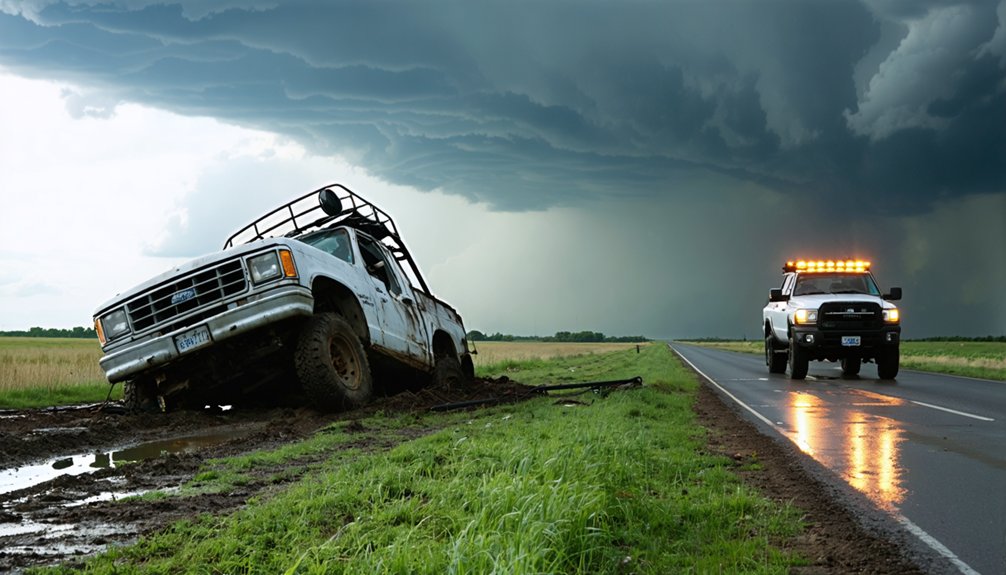
On May 31, 2013, you lost three of storm science’s most dedicated truth-seekers—Timothy Samaras, Paul Samaras, and Carl Young—to the very forces they spent their lives trying to understand. They weren’t thrill-seekers; they were precision researchers whose TWISTEX instrumentation was reshaping tornado science. The El Reno tornado‘s violent northward pivot and rain-wrapped obscuration made survival impossible within seconds. Their sacrifice permanently transformed safety protocols and community ritual alike, and there’s far more to uncover about what they left behind.
Key Takeaways
- Timothy Samaras, Paul Samaras, and Carl Young were lost on May 31, 2013, during the unprecedented El Reno tornado.
- The El Reno tornado defied predictive models, shifting northward violently at speeds exceeding 50 mph, making survival impossible.
- A physical memorial at El Reno anchors their sacrifice, serving as a gathering point for the storm chasing community.
- Storm chasers honor Timothy Samaras’s memory through a McDonald’s burger dashboard ritual, keeping his presence alive in the field.
- Their legacy transformed storm chasing safety protocols, emphasizing escape routes, wider berths, and constant radar communication.
Who Were Timothy Samaras, Paul Samaras, and Carl Young?
Three names stand at the center of one of storm chasing’s most tragic chapters: Timothy Samaras, his son Paul Samaras, and Carl Young, all killed on May 31, 2013, when the El Reno tornado struck their vehicle.
You’ll find the Samaras legacy rooted in rigorous field research — Timothy documented severe storms for National Geographic and earned recognition as one of the profession’s most respected figures. Paul shared that same drive, pursuing storm research alongside his father with quiet dedication.
Carl Young’s contributions brought essential scientific grounding to the team; he taught extreme weather and geology at Lake Tahoe Community College and served as the TWISTEX team’s meteorologist and navigator.
Together, they weren’t just chasers — they were researchers pushing the boundaries of what you could learn from nature’s most violent forces.
What Happened on May 31, 2013 in El Reno?
On May 31, 2013, a single tornado reshaped storm chasing history in ways the community hadn’t anticipated. The El Reno tornado‘s tornado dynamics defied standard predictive models, initially tracking southeast before violently shifting northward. It exceeded 50 mph, wrapping itself in rain that obscured its true trajectory from experienced chasers.
You’d recognize how this fundamentally challenged chasing ethics—even seasoned professionals operating within established safety protocols couldn’t anticipate this storm’s erratic behavior. The tornado’s unprecedented size and violent intensity created conditions where situational awareness became nearly impossible to maintain.
Timothy Samaras, Paul Samaras, and Carl Young were struck by their vehicle during this catastrophic encounter. Their deaths weren’t products of recklessness—they represented a sobering reminder that nature ultimately dictates its own terms, regardless of your expertise.
Who Was the TWISTEX Team and What Were They Trying to Prove?
When you study the TWISTEX team, you’re examining one of storm chasing‘s most disciplined research units, led by Timothy Samaras and supported by his son Paul and on-board meteorologist Carl Young.
You’ll find their core mission centered on deploying instrumented probes directly into tornado paths to capture ground-level pressure, temperature, and wind data that conventional methods couldn’t reach.
Their work wasn’t spectacle-driven — it was a methodical push to fill critical gaps in tornado science, particularly in understanding near-surface atmospheric dynamics.
TWISTEX Team Origins
The TWISTEX team — short for Tactical Weather Instrumented Sampling in Tornadoes EXperiment — was built around Timothy Samaras’s singular obsession: placing scientific instruments directly in a tornado’s path to capture data no researcher had reliably gathered before.
Understanding TWISTEX origins means understanding what conventional storm research couldn’t deliver. Standard weather stations couldn’t withstand direct tornado contact. Samaras engineered probes that could. He assembled a lean, purposeful crew around that mission — his son Paul, who shared his father’s drive for severe weather documentation, and Carl Young, whose meteorological expertise provided critical navigational precision in the field.
Together, they weren’t chasing spectacle. They were closing measurable gaps in atmospheric science. Each deployment pushed instrumentation closer to the vortex, generating ground-truth data that modelers and forecasters genuinely needed to improve tornado prediction and public safety.
Their Research Goals
From that foundation of precision instrumentation, TWISTEX’s research goals come into sharp focus. The team pursued direct tornado measurement, deploying probes into storm paths to capture pressure, temperature, and wind data that remote sensing simply couldn’t deliver.
You’d understand their mission as fundamentally about freedom — freedom from uncertainty, freedom from preventable death. They wanted to decode storm patterns that kill communities and strip people of everything they’ve built.
Their research methodologies centered on ground truth: placing instruments where the violence actually occurs, then surviving to analyze the results. Timothy Samaras believed precise data would ultimately improve warning systems, buying ordinary people more time to escape.
Every deployment carried risk. But TWISTEX accepted that risk deliberately, believing knowledge earned through sacrifice protects the lives of those who’d never even see a storm coming.
Why the El Reno Tornado Caught Expert Chasers Off Guard?
Even seasoned chasers like the TWISTEX team couldn’t have fully anticipated the El Reno tornado‘s sudden northward pivot after it initially tracked southeast. This shift placed them directly in its path with little warning.
You’d have found the dense rain wrapping around the storm further complicated accurate trajectory assessment, masking the tornado’s true movement until escape routes were severely compromised.
At speeds exceeding 50 miles per hour, the storm closed the gap between safety and catastrophe faster than standard repositioning protocols could counter.
Tornado’s Sudden Direction Change
Although experienced storm chasers had positioned themselves based on the tornado’s initial southeast trajectory, the El Reno twister abruptly shifted northward — catching even the most seasoned researchers off guard.
Understanding tornado dynamics means accepting that storm patterns don’t always follow predictable models.
The tornado’s directional shifts happened with brutal speed, exceeding 50 miles per hour after its course change. Rain wrapping further obscured its actual trajectory, stripping away your ability to visually track its movement.
When you’re monitoring a storm this size and intensity, standard safety measures can become dangerously inadequate within seconds.
What happened to Timothy Samaras, Paul Samaras, and Carl Young wasn’t a failure of expertise — it was a sobering reminder that nature operates beyond human calculation, demanding perpetual respect from those who pursue it.
Rain Obscured Actual Path
Beyond the tornado’s violent course shift lay another, equally lethal factor: rain wrapping. As you track storms, you’ll understand that rain visibility directly compromises your situational awareness.
On May 31, 2013, dense precipitation curtained the El Reno tornado‘s actual trajectory, masking its true position from even the most experienced teams.
When you’re executing storm tracking in real-time, you’re relying on visual confirmation alongside radar data. But rain wrapping stripped that visual confirmation entirely.
The Samaras team couldn’t see what the storm was actually doing beneath that wall of precipitation. Even sophisticated instruments couldn’t compensate fast enough for the tornado’s accelerating movement.
This deadly combination — obscured sightlines plus unprecedented speed — removed every safety margin these researchers had carefully built into their field protocols.
Nature had simply outmaneuvered them.
Storm’s Unprecedented Speed
What made the El Reno tornado so catastrophic wasn’t just its violence — it was its speed. The storm’s dynamics shifted without warning, accelerating beyond 50 miles per hour after an abrupt northward turn. You couldn’t have anticipated that.
Even experienced teams with professional instruments struggled to process the rapid directional change in real time. Chaser safety depends on reading predictable behavior — and El Reno defied every established pattern.
The tornado’s extraordinary pace compressed your decision window to near zero. What appeared manageable became unsurvivable within seconds. Timothy Samaras, Paul Samaras, and Carl Young weren’t reckless; they were experienced professionals caught in genuinely unprecedented storm dynamics.
Understanding this speed anomaly isn’t about assigning blame — it’s about honoring their sacrifice by learning exactly what overtook them.
How the Storm Chasing Community Grieved and Rallied After El Reno
When the El Reno tornado claimed Timothy Samaras, Paul Samaras, and Carl Young on May 31, 2013, the storm chasing community absorbed a loss it hadn’t experienced before.
You’d recognize the grief in how chasers gathered at the El Reno memorial, standing beside the field where the team was found. Community resilience emerged through collective action — researchers, educators, and field operators united around shared purpose rather than retreat.
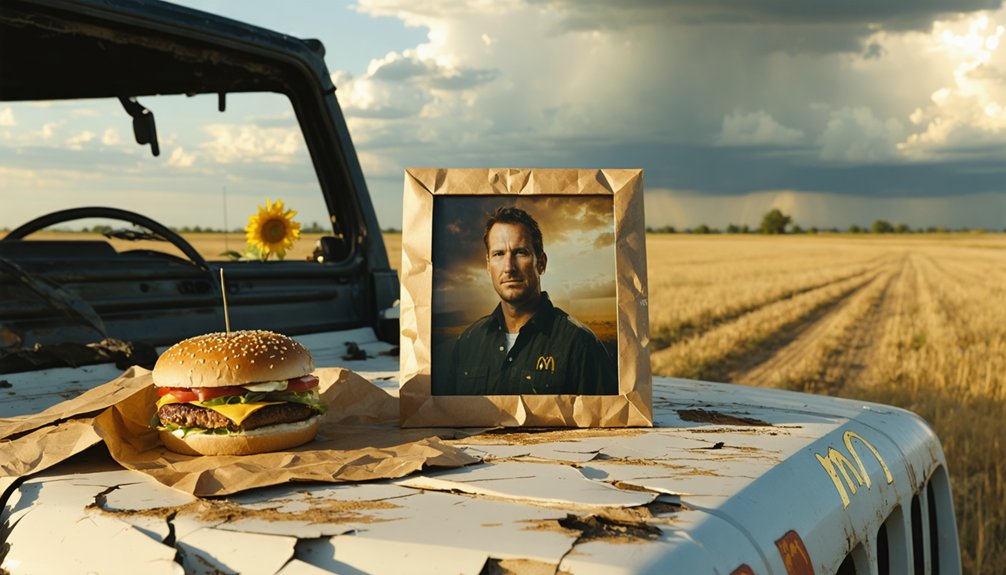
Emotional healing took a concrete form: chasers began placing McDonald’s burgers on their dashboards, honoring Timothy Samaras’s superstition and keeping his presence alive in the field.
Chasers keep a McDonald’s burger on the dash — a quiet ritual that carries Timothy Samaras into every storm.
The three weren’t mourned passively. Their discipline, humility, and sacrifice reshaped how you approach severe weather research — as a pursuit worth honoring through rigorous, informed, and respectful practice.
What El Reno Changed About Storm Chasing Safety Protocols
The El Reno tornado didn’t just claim three lives — it exposed critical gaps in how storm chasers assessed risk in real time. After May 31, 2013, the community rewrote its storm safety standards fundamentally.
You now operate under protocol changes that prioritize escape routes before positioning. Rain-wrapped tornadoes demand wider berths. Speed and direction assessments must account for rapid course reversals — El Reno shifted northward without warning, trapping experienced teams who’d read the storm correctly moments before.
Modern chasers maintain constant communication with mobile radar operators. You’re trained to treat tornado size estimates as unreliable until verified.
These aren’t bureaucratic rules — they’re lessons purchased at an extraordinary cost. Timothy Samaras, Paul Samaras, and Carl Young’s deaths transformed cautious fieldwork from preference into professional obligation.
The El Reno Memorial and What It Represents
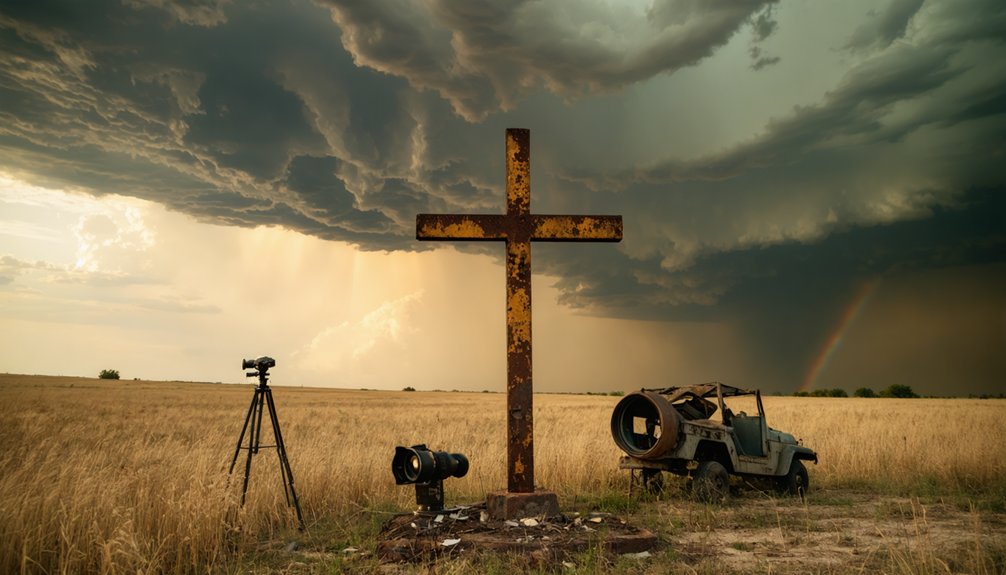
Beyond protocol rewrites and operational checklists, something more permanent took shape beside the field where Timothy Samaras, Paul Samaras, and Carl Young were found — a physical memorial in El Reno that anchors their sacrifice in a specific place and time.
When you visit that site, you’re standing inside memorial significance made concrete. The storm chasing community gathered there to honor three researchers who gave everything pursuing atmospheric truth. They weren’t reckless — they were experienced, disciplined professionals overwhelmed by an unpredictable storm.
The community impact radiates outward from that marker. Chasers remember them as role models, not cautionary figures. You carry their legacy every time you deploy equipment responsibly.
That memorial doesn’t just commemorate loss — it defines what this profession demands and what it’s genuinely worth protecting.
The McDonald’s Burger Tradition and Other Rituals That Honor Samaras
Memorials don’t always take the form of stone and plaque — sometimes they live in the small, deliberate rituals that a community quietly adopts and carries forward.
Among storm chasers, the McDonald’s Tribute stands as one such practice. You’ll find active chasers placing a McDonald’s burger on their dashboard before heading into the field — a direct nod to Timothy Samaras’s personal superstitions.
This chasing ritual connects you to his legacy every time you roll toward a developing storm system. It’s a quiet acknowledgment that his discipline, precision, and sacrifice shaped how the profession operates today.
You’re not merely following superstition — you’re participating in a living memorial that keeps Samaras’s standard present inside every vehicle pointed toward dangerous weather.
Why Timothy Samaras, Paul, and Carl Young Still Matter to Storm Science
Rituals and burgers on dashboards speak to how deeply Timothy Samaras, Paul Samaras, and Carl Young shaped the storm chasing community’s identity — but their influence runs far deeper than cultural tradition.
Their work directly advanced your understanding of storm impact — specifically how tornadoes behave unpredictably at close range. Timothy’s instrumentation methods gave science precise, ground-level data that satellites couldn’t capture.
Carl Young’s meteorological expertise sharpened navigational decision-making in the field, while Paul’s documentation contributed visual records researchers still reference.
Their deaths reshaped chaser safety protocols, forcing communities to confront how quickly conditions can change direction and speed. You now chase with protocols informed by their sacrifice.
Their legacy isn’t simply memorial — it’s operational, embedded in every safety decision you make before you ever leave the vehicle.
Frequently Asked Questions
Yes, Timothy and Paul Samaras shared the same birthday, a remarkable birthday significance that deepened their bond. You’ll find their shared experiences extended beyond storm chasing, uniting them in life, passion, and ultimately, an unforgettable legacy.
What Subject Did Carl Young Teach Before Joining TWISTEX?
Before joining TWISTEX’s storm chasing team, you’d recognize Carl Young’s educational background included teaching extreme weather and geology at Lake Tahoe Community College, where he’d shaped minds before dedicating his expertise to atmospheric research.
Where Exactly Is the El Reno Memorial Physically Located?
Like a beacon anchoring El Reno history, you’ll find the memorial standing beside the field where the team was discovered. Its Memorial significance runs deep, marking the exact ground where three storm chasers made their final stand.
How Fast Was the El Reno Tornado Moving When It Shifted?
When the El Reno tornado shifted direction, you’re looking at tornado dynamics that accelerated past 40 mph northward — a brutal storm tracking reality that caught even seasoned chasers off guard, costing lives tragically.
What Personal Trait Was Paul Samaras Most Remembered For?
You might think storm chasers are reckless, but Paul Samaras embodied a gentle spirit. His dedication to science and passion for storms reflected reverence for all life, making him truly unforgettable among those who’ve chased freedom through violent skies.
References
- https://okcfox.com/news/local/twistex-memorial-dedicated-to-3-killed-in-el-reno
- https://www.youtube.com/watch?v=jRd0S4jU0d8