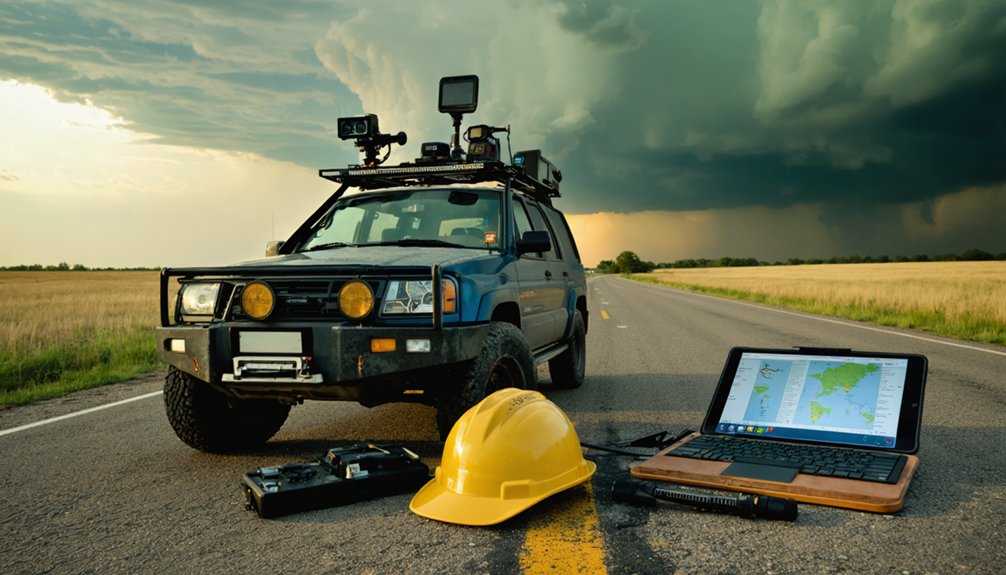
Ryan Hall launched his YouTube meteorology channel after the December 2021 Mayfield tornado outbreak, transforming severe weather coverage through rapid-fire delivery and unfiltered analysis. You’ll find his signature style broadcasts tornado warnings minutes faster than traditional media, pulling 50,000 concurrent viewers during outbreaks while integrating professional-grade tools like Weatherwise radar and WeatherFlow Tempest stations. His million-view forecasts—including the viral “Really Strange Storm” video—built a 3-million-subscriber base through marathon streams that prioritize technical precision over commercial constraints, earning him recognition as the internet’s weatherman through democratized meteorological communication that connects storm chasers with affected communities in real-time.
Key Takeaways
- Launched YouTube channel during December 2021 Mayfield tornado outbreak, providing real-time warning counts and analysis beyond official bulletins.
- Signature rapid-fire delivery condensed complex meteorological data into digestible 15-second segments using purpose-built production infrastructure.
- Marathon live streams offered uninterrupted severe weather coverage, connecting storm chasers with communities faster than traditional media.
- Democratized professional meteorology by integrating free tools like Weatherwise radar app and WeatherFlow Tempest stations for viewers.
- Viral forecast videos like “A Really Strange Storm Is Coming” consistently exceeded one million views, building 3-million-subscriber base.
From Broadcast Meteorology Student to Digital Weather Pioneer
Ryan Hall’s meteorological trajectory began with childhood fascination, progressing through formal studies at Mississippi State University where he earned an associate’s degree in science with concentrated coursework in broadcast meteorology—though he never completed the full bachelor’s program.
His degree pursuit provided technical foundation in atmospheric dynamics and weather pattern analysis, but traditional television broadcasting proved incompatible with personal autonomy. During college, he conducted on-air weather segments at an Eastern Kentucky station, gaining operational experience in forecast delivery.
Television weather demanded conformity, but Hall’s Eastern Kentucky broadcasts revealed an industry fundamentally at odds with independent meteorological expression.
However, broadcasting constraints immediately surfaced: mandated beard removal, accent modification requirements, and rigid presentation protocols. These institutional limitations contradicted freedom-oriented values, prompting strategic pivot from conventional media.
Recognizing emerging digital platforms‘ potential for unfiltered meteorological communication, Hall abandoned the traditional TV weatherman track, positioning himself as an innovative digital forecaster before 2021’s social media meteorology surge.
Launching a YouTube Channel That Changed Weather Coverage
The December 2021 Mayfield tornado outbreak catalyzed Hall’s transformation from regional digital forecaster to nationally-recognized weather communicator, with live stream coverage delivering real-time warning counts and supplemental analysis that filled critical gaps beyond National Weather Service bulletins. This milestone demonstrated how independent creators could leverage advanced weather visualization tools to democratize life-saving information outside traditional broadcast constraints.
Hall’s real time forecasting evolution continued through events like the January 5, 2025 winter storm, where early-launch streams and extended multi-part coverage provided continuous monitoring unavailable through conventional media. The integration of his free Weatherwise radar app, Y’all-O-Meters, and WeatherFlow Tempest stations created an ecosystem where viewers accessed professional-grade meteorological tools previously reserved for institutional gatekeepers.
The Up-Tempo Style That Captivated Millions of Subscribers
You’ll notice Hall’s signature rapid-fire delivery transforms dense meteorological data—model ensembles, helicity parameters, SPC outlooks—into digestible 15-second segments that sustain viewer retention through 8-hour severe weather marathons.
His production pipeline integrates live radar composites, animated jet stream analyses, and real-time probability updates at a cadence that mirrors the temporal resolution of mesoscale convective events themselves.
This kinetic approach converts traditional forecast discussions into high-stakes broadcasts, where viewers track tornado warnings and hail swaths with the same urgency they’d experience during NFL RedZone coverage.
Fast-Paced Visual Production
Behind every million-view live stream sits a meticulously engineered production infrastructure that’d make traditional broadcast stations envious. Ryan’s $500,000 dedicated weather house features purpose-built rooms for live broadcasts, recordings, and equipment storage.
His autofocus cameras deliver razor-sharp visuals during rapid seasonal switch updates, letting him pivot between radar displays and forecast maps without missing critical developments. You’ll notice the production quality spike since 2021—multiple field contributors and remote meteorologists feed real-time data while his custom website generates weather pattern analysis graphics instantly.
This setup enables him to broadcast life-saving tornado warnings minutes faster than conventional media, giving you actionable intelligence when it matters most. The technical precision matches his delivery pace, creating an unfiltered weather experience that respects your time and autonomy.
Marathon Severe Weather Streams
When severe weather targets populated regions, Ryan Hall’s marathon broadcasts transform into multi-hour command centers that dissect every mesocytic rotation and velocity couplet in real-time. You’ll witness 8-10 hour sessions where traditional networks remain dark, particularly during overnight events like the December 2021 Mayfield tornado.
These extended broadcasts deliver:
- Continuous doppler analysis connecting storm chasers with affected communities
- Unfiltered forecast updates without commercial interruption constraints
- Real-time emergency coordination bypassing traditional media gatekeepers
- Viewer engagement metrics exceeding 1 million views per upload
The February 2026 East Coast snowstorm exemplified this model—10 hours Sunday, resuming at 7 a.m. Monday. This approach generated partnership opportunities while building Hall’s 3-million-subscriber base through direct-access meteorology that conventional broadcasters couldn’t match.
Viral Moments and Million-View Weather Forecasts
Ryan Hall’s channel transformation accelerated when his video “A Really Strange Storm Is Coming, Tornadoes, Hurricane Force Winds, Flash Flooding, and more” surpassed 1 million views, demonstrating that severe weather forecasting could achieve viral reach comparable to entertainment content.
His coverage of high-impact meteorological events—particularly winter weather systems and multi-hazard severe weather outbreaks—consistently breaks the million-view threshold that most traditional broadcast meteorologists never achieve.
You’ll find that his 8-10 hour live streams during active severe weather patterns now routinely attract viewership numbers that rival major network television broadcasts.
Christmas Cold Snap Coverage
During the December holiday period, Hall’s coverage of an Arctic blast and widespread snowstorm system generated unprecedented engagement metrics across his platform.
His forecast accuracy analysis through extended live streams—including one 10-hour session—delivered real-time model interpretations while traditional networks went dark. The virtual audience engagement reached extraordinary levels as viewers tuned in for unfiltered meteorological data during critical travel periods.
Key coverage elements included:
- Multi-hour live streams tracking record-breaking temperature anomalies and snowfall accumulations across affected regions
- Integration of storm chaser field reports providing ground-truth validation of forecast models
- Early morning follow-up broadcasts (pre-7 a.m.) capturing peak holiday audience demographics
- Technical terminology like “full-dumpage snowicane” that resonated with engaged viewers seeking authentic weather analysis
This approach bypassed traditional media gatekeepers, empowering audiences with direct access to professional meteorological expertise.
Strange Storm Video Success
Several meteorological forecasts have achieved multi-million view counts on Hall’s platform, driven by specific atmospheric setups that combined technical complexity with widespread public impact.
You’ll find his meteorological showmanship peaks during high-stakes severe weather scenarios—tornado outbreaks, derecho formations, and extreme temperature anomalies. His streaming weather evangelism converts complex mesoscale phenomena into accessible real-time analysis without governmental filtering.
The platform’s viral moments stem from accurate nowcasting during rapidly-evolving situations where traditional outlets lag behind social media’s immediacy. You’re watching unfiltered atmospheric data interpretation, bypassing institutional weather communication structures.
His success reflects growing demand for independent meteorological analysis that respects your intelligence while delivering actionable forecast data. The model prioritizes direct-to-consumer weather information over bureaucratic channels, appealing to viewers seeking autonomous preparedness solutions.
Live Stream View Records
Multi-million view counts now define Hall’s most successful live stream broadcasts, with severe weather outbreak coverage consistently surpassing traditional media reach. You’re witnessing meteorological events alongside 3.16 million subscribers who’ve rejected gatekept weather information for direct forecaster access.
Real-time viewer engagement transforms passive consumption into interactive viewing experiences through:
- Nowcasting activation when convective allowing models underperform
- Continuous multi-day coverage during March 2026’s severe outbreak
- Overnight storm tracking with Y’all Call wake-up alerts
- Yawbot intensity scores providing 24/7 waiting room monitoring
You’ll find Hall’s March 5-7, 2026 coverage exemplified this approach—live all day Thursday, skipping traditional uploads for real-time updates. His digital-first infrastructure reaches audiences exceeding most private commercial organizations, delivering unfiltered severe weather intelligence exactly when you need it.
Building The Y’all Squad Community and Disaster Relief Efforts
When Ryan Hall launched the Y’all Squad from the Weather House production facility, he established a meteorological community that merges severe weather analysis with direct disaster response capabilities.
The Y’all Squad transformed severe weather forecasting into an integrated platform combining real-time meteorological analysis with immediate disaster relief coordination.
You’ll find this collective operates beyond traditional forecast dissemination—fundraising initiatives channel viewer support directly to tornado-affected populations, creating actionable relief mechanisms during critical events. The squad’s 3.16 million subscribers access radar interpretation tools and preparedness protocols through unfiltered educational streams, bypassing conventional media gatekeepers.
Community partnerships extend across storm chaser networks and real-time data integration platforms, enabling exhaustive coverage during outbreak scenarios. This model demonstrates how independent meteorological content can achieve commercial-scale reach while maintaining charitable mission parameters.
You’re witnessing forecast delivery that prioritizes life-safety information alongside coordinated relief deployment for disaster-impacted communities.
Life at The Weather House: Family, Production, and Marathon Streams

The Weather House operates through:
- 20-person production team including remote meteorologists and field stormchasers tracking tornado proximity
- Multi-monitor display systems cycling Storm Prediction Center outlooks and live warning dissemination
- Daily merchandise operations shipping 200+ packages nationwide
- Advanced camera networks monitoring weather instruments with directional precision
Computer systems behind metal walls transmit data while viewer-made decorations—including “little Ryan” memorabilia—personalize workspaces where forecasters maintain autonomous, unfiltered severe weather coverage.
Earning the Title of “The Internet’s Weatherman”
Ryan Hall’s self-designation as “The Internet’s Weatherman” emerged from measurable platform dominance rather than institutional credentialing. You’ll observe his weather forecasting expertise derived from Mississippi State’s meteorology program and field experience, not traditional broadcast routes.
His engaging online personality—characterized by rapid-fire synoptic analysis and calm delivery during high-impact events—differentiated him from legacy media constraints.
The December 2021 Mayfield tornado coverage crystallized this title when networks went dark and Hall maintained live streams throughout nocturnal severe weather. You witnessed real-time mesoscale discussions, radar interpretation, and tornado probability assessments reaching audiences corporate media couldn’t serve.
Frequently Asked Questions
What Is Ryan Hall’s Annual Income From His Youtube Channel?
Your estimated YouTube revenue ranges from $250,000 to $285,544 annually, though you’ll find actual figures vary considerably. His personal investment portfolio likely diversifies income streams beyond ad revenue, maximizing financial independence and forecast-based growth opportunities.
Does Ryan Hall Have Formal Meteorologist Certification or Professional Credentials?
Ironically, you’re watching someone without formal meteorology training dominate weather media. Hall recently earned AMS Digital Meteorologist Certification, giving him legitimate weather analysis credentials, though he lacks the traditional bachelor’s degree most meteorologists possess.
How Did Ryan Hall Meet His Wife Stephanie Mercedes Hall?
You won’t find documented details on how they met. Their personal life milestones remain private, though the couple’s philanthropic efforts occasionally surface. Public records focus on Ryan’s meteorological content rather than relationship origins or dating history.
What Specific Equipment and Software Does Ryan Hall Use for Production?
You’ll find Ryan uses a Roadcaster Pro mixer, autofocus camera equipment with multiple monitors, and DJI Power 2000 for field operations. However, his specific video editing software isn’t disclosed in available technical specifications of his production workflow.
Has Ryan Hall Ever Been Directly Involved in Storm Chasing Activities?
Yes, you’ll find storm chasing experiences documented on his channel, though his meteorological background emphasizes broadcast analysis over field pursuit. He primarily conducts severe weather coverage from his studio rather than actively chasing storms.