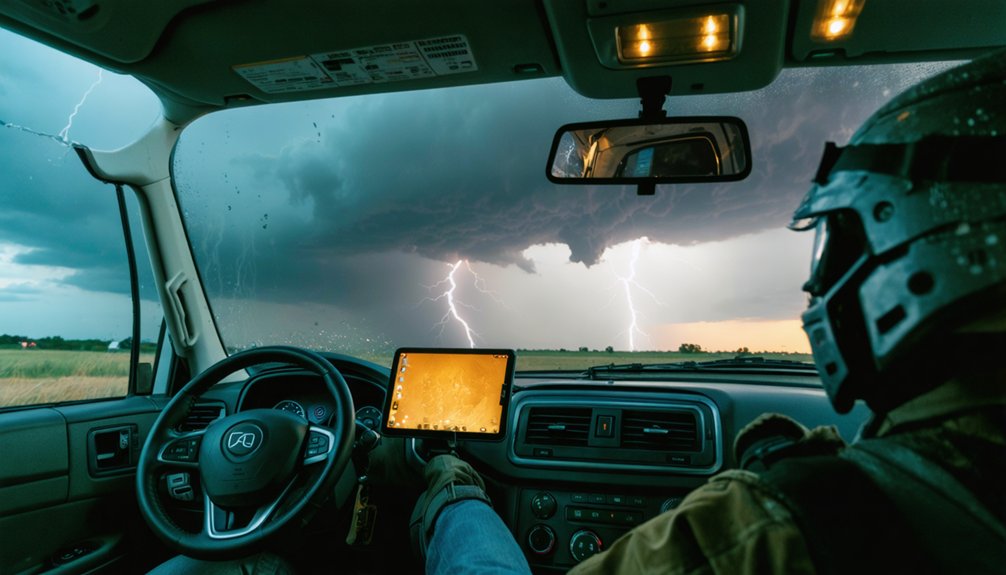
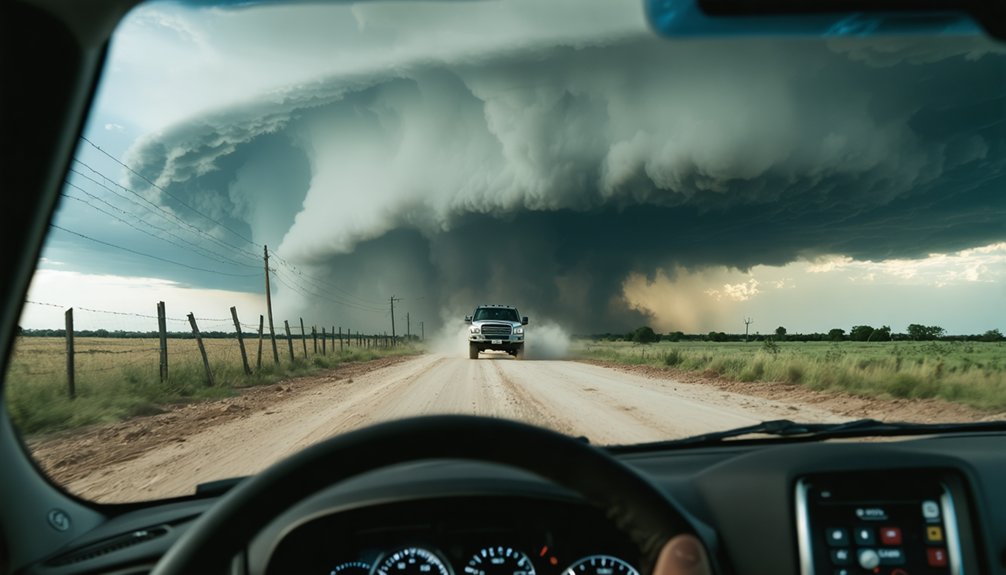
Nighttime storm chasing cuts your visual storm assessment by 60-70%, so you’ll need dual-polarization radar and mobile Doppler apps to identify rotation and debris signatures. Position yourself in the storm’s trailing stratiform region, set your camera to f/8 with ISO 100, and adjust shutter speeds between 2-15 seconds. Assign clear driver-observer roles, establish escape routes before darkness falls, and implement the 30/30 lightning rule religiously. Your injury risk triples on unlit rural roads during wet conditions, making proper protocols essential for survival in low-visibility operations.
Key Takeaways
- Visual storm assessment decreases 60-70% at night; rely on dual-polarization radar, lightning detection apps, and mobile Doppler for structure analysis.
- Weather-related crashes spike on wet roads; avoid positioning under wall clouds, overpasses, or isolated trees during electrical activity.
- Apply 30/30 lightning rule: seek shelter 30 minutes after last thunder and use legs-together stance if caught outside.
- Assign dedicated driver and observer roles with clear communication protocols, escape routes, and PTT radio redundancies for coordination.
- Adjust camera settings based on distance: f/11-f/16 for close strikes, f/5.6-f/4 beyond 5km, with 2-15 second shutter speeds.
Essential Visibility and Lighting Strategies for Dark Conditions
When darkness falls during severe weather, your camera’s ability to capture lightning hinges on precise manual settings that balance ambient light with electrical discharge intensity. Set your aperture to f/8 with ISO 100, then adjust shutter speeds from 2 to 15 seconds as darkness deepens. For strikes within 100 meters, close down to f/11 or f/16. Beyond 5 km, open to f/5.6 or f/4.
Your camera angle placement determines success—position yourself in the trailing stratiform region where erratic discharges occur. Landscape scouting considerations include the tail-end-Charlie position of storm lines for ideal visibility. Mount weather-sealed lenses on heavy-duty tripods, disable optical stabilization, and use intervalometers for continuous shooting.
The storm’s backside illuminates cloud features while keeping you safely positioned.
Nighttime storm chasing amplifies already-serious roadway risks—injury severity spikes nearly three times higher on unlit rural roads where severe weather typically develops. You’ll face substantially longer visual reaction times that increase stopping distances, while road surface conditions deteriorate rapidly during precipitation events.
Over 77 percent of weather-related crashes occur during rain or mist, with wet pavement and fatigue combining to elevate crash severity. Your response times will be compromised when traversing around stopped chasers who fail to pull completely off roadways, creating collision hazards for high-speed traffic.
Avoid positioning yourself under rotating wall clouds where large hail threatens, and never park under overpasses—you’ll block evacuation routes. Interstate highways, while offering limited storm access, reduce your exposure to convergence chaos on rural roads.
Lightning Protection Protocols in Low-Light Environments
Lightning detection becomes exponentially more difficult after sunset when visual cues disappear and your ability to assess storm structure diminishes by 60-70 percent compared to daylight conditions. Implement nighttime shelter identification protocols before darkness: pre-scout enclosed buildings and fully enclosed metal vehicles within your chase zone, measuring exact distances and access routes.
Apply the 30/30 rule rigorously—when lightning-to-thunder interval drops below 30 seconds, you’re within six miles of strike potential. Remain sheltered 30 minutes after the last thunder. Establish vehicle/exterior access protocols that minimize your time outside: equipment transfers should occur exclusively during electrical lulls, never during active lightning.
Avoid isolated trees and metal fences regardless of rain intensity. Your legs-together stance reduces cardiac current pathways if caught outside, though enclosed shelter remains non-negotiable for survival.
ACES Framework for Nighttime Operations
Adapted from the National Wildfire Coordinating Group’s LCES standard, the ACES framework (Awareness, Communication, Escape routes, Safe zones) provides storm spotters with a systematic protocol for maintaining operational safety during low-light conditions. This autonomy-preserving system empowers you to make independent stop/go decision criteria while maintaining NWS coordination.
Core ACES components for nighttime operations:
- Situational awareness monitoring requires continuous evaluation of surroundings, hazardous terrain, and rapidly changing storm dynamics using dual-panel BREF and rainfall data
- Constant communication with spotter teams enhances real-time condition assessment and supports two-person mobile operations
- Multiple escape routes demand mental evaluation of roads, terrain, and precipitation proximity—backing off when conditions deteriorate
- Safe zone identification prioritizes strategic positioning over aggressive mesocyclone pursuit, accepting missed intercepts as acceptable risk management
Radar Technology and Data Interpretation for Darkness
Multiple radar technologies now form the backbone of nighttime storm chasing operations, compensating for visual limitations that compromise spotter safety after sunset. Dual-polarization radar employs target classification methods to distinguish tornado debris from precipitation, identifying random-shaped objects like insulation or leaves with high confidence.
You’ll receive critical debris signatures tracking materials 1-3 miles away, even through rain-wrapped conditions. Phased array systems scan complete storm structures in under one minute, delivering rapid updates on circulation and convergent flow that precede tornado formation. Mobile Doppler units positioned kilometers from storm bases capture low-level rotation invisible to distant installations.
Advanced data analysis techniques through apps like RadarOmega integrate dual-polarization products, velocity fields, and real-time lightning detection, transforming raw measurements into actionable intelligence that empowers independent decision-making during high-risk nocturnal operations.
Team Coordination and Role Distribution for Safe Chasing
When you’re chasing severe weather, assigning clear roles—particularly a dedicated driver and separate observer—prevents dangerous distractions that compromise reaction time during rapidly evolving storms. Establish communication protocols before departure, including radio frequencies, GPS tracking intervals, and standardized hazard callouts to maintain situational awareness across all team members.
Pre-chase safety planning must include mapped escape routes, rally points, and hospital locations uploaded to shared devices, ensuring your team can execute coordinated responses when visibility drops or conditions deteriorate.
Dedicated Driver and Observer
Because storm chasing demands split-second decisions while traversing unfamiliar rural roads at highway speeds, you’ll need a clear division of labor between driver and observer. The driver maintains complete focus on vehicle management—road conditions, traffic, and identifying two escape routes before entering warned areas. This dedicated attention eliminates distracted behavior that compromises situation awareness.
Your observer handles critical data interpretation:
- Real-time radar monitoring through RadarScope, GRLevelX, or RadarOmega
- Storm structure analysis and mesoscale trend identification
- GPS coordinate sharing with chase teams and emergency services
- Route planning and escape route verification during dynamic conditions
This partnership structure prevents the dangerous practice of dividing attention between screens and roadways. Clear role assignment before deployment guarantees both team members understand their responsibilities when conditions deteriorate rapidly.
Communication Protocol Between Partners
Role separation between driver and observer forms only half of an effective chase team structure—both positions require robust communication systems to function as a coordinated unit. You’ll need PTT radios enabling hands-free coordination without eyes leaving the road.
Share real-time GPS locations with your entire team continuously, logging intentions before pursuit begins. Establish clear role definitions: who leads, who contacts authorities, who monitors weather channels.
Build communication redundancies through multiple platforms—text, voice, apps, satellite phones—ensuring connection when cellular networks fail. Maintain HAM radios and NOAA Weather Radios as backup systems. Program panic buttons on devices like Peak PTT-84G to transmit distress signals with GPS coordinates.
Your freedom to chase depends on disciplined protocols that provide real time status updates across every channel available.
Pre-Chase Safety Planning
Before entering the field, your chase team must establish a structured coordination framework that distributes critical responsibilities across qualified personnel. Designate a driver focused exclusively on navigation and road conditions, separate from storm observation duties. Your meteorologist handles detailed weather forecasting through radar interpretation and model analysis, while another member manages real-time hazard assessments and spotter network reporting.
Essential pre-chase coordination elements:
- Analyze SPC outlooks, mesoscale discussions, and road networks to identify escape routes and staging areas
- Verify cell coverage maps, fuel availability, and local infrastructure constraints at target locations
- Establish team check-in protocols and positioning standards for the storm’s right front quadrant
- Guarantee CPR-trained personnel and National Weather Service spotter certification across your crew
This framework maximizes situational awareness while maintaining operational independence during rapidly evolving chase scenarios.
Frequently Asked Questions
What Emergency Equipment Should I Pack for Nighttime Storm Chasing?
Don’t let darkness become your enemy—pack battery-powered flashlights, NOAA weather radios, robust first aid kits, and emergency food supplies. You’ll need waterproof headlamps, power banks, and protective gear to chase storms safely and independently.
How Do I Identify Safe Shelter Options in Unfamiliar Rural Areas?
You’ll identify adequate shelter locations by checking for ICC 500-labeled buildings like schools or fire stations. Assess local infrastructure safety using GPS coordinates of certified safe rooms, and verify debris impact ratings meet FEMA P-361 standards beforehand.
What Are Recommended Communication Protocols When Cell Service Is Lost?
When cell service fails, you’ll need backup satellite phones for emergency contacts and alternative radio communication like HAM or two-way systems. Maintain GPS tracking, establish check-in protocols, and coordinate through VHF/UHF networks for reliable team communication independence.
Should I Chase Alone at Night or Cancel the Chase?
Cancel night chases or bring travel companions—statistical data shows 1 chaser death yearly and reduced lightning visibility at night. If you’re determined to proceed, establish a pre-planned route and communicate your position constantly to minimize documented risks.
How Do Weather Conditions Affect Vehicle Insurance Coverage During Chasing?
Weather worsens warranty worthiness—comprehensive coverage protects your vehicle from storm damage minus policy deductibles, but insurers scrutinize chasing-related claims. You’ll need commercial policies for tour operations, plus weather monitoring services to document legitimate encounters versus reckless pursuit.