You’ll earn an average of $45,374 annually as a storm chaser—roughly $21.81 per hour—but your actual take-home varies dramatically based on experience and specialization. Entry-level chasers start around $29,000 yearly, while seasoned professionals commanding research contracts exceed $130,000. However, these figures don’t account for substantial operational costs: you’re looking at $6,200+ in vehicle expenses, $1,591 in fuel, and $5,000+ in equipment per season. Geographic location, credential development, and income diversification strategies greatly impact your net profitability in this field.
Key Takeaways
- Storm chasers earn $21.81-$43 per hour, translating to annual salaries ranging from $32,000 to $93,500 depending on experience level.
- Entry-level positions start at $29,000 yearly, while top earners with media contracts can exceed $130,000 annually.
- Geographic location significantly impacts earnings, with San Jose offering $177,560 total compensation versus typical national averages.
- Operational expenses including vehicles, fuel, lodging, and equipment can reduce net profits to just $2 per hour.
- Income diversification through footage sales, consulting, documentary work, and content creation maximizes earning potential for storm chasers.
What Storm Chasers Actually Earn Per Hour and Per Year
Storm chaser income varies dramatically across the United States, with average hourly wages typically hovering around $21.81 to $22 per hour, though some sources report remarkably higher rates at $43 per hour. Your annual earnings translate to approximately $45,374, though experienced professionals can exceed $130,000 yearly. The storm chaser lifestyle demands flexibility, as typical work hours concentrate during severe weather seasons rather than traditional schedules.
You’ll find hourly wages ranging from $15.38 at the 25th percentile to $26.92 at the 75th percentile, with top earners commanding $32 hourly. However, real-world data reveals net profits can plummet to just $2 per hour after factoring expenses. Annual salaries span from $32,000 for entry positions to $68,000 for established chasers, with geographical variations affecting compensation noticeably.
Understanding the Full Salary Range for Storm Chasing Professionals
Storm chasing salaries span from $29,000 at the 25th percentile to $93,500 for top earners, with entry-level professionals typically starting around $66,200 annually while experienced chasers can exceed $130,000.
You’ll find geographic location dramatically affects your earning potential—San Jose, California storm chasers earn $177,560 annually, more than double the national average, while positions in Green River, Wyoming offer $60,660. Your hourly compensation ranges from $14 to $44 depending on your experience level and market demand in your region.
Entry-Level to Top Earners
How much can you actually expect to earn pursuing severe weather phenomena professionally? Entry-level positions start at $29,000 annually ($8.41-$14/hour), positioning you at the 25th percentile with $32,000.
Your income variability expands considerably through skill development—the national average reaches $45,374-$90,210 yearly ($21.81-$43/hour). At the 75th percentile, you’ll command $56,000-$61,000 ($27-$29.33/hour), while top earners securing research or media contracts achieve $68,000-$132,180 annually ($35.10-$53.37/hour). Seasoned professionals exceeding $130,000 demonstrate that experience-based progression directly correlates with compensation.
However, net profit calculations reveal substantial expenses reduce actual take-home pay. Your earning trajectory depends entirely on specialization choices, years tracking systems, and positioning within meteorological research versus independent documentation roles.
Geographic Location Pay Differences
Where you base your operations fundamentally alters your earning potential, with Canadian metropolitan areas offering the most stable compensation structures. Kentville, NS leads at $65,797 annually, while British Columbia markets show minimal 3% pay variations across locations.
Regional disparities become stark when comparing international scales:
- North American Range: US compensation spans $0-$90,000 depending on employment type, while Canadian cities cluster tightly at $63,513-$65,797
- European Markets: €35,000-€70,000 ($38,000-$76,000 USD) for research-focused positions
- Asia-Pacific and Latin America: $20,000-$60,000 based on local economic conditions
San Jose, CA tops US markets at $177,560 total compensation versus the $89,932 national average. Independent operators face significant equipment and travel costs that directly impact net earnings, making geographic selection essential for sustainable operations.
How Top-Performing Storm Chasers Maximize Their Income
Elite professionals in the storm chasing field leverage strategic combinations of income diversification, geographic positioning, and specialized expertise to achieve compensation levels nearly double the national average of $89,932. You’ll maximize earnings by relocating to high-demand markets like San Jose, where compensation reaches $177,560.
Diversify beyond standard employment through documentary work, licensed footage sales, and consulting services for film productions. Strong client relationship management with broadcasting networks and weather technology companies secures recurring partnership opportunities.
Develop specialized credentials in severe weather prediction and hurricane analysis to command premium rates. Talent acquisition strategies that emphasize published research and technical certifications position you for lucrative consulting engagements with insurance and aviation sectors, while content creation platforms generate scalable passive revenue streams.
Entry-Level and Low-End Storm Chaser Compensation
When you’re starting your storm chasing career, you’ll likely earn between $8.41 and $14.00 per hour, with first-year annual salaries ranging from $29,000 to $32,000.
Your positioning at the 25th percentile translates to approximately $13.94 to $15.38 hourly, placing you near federal minimum wage standards.
These baseline compensation figures reflect the reality that inexperienced chasers face limited earning potential until they develop specialized skills in meteorological forecasting, damage assessment, or media documentation.
Starting Salary Expectations
Entry-level storm chasers face considerable salary variability, with hourly wages ranging from a low of $8.41 to approximately $22 for beginners. Your initial compensation depends heavily on employment type and geographic location.
Starting salary benchmarks include:
- Hourly rates: $9.13-$22 for entry-level positions, with Texas-specific rates starting at $8.51
- Annual compensation: Entry-level roles average $63,000-$66,200, though 25th percentile earners make $29,000-$29,800
- Freelance reality: Gross earnings of $10,000 against $13,700 in expenses create net losses
Your employee motivation must extend beyond immediate financial gain. Skill development through apprenticeships or meteorological organizations provides pathways to higher-paying positions. The pursuit demands financial resilience during initial years while building expertise and industry connections.
25th Percentile Earnings
Lower-tier storm chaser compensation reflects the financial challenges facing those entering this specialized field. 25th percentile earnings place you at $29,000-$32,000 annually nationwide, translating to $14-$15 hourly. Oklahoma’s market mirrors these figures at $29,500 yearly with $14 hourly rates.
Nationwide wage variations reveal stark contrasts—some sources report entry positions starting at $63,000-$66,200 annually ($32 hourly), while others document lows of $17,543 in specific markets. The bottom-tier spectrum spans $8.41-$9.13 hourly in certain regions, though $20-$22 represents more typical entry benchmarks. You’ll find Oklahoma’s minimum at $8.43 hourly.
These disparities stem from employment types—freelance versus institutional positions, research versus media roles, and geographic storm activity density. Understanding these compensation tiers helps you navigate career entry strategically.
Hourly Wage Minimums
The hourly wage floor for storm chasers bottoms out at $8.41 nationally, creating stark compensation realities for those entering the profession. You’ll face significant regional disparities that directly impact your financial stability and capacity for ongoing training.
Entry-level compensation varies dramatically by location:
- Bottom-tier markets offer $8.41-$9.13 hourly, translating to just $29,000-$32,000 annually
- Mid-range states like Texas provide $20.32 per hour ($42,265 yearly)
- Premium locations including Green River, Wyoming and San Francisco command $28.00-$29.16 hourly rates
The 25th percentile bracket places most beginners at $13.94-$15.38 per hour. Your geographic choice becomes critical—Pennsylvania’s $21.87 hourly rate versus national minimums represents a 160% wage differential. Experience level, meteorological expertise, and willingness to relocate determine whether you’ll start at poverty wages or sustainable compensation.
Geographic Hotspots: Where Storm Chasers Earn the Most Money
While storm chasing opportunities exist nationwide, your earning potential varies dramatically based on geographic location and market specialization. Wichita, Kansas dominates as Tornado Alley’s operational hub, where storm chaser tourism operations command $2,600-$4,900 per multi-day tour. You’ll find media roles paying up to $132,180 annually at institutions like the Storm Prediction Center and National Weather Center, averaging $90,210 nationwide.
Roofing contractors targeting storm-damaged markets generate up to $25 million per event, with Federal Way, Washington offering $100K-$130K sales positions. Pennsylvania’s Schwenksville posts storm damage adjuster roles at $60K-$65K with benefits. Your maximum earnings correlate directly with positioning yourself in high-probability storm regions and understanding storm chaser licensing requirements for specific market sectors you’re targeting.
The Reality Behind Storm Chasing Income Claims
You’ve likely encountered salary figures claiming storm chasers earn $50,000 to $90,000 annually, but these advertised numbers rarely account for the operational realities that dramatically reduce net income.
Field practitioners report actual take-home pay as low as $2 per hour after deducting fuel costs, vehicle maintenance, equipment replacement, lodging, and liability insurance—expenses that can consume 70-80% of gross revenue.
Even veteran chasers with decades of severe weather experience struggle to achieve consistent profitability, as seasonal income variability and unpredictable storm frequency prevent reliable earnings projections.
Advertised vs. Actual Earnings
When you search online for storm chaser salaries, you’ll encounter figures that paint an unrealistically lucrative picture of the profession. Job aggregators advertise averages between $50,611 and $89,932 annually, yet veteran chasers report drastically different realities.
The disparity stems from three critical factors:
- Crowdsourced data limitations allow unverified self-reported incomes to skew averages upward without field validation
- Employer reporting biases blend salaried meteorology positions with independent chasing work, creating misleading composites
- Geographic anomalies like San Jose’s $177,560 figure reflect tech-hub compensation, not typical chasing earnings
Experienced chasers report net profits around $2 per hour after expenses. The 25th percentile sits at $29,000 annually—far below advertised claims. These platforms conflate passion-driven fieldwork with traditional meteorological careers, obscuring financial truth.
Hidden Expenses Reduce Profit
Because advertised salaries ignore operational costs, aspiring storm chasers face financial shock when expenses erode projected earnings. You’ll confront $6,200 in vehicle costs at 20,000 miles per season, plus $1,591.89 in fuel alone. Your operational overhead expands with $1,500 for lodging and food, $1,000 in cellular data, and $5,000 in initial camera gear. First-year totals hit $13,700 before generating revenue.
Recurring maintenance, tire replacement, and unexpected repairs create hidden drains on cash flow. Since 1993, documented chase expenses exceed six figures through cumulative gear, technology, and vehicle investments. Extended fuel tanks, recovery equipment, and weather radios add layers of cost. Seasonal out-of-pocket spending ranges $2,000-$5,000, making profitability nearly impossible without strategic marketing and multiple revenue streams beyond storm footage sales.
Experience Doesn’t Guarantee Income
Salary aggregator websites advertise storm chaser incomes between $60,000 and $130,000 annually, yet these figures collapse under scrutiny when field professionals report net earnings as low as $2 per hour after expenses. The promised income progression from entry-level ($63,000) to experienced professional ($130,000+) ignores the financial reality of independent operators.
Geographical variances compound this discrepancy:
- Remote locations (Green River, Wyoming; Whitehorse, Yukon) advertise $29.16–$31.63 hourly rates that vanish after fuel, lodging, and equipment costs
- Tech-hub premiums in San Jose ($177,000) apply exclusively to research positions, not field chasers
- Historical earnings below $30,000 contradict published medians of $45,000–$56,000
Employment classification determines whether you’ll achieve advertised figures or subsistence wages.
Hidden Costs and Expenses That Impact Take-Home Pay
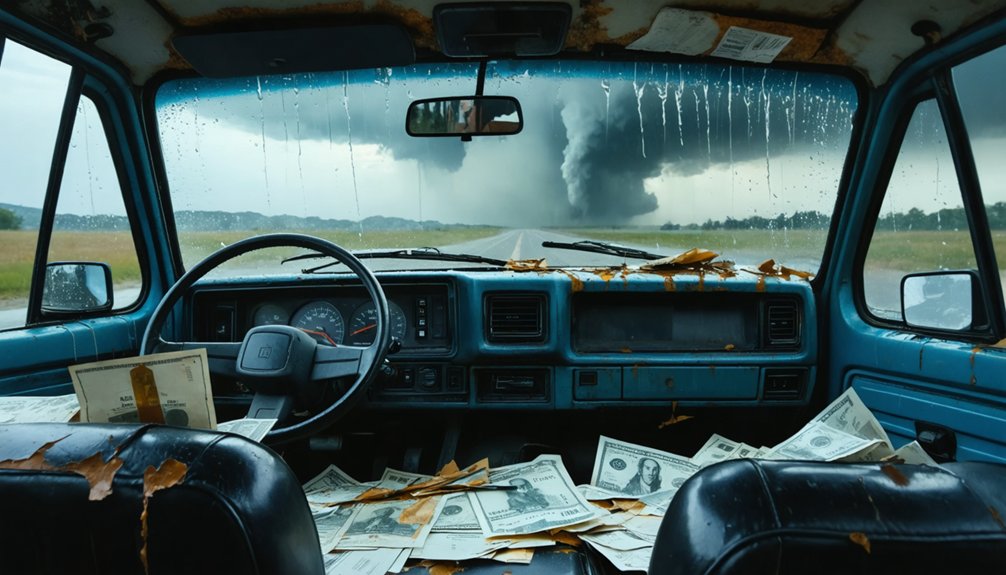
Although storm chasing appears lucrative when you’re selling footage to major networks, the profession’s hidden expenses dramatically erode your actual earnings. Your vehicle maintenance alone consumes 30-40% of gross income through fuel costs exceeding $500 monthly, tire replacements every 15,000 miles on rough terrain, and hail damage repairs averaging $3,000 annually.
Equipment maintenance demands another 20-25%, with camera gear depreciating rapidly, radar systems requiring $10,000+ upfront investments, and drone replacements after inevitable crashes. You’ll face $100+ nightly lodging during multi-day chases, premium satellite communication fees, and self-employment taxes claiming 15-30% of variable income.
Unless you secure industry sponsorships offsetting these operational burdens, your take-home pay typically represents only 25-35% of reported gross earnings—far less than traditional meteorology positions offer.
Factors That Determine Your Storm Chasing Salary Potential
Your storm chasing income fluctuates based on five critical variables that create dramatic salary disparities across the profession.
Geographic location dominates earning potential—San Jose pays $177,560 (97% above national average), while other regions hover around $50,000-$60,000. Experience level determines whether you’ll earn $63,000 entry-level or exceed $130,000 as a seasoned professional.
Skill specialization separates weekend hobbyists from career chasers:
- Meteorology expertise combined with data interpretation capabilities commands premium compensation
- Advanced equipment proficiency increases your value to research teams and media outlets
- Team composition dynamics influence payment structures—TV crews and scientific organizations pay considerably more than independent operations
Employment type varies from $21.81 hourly contracts to $93,500 annual positions. Role variation matters critically: research positions average $90,000 while basic chasing roles pay $45,374.
How Storm Chaser Pay Compares to National Salary Averages
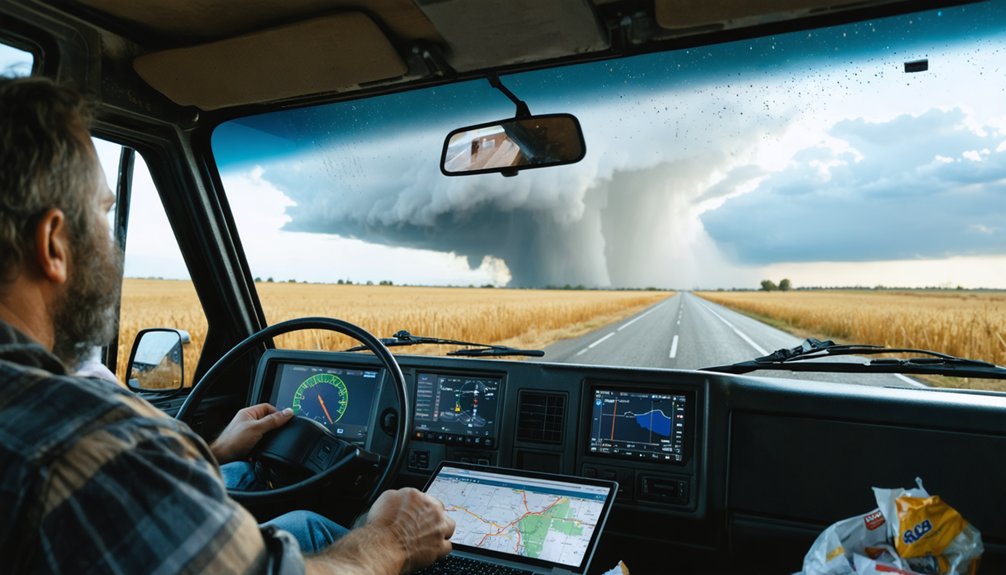
When stacked against national employment benchmarks, storm chasing falls considerably short of median compensation expectations—the $50,611 average represents just 44% of typical US household income. Your hourly wage of $24.33 trails many skilled trades, though top performers reach $93,500 annually.
Regional pay disparities create substantial variation, with Green River, WY offering $60,660 while entry positions start at $29,000. Income distribution patterns reveal concentrated clustering between $45,374-$50,611, suggesting limited mid-career advancement without specialization.
You’ll find tornado chasing commands premium compensation at $76,607, nearly 51% above baseline rates. The profession’s 220% geographic variance and $15 pay range indicate your earning potential depends heavily on location selection and niche expertise development.
Career Growth and Job Market Outlook for Storm Chasers
How does career progression function in a field where 95% of participants operate without compensation? Your career prospects depend on shifting from hobby chaser to formal atmospheric science roles. The job market shows contrasting signals:
Formal Employment Metrics:
- Atmospheric scientists face 1% growth (2024-2034), slower than average occupations
- Approximately 700 annual openings emerge primarily from workforce replacements
- Meteorology majors maintain 0.58% unemployment—lowest among all degree fields
Job stability exists for degreed professionals at TV stations, National Weather Service, or research institutions. However, most chasers maintain primary employment elsewhere while pursuing storms intermittently. You’ll find limited salaried positions despite strong educational outcomes. The path forward requires accepting storm chasing as passionate sideline work rather than standalone income, unless you secure atmospheric science credentials for traditional meteorology careers.
Frequently Asked Questions
Do Storm Chasers Need Special Licenses or Certifications to Get Paid?
You’re free to chase storms without licenses—no specialized training requirements exist for paid work. However, SKYWARN certification and necessary safety protocols are strongly recommended to protect yourself, maximize earnings potential, and guarantee professional credibility with clients.
Can Storm Chasing Be a Full-Time Job Year-Round?
Storm chasing can’t sustain you year-round as full-time work. You’ll need seasonal employment during peak months and leverage your weather forecasting expertise for indoor meteorology roles—typically earning $97,450 annually—to maintain financial independence between chase seasons.
What Type of Insurance Do Professional Storm Chasers Need?
You’ll primarily pursue vehicle insurance for your chase cars and equipment insurance for cameras, radar systems, and weather instruments. Additionally, you need liability coverage protecting against property damage claims and workers’ compensation if employing crew members during storm operations.
Do Storm Chasers Get Paid by Media Outlets for Footage?
Yes, you’ll get paid by media outlets, but funding sources vary widely. National networks pay $400 for exclusive tornado footage, while locals offer $100. However, brokers control media revenue share, leaving you with fractions despite networks earning six-figure daily profits.
How Do Storm Chasers File Taxes as Independent Contractors?
You’ll file Form 1040 with Schedule C reporting your storm chasing income and expenses. You’re responsible for self-employment taxes (15.3%) and must make quarterly estimated payments if you’ll owe $1,000+ annually.