You’ll earn an average of $45,374 annually as a storm chaser, though compensation varies drastically by location and experience level. Entry-level chasers typically start around $29,000 ($15.38/hour), while experienced professionals command $56,000-$68,000 at the 75th percentile. Top-tier specialists in premium markets like San Jose can reach $177,560, whereas Texas positions average $42,272. Geographic positioning acutely affects your earning potential, with Canadian locations exceeding US averages by 44%. Understanding the factors driving these compensation differences will help you maximize your meteorological career trajectory.
Key Takeaways
- Storm chasers earn an average annual salary of $45,374 nationally, with hourly rates typically ranging from $22 to $24.
- Entry-level positions start around $29,000 yearly, while experienced professionals can command $68,000 to $132,180 in specialized roles.
- Geographic location significantly impacts earnings, with San Jose paying $177,560 compared to Texas markets averaging $42,272 annually.
- Top-tier storm chasers earning $130,000+ supplement income through media contracts, research partnerships, and consulting services beyond base salary.
- Seasonal employment patterns and atmospheric activity directly affect income stability, with net profits averaging only $2 per hour after expenses.
Average Storm Chaser Salary Breakdown
While storm chasing captivates public imagination through dramatic footage of tornadoes and severe weather, the profession’s financial reality presents a more nuanced picture. You’ll find the national average salary sits at $45,374 annually, translating to approximately $22 per hour. However, seasonal work demands create significant income variability, with the 25th percentile earning $32,000 while top performers reach $68,000.
Geographic location dramatically impacts compensation—San Jose commands $177,560 compared to New York City’s $49,640. Expense reimbursement considerations prove critical, as experienced chasers report net profits around $2 per hour after deducting fuel, equipment, and vehicle maintenance costs. The hourly wage spectrum ranges from $15.38 to $26.92 for most positions, though specialized roles can command rates exceeding $38 hourly.
Salary Ranges: Entry-Level to Top Earners
Storm chaser compensation exhibits significant stratification across career progression levels, with entry-level positions starting at $12,621 annually ($8.41/hour) and extending to approximately $63,000 for more skilled beginners.
You’ll find mid-career professionals earning between $29,000-$61,000 depending on percentile ranking, while top-tier specialists command $68,000-$93,500 in standard markets. High-demand metropolitan areas like San Jose and San Francisco push experienced chaser salaries to $177,000, with elite professionals generating combined annual income exceeding $339,000 through base compensation, bonuses averaging $2,353, and supplemental revenue streams including $500 per footage sale and $3,500 per civilian ride-along experience.
Entry-Level Starting Salaries
Compensation data reveals significant variance in entry-level storm chaser salaries, with the 25th percentile nationally positioned at $29,000 annually while entry-level estimates reach $66,200 in certain markets. Your starting hourly wage typically ranges from $13.94 to $15.38, though geographical location creates substantial disparities—Florida’s 25th percentile sits at $23,900 versus Green River, Wyoming’s $60,660.
Entry level education requirements remain minimal, allowing you immediate field access without formal meteorology degrees. However, career advancement opportunities correlate directly with technical skill acquisition and storm documentation capabilities. Your initial compensation averages $21.81 hourly ($32,000 annually at the 25th percentile), with high-cost regions like San Jose offering advanced practitioners up to $177,560. Experience and specialized equipment investment accelerate your earning trajectory beyond these baseline figures.
Experienced Professional Earnings
Experienced storm chasers demonstrate earnings stratification across three distinct compensation tiers, with 75th percentile professionals commanding $56,000 annually ($27 hourly) while top-tier specialists secure $68,000 to $132,180 in base compensation.
Your career progression trajectory depends on quantifiable demand factors: geographic positioning in premium markets like San Jose ($177,560 total compensation) and specialized scientific research roles that leverage meteorological expertise.
Veterans with several years’ field experience access the $130,000+ bracket, earning approximately $43 hourly through combined revenue streams. However, you’ll face significant operational overhead—actual net income often represents less than half your gross revenues after equipment, fuel, and travel expenses.
The highest-performing professionals integrate media contracts, research partnerships, and consulting services to maximize their earning potential beyond traditional chase-only compensation models.
Hourly Pay Rates for Storm Chasers
Your hourly compensation as a storm chaser averages $21.81 nationally, with documented ranges spanning $9.13 to $35.10 based on experience level and employment classification.
Peak earners command $32 per hour, representing the 90th percentile of compensation data across the meteorological tracking profession.
Geographic wage disparities prove significant, with Maryland operators earning $24.25 hourly compared to Virginia’s $21.63, reflecting regional demand variations and cost-of-living adjustments.
Average Hourly Wage Breakdown
When analyzing compensation structures for storm chasers, the national average hourly wage stands at $24.33, derived from an annual baseline of $50,611. You’ll find wages distributed across a substantial range—from $8.41 to $53.37 per hour—with the majority clustering between $13.94 and $29.33. This variance directly correlates with storm chaser risks and expertise levels.
Percentile analysis reveals critical thresholds: 25th percentile earners receive $14 hourly, while 75th percentile professionals command $29. Top-tier specialists achieve $44 per hour, though job stability factors create significant income fluctuations.
Geographic location influences compensation substantially—Green River, WY offers $29.16 hourly versus Pennsylvania’s $21.87. Entry-level positions start around $20 per hour, while seasoned meteorological professionals in specialized research roles reach $64, reflecting technical proficiency and environmental assessment capabilities.
Peak Earnings Per Hour
Storm chaser hourly earnings demonstrate significant stratification across experience and specialization levels. You’ll find peak rates reaching $64 per hour for experienced professionals during seasonal demand spikes, while specialized lineman storm chasers command weekly equivalents of $13,000-$14,000. The upper wage threshold sits at $53.37 per hour nationally, though geographic variation affects compensation substantially.
During peak storm season, top earners consistently achieve $44 per hour, with high-demand regions pushing rates even higher. However, you should note the substantial range: entry-level positions start around $8.41 per hour, creating a $45 hourly differential between beginners and veterans. Florida’s maximum caps at $26.23 per hour, demonstrating regional market constraints. Net profitability varies considerably—some chasers report $2 per hour after factoring fuel, equipment depreciation, and operational expenses.
Geographic Hourly Pay Differences
Geographic wage stratification reveals a $23.22 hourly differential between the highest and lowest-paying markets for storm chasers. You’ll find California’s Bay Area dominates US compensation, with San Francisco ($28.00) and San Mateo ($28.05) leading metropolitan markets. However, Green River, Wyoming‘s $29.16 rate tops domestic locations. Canadian markets demonstrate superior regional salary variations, where Kentville, Nova Scotia commands $31.63 hourly—establishing international market premiums.
Cost of living adjustments don’t consistently correlate with compensation patterns. Santa Rosa‘s $27.09 rate mirrors San Francisco’s despite lower housing costs, while Pennsylvania ($21.87) and New Jersey ($22.15) show compressed wages relative to their metropolitan expenses. The 75th percentile benchmark ($27.00) aligns with premium California markets, indicating high-performing chasers can access competitive rates regardless of base location through strategic market positioning.
Geographic Location Impact on Earnings
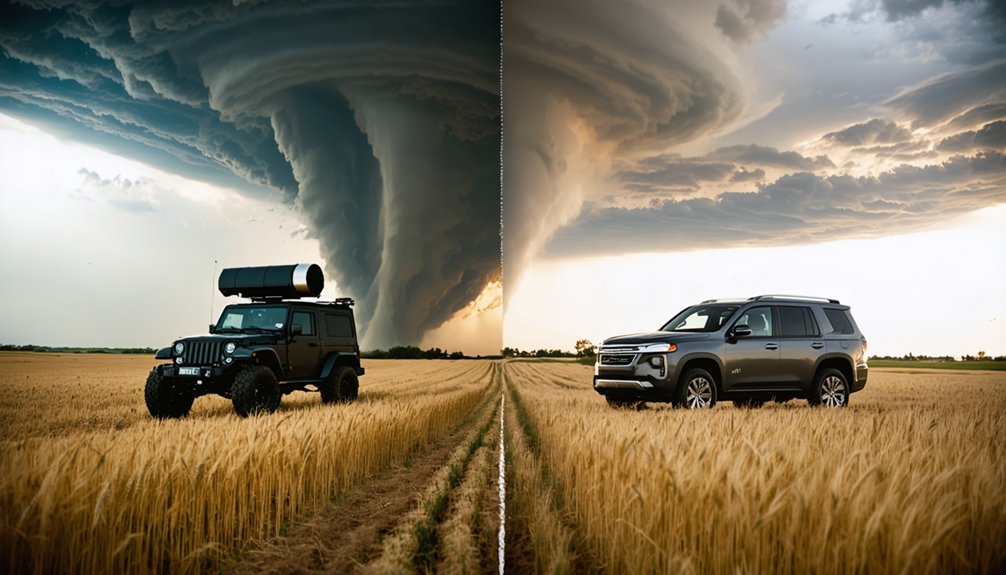
Salary variability for storm chasers demonstrates pronounced geographic disparities, with compensation spanning from $42,272 in Texas to $177,560 in San Jose, California. Canadian locations like Kentville ($65,797) and Whitehorse ($65,378) exceed the US national average by 44%, offering you consistent opportunities without taxation impact on net income from state levies.
British Columbia cities maintain steady demand, with Victoria paying $64,284 annually. San Jose’s compensation nearly doubles national averages due to specialized meteorological requirements and elevated operational risks. Texas markets present lower baseline salaries—Eagle Pass leads at $46,810, just 10.7% above state average. Seasonal employment challenges affect earnings consistency, particularly in storm-dependent regions.
You’ll find location-driven demand and atmospheric activity patterns directly determine your earning potential and operational frequency.
Real-World Income After Expenses
Vehicle costs alone consume significant portions of your earnings, while insurance for high-risk operations and tax obligations further diminish returns. Media-affiliated or research-backed chasers retain higher net percentages through institutional support, but independent operators face stark economic constraints.
Understanding these post-expense realities helps you evaluate whether storm chasing offers sustainable income or remains better suited as part-time passion work.
Factors That Influence Storm Chaser Compensation
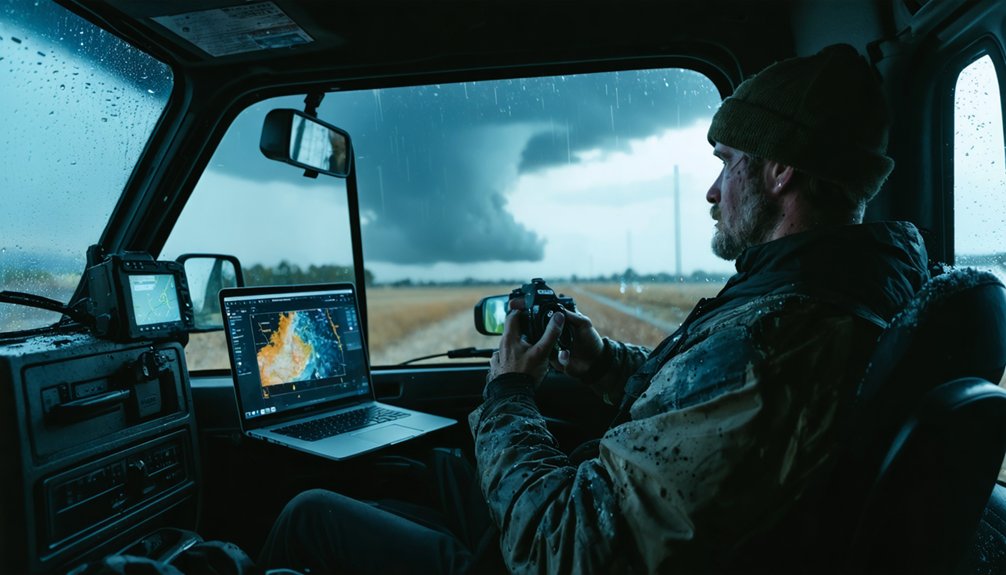
Multiple variables determine your compensation as a storm chaser, with quantifiable differences spanning from $29,000 to over $177,000 annually depending on specific circumstances.
Your geographic location creates substantial pay disparities—San Jose, CA tops at $177,560 while other regions average $45,374. Experience level directly correlates with earnings: entry-level positions start at $63,000, advancing to $130,000+ with specialized meteorology expertise and advanced equipment handling capabilities.
Employment type profoundly impacts income. Media crew roles command premium compensation due to hazard exposure, while research positions offer specialized work rates. Professional development opportunities and corporate sponsorships provide additional revenue streams beyond base salary.
Your skill proficiency determines percentile placement—75th percentile earners make $56,000-$61,000, while top performers reach $93,500. Quick decision-making abilities and technical competencies grant higher compensation tiers within this autonomous profession.
Frequently Asked Questions
What Education or Certifications Do I Need to Become a Storm Chaser?
You’ll need meteorology coursework through a bachelor’s degree ($40,000-$100,000) and weather forecasting skills developed via SKYWARN training. Master’s degrees open up research positions, while 44.7% of chasers hold bachelor’s degrees, giving you professional flexibility.
How Do Storm Chasers Find Job Opportunities or Get Hired?
You’ll find storm chaser positions by networking with meteorologists at conferences, contacting weather organizations like NOAA and universities directly, monitoring job boards like Indeed and ZipRecruiter, and building portfolios showcasing your field data collection and radar interpretation skills.
Do Storm Chasers Work Year-Round or Only During Storm Season?
You’ll chase storms 3-6 months during peak season, then shift to off season employment like equipment maintenance and weather monitoring activities. Full-time researchers work year-round analyzing data, while amateur chasers pursue independent ventures between storm cycles.
What Equipment Costs Should I Budget for as a Storm Chaser?
You’ll need to budget $5,000 initially for camera equipment, plus ongoing fuel expenditures of approximately $1,600 annually and vehicle maintenance costs at $0.31 per mile, totaling around $6,200 for 20,000 chase miles yearly.
Can Storm Chasing Be a Full-Time Career or Just Side Income?
Storm chasing typically functions as seasonal work rather than full-time employment. You’ll likely need part-time income streams since operational costs consume profits, with net earnings averaging $2/hour after expenses, making financial independence challenging without supplementary revenue sources.