You’re 2.8 times more likely to die from vehicular accidents than tornadoes while storm chasing, with 14 highway fatalities versus 5 tornado-related deaths. Semi-trailer collisions account for five deaths through stop sign violations and hydroplaning incidents, while driver fatigue contributes to 31% of fatal-to-the-driver crashes. Your risk triples during 2-4 AM and 2-4 PM circadian vulnerability windows, with wet pavement conditions present in 73% of weather-related fatalities. Understanding specific collision mechanisms and implementing evidence-based safety protocols can substantially/considerably/greatly reduce these operational hazards.
Key Takeaways
- Vehicular accidents cause 14 chaser deaths compared to 5 from tornadoes, making road travel the primary operational hazard.
- Semi-trailer collisions at rural intersections and hydroplaning incidents account for the majority of fatal chaser accidents.
- Driver fatigue contributes to 31% of fatal crashes, with risk tripling during 2-4 AM and 2-4 PM periods.
- Hydroplaning prevention requires speed reduction, proper tire pressure maintenance, and avoiding standing water on roadways.
- Most fatalities occur during post-chase highway travel rather than active storm intercepts, requiring sustained situational awareness.
Car Crashes Pose Greater Threat Than Tornadoes to Storm Chasers
Storm chasing fatality data reveals a counterintuitive threat hierarchy: vehicular accidents have claimed 14 chaser lives, while tornadoes—the phenomenon they pursue—account for only 5 deaths as of 2023. You’ll face your greatest risk during road travel, not from the storms themselves.
High speed pursuits across rural highways and urban chasing through populated areas exponentially increase collision probability. The El Reno tornado remains the only multi-fatality tornado event among chasers, underscoring tornado encounters’ relative safety compared to vehicular operations. You’re statistically more vulnerable during transit phases than storm intercepts.
This risk asymmetry demands recalibration of your safety protocols—prioritizing defensive driving techniques over storm proximity management. Lightning, flash floods, and hail have produced zero documented chaser fatalities, further cementing road travel as the primary operational hazard you must mitigate.
Recent Fatal Accidents Highlight Dangers of Highway Travel
Recent accident data reveals you’re statistically more vulnerable during highway transit phases than tornado intercept operations.
Between 2005 and 2017, semi-trailer collisions accounted for multiple chaser fatalities, including the 2005 Interstate 20 hydroplaning incident that resulted in a head-on impact with a flatbed truck.
You’ll find that intersection violations during active chase periods have produced the highest casualty counts, with the 2017 Spur crash killing three experienced chasers in a single stop-sign collision.
Multiple Chaser Deaths Recently
While tornado intercepts attract media attention, highway travel accounts for the majority of storm chaser fatalities in documented incidents.
You’ll find that 15 total deaths have occurred throughout storm chasing history, with the 2017 Spur, Texas collision representing one of the deadliest single events—claiming Corbin Jaeger, Kelley Williamson, and Randall Yarnall when an SUV ran a stop sign.
Rural intersection crashes continue as the primary threat, compounded by hydroplaning incidents like Jeff Wear’s 2005 Interstate 20 fatality and wildlife encounters such as Christopher Phillips’ 1984 rollover.
Chaser fatigue management becomes critical during multi-day deployments, particularly when returning home after unsuccessful intercepts. You’re statistically more vulnerable during transit than direct tornado encounters, with poor visibility and decision-making deterioration presenting measurable risks.
Semitrailer Collisions Prove Deadly
Large commercial vehicles represent a disproportionate percentage of storm chaser fatalities, with semitrailer collisions accounting for five documented deaths between 2005 and 2017. These incidents occurred across multiple scenarios where traffic distraction concerns and road conditions intersected with commercial truck traffic.
Analysis reveals four primary collision mechanisms:
- Stop sign violations at high speed (Spur, Texas incident at 70 mph)
- Hydroplaning events on rain-soaked interstates (I-20 and Kansas incidents)
- Stationary vehicle strikes during storm-related road obstructions (Minnesota I-90)
- Median crossings from evasive maneuvers (Iowa I-80 deer avoidance)
Vehicular maintenance importance becomes critical when operating in severe weather corridors. You’ll find that most fatalities occurred during post-chase highway travel rather than active intercepts, indicating fatigue management and situational awareness deficits compound mechanical vulnerabilities.
Hydroplaning and Weather-Related Road Conditions
Hydroplaning occurs when water accumulation in tire treads prevents adequate contact with the road surface, causing vehicles to skid across a thin water layer rather than maintain traction. You’ll face maximum risk at speeds exceeding 35 mph, with critical danger emerging above 55 mph. Weather-related crashes constitute 22% of annual accidents, with 73% of fatalities occurring on wet surfaces.
Road conditions monitoring becomes essential during initial rainfall when oil residue creates hazardous slickness within ten minutes. Hydroplaning detection techniques include listening for water splashing sounds beneath your vehicle. You can mitigate risk through speed reduction, maintaining proper tire pressure, and avoiding standing water accumulation in tire paths.
Since 1950s research confirmed prevention viability, you’ve possessed the knowledge to reduce these controllable hazards through deliberate driving modifications.
Extended Driving Hours and Fatigue Risks
How does extended time behind the wheel compromise storm chaser safety? Driver fatigue represents the principal cause in 31% of fatal-to-the-driver crashes, with drowsy driving contributing to 17.6% of all fatal crashes using 2017-2021 data. You’ll face predictable fatigue windows between 2-4 AM and 2-4 PM when circadian rhythms peak, tripling your accident likelihood.
Storm chasers face triple the accident risk during predictable fatigue windows when circadian rhythms peak between 2-4 AM and 2-4 PM.
Implementing driver specific fatigue countermeasures becomes critical:
- Monitor drive duration between 0-6 hours when fatigue effects increase considerably
- Recognize that nighttime operations create distinct risks beyond daytime driving hours
- Understand that reaction times slow and attention decreases, mimicking alcohol impairment
- Apply risk informed planning practices to avoid extended interstate travel during circadian vulnerability periods
Fatigue-related accidents demonstrate severe outcomes, averaging 2.00 fatalities per incident in commercial vehicle scenarios.
Vehicle Vulnerabilities and Collision Patterns
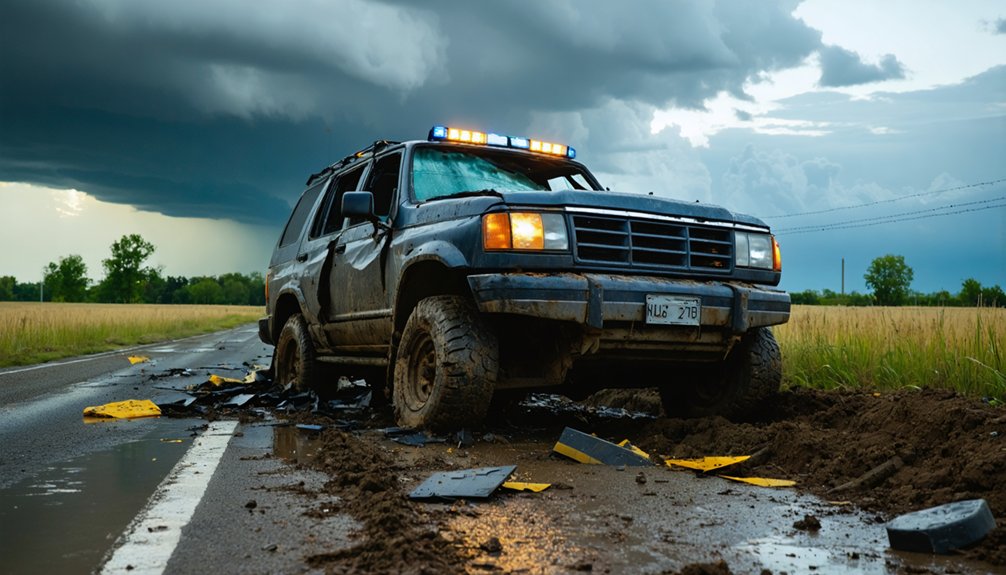
Road accidents account for 14 of the 19 documented storm chaser fatalities, establishing vehicular collisions as the dominant mortality factor—nearly three times deadlier than tornadoes themselves. Vehicle performance limitations become critical when you’re racing bumper-to-bumper through congested highways, where rear-end collisions constitute 82.7% of weather-related crashes and sideswipes reach 83.4%.
Distracted driving behaviors manifest when you’re simultaneously monitoring meteorological data while steering—a dangerous combination that experts predicted would inevitably prove fatal. The 2017 Texas incident exemplifies this vulnerability: three chasers died when one SUV operator ran a stop sign during active pursuit. Even specialized vehicles aren’t immune—EF4 winds displaced the reinforced Dominator platform.
Rain conditions, prevalent during chase operations, contribute to 74% of weather-related fatalities annually, while fog conditions produce 17.3 deaths per 1,000 crashes.
Safety Protocols and Risk Reduction Measures
Given the documented fatality patterns, thorough safety protocols address the three critical failure points: driver attention management, vehicle positioning relative to storm systems, and environmental hazard navigation. You’ll mitigate visibility challenges through mandatory headlight activation and dedicated driver assignment during active pursuit operations. Rapid deployment readiness requires systematic pre-storm preparation:
Safety protocols must address three critical failure points: driver attention management, vehicle positioning relative to storm systems, and environmental hazard navigation.
- Communication redundancy: NOAA Weather Radios, HAM systems, and continuous GPS tracking with team coordination
- Escape route discipline: Maintain two viable exits; never core-punch precipitation masses or approach rotating wall clouds
- Hydroplaning prevention: Avoid water accumulation along tire paths; reduce speed on compromised surfaces
- Emergency positioning: Drive perpendicular to tornado trajectories; seek depression terrain when shelter’s unavailable
You won’t outrun tornadoes. Instead, employ systematic hazard assessment, maintain safe standoff distances, and preserve vehicular mobility through disciplined environmental monitoring.
Frequently Asked Questions
What Specific Vehicle Modifications Can Improve Storm Chaser Safety During Pursuits?
You’ll maximize pursuit safety by installing improved suspension systems with redundant airbags, reinforced vehicle frames using steel-composite armor, hydraulic anchoring spikes, and polycarbonate windows. These modifications provide structural integrity, stability control, and debris protection during high-wind encounters.
Are There Insurance Policies Designed Specifically for Storm Chasing Activities?
You’ll find specialized storm chasing policies exist but remain rare—roughly 80% of chasers rely on standard extensive insurance coverage without disclosure. These niche plans address exclusions in conventional policies, though they carry vastly higher premiums reflecting elevated risk profiles.
Should Storm Chasers Use Different Communication Systems to Coordinate Safe Positioning?
Yes, you’ll drastically improve safety margins by implementing redundant communication systems that enable real-time weather data sharing and enhanced vehicle tracking. HAM radios, satellite devices, and GPS beacons eliminate cellular dependency, providing autonomous operational control during network failures.
What Emergency Equipment Should Storm Chasers Carry in Their Vehicles?
You’ll need thorough emergency supplies inventory including first aid kits, vehicle recovery tools, and communication devices. You’ll require weather monitoring equipment like portable anemometers, lightning detectors, and real-time radar systems for data-driven storm tracking and situational awareness.
Do Storm Chasing Groups Have Standardized Safety Certification or Training Requirements?
No standardized safety certification exists across storm chasing groups. You’ll find varying requirements by organization—some recommend SKYWARN training covering weather monitoring devices and chase route planning, but there’s no mandatory universal credential or regulatory oversight for independent chasers.