You’ll face greater mortality risk from highway accidents than tornadoes when storm chasing—6 of 15 documented fatalities resulted from traffic incidents versus zero from direct strikes. Reduce your speed 20-25 mph below posted limits during wet roads and low visibility, maintain functional headlights and seat belts, and equip your vehicle with road flares, tow ropes, and hail-rated goggles. Proper spatial awareness and speed compliance transform this meteorological pursuit into a survivable driving operation, with thorough protocols detailed throughout this guide.
Key Takeaways
- Highway accidents pose greater mortality risk to storm chasers than tornadoes, accounting for at least 6 of 15 documented fatalities.
- Reduce speed 20-25 mph below posted limits during wet roads, reduced visibility, storm cores, and nighttime chasing operations.
- Essential safety equipment includes road flares, tow ropes, ANSI high-visibility vests, hail-rated goggles, and polarized sunglasses.
- Variable speed limits decrease from 65 mph at 900-foot visibility to complete road closure below 175 feet visibility.
- Immediately reduce speed when precipitation or blowing dust compromises visibility and watch for dark green skies indicating hail.
Understanding the Real Risks: Fatality Statistics and Highway Dangers
The statistical record reveals a counterintuitive reality: storm chasers face greater mortality risk from highway accidents than from the very tornadoes they pursue. Among 15 documented fatalities, at least six resulted from traffic incidents—hydroplaning collisions, wrong-way driver impacts, and stop-sign violations. Zero deaths occurred from direct tornado strikes during intercepts, while road hazards claimed lives on both chase and non-chase days.
The 2013 El Reno event represents the sole vehicular overtake fatality, contrasting sharply with 553 tornado deaths among the general population in 2011 alone. Storm chasers have maintained safe positioning even near tornadoes that claimed over 100 lives, demonstrating that proper spatial awareness and storm evolution monitoring significantly mitigates atmospheric risks. The first storm chasing fatality occurred on April 26, 1984, marking the beginning of a documented safety record spanning multiple decades across numerous states. Your autonomous pursuit of severe weather demands rigorous driving discipline and recognition that weather risks manifest primarily through compromised vehicle control, not funnel proximity. Surface transportation, not atmospheric phenomena, constitutes your primary operational threat.
Critical Driving Protocols: Speed Limits and Traffic Law Compliance
You must comply with variable speed limits (VSL) that decrease from 65 mph at 900-foot visibility to complete road closure below 175 feet, while officers retain authority to cite speeds “too fast for conditions” even under posted limits.
Essential equipment includes functional headlights for rain/dust visibility, hard-top vehicles for golf ball-sized hail protection, and seat belts as legally mandated safety restraints.
High-risk conditions requiring speed reductions of 20-25 mph below posted limits include wet roads, reduced visibility zones, storm cores with heavy precipitation, and nighttime operations where spotting capability and maneuver response time become critically impaired. Modern VSL systems utilize environmental sensor stations that detect air temperature, humidity, precipitation, wind speed, and pavement conditions to automatically calculate safe speed recommendations for hazardous weather scenarios. Storm chasers should recognize that vehicle accident fatalities have occurred in the community, emphasizing the critical importance of adhering to safe driving protocols even when the death was not directly caused by the storm itself.
Speed Limit Enforcement Rationale
Why do traffic laws mandate adherence to posted speed limits even during meteorological emergencies? Speed limit necessity stems from documented collision data: high-speed pursuits generate *considerably* more injuries than low-speed operations, with pursuit-related property damage occurring in 40% of documented cases.
Public safety concerns escalate when hundreds to thousands of chasers converge simultaneously, creating what legislators characterize as “Wild West” conditions on public infrastructure. You’ll encounter congestion that impedes both media operations and emergency response vehicles. Road congestion during storms has prompted lawmakers to explore regulatory frameworks that address traffic density issues during severe weather events.
Law enforcement agencies assess pursuit risks through traffic density, meteorological conditions, road surface characteristics, and area classification. The annual 50,000 police chases produce one fatality daily, demonstrating quantifiable consequences of velocity-based decisions. Current law enforcement practices struggle to effectively enforce existing traffic regulations during severe weather convergence events.
These empirical parameters establish regulatory frameworks that balance operational freedom against documented casualty statistics and infrastructure protection requirements.
Essential Safety Equipment Requirements
Your personal safety preparedness inventory should incorporate:
- Emergency signaling apparatus: Road flares establish 300-meter hazard perimeters in compromised traffic patterns, alerting approaching vehicles to stationary intercept positions.
- Vehicular recovery systems: Tow ropes (minimum 10,000-pound tensile strength) enable self-extraction from soft terrain without external assistance. High-visibility ANSI vests ensure operator detection during roadside operations in reduced-visibility conditions.
- Ocular protection protocols: Hail-rated goggles prevent corneal trauma during core penetration maneuvers exceeding 50mm diameter precipitation events. Polarized sunglasses are essential for viewing storm structure and identifying rain-wrapped tornadoes through UV ray reduction.
These configurations maximize operational autonomy while reducing third-party dependency during remote deployments.
High-Risk Driving Conditions
While atmospheric phenomena demand your analytical focus, vehicular control degradation presents the primary fatality mechanism in storm intercept operations. Reduce speed immediately when precipitation or blowing dust compromises visibility thresholds. Snow-covered and water-saturated surfaces require velocity reduction to prevent hydroplaning along tire contact paths. Water splash sounds indicate excessive speed for current conditions.
Weather anomaly awareness necessitates continuous environmental scanning rather than radar fixation. Monitor for dark green sky tints, hail signatures, and auditory cues suggesting tornadic development. Signal all directional changes per traffic regulations—your autonomy doesn’t supersede legal compliance with posted limits and lane-change protocols. Task saturation during active tornado observation can cause you to miss critical details or neglect important vehicle control functions, particularly when adrenaline peaks.
Vehicle handling techniques include maintaining extended following distances and positioning perpendicular to identified tornado trajectories. Yield to construction zones, biological obstacles, and disabled vehicles. Defensive spacing from other chase units prevents collision cascades during rapid repositioning maneuvers. Tornadoes can form and intensify within minutes, requiring constant vigilance and readiness to execute evasive protocols without hesitation.
Advanced Radar Monitoring Techniques for Storm Tracking
When intercepting severe weather, you must leverage multiple radar data sources to maintain situational awareness and track rapidly evolving storm systems. Professional chasers combine GRLevel3 or RadarScope’s super-resolution data with MRMS mosaics to identify supercell signatures and fill coverage gaps. This integrated approach enables precise storm positioning and threat assessment.
Critical monitoring techniques include:
- Velocity couplet analysis: Detect tight rotation indicating mesocyclone formation, then confirm with storm relative motion adjustments to isolate rotating features from background flow.
- Correlation Coefficient verification: Identify debris balls that correlate with reflectivity hook echoes, confirming tornado ground contact even during rain-wrapped events.
- Echo Tops interpretation: Assess maximum precipitation height and particle type analysis through Differential Reflectivity, revealing updraft intensity and hail potential.
Deploy these methods systematically for autonomous decision-making in dynamic intercept situations.
Developing Effective Escape Routes and Road Strategies
Because storm systems move at speeds between 20-60 mph and can generate satellite tornadoes with minimal warning, establishing multiple exit vectors before positioning becomes non-negotiable for survival. You’ll need to identify storm staging positions on southeast quadrants where parallel road grids enable 180-degree escapes without dead-ends.
Study road networks beforehand, marking single-bridge crossings that compromise retreat options. Your coordinated chasing strategies should account for convergence zones on high-risk days—traffic density directly impacts escape velocity. Never position under rotating wall clouds; maintain awareness of storm motion vectors continuously.
Interstate highways provide ideal outrun corridors for tornadoes under 60 mph. Avoid borders, night-closing gates, and Native American land restrictions that eliminate escape flexibility. Pre-identified culverts serve as last-resort options only when entrapment becomes unavoidable.
Professional Data Collection Methods and Equipment Deployment
Professional storm interception requires deployment of integrated sensor arrays that transform vehicle platforms into mobile atmospheric laboratories capable of capturing microclimate data within proximity to severe convective systems.
Your equipment configuration demands careful payload capacity considerations—modified research trucks accommodate complex sensor packages including anemometers, barometers, and disdrometers while maintaining structural integrity under extreme wind loads. Remote data transmission capabilities through dual hotspot systems (Verizon/AT&T) guarantee continuous connectivity for real-time telemetry during intercepts.
Essential deployment protocols include:
- Portable weather stations (Kestrel 5500 series) mounted via custom roof racks measuring temperature, pressure, humidity, and wind parameters
- Lightning detection equipment (Thor Guard/StrikeAlert HD) identifying electrical activity within storm cores
- Radar applications (RadarScope Pro) providing high-resolution precipitation analysis unavailable through consumer platforms
Waterproof, drop-tested instrumentation withstands hail impacts and severe environmental conditions throughout operational cycles.
The Evolving Science of Tornado Formation and Climate Impact
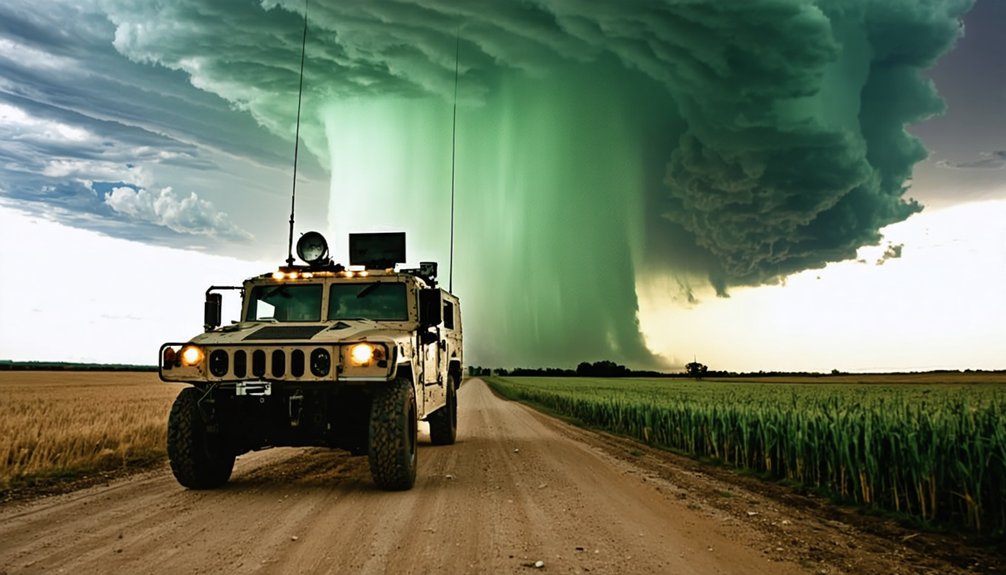
Understanding tornadogenesis requires abandoning conventional top-down formation models that dominated atmospheric science for decades. Recent radar measurements from Oklahoma and Kansas confirm rotation develops near-ground before extending upward—contradicting precipitation-driven downdraft theories.
You’ll find tornadic supercells exhibit less-cold outflow and enhanced storm-relative helicity pockets that intensify rotation through buoyancy maintenance rather than thermal forcing alone.
Environmental risk factors now include lower cloud bases, stronger low-level wind shear, and pocket extent rather than maximum values. KITD’s 2026 projections indicate 15% increased Central Plains activity driven by persistent La Niña and Gulf warming—demonstrating regional tornado frequency shifts.
WoFS modeling provides hour-advance warnings by analyzing thermodynamic variables at fine scales, though precipitation characteristics and terrain effects remain incompletely simulated challenges.
Frequently Asked Questions
What Insurance Coverage Do Storm Chasers Need for Equipment and Vehicle Damage?
You’ll need commercial auto insurance with liability insurance coverage for pursuit-related accidents, plus inland marine policies providing equipment replacement policies for cameras, weather stations, and tracking systems. Standard personal auto insurance won’t cover storm chasing activities.
How Do Chasers Communicate and Coordinate With Emergency Responders During Intercepts?
You’ll establish real-time coordination with emergency responders using amateur radio protocols and standard call signs, maintaining situational awareness through EOC channels. Follow prescribed communication procedures, relay precise weather data, and coordinate via AUXCOM networks during active intercepts.
What Physical Fitness Level Is Required for Extended Storm Chasing Expeditions?
Marathon-like cardiovascular endurance proves essential—you’ll need 55% combined scores on timed 1.5-mile runs and 500-meter rows at 60th percentile minimum. Muscular strength supports extended vehicle operations across 4,500 miles over ten demanding days.
Are There Legal Restrictions on Where Chasers Can Position Vehicles or Equipment?
Yes, you’ll face restricted roadside parking on limited-access highways where stopping creates legal liability concerns. You must verify parking legality, position vehicles completely off right-of-way, obey all traffic laws, and avoid implying official status with equipment.
What Training Certifications Should Beginners Complete Before Their First Chase Season?
You’ll need SKYWARN certification first, then develop weather data analysis skills through COMET MetEd modules. Master vehicle operation techniques via defensive driving courses. These free programs don’t restrict your independence while ensuring you’re prepared for severe weather encounters.
References
- https://stormtrack.org/threads/how-does-storm-chasing-compare-to-other-high-risk-activities.30926/
- https://www.flame.org/~cdoswell/chasesums/Chase_safety.html
- https://www.preventionweb.net/news/what-do-storm-chasers-really-do-two-tornado-scientists-take-us-inside-chase-and-tools-studying
- https://hull-repository.worktribe.com/preview/4415817/Hunter_ Nicolle – Storm Chasing in Contemporary American Society and Culture.pdf
- https://stormchasercoaching.com/post/is-storm-chasing-safe
- https://www.thecitizen.org.au/articles/more-storm-chasers-have-died-road-fatalities-actual-tornadoes
- https://stormtrack.org/threads/storm-chasing-fatalities-a-look-back.30662/
- https://injuryfacts.nsc.org/home-and-community/safety-topics/weather-related-deaths-and-injuries/data-details/
- https://www.weather.gov/hazstat
- https://www.ncei.noaa.gov/stormevents/