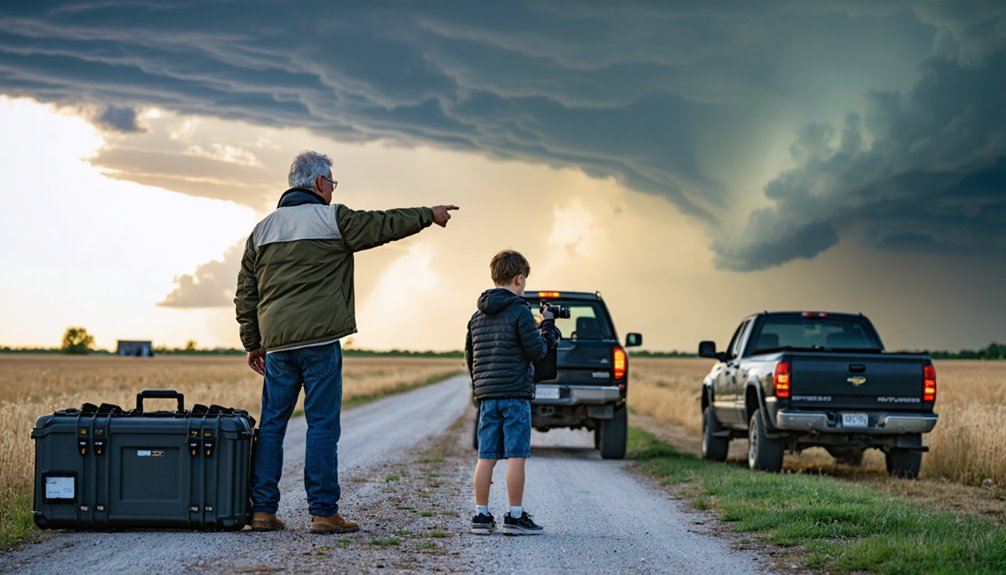
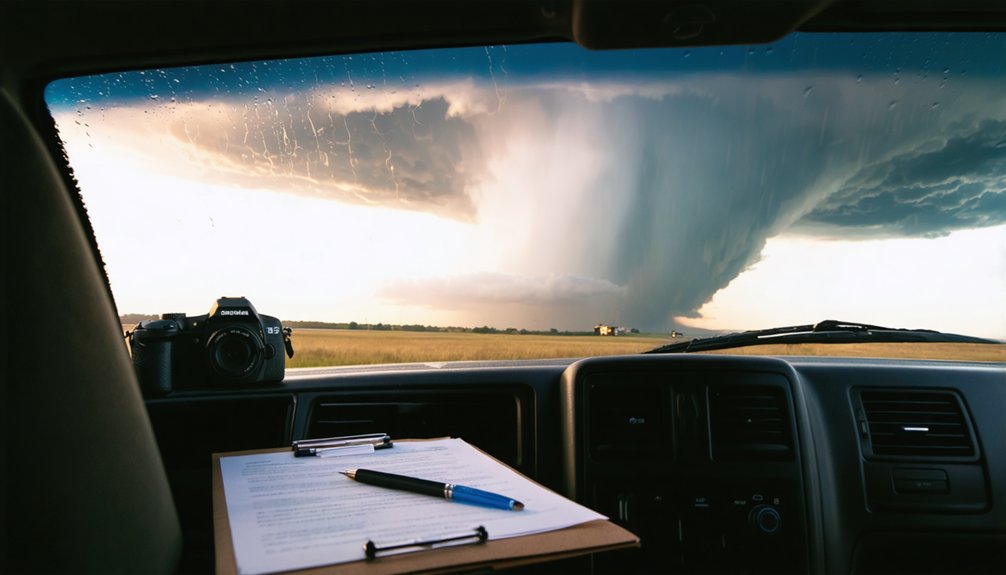
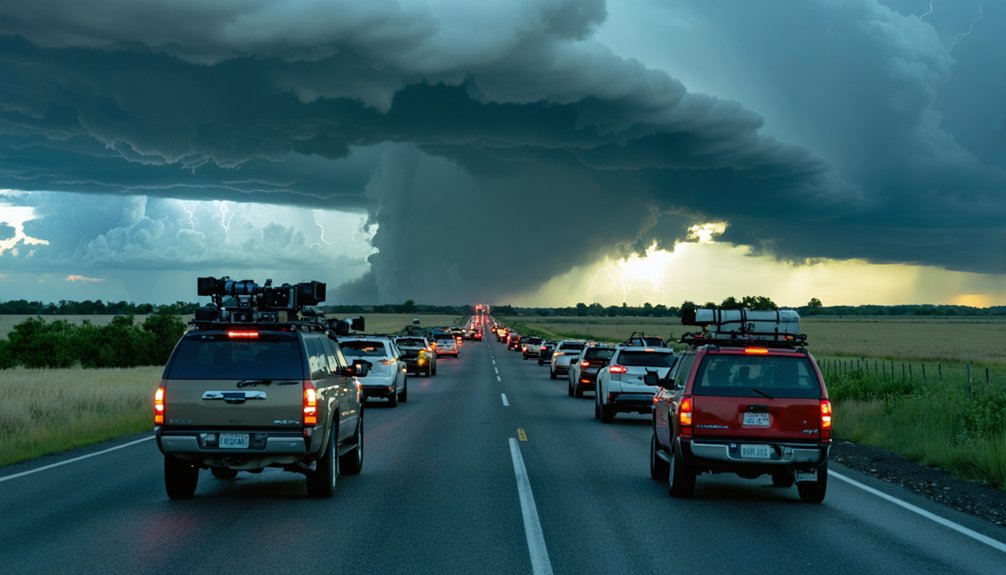
You’ll face higher fatality risks from vehicular accidents (14 deaths) than tornado encounters (5 deaths) when storm chasing, with distraction and fatigue creating the primary hazards. Despite tracking systems that materialize EF4/EF5 tornadoes within minutes, your exposure to road travel dangers—including hydroplaning and intersection collisions—statistically exceeds atmospheric threats by nearly 3:1. Person-day risk calculations reveal storm chasing maintains lower mortality rates than skiing’s 51 annual fatalities, though the growing amateur chaser population of 350,000-400,000 SKYWARN spotters complicates these metrics as training gaps emerge.
Key Takeaways
- Vehicular accidents cause nearly three times more storm chaser deaths than tornadoes, making road safety the primary concern.
- Violent tornadoes can form within minutes, requiring chasers to recognize visual cues like wall clouds and calculate probabilities carefully.
- Large hail and high winds pose escalating threats, demanding technical proficiency during core penetration and close-range observations.
- Storm chasing carries lower fatality rates than skiing when measured per person-day, though road travel dominates actual risk.
- Training gaps leave 350,000-400,000 amateur spotters unprepared for nowcast complexities, threatening safety during critical warning scenarios.
The Hidden Danger: Why Car Accidents Claim More Lives Than Tornadoes
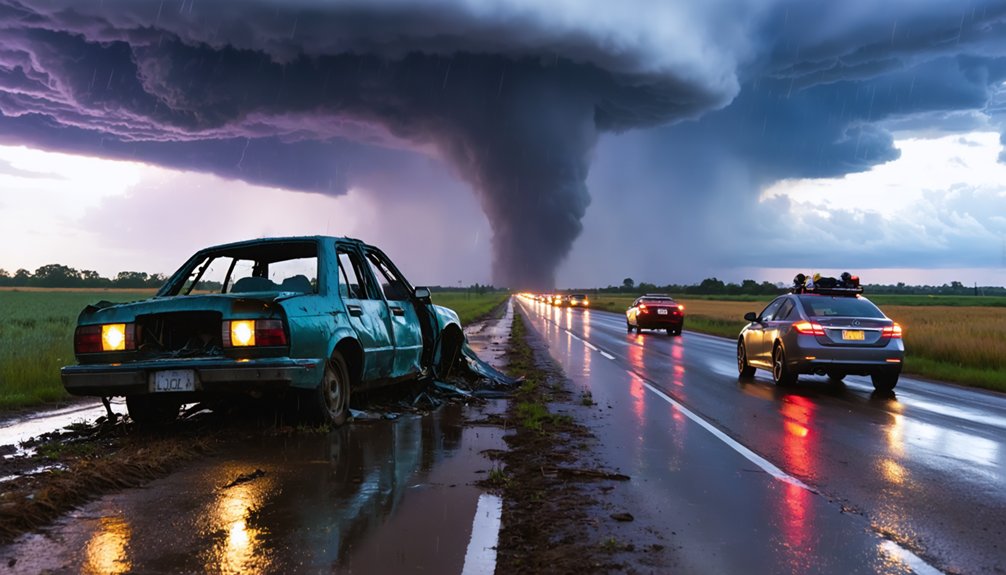
While tornadoes dominate public perception of storm chasing dangers, vehicular accidents represent the activity’s most lethal threat. Statistical analysis reveals car accidents caused 14 deaths compared to 5 tornado-related fatalities.
You’ll face three primary risk factors: extended travel hours requiring rigorous fatigue management protocols, sky-focused distraction compromising road awareness, and increased chaser volume creating congestion at critical intersections safety points. Hydroplaning killed three University of Oklahoma students, while semitrailer collisions occurred at roadside hazard stops.
Despite these incidents, storm chasing’s risk profile remains favorable—averaging under one death annually since 2005. When calculated using person-day metrics across 35,175 to 502,500 annual participant-days, the activity demonstrates lower fatality rates than skiing’s 1-in-944,444 benchmark, assuming proper vehicular risk mitigation.
Understanding the Rare But Real Tornado Threat
Vehicular hazards dominate chaser mortality statistics, yet tornado encounters constitute the activity’s defining existential risk. You’re traversing environments where violent EF4/EF5 phenomena—fewer than 70 annually worldwide—can materialize within minutes.
Road accidents kill more chasers than tornadoes, but violent EF4/EF5 storms remain the ultimate threat materializing in minutes.
Visual detection cues become critical: wall clouds persist 10-20 minutes pre-genesis, while beaver’s tails indicate rotational intensification. Rain-wrapped and nocturnal tornadoes eliminate visibility advantages, transforming pursuits into probability calculations rather than certainty.
You’ll encounter needle funnels, anticyclonic rotations, and multiple-vortex structures that defy standardized assessment protocols. Storm damage assessments post-event reveal wind speeds exceeding 200 mph in compact zones.
With U.S. averages of 1,200-1,300 annual events and 70 fatalities, your exposure remains statistically minimal—until proximity eliminates that buffer. Autonomous decision-making determines survival when meteorological chaos exceeds forecast parameters.
Weather Hazards That Haven’t Turned Fatal Yet
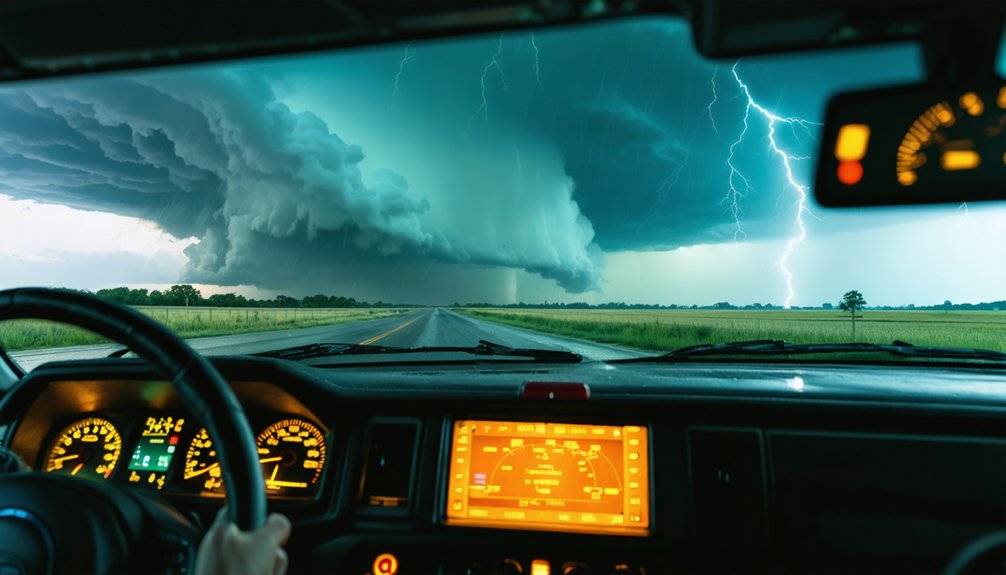
Beyond the tornado vortex itself, you’re traversing a constellation of meteorological threats that haven’t yet claimed chaser lives but carry escalating probability vectors. Large hail incidents—projected to surge 145% for 2+ inch stones in central U.S. spring systems—generate $8-14 billion annual insured losses while producing nonfatal struck injuries during intercept operations.
High wind events compound at 1.83% annually, reaching 25,371 reported incidents in 2024 versus 16,123 in 2000. These phenomena contribute to severe storm complexes causing 200 deaths yearly among the general population. You’ll encounter hailstone impacts injuries during core penetration maneuvers, particularly as favorable conditions expand into new regions. The data confirms what autonomous chasers already understand: freedom requires calibrated risk assessment against statistically intensifying hazards that demand technical proficiency.
How Storm Chasing Risk Compares to Skiing and Other Activities
Storm chasing’s mortality profile differs substantially from recreational skiing when normalized through person-day exposure metrics. Skiing generates 51 annual fatalities across 50 million person-days, yielding a standardized risk metric of 1 death per 944,444 exposures. You’ll find storm chasing’s 13 deaths from 2005-2019 span an estimated 35,175 to 502,500 annual person-days, though refinement of chaser population data remains necessary for precise rate calculations.
This person day risk profile methodology, borrowed from whitewater rafting analysis, enables direct comparison across adventure activities without participation volume distortion. Road travel dominates your actual exposure risk, far exceeding tornado threats in mortality statistics.
The standardized risk metrics framework empowers you to make informed decisions about voluntary risk acceptance when pursuing severe weather documentation and atmospheric research objectives.
The Rising Amateur Storm Chaser Problem
While quantitative risk assessment frameworks enable informed decision-making for experienced chasers, the exponential growth of amateur participation has fundamentally altered the storm chasing landscape since the 1970s. You’re witnessing 350,000 to 400,000 trained SKYWARN spotters nationwide, driven by broadcast media engagement and social platforms amplifying chaser recognition.
The storm chasing community has exploded from niche expertise to 400,000 spotters, fundamentally reshaping operational dynamics and safety protocols.
Stormtrack’s forums document this surge: 5.4K threads generating 78.1K messages, with 1.9K introductory threads for newcomers traversing 10,000+ annual severe thunderstorms.
However, spotter training guidelines—typically 2-hour sessions covering basic meteorology—don’t equip you with professional-grade capabilities like 391 chase days or 230,798 miles of experience. You’ll find amateurs filing 6-24 reports seasonally without understanding nowcast complexities or flood risks that claim thousands annually.
This training gap threatens both personal safety and operational effectiveness during critical warning scenarios.
When Multiple Weather Threats Strike Simultaneously
When supercells produce concurrent hail, tornadoes, and severe winds, rainfall rates often exceed 2-3 inches per hour, triggering flash floods in low-lying areas and roadside drainage systems.
You’ll encounter layered hazards—reduced visibility from precipitation and blowing dust, hydroplaning risks on hail-covered pavement, and the temptation to shelter under bridges or in culverts where rising water can trap your vehicle within minutes.
Situational awareness demands continuous monitoring of radar-indicated precipitation rates, local topography, and drainage patterns while simultaneously tracking tornadic rotation and hail cores.
Rainfall Creates Flash Floods
Meteorologists have documented a particularly dangerous phenomenon where tornado and flash flood warnings occur simultaneously—termed TORFF events—creating compounding hazards that demand heightened situational awareness from storm chasers.
Flash flood warnings precede tornado warnings in nearly two-thirds of cases, with multicell storms generating the highest frequency (n=138). You’ll encounter critical hydrological factors: soil saturation from preceding rainfall eliminates absorption capacity, while steep topography accelerates runoff velocities.
Weak winds aloft produce slow-moving thunderstorms that train over identical areas, depositing concentrated precipitation. Clay-rich soils derived from shale bedrock cause slow drainage, amplifying flood risk. Mountain streams can surge from six inches to ten feet within an hour.
Urban environments with impervious surfaces generate rapid runoff, overwhelming storm drain infrastructure and creating life-threatening conditions.
Sheltering In Drainage Dangers
As simultaneous tornado and flash flood warnings converge, you’ll face a critical survival paradox: the instinct to shelter in low-lying structures or drainage systems directly conflicts with hydrological realities that transform these spaces into death traps.
Open culverts create powerful suction hazards during high-flow conditions, with 48-inch openings generating forces that have killed at least three dozen people since 2015. Hurricane Ida demonstrated this lethality when four of five individuals swept into New Jersey’s drainage infrastructure perished.
Drainage pipe safety protocols remain inconsistent across municipalities, with no federal regulations mandating protective grates despite engineering solutions proven effective in Denver’s Mile High Flood District. Flood risk communication strategies must emphasize alternative shelter locations, as submerged pipe entrances become invisible beneath floodwaters, eliminating your ability to identify and avoid these fatal hazards.
Layered Hazards Require Awareness
Storm chasers confronting supercell environments rarely encounter isolated threats—atmospheric conditions that generate tornadoes simultaneously produce hail exceeding 2 inches in diameter and straight-line winds surpassing 75 mph. You’ll navigate compounded hazards when heavy precipitation, blowing dust, and hail fog devastate driving visibility while dodging downed power lines and debris-strewn weather roadways.
Mid-afternoon dryline initiation across the Texas Panhandle escalates to evening tornado-hail-wind peaks throughout Oklahoma and Arkansas, where discrete supercells shift into bowing mesoscale convective systems sustaining 75+ mph gusts overnight. Multitasking—radar interpretation, navigation, documentation—divides attention precisely when rain-slicked surfaces and hail accumulation demand full focus.
Defensive protocols include partner task delegation and strategic pull-overs, mitigating fatality risk from layered meteorological and operational threats converging on high-shear chase days.
Frequently Asked Questions
What Safety Equipment Should Storm Chasers Carry in Their Vehicles?
You’ll need emergency weather radios and vehicle safety equipment coincidentally aligned with NOAA specifications: power inverters, first-aid kits, tire repair systems, protective gear including ANSI-rated vests, and communication devices. You’re empowered to chase storms while maintaining operational readiness.
Are There Licensing Requirements or Certifications for Professional Storm Chasers?
You don’t need universal licensing, though qualifications of experienced storm chasers typically include meteorology degrees (44.7% Bachelor’s, 24.7% Master’s) and SKYWARN training. Proper precautions for storm chasing involve voluntary certifications in radar interpretation and emergency response protocols.
How Do Storm Chasers Communicate With Each Other During Severe Weather?
You’ll communicate via ham radio repeaters and two-way radios like Midland MXT115, enabling real-time data sharing and coordinated positioning. SKYWARN nets relay weather reports through Net Control Stations, while linked repeater systems extend your range across hundreds of miles.
What Insurance Coverage Do Storm Chasers Need for Their Activities?
Don’t put the cart before the horse—you’ll need extensive liability insurance coverage for property damage and bodily injury, plus collision protection meeting vehicle maintenance requirements, given the high-risk atmospheric conditions and hazardous road exposures you’ll encounter.
Which U.S. States Have the Highest Storm Chaser Fatality Rates?
No state-specific storm chaser fatality data exists. You’ll find chasers concentrate where tornado formation patterns emerge—Oklahoma, Kansas, Texas—but weather radar interpretation and voluntary safety practices mean fatalities remain statistically rare: under one annually nationwide.