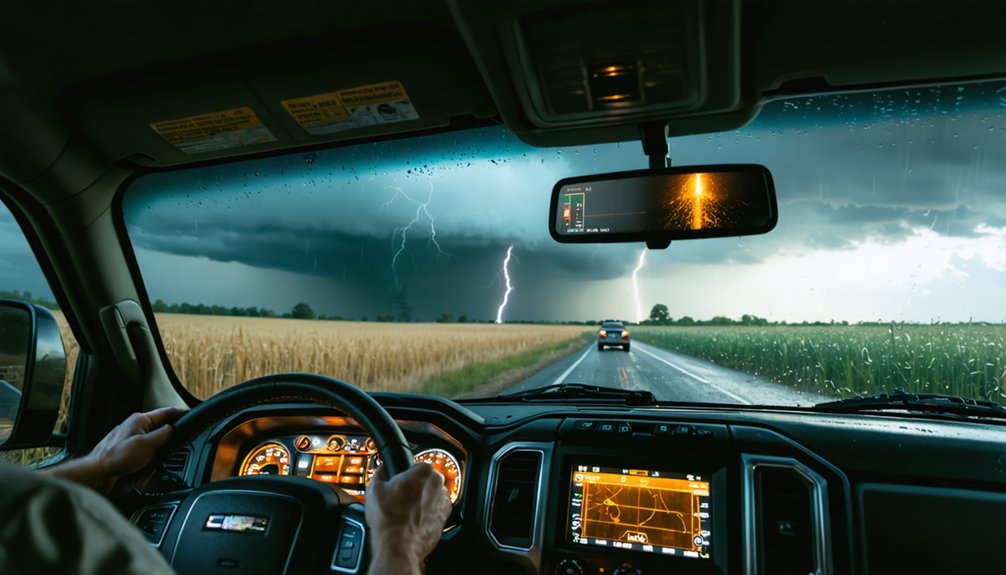
HP, LP, and classic supercells all feature a rotating mesocyclone, but they differ in how precipitation interacts with the updraft. In an LP supercell, you’ll see minimal rainfall and an exposed updraft. Classic supercells balance moisture and wind shear, producing visible hook echoes and frequent tornadoes. HP supercells wrap heavy rain around the mesocyclone, hiding tornadoes and creating flash flood risks. Each type carries unique dangers worth understanding before you encounter one.
Key Takeaways
- Classic supercells feature a well-defined hook echo, moderate rainfall, and produce the strongest, most visible tornadoes with maximum warning time.
- LP supercells develop in dry conditions, produce minimal precipitation, rarely generate tornadoes, and maintain a fully exposed updraft against a dry sky.
- HP supercells wrap heavy rainfall around the mesocyclone, obscuring structural features and hiding dangerous tornadoes, creating significant flash flooding risks.
- LP supercells form along western Great Plains boundaries, while HP supercells dominate high-moisture corridors further east, reflecting distinct environmental moisture requirements.
- Supercells can evolve between HP, LP, and classic types as surrounding atmospheric conditions, moisture levels, and wind shear change over time.
What Separates Supercells From Ordinary Thunderstorms?
When most thunderstorms fire up, they live and die within an hour, driven by a simple convective cycle where the downdraft chokes the updraft and collapses the storm.
Supercells break that pattern entirely. The defining supercell characteristic is a persistent, rotating updraft called a mesocyclone, spanning 2–10 km and sustaining itself for at least 30 minutes.
Wind shear tilts the storm’s axis, physically separating the updraft from the downdraft. That separation is everything. It means inflow keeps feeding the engine without interference, allowing the storm to dominate its environment rather than destroy itself.
Understanding these thunderstorm dynamics tells you why supercells produce the most violent weather on Earth, including large hail, damaging winds, and the strongest tornadoes.
Ordinary storms simply can’t compete structurally.
What Atmospheric Conditions Produce Each Supercell Type?
High precipitable water values combined with weak mid-level storm-relative winds favor HP supercells, flooding low-level inflow with moisture.
LP supercells develop where moisture balance tips dry, with strong mid-level storm-relative winds that carry precipitation away from the updraft.
Strong mid-level storm-relative winds strip precipitation away, leaving LP supercell updrafts exposed and visually striking against dry air.
Classic supercells occupy the middle ground — sufficient moisture without excess, paired with moderate wind shear that organizes balanced updraft-downdraft separation.
Low-level moisture and precipitable water values are your primary diagnostic tools.
You’ll typically find LP supercells along the western Great Plains boundary where humid and dry-hot air masses collide, while HP variants dominate high-moisture corridors further east.
How HP, LP, and Classic Supercells Differ in Structure and Behavior
Each supercell type organizes its updraft, downdraft, and precipitation core differently, and those structural differences drive distinct behaviors you’ll observe on radar and in the field. Understanding these supercell characteristics helps you read storms accurately across their entire storm lifecycle:
- Classic supercells position the updraft centrally, producing a textbook hook echo, BWER, and rain-free wall cloud.
- LP supercells push the updraft rearward, generating minimal precipitation but significant large hail and strong mid-level storm-relative winds.
- HP supercells shift the updraft forward, wrapping heavy rain and hail completely around the mesocyclone.
- Tornado visibility varies sharply—classic tornadoes are exposed, LP tornadoes are rare, and HP tornadoes hide dangerously inside precipitation.
These structural contrasts aren’t static; storms evolve between types as environmental conditions change.
How Does Precipitation Differ Across HP, LP, and Classic Supercells?
Precipitation volume and distribution separate the three supercell types more sharply than almost any other characteristic.
LP supercells produce minimal rainfall, concentrating precipitation in a small nucleus while generating large hail despite low overall output. Their precipitation patterns stay tightly confined, leaving the updraft visually exposed.
LP supercells run lean — minimal rainfall, concentrated hail, updraft fully exposed against an otherwise dry sky.
Classic supercells deliver moderate rainfall intensity, organizing precipitation into a distinctive hook shape around the mesocyclone with balanced rain and hail distribution.
HP supercells represent the extreme opposite, wrapping enormous rainfall intensity around the updraft and mesocyclone entirely. Their precipitation patterns extend broadly, creating flash flooding risks and obscuring structural features from ground-level observation.
You’re fundamentally dealing with a spectrum: LP keeps things dry and visible, classic balances both, and HP drowns the storm in its own output.
How to Identify Each Supercell Type on Radar
Radar signatures tell you almost everything you need to distinguish supercell types before you ever look at the sky. Each type broadcasts distinct patterns during supercell development:
- Classic supercells display a well-defined hook echo, V-notch, and bounded weak echo region — textbook identification.
- LP supercells show minimal precipitation return, often just a small nucleus, signaling large hail potential despite low rain volume.
- HP supercells produce a kidney-shaped or circular precipitation shield wrapping entirely around the mesocyclone, obscuring low-level rotation.
- All three types show a 2–10 km rotating mesocyclone signature when velocity products are applied.
Watch for supercell development as storms shift between types — an LP storm moving into higher moisture can rapidly develop classic or HP characteristics.
Which Supercell Type Produces the Most Dangerous Tornadoes?
When evaluating tornado danger, you can’t simply equate frequency with lethality—HP supercells produce the most deadly US tornadoes because heavy precipitation wraps around the mesocyclone, concealing the tornado until you’re dangerously close.
Classic supercells, by contrast, generate the strongest and most frequent tornadoes, with well-defined hook echoes giving you critical lead time to identify rotation and issue warnings.
You should treat HP tornadoes as the higher immediate threat to life, while recognizing that classic supercells dominate in raw tornado intensity and production rate.
HP Tornadoes Hidden Danger
Among the three supercell types, HP supercells produce the most dangerous tornadoes—not because they’re stronger, but because heavy rainfall wraps around the mesocyclone, concealing the tornado until you’re dangerously close.
Rain-wrapped tornadoes make visual tornado detection nearly impossible, stripping your ability to react in time.
Key dangers HP supercells present:
- Obscured visibility – precipitation walls eliminate visual warning distance
- Delayed detection – you won’t see rotation until you’re inside the bear’s cage
- Flash flooding risk – torrential rainfall compounds tornado threats simultaneously
- Highest US tornado fatalities – rain-wrapped tornadoes account for more deaths than classic or LP events
Radar remains your primary defense.
Velocity scans revealing tight rotational couplets give you the critical seconds needed to act before visual confirmation becomes possible.
Classic Supercell Tornado Strength
Three supercell types exist on a tornado-threat spectrum, but classic supercells sit at the intersection of frequency and intensity—producing strong, well-documented tornadoes more consistently than LP or HP storms.
You’ll find that supercell dynamics in classic storms create ideal conditions: balanced moisture, a well-defined hook echo, and an exposed mesocyclone that meteorologists can track precisely. This structural clarity directly correlates with tornado intensity, as the rain-free updraft base allows unobstructed inflow and sustained rotation.
LP supercells rarely produce tornadoes, while HP storms generate rain-wrapped threats that complicate warning lead times. Classic supercells deliver visible, trackable tornadoes—often reaching EF3 or higher.
That visibility isn’t just scientifically valuable; it gives you maximum warning time to act decisively before impact.
Frequently Asked Questions
Can a Supercell Change From One Type to Another During Its Lifetime?
Yes, you’ll see supercells shift between types during storm evolution. A classic supercell classification can change from LP to classic off the Caprock as low-level moisture and precipitable water values change throughout the storm’s lifecycle.
Why Do LP Supercells Produce Large Hail Despite Generating Little Rainfall?
LP supercells produce large hail because strong mid-level storm-relative winds in their storm dynamics extend hailstone residence time in the updraft, enhancing hail formation cycles while carrying precipitation away, so you’ll see minimal rainfall but significant hail accumulation.
Are HP Supercells More Common in Certain Regions of the United States?
Yes, you’ll find HP supercells more frequently in high-moisture regions like the Gulf Coast and southeastern U.S., where supercell frequency peaks due to regional variations in precipitable water values and weak mid-level storm-relative winds.
How Long Must Mesocyclone Rotation Persist for a Storm to Be a Supercell?
For a storm’s mesocyclone persistence to meet storm classification as a supercell, you need rotation lasting at least 30 minutes. This sustained, organized rotation separates true supercells from ordinary convective storms in meteorological assessment.
What Role Does Precipitable Water Play in Determining Supercell Type?
Like a puppet master pulling strings, precipitable water drives moisture dynamics and storm classification—you’ll find high values spawn HP supercells, low values create LP types, and balanced moisture produces classic supercells.
References
- http://wx4cast.blogspot.com/2011/05/types-of-thunderstorms-part-2.html
- https://www.weather.gov/ama/supercell
- https://content.meteoblue.com/en/research-education/educational-resources/meteoscool/weather/thunderstorms/supercells/
- https://www.eoas.ubc.ca/courses/atsc113/flying/met_concepts/04-met_concepts/04a-Tstorm_types/index-supercell.html
- https://stormtrack.org/threads/supercell-type.25529/