You can’t credit storm chasing to a single founder, but two figures stand out. David Hoadley began chasing in 1956 out of personal curiosity, later founding *Storm Track* magazine and shaping the culture of the practice. Neil Ward pursued storms scientifically during the same era, developing foundational theories on tornado formation. Their parallel, independent pursuits established storm chasing’s dual identity—cultural and scientific—and the full story runs considerably deeper than either name alone suggests.
Key Takeaways
- David Hoadley began storm chasing in 1956 out of personal curiosity, founding *Storm Track* magazine and establishing storm chasing’s foundational culture.
- Neil Ward systematically intercepted storms for empirical study, developing foundational ideas about thunderstorm structure and tornado formation before Doppler radar existed.
- The Tornado Intercept Project, launched in 1972, formalized storm chasing as a scientific discipline with rigorous methodologies and safety protocols.
- John P. Finley initiated systematic tornado study in 1882, publishing 15 forecasting rules that transitioned tornado research from folklore to science.
- Major Fawbush and Captain Miller issued the first successful tornado forecast in 1948, marking a pivotal milestone in severe weather prediction history.
Storm Chaser vs. Storm Spotter: What the Term Actually Means?
When most people hear “storm chaser,” they picture a thrill-seeker racing toward a tornado, camera in hand—but that image obscures a meaningful professional and functional distinction.
Storm chaser roles involve actively pursuing severe weather systems, often covering vast distances to intercept and document storms firsthand.
Storm spotters, by contrast, operate from fixed positions, relying on storm spotting techniques like visual identification of rotation, wall clouds, and precipitation patterns to relay real-time data to local warning authorities.
You’d be wrong to treat these as interchangeable terms.
Spotters feed the warning network; chasers generate field intelligence and raw data.
Both serve critical functions, yet they occupy distinct operational spaces within severe weather response.
Understanding the difference sharpens your grasp of how modern severe weather documentation actually works.
America’s First Tornado Records and the Roots of Storm Chasing
If you trace storm chasing back to its earliest roots, you’ll find America’s first recorded tornado reported in Massachusetts in 1643, a full two centuries before any systematic effort to study such storms emerged.
It wasn’t until 1882 that U.S. Army Sergeant John P. Finley conducted the first serious investigative work on tornadoes, publishing 15 foundational forecasting rules — yet the U.S. government’s 1887 ban on using the word “tornado” in official forecasts actively suppressed that progress.
The ban’s reversal in 1950 by the U.S. Weather Bureau finally cleared the path for open research, setting the institutional groundwork that would eventually give rise to organized storm chasing.
America’s First Tornado Sighting
Though the formal discipline of storm chasing wouldn’t take shape for centuries, America’s relationship with tornadoes begins with a single recorded observation in 1643 Massachusetts—the earliest known documentation of a tornado on American soil.
This entry marks a critical threshold between tornado folklore and verifiable historical accounts. Before systematic meteorology existed, communities interpreted violent storms through cultural and religious frameworks, leaving observations fragmented and unreliable.
That 1643 record changes everything. It establishes a documented starting point from which you can trace America’s evolving understanding of tornadoes—from fearful mythology to structured scientific inquiry.
Without it, reconstructing the early history of atmospheric violence across North America becomes largely speculative.
Recognizing this moment isn’t trivial. It’s the foundational data point that anchors every subsequent advancement in tornado research and, ultimately, storm chasing itself.
Early Tornado Research Efforts
From that 1643 observation forward, tornado research advanced slowly and unevenly—shaped more by military necessity and institutional caution than by scientific curiosity.
In 1882, Army Sergeant John P. Finley published 15 rules for tornado forecasting, representing early research’s most disciplined effort. Yet within five years, the U.S. government banned the word “tornado” from official forecasts entirely, suppressing knowledge rather than advancing it.
You can see the pattern clearly: institutional control consistently outpaced scientific progress.
That changed in 1948, when Major Ernest J. Fawbush and Captain Robert C. Miller issued the first successful tornado forecast at Tinker Air Force Base.
Lifting The Tornado Ban
When the U.S. Weather Bureau reversed its tornado forecast ban in 1950, it fundamentally transformed tornado forecasting in America. For 63 years, that prohibition had suppressed scientific inquiry and left communities dangerously uninformed.
You can trace the research impact directly through what followed: meteorologists now openly studied, discussed, and communicated tornado threats without institutional penalty.
This reversal didn’t happen in isolation. Fawbush and Miller’s successful 1948 forecast at Tinker Air Force Base had already demonstrated that prediction was possible, forcing government officials to confront an outdated, counterproductive policy.
Once lifted, the ban’s removal created intellectual breathing room that accelerated storm science considerably.
For freedom-minded researchers, 1950 represented more than policy reform — it was official acknowledgment that suppressing knowledge ultimately costs lives.
David Hoadley: The Man Who Started Storm Chasing
Before storm chasing became a scientific discipline or a cultural phenomenon, David Hoadley was already doing it. In 1956, he began pursuing storms across his North Dakota hometown, driven purely by curiosity and determination — no institutional backing, no government funding.
Hoadley’s impact extends far beyond his personal pursuits. By founding *Storm Track* magazine, he created the first structured community for like-minded individuals, establishing a shared language and purpose among scattered enthusiasts.
Community building became his defining legacy. The magazine united isolated chasers into a cohesive first generation, predating any scientific or governmental initiative. You can trace today’s chasing culture directly back to that foundation.
Hoadley didn’t wait for permission — he simply went out and built something entirely his own.
Neil Ward and the Rise of Scientific Storm Chasing
While David Hoadley pursued storms out of personal fascination, Neil Ward approached the practice with scientific intent, becoming the first researcher to systematically intercept storms for empirical study.
You’ll find Ward’s work particularly significant because he developed foundational ideas about thunderstorm structure, tornado formation, and forecasting methodology during an era that predated Doppler radar technology.
His contributions to storm dynamics established an analytical framework that later researchers would build upon, bridging the gap between amateur observation and institutionalized meteorological inquiry.
Ward’s Scientific Chasing Approach
Though David Hoadley had already established storm chasing as a personal pursuit, Neil Ward transformed it into a scientific discipline.
Where Hoadley followed storms out of passion, Ward approached them with rigorous scientific methodology, treating each storm interception as a structured research opportunity rather than an adventure.
Operating during the pre-Doppler era, Ward prioritized data collection over spectacle.
You’d recognize his approach as distinctly purposeful — every intercept served a defined research objective. He concentrated on understanding thunderstorm structure, tornado formation, and forecasting mechanics, building foundational knowledge that others would later expand upon.
Ward’s discipline fundamentally redefined what chasing could accomplish.
He demonstrated that direct storm observation, when conducted systematically, could generate insights that remote instrumentation alone couldn’t provide — a principle that continues driving field research today.
Pre-Doppler Storm Research
Ward’s systematic fieldwork didn’t emerge in isolation — it took shape against a specific technological backdrop that defined both the limitations and possibilities of storm research in his era.
Pre-Doppler challenges meant you couldn’t remotely detect internal wind structures; researchers depended entirely on visual observation, surface instrumentation, and conventional radar. Early storm methodologies demanded physical proximity to violent weather, placing scientists directly in harm’s way to gather what today’s instruments capture passively.
Ward embraced this constraint deliberately, developing intercept strategies that maximized data collection despite technological scarcity. His approach demonstrated that disciplined observation could yield meaningful scientific insight without sophisticated equipment.
That intellectual independence — extracting knowledge from raw, unmediated experience — represents exactly the kind of methodological freedom that defines genuine scientific inquiry under difficult, resource-limited conditions.
Ward’s Storm Dynamics Contributions
From those constrained fieldwork conditions, Neil Ward built a body of contributions that fundamentally reshaped how scientists understood storm dynamics. His research methods prioritized direct storm interception, yielding ground-truth data that laboratory models couldn’t replicate.
His key contributions included:
- Thunderstorm structural analysis that clarified internal circulation patterns
- Tornado formation theories linking surface convergence to mesocyclone development
- Forecasting frameworks derived from observational field data
- Pre-Doppler instrumentation techniques that maximized limited technological resources
Ward’s work proved that independent, field-driven inquiry could outpace institutionally cautious approaches.
You can trace modern tornado warning accuracy directly back to the observational foundations he established. His legacy demonstrates that pursuing knowledge beyond bureaucratic constraints produces breakthroughs that protect lives and expand scientific understanding.
How the Tornado Intercept Project Shaped Modern Storm Chasing
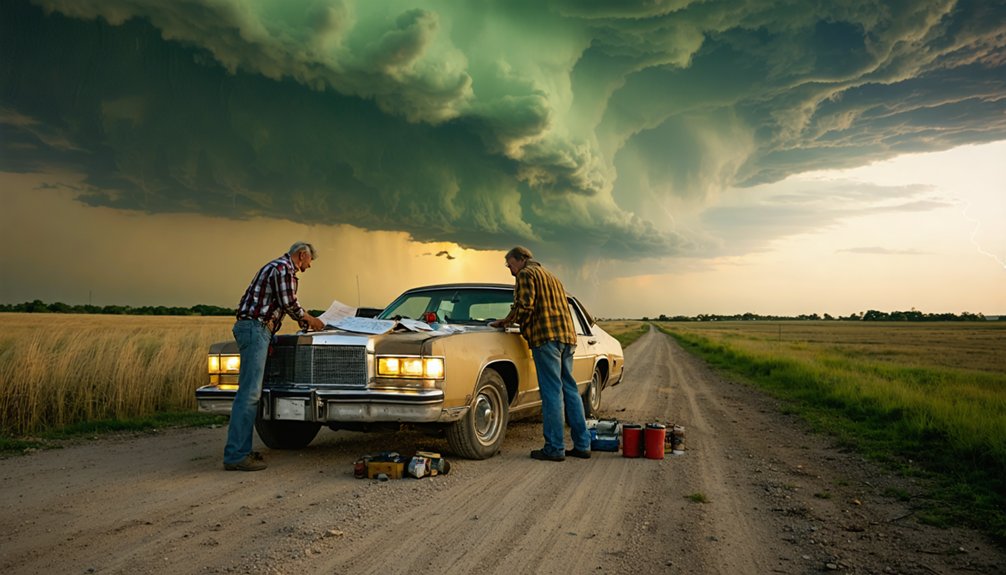
When the University of Oklahoma and the National Severe Storms Laboratory launched the Tornado Intercept Project in 1972, they effectively transformed storm chasing from an informal pursuit into a structured, scientific discipline.
Dr. Joe Golden’s initiative introduced rigorous research methodologies, establishing safety protocols and systematic data collection that earlier chasers hadn’t formalized. The 1973 Union City intercept documented tornado evolution in unprecedented detail, merging ground observations with experimental Doppler radar.
Rigorous methodology, safety protocols, and the 1973 Union City intercept transformed storm chasing into a legitimate scientific discipline.
You can trace modern chasing ethics directly to these foundational practices—responsible positioning, coordinated communication, and prioritizing scientific integrity over spectacle.
Community building followed naturally, as researchers and independent chasers recognized shared goals. This project didn’t just advance meteorological understanding; it created an intellectual framework that continues shaping how you approach storm chasing today.
The Radar Breakthroughs That Gave Early Storm Chasers Their First Real Tools
The structural rigor that the Tornado Intercept Project introduced depended heavily on a parallel technological development: radar systems capable of revealing storm interiors that ground observers couldn’t otherwise interpret.
These radar advancements didn’t emerge overnight—they built incrementally, handing early chasers tools that transformed guesswork into structured pursuit.
- 1953 produced the first documented tornado hook echo, confirming radar’s diagnostic value
- Early technology exposed rotational signatures previously invisible from the ground
- Doppler radar’s pre-NEXRAD development ran parallel to 1970s field research
- Government-funded programs collected critical data that would later anchor modern warning infrastructure
You can trace today’s warning systems directly to these foundational breakthroughs.
Each radar improvement expanded what chasers could anticipate, shifting storm interception from reactive survival into deliberate, evidence-driven fieldwork.
How the 1996 Film Twister Reshaped Storm Chasing Culture
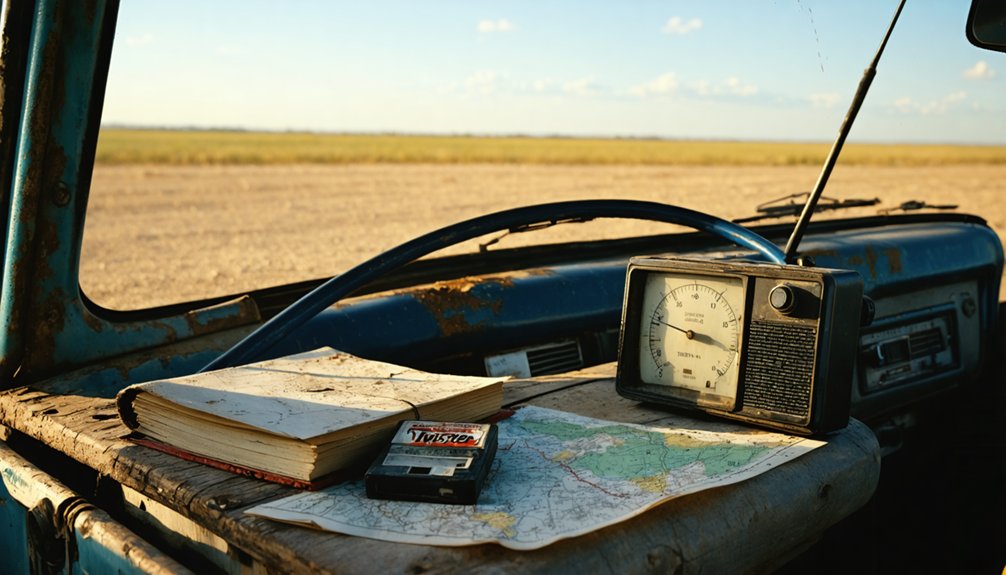
The film’s influence triggered an immediate cultural shift. Public fascination with tornadoes exploded, drawing thousands toward chasing evolution paths that prioritized spectacle over science. Media portrayal romanticized danger, distorting the community’s foundational rigor.
You can trace tornado tourism directly to this moment. Commercial tour operators emerged throughout the 2000s, capitalizing on Twister’s impact by monetizing access to Tornado Alley.
Simultaneously, the internet accelerated community growth—forums, photo archives, and video-sharing platforms connected chasers globally.
The hobby you’d recognize today—visible, commercialized, culturally embedded—wasn’t born in a research lab. It was born in a theater.
The Disputed Origin: Hoadley, Ward, and the First Storm Chaser
Before the hobby had a name, two figures were already shaping its identity through vastly different means—and that’s precisely why attributing storm chasing’s origin to a single person remains contested.
- Hoadley Legacy: David Hoadley began chasing in 1956, founded *Storm Track* magazine, and built the first independent chaser community.
- Ward Contributions: Neil Ward pursued storms scientifically, advancing thunderstorm structure and tornado dynamics before Doppler technology existed.
Hoadley operated outside institutions, driven by personal freedom and curiosity.
Ward worked within research frameworks, prioritizing empirical data collection.
You’ll find historians splitting the distinction between cultural founder and scientific pioneer. Neither title cancels the other.
Together, Hoadley and Ward established storm chasing’s dual identity—one rooted in individual independence, the other in disciplined inquiry.
Frequently Asked Questions
What Equipment Did Early Storm Chasers Use Before Modern Technology Existed?
Flying by the seat of their pants, early storm chasers relied on vintage instruments like barometers and anemometers for storm analysis. You’d use visual observation, paper maps, and basic radio communication to track dangerous weather systems independently.
Did Any Early Storm Chasers Die While Pursuing Tornadoes?
The records don’t document early storm chaser tornado fatalities specifically, but you’d recognize the early challenges they faced were immense — pursuing violent storms without Doppler radar, structured protocols, or reliable communication made every chase extraordinarily dangerous.
How Long Does a Typical Storm Chasing Expedition Last?
Like Ahab’s relentless pursuit, your storm chasing expedition typically lasts several days to weeks. Through careful expedition planning, you’ll chase storm duration windows, actively tracking volatile systems across the southern plains for ideal intercept opportunities.
Were There Female Storm Chasers in the Early Days?
The historical record doesn’t spotlight pioneering women in storm chasing’s earliest days, but their historical contributions likely existed unacknowledged. You’d find the field dominated by male researchers and hobbyists through the 1970s institutional and grassroots movements.
How Did Early Storm Chasers Fund Their Research and Expeditions?
Passion versus poverty: you’d scrape funds through grant applications and community support, as early chasers like Hoadley self-financed, while government-backed programs like NOAA’s Tornado Intercept Project secured institutional funding, driving research forward independently.
References
- https://www.rmets.org/metmatters/history-storm-chasing
- https://www.stmweather.com/blog/a-history-of-tornado-chasing-and-upcoming-girls-who-chase-training
- https://www.mikesmithenterprisesblog.com/2024/08/pre-twisters-origin-of-storm-chasing.html
- https://abc7amarillo.com/news/local/the-evolution-of-storm-chasing
- https://www.youtube.com/watch?v=jhTwSoDXC7w
- https://survive-a-storm.com/blog/the-history-of-storm-chasing/
- https://stormtrack.org/threads/history-of-storm-chasing-back-to-day-one.32873/
- https://www.youtube.com/watch?v=r4zgNNA_wj4