Social media revolutionized storm chasing by transforming it from a small scientific community of fewer than 100 practitioners in the 1990s into a crowded field with thousands of participants. You’ve witnessed platforms like YouTube and TikTok reshape operational dynamics—algorithmic reward systems now incentivize extreme proximity over meteorological documentation, while real-time data transmission through Twitter and Facebook enables life-saving evacuations but simultaneously creates traffic congestion near warned cells. This digital transformation collapsed traditional revenue models as market oversaturation reduced professional footage value, while democratizing atmospheric science knowledge for unprecedented public engagement with severe weather phenomena.
Key Takeaways
- Social media transformed storm chasing from scientific documentation into entertainment-driven content creation optimized for viral engagement and algorithmic promotion.
- Pandemic lockdowns accelerated meteorological interest, with platforms enabling knowledge democratization and converting casual observers into dedicated weather enthusiasts.
- Real-time social media data exchange enables rapid trajectory adjustments and community-sourced monitoring, potentially saving lives during severe weather events.
- Algorithmic reward systems incentivize dangerous proximity to tornadoes, with chasers positioning within 200-500 meters for maximum engagement metrics.
- Amateur smartphone footage saturation collapsed professional revenue models, dropping from $400 broadcast sales to unpredictable YouTube monetization averaging $150 per video.
From Handful to Hundreds: The Exponential Growth of Storm Chasers
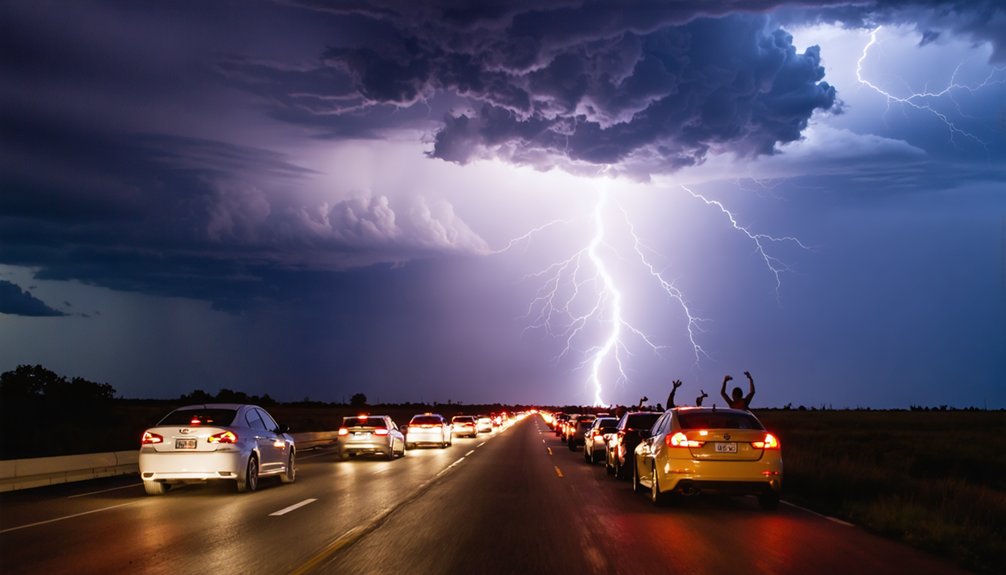
When David Hoadley initiated systematic storm chase operations in 1956 across North Dakota’s plains, he represented a solitary figure in what would become a field populated by hundreds.
From lone pioneer to crowded pursuit: storm chasing evolved from Hoadley’s solitary 1956 expeditions into a field commanding hundreds of participants.
You’ll observe the exponential trajectory began with the 1972 Tornado Intercept Project, then accelerated through technological catalysts: VHS documentation in the early 1990s, internet connectivity from mid-1990s, and the 1996 Twister release.
The 2007-2011 Storm Chasers series drove unprecedented participation. By 2010, smartphones enabled real-time data transmission, fundamentally altering operational dynamics.
Prime May-June periods now witness hundreds of active chasers converging on Tornado Alley’s 800-1200 annual events. This growth reflects increasing demographic diversity and shifting motivations behind chasing—from pure scientific inquiry to media documentation and personal fulfillment across expanding international territories.
How Pandemic Boredom Created a New Generation of Weather Enthusiasts
The COVID-19 lockdowns of 2020-2021 correlated with measurable increases in weather-related social media engagement, as homebound populations sought accessible outdoor content during movement restrictions.
You’ll find that meteorological content creators under 30 experienced accelerated follower acquisition rates during this period, establishing new distribution channels for real-time storm documentation. This demographic shift introduced digital-native audiences to severe weather phenomena through platforms like TikTok and Instagram, fundamentally altering the age distribution and technological fluency of the storm chasing community.
Lockdown Sparked Chasing Interest
Global stay-at-home orders during 2020 generated an unprecedented surge in digital weather enthusiast engagement, fundamentally altering the demographic composition of storm chasing communities. You witnessed confinement-driven curiosity transform casual observers into dedicated meteorological hobbyists through accessible online storm education platforms.
Pandemic fueled hobbyist growth emerged from three critical factors:
- Unrestricted access to live drone footage from events like the March 24 Mississippi tornado enabled real-time virtual observation without geographical constraints
- Exponential increases in storm-related search queries correlated directly with lockdown enforcement periods across multiple regions
- Social media platforms facilitated instant knowledge transfer from professional chasers to homebound newcomers seeking autonomy in weather monitoring
This democratization of atmospheric science knowledge eliminated traditional barriers, granting you independent pathways into severe weather analysis previously reserved for credentialed professionals or well-funded expeditions.
Young Creators Gain Followers
Pandemic-imposed isolation catalyzed exponential follower acquisition patterns among weather content creators, particularly those targeting youth demographics through platform-specific engagement strategies. You’ll observe TikTok and YouTube algorithms amplified storm-chasing content during lockdown periods, when confined audiences sought visceral outdoor experiences vicariously.
Meteorologist Boylan documented unprecedented youth engagement opportunities, noting fascination levels among younger cohorts previously unexposed to meteorological phenomena. Real-time storm reporting satisfied demand for immediate, unfiltered weather experiences—liberating viewers from traditional broadcast constraints. This demographic shift fundamentally altered chasing culture, diversifying chasing demographics beyond established enthusiast networks.
Phillips’ 140% follower increase during hurricane season exemplifies this accelerated growth trajectory. Storm chasers leveraging minute-by-minute updates through multiple platforms captured audiences craving autonomy in information consumption, bypassing institutional gatekeepers for direct meteorological access.
Youtube and Tiktok: Transforming Storm Chasing Into Digital Entertainment
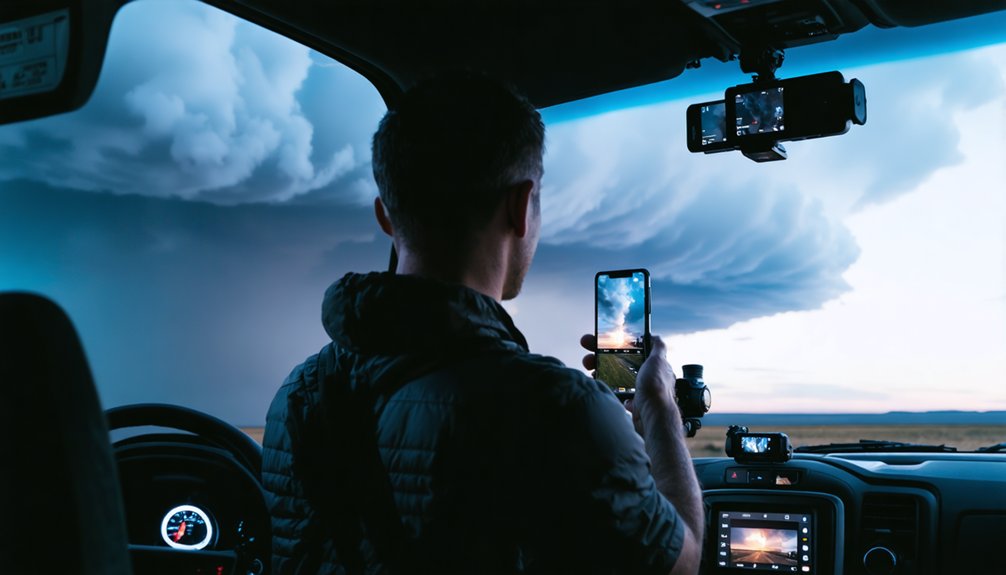
Storm chasing’s transformation into digital entertainment accelerated dramatically with YouTube and TikTok’s rise, fundamentally altering practitioner motivations and methodologies. You’re witnessing a paradigm shift where chasers prioritize digital personas over scientific pursuit, adapting content to audience preferences across platforms.
Digital platforms transformed storm chasing from scientific documentation into algorithmic entertainment, where viral potential now dictates pursuit decisions over meteorological merit.
This evolution birthed a new professional model blending meteorological forecasting with narrative storytelling.
Platform-Driven Changes:
- Content Optimization: Chasers now tailor footage specifically for algorithmic promotion, emphasizing dramatic close-range tornado documentation over safety protocols
- Monetization Pressure: The profession transformed from scientific documentation into full-time content creation, with viral potential determining chase decisions
- Competition Dynamics: Smartphone video saturation devalued professional footage, forcing chasers toward increasingly extreme positioning to differentiate content
This unrestricted digital landscape empowers independent creators while simultaneously incentivizing risk-taking behavior that challenges traditional storm-chasing ethics and safety standards.
Gas Station Gatherings: The New Social Hubs of the Chasing Community
Across the Great Plains’ dispersed rural landscape, gas stations function as critical convergence nodes where storm chasers synchronize operations, exchange real-time meteorological data, and temporarily abandon vehicular pursuit for logistical necessitation. You’ll witness community connections forming organically during refueling protocols—tour operators coordinate client movements, independent streamers execute chat-driven purchase behaviors, and veteran chasers establish impromptu gatherings to assess mesocyclone development trajectories.
These roadside hubs transcend mere commercial function. When El Reno’s EF5 circulation expanded unexpectedly, clustered chasers transformed gas stations into emergency shelter points, huddling in bathrooms as tornado vortices approached within 100-meter proximity.
Spotter Network data reveals concentrated chaser distributions near these facilities, validating their role as strategic coordination points. Your pursuit flexibility depends on these accessible waypoints where meteorological assessment supersedes rigid routing protocols.
From News Agency Contracts to Freelance Saturation: The Evolution of Storm Video Sales
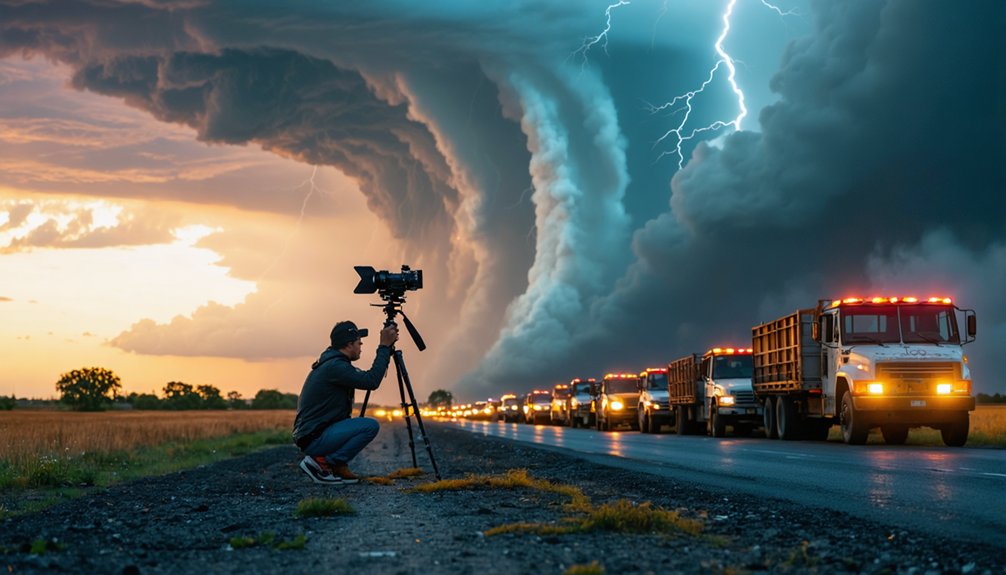
How did severe weather videography transform from predictable broadcast contracts into volatile digital marketplaces where economics dictate coverage patterns? You witnessed traditional chaser compensation structures collapse when profitable licensing models shifted from $400 network sales to unpredictable YouTube monetization.
Early 2000s investments in Sony TRV900 cameras yielded controlled income through broadcast-quality footage sales, but market saturation destroyed pricing power.
Revenue Evolution Metrics:
- 2003 Traditional Model: 20 tornado videos generated $5,500 gross against $13,700 expenses—$8,200 net loss
- Brokering Agencies: Delayed payouts by months but maintained premium rates through exclusive network contracts
- Digital Platforms: YouTube’s $150-per-video long-term revenue versus one-time $50 local sales
You’re now rejecting dozens of lowball offers annually, preserving footage value while networks source amateur content. Cellular data costs and hotel expenses continue eroding margins in this democratized, oversaturated marketplace.
The Dark Side of Virality: When Content Creation Compromises Safety
While traditional storm documentation prioritized meteorological observation and safety protocols, algorithmic reward systems now incentivize proximity over prudence—transforming severe weather photography into a competition for extreme engagement metrics. You’re witnessing exaggerated risk taking as novice chasers push beyond operational limits, driven by platforms that quantify success through virality rather than scientific value.
Research confirms social media reactions trigger addictive feedback loops, where likes and shares motivate increasingly dangerous behaviors. The market’s saturated with hundreds of chasers at single events, yet public footage from impact zones consistently outperforms professional content—creating perverse incentives to abandon established safety margins.
This diminishing ethics extends beyond individual welfare: misinformation proliferates unchecked during active weather events, as platforms prioritize viral content over verified emergency information, fundamentally compromising your autonomy to make informed decisions.
Racing for the Perfect Shot: Competition and Risk-Taking in Modern Chasing
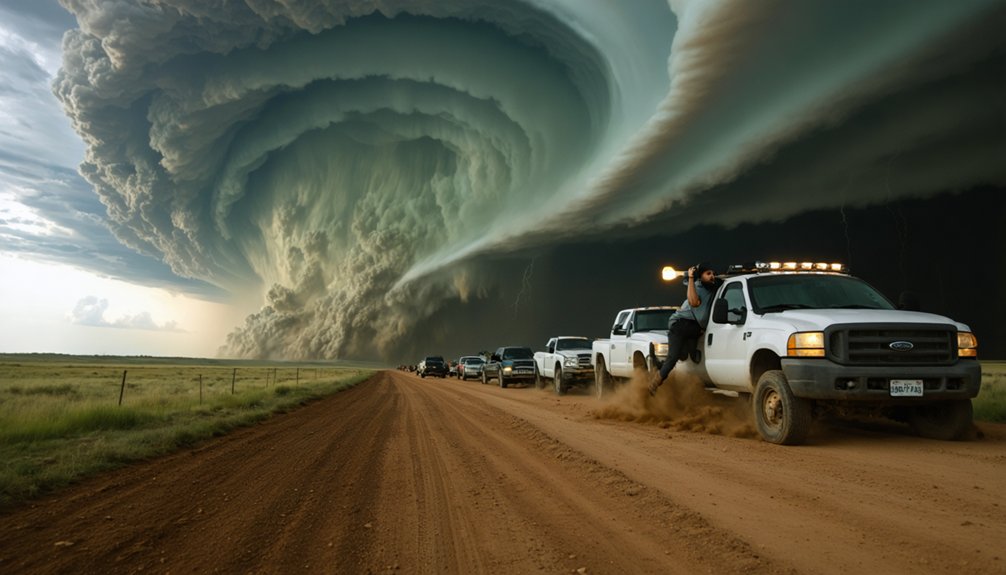
You’re witnessing a behavioral shift where storm chasers position their vehicles within 200-500 meters of tornadoes—distances that meteorologists classify as high-risk zones—to capture platform-optimized content.
This proximity competition generates measurable consequences: National Weather Service reports document increased traffic density near warned storm cells, with some Oklahoma intercept points recording 50+ chase vehicles converging on single road networks during peak events.
The convergence creates documented hazards including blocked evacuation routes, first responder access delays averaging 8-12 minutes, and multiple vehicle accidents at rural intersections during 2011-2013 outbreak sequences.
Dangerous Proximity for Views
The proliferation of social media platforms has fundamentally altered storm chasing’s risk calculus, transforming what was once primarily a scientific or weather-spotting endeavor into a competition for viral content. You’re witnessing a dangerous shift where chasers prioritize proximity over protocols, driven by adrenaline fueled media consumption patterns and social status incentives embedded in platform algorithms.
Critical Risk Escalation Factors:
- Algorithmic Reward Systems – Platforms amplify close-encounter footage with millions of views, creating direct correlation between danger and digital currency
- Competitive Positioning – Annual US tornado occurrences (800-1200 events) attract proximity-seeking participants willing to accept injury/fatality probabilities for unique shots
- Real-time Documentation Pressure – Live-streaming capabilities incentivize maintaining hazardous positions during rapidly-evolving meteorological events
This viewer-driven demand cycle systematically undermines safety protocols, converting weather observation into risk tourism.
Traffic Congestion and Crowding
Convergence zones now extend beyond meteorological phenomena to describe the vehicular bottlenecks that plague modern chase operations, where saturated participant numbers transform rural road networks into congested corridors during active severe weather events.
You’ll encounter crowded pursuit routes where ideal vantage points become parking lots, forcing split-second navigation decisions while competitors occupy critical positions. Rural intersection dangers multiply exponentially when dozens of vehicles converge simultaneously—chasers monitoring screens rather than traffic patterns create collision vectors at unmarked crossroads.
The influx systematically degrades your operational mobility: urban-style congestion now characterizes previously open territory, while road capacity limitations compound with decreased situational awareness. This density fundamentally alters risk calculus, transforming what autonomous individuals once approached as solo reconnaissance into crowded competitive events where freedom of movement yields to tactical positioning constraints.
Real-Time Weather Information: Saving Lives Through Social Media Networks
When severe weather threatens populated areas, storm chasers and meteorologists leverage social media platforms to disseminate pivotal real-time data that traditional broadcast schedules can’t accommodate. You’ll find meteorologists like Denis Phillips providing 24/7 guidance through Facebook, Twitter, and YouTube, with his follower count jumping from 500,000 to 1.2 million during active hurricane seasons.
Social media delivers critical storm updates instantly when traditional broadcasts can’t keep pace with rapidly changing severe weather conditions.
Smartphone-enabled sensor aided forecasting allows direct field uploads, while social media cross verification through multiple platforms guarantees accuracy.
Critical advantages include:
- Continuous interactive forecasting replacing periodic TV broadcasts with minute-by-minute updates
- Rapid trajectory adjustments when storms shift unexpectedly, enabling immediate evacuation decisions
- Community-sourced monitoring through hashtag-organized networks sharing live positions and conditions
You’re accessing life-saving information directly, bypassing centralized gatekeepers during essential moments when traditional media can’t respond fast enough.
The Citizen Journalist Effect: How Public Videos Changed the Professional Market
YouTube’s algorithmic architecture fundamentally restructured storm chasing’s professional landscape by enabling content creators without meteorological credentials to capture market share previously dominated by credentialed broadcast meteorologists and veteran field researchers. Algorithmic recommendation impacts prioritized engagement metrics over educational value, elevating entertainment-focused chasers like 21-year-old Freddy McKinney to 25,000+ subscribers while marginalizing traditional scientific documentation.
You’ve witnessed monetization strategies analysis reveal that platforms reward sensationalist content—screaming, death-defying proximity shots, and dramatic storytelling—creating financial incentives for increasingly risky behavior. This market transformation displaced centralized communities like Storm Track, fragmenting collaborative information sharing across TikTok, YouTube, and Instagram.
Professional pathways emerged for individuals interpreting public National Weather Service data without formal training, fundamentally democratizing—yet simultaneously sensationalizing—severe weather coverage and transforming amateur storm chasing into entertainment-driven enterprise.
Market Oversaturation: Why Professional Storm Chasers Face Unprecedented Challenges
You’re witnessing a market collapse where revenue per licensed storm video has decreased 60-80% since 2010, directly correlating with exponential growth in amateur content producers flooding distribution channels.
The brokerage income model that sustained early professional chasers now fragments across hundreds of competitors simultaneously targeting identical footage licensing opportunities.
Your operational reality includes $340-360 monthly baseline technology costs while competing against amateur operators who distribute equivalent content without requiring revenue recovery, creating an economically unsustainable professional environment.
Declining Revenue Per Video
Despite 2025 marking a banner year for tornado activity, professional storm chasers experienced catastrophic revenue collapse due to converging market forces that fundamentally altered the economics of severe weather documentation.
You’re witnessing unprecedented content saturation destroying your income streams through three primary mechanisms:
- Platform Algorithm Degradation: Declining viewership per video correlates directly with oversupply—weekly “once a decade intercepts” fragment audience attention across thousands of identical wedge tornado captures
- Advertising Market Collapse: Declining ad rates reflect platform recognition that tornado content no longer commands premium CPM when viewers can access unlimited alternatives within seconds
- Engagement Metric Deterioration: Media attention spans compress to hours post-event, eliminating residual revenue from catalog content that previously generated sustained income
Your operational freedom evaporates when 95% revenue theft combines with algorithmic devaluation, forcing shutdown despite historically peak production output.
Amateur Competition Intensifies Nationwide
Over 10,000 amateur storm chasers now saturate Tornado Alley annually, creating unprecedented market oversaturation that systematically dismantles professional viability through three quantifiable mechanisms.
First, intercept location congestion generates infrastructure strain—50+ vehicles per event block rural roads, escalating safety incidents 30% while obstructing professional positioning.
Second, content saturation algorithms demote your unique expertise beneath duplicate amateur footage, with viral posts burying specialized meteorological analysis.
Third, economic displacement occurs as sponsorships migrate toward high-follower novices despite inferior technical quality. You’ll face rising insurance premiums, unrecoverable operational costs, and public nuisance concerns from communities overwhelmed by vehicular convergence.
This democratization paradox grants market access to thousands while eliminating sustainable revenue models for experienced professionals operating without regulatory barriers or quality gatekeeping mechanisms.
Frequently Asked Questions
What Equipment Do Beginner Storm Chasers Need to Get Started?
You’ll need a reliable vehicle, smartphone with radar apps, basic camera gear for storm-related photography techniques, and a mobile weather station setup including an anemometer and barometer. Don’t forget safety equipment and two-way radios for independent pursuit operations.
How Much Money Can Professional Storm Chasers Realistically Earn Today?
You’ll realistically earn $40,000-$90,000 annually through traditional employment, but modern storm chasers augment income via social media monetization and crowd funding opportunities—leveraging digital platforms to bypass conventional salary constraints and maximize independent revenue streams.
What Training or Certification Is Required to Become a Storm Chaser?
You’ll find no necessary qualifications or mandatory certifications exist for storm chasing. However, developing field observation skills through voluntary SKYWARN training enhances your meteorological knowledge and reporting accuracy, giving you freedom to pursue severe weather documentation independently.
How Do Storm Chasers Coordinate With Emergency Services During Active Situations?
You’re the critical link between ground truth and emergency response. You’ll coordinate through real-time communication channels like HAM radio networks and SpotterNetwork, providing GPS-verified weather data sharing directly to NWS offices and Emergency Operations Centers during active events.
What Insurance or Legal Considerations Exist for Professional Storm Chasing?
You’ll need thorough liability coverage protecting against property damage risks during storm intercepts. Your policy must address vehicle collisions, equipment failures, and third-party injuries. Verify your insurer covers meteorological research activities, as standard policies often exclude storm-proximity operations.