Dorothy from the 1996 film *Twister* was inspired by TOTO, a 350-pound barrel-shaped instrument developed in 1979 by Dr. Al Bedard and his team. While Dorothy’s fictional design dispersed hundreds of winged sensors into a tornado’s vortex to map internal wind patterns, TOTO’s real deployments between 1981 and 1987 never captured data from inside a funnel. The device’s weight and metal construction prevented rapid repositioning, leading to its retirement and transformation of modern tornado research methodology through lighter, distributed sensor arrays and advanced technology systems.
Key Takeaways
- Dorothy was a fictional tornado research device featured in the 1996 film Twister, designed to deploy sensors into tornadoes.
- The device was inspired by TOTO, a real 250-350 lb barrel-shaped instrument developed in 1979 by meteorologists.
- TOTO was retired in 1987 due to safety limitations from its weight and inability to reposition quickly.
- Dorothy’s fictional success influenced modern tornado research, including lighter sensor arrays and drone-based measurement systems.
- Original Dorothy props are displayed alongside actual research equipment, with collectors tracking authentic production pieces and replicas.
TOTO: The Real-World Predecessor That Started It All
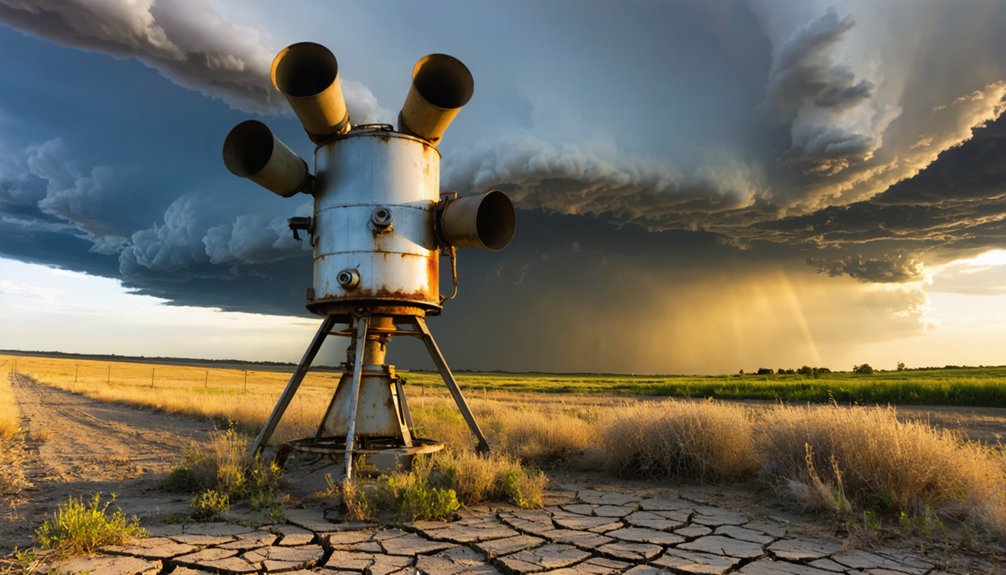
In 1979, researchers set out to solve one of meteorology’s most vexing problems: how to measure conditions inside a tornado’s core. Dr. Al Bedard, Carl Ramzy, and Dr. Howard Bluestein developed TOTO—the TOtable Tornado Observatory—a 250-350 lb barrel-shaped instrument packed with anemometers, pressure sensors, and humidity gauges. You’d deploy it from a pickup truck in 30 seconds, positioning it directly in a tornado’s path.
Throughout the 1980s, storm-chasing teams attempted numerous deployments. The closest encounter came April 29, 1985, near Ardmore, Oklahoma, when a weak tornado sideswiped the device. However, TOTO’s high center of gravity and cumbersome weight created critical safety limitations. The lessons learned from these field operations ultimately forced program discontinuation in 1987, pushing researchers toward lighter, distributed instrumentation networks.
From Weather Barrel to Hollywood Blockbuster
Hollywood’s most iconic tornado didn’t emerge from a computer rendering or elaborate mechanical rig—it came from a 35-foot muslin sock stretched between a steel gantry crane and a floor-mounted rod. Arnold “Buddy” Gillespie’s 1939 Wizard of Oz effect confronted practical challenges head-on.
Manufacturing limitations killed the original rubber cone design—too stiff for realistic movement. His solution? Fuller’s Earth sprayed onto muslin created wind-blown debris as the sock shifted laterally. Gray cotton balls on glass panels, moved in opposition, generated boiling mammatus clouds while obscuring the gantry mount.
Three model houses rotated through the funnel, one surviving to auction. This pioneering work established tornado visualization standards that influenced Twister’s Dorothy device decades later, proving ingenious low-tech solutions often outperform complex alternatives.
How Dorothy Was Designed to Work in the Movie
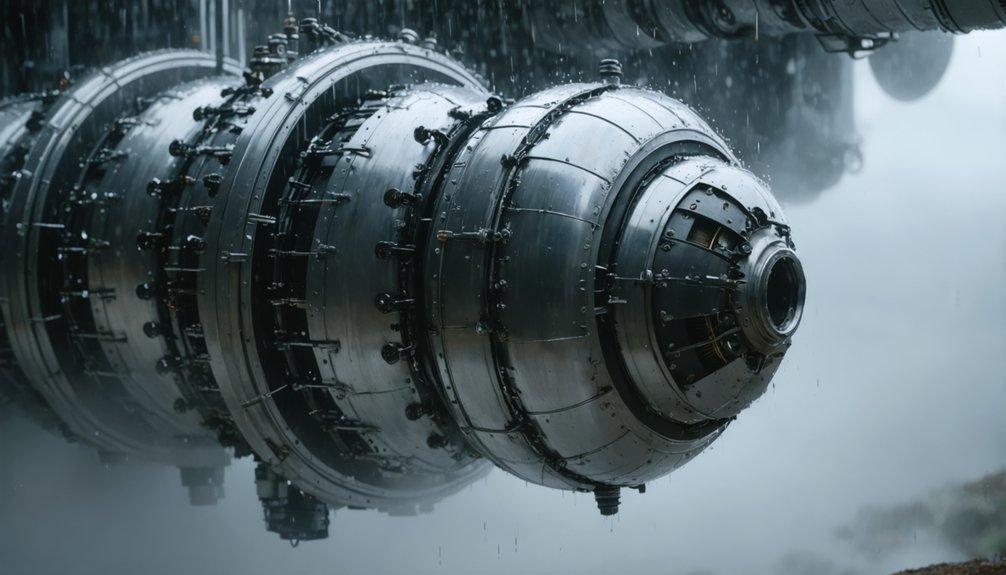
Dorothy’s operational concept centered on positioning the device in a tornado’s path, where the funnel’s vortex would lift and disperse hundreds of winged sensors into its internal structure. Each sensor transmitted real-time telemetry via radio back to the research team’s mobile station, capturing wind speeds, pressure gradients, and structural dynamics from multiple points within the funnel.
This distributed sensor network would map the tornado’s interior wind patterns with unprecedented spatial resolution, enabling scientists to develop 3-to-15 minute advanced warning systems based on direct funnel analysis rather than external radar signatures alone.
Sensor Deployment by Tornado
The fictional Dorothy device operated on a deceptively simple principle: position a barrel-shaped housing directly in a tornado’s path, allow the vortex to trigger automatic release, and let tornadic winds disperse hundreds of sensors throughout the funnel structure.
You’d witness the 55-gallon drum opening automatically upon tornado impact, releasing its payload into the vortex. The sensor distribution patterns enabled simultaneous three-dimensional measurements across the entire funnel, capturing wind speeds, flow asymmetries, and internal tornado structure data previously inaccessible to researchers.
However, sensor durability testing proved critical—these instruments needed reinforced construction to survive extreme wind forces while transmitting data. This revolutionary approach would’ve extended warning times from three to fifteen minutes, but deployment required pinpoint accuracy in an inherently unpredictable environment where tornado path shifts routinely destroyed equipment.
Real-Time Data Transmission
Once deployed sensors dispersed throughout the tornado funnel, Dorothy’s wireless transmission architecture became operational—hundreds of miniature instruments simultaneously radioed measurements back to ground-based monitoring stations positioned at safe distances from the vortex’s destructive path.
You’d receive anemometer readings tracking wind velocities, funnel geometry mapping, and atmospheric pressure fluctuations through robust transmission protocols designed for hostile electromagnetic environments. This real time data analysis capability eliminated post-event reconstruction delays, letting meteorologists observe tornado evolution as it happened.
The integrated Doppler radar complemented internal sensor feeds, creating thorough storm profiles. Dorothy’s transmission infrastructure targeted a critical objective: extending tornado warning times from three minutes to fifteen by providing actionable intelligence during active deployments, enabling immediate threat assessment and predictive model development.
Internal Wind Structure Mapping
Upon successful deployment, Dorothy’s barrel structure split open to disperse hundreds of miniature sensors directly into the tornado’s rotating column, where updraft velocities carried each instrument upward through distinct vertical layers of the funnel.
You’d see each sensor capturing simultaneous measurements of wind speed, atmospheric pressure, temperature, and humidity at multiple coordinates throughout the vortex. This distributed network transformed ground based meteorological observation by creating a three-dimensional X-ray of the tornado’s internal architecture.
The data revealed asymmetric flow patterns and structural dynamics previously inaccessible to researchers, enabling precise computational tornado dynamics modeling. Dorothy’s approach bypassed traditional remote sensing limitations, allowing direct penetration into zones where conventional equipment couldn’t survive.
These multi-point readings mapped the funnel’s true behavior, advancing warning systems beyond surface-level interpretation.
The Dangerous Reality of Chasing Tornadoes With Equipment
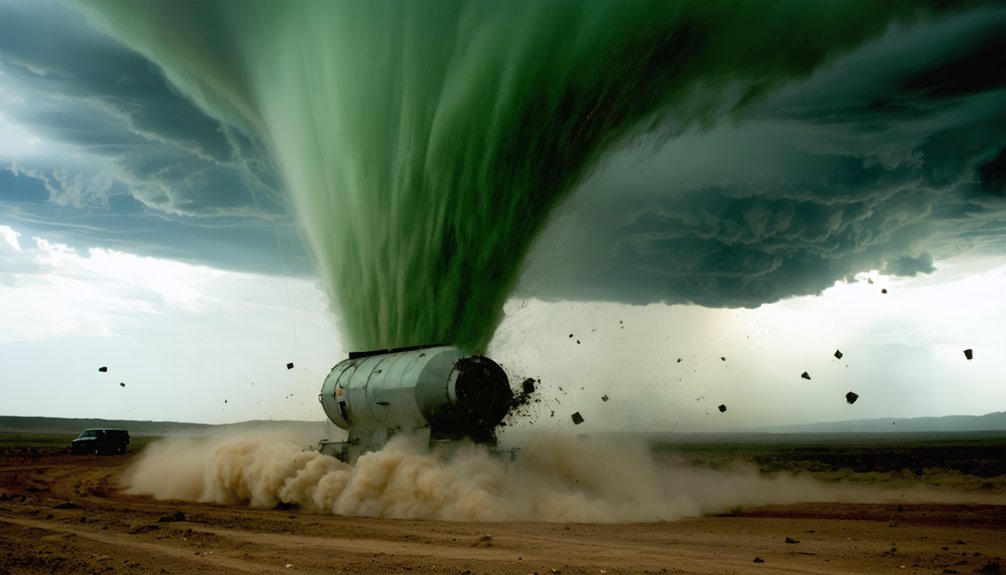
When equipment deployment brings researchers into direct tornado paths, the consequences can prove fatal. On 31 May 2013, Tim Samaras, Paul Samaras, and Carl Young died near El Reno while deploying in situ probes into a 2.6-mile-wide tornado that rapidly swelled and accelerated. Their tornado-hunt truck was thrown 200 yards.
You’ll find that technological limitations prevent accurate prediction of sudden tornado growth—winds exceeded 250 mph, blocking escape routes in seconds.
Safety protocols must account for rain-obscured tornadoes and rear flank downdraft injuries occurring outside the direct path. Beyond tornado strikes, equipment-related incidents include vehicle collisions after stopping for downed power lines.
You’re facing hydroplaning risks during retreats and core punching through heavy precipitation. Direct equipment deployment demands understanding that nature destroys vehicles instantly.
Why TOTO Never Achieved Its Mission
Technological limitations compounded these issues. T.O.T.O.’s weight and metal construction prevented rapid repositioning as storms evolved. You couldn’t predict precise tornado paths, making successful intercepts nearly impossible.
The National Severe Storms Laboratory retired the observatory in 1987, acknowledging that protecting researchers outweighed potential scientific gains.
Dorothy’s Legacy in Actual Tornado Research
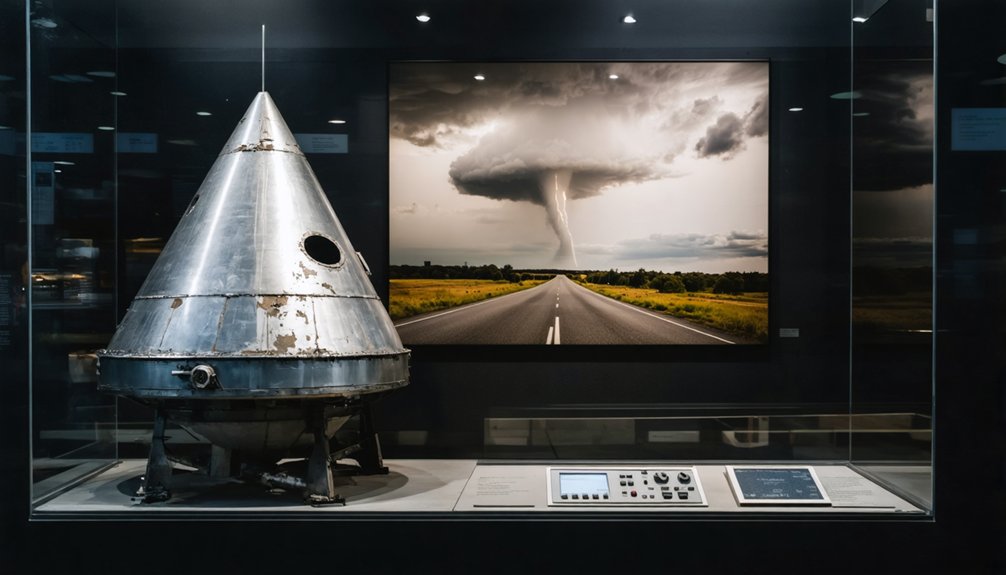
TOTO’s retirement in 1987 didn’t end its influence on tornado research—it transformed it. You’ll find its legacy in today’s lighter, deployable sensor arrays that’ve replaced cumbersome 250-lb barrels. Modern researchers now use rocket-launched sensors and live-streaming technology for direct tornado penetration—methods TOTO’s team couldn’t access in the 1970s.
The Twister film amplified this evolution through community engagement, making tornado science accessible to millions. You can see Dorothy props alongside actual TOTO units at the National Weather Center, serving educational outreach for next-generation meteorologists. Current Dominator vehicles cite Dorothy’s fictional success as partial inspiration.
TOTO’s fundamental mission—extending tornado warnings through internal measurements—now succeeds through distributed sensor networks that increase direct-hit probability while eliminating dangerous manual deployment.
Today’s Advanced Tools for Studying Tornadoes
Modern tornado research operates through integrated technology systems that would’ve been unimaginable during TOTO’s era. You’ll find UAS flying into hazardous zones at low altitudes, equipped with sensors measuring temperature, pressure, humidity, and wind speed. High-resolution multi-spectral cameras map tornado damage parameters while detecting ground-invisible patterns.
Data visualization techniques have revolutionized forecasting. Wild Weather Service produces city-specific tornado maps with 24-hour advance predictions, having located over 520 tornadoes and tracked $460 billion in hurricane damage. From storm chasers’ perspectives, apps like RadarScope and MyRadar deliver high-resolution radar beyond standard platforms, featuring historical images, projected storm tracks, and dual-pane editions.
Combined UAS, radar, satellite, and ground networks create complete storm pictures. NOAA’s requested Wild Weather Service data since 2022, verified by Notre Dame researchers and field teams.
Where You Can See the Original Props and Devices
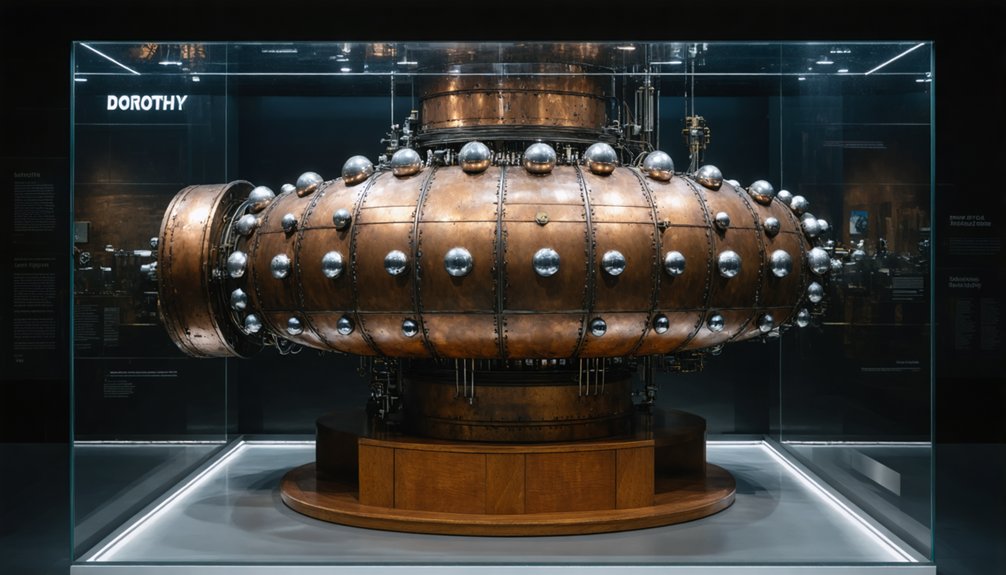
Prop authenticity remains verified for the original Dorothy sensor packs, though collectors track both genuine production pieces and replica versions. You can examine the device that inspired real atmospheric research programs.
Multiple Dorothy variants, including the modified Dorothy III with aluminum can wings, exist in documented collections, preserving the intersection of Hollywood storytelling and meteorological science.
Frequently Asked Questions
What Other Movies Have Been Inspired by Real Meteorological Research Equipment?
You’ll find “Twisters” (2024) showcases portable radars for real-time 3D tornado modeling, while “Eyes in Outer Space” (1959) featured satellite-based weather data visualization. Both films drew from authentic storm chasing techniques and meteorological equipment used in field research operations.
How Do Tornado Researchers Determine Which Storms to Target for Deployment?
You’ll analyze radar signatures, you’ll monitor atmospheric instability, you’ll track convergence zones. Storm selection criteria depend on mesocyclone strength and accessibility. Deployment logistics require rapid response teams positioning equipment where tornado genesis probability peaks within operational windows.
What Happened to the Original TOTO Device After It Was Retired?
After tornado research equipment’s retirement in 1987, you’ll find the device’s current location at the National Weather Center in Norman, Oklahoma, where it’s displayed alongside Twister movie props, demonstrating field deployment evolution and operational limitations.
Are There Ethical Concerns About Risking Lives for Tornado Research Data?
Yes, you’ll find balancing scientific progress and public safety creates tension—TOTO’s 1987 retirement proved ethical treatment of research participants outweighs data collection when deployment risks electrocution, debris strikes, and vehicle accidents during active tornado intercepts.
How Much Did It Cost to Develop and Operate TOTO?
Specific research funding figures aren’t documented, but you’ll find TOTO cost hundreds to thousands in 1980s dollars for construction and instrumentation. Operational expenses included extensive fuel, hotels, and personnel—over 500 miles per deployment chase.