You’ll need GPS trackers with IP67+ waterproof ratings, 4G LTE connectivity, and extended battery capacity for storm chasing operations. Dual-frequency receivers maintain accuracy during ionospheric disturbances, while 10,000 mAh batteries deliver 2.5 months at 15-minute updates—critical when cellular networks fail. Look for operating ranges from -30°C to 85°C, sealed housing against moisture infiltration, and inverter-compatible power systems for multi-day deployments. Strategic update frequency configurations balance real-time positioning against battery drain during active pursuit scenarios, and the following breakdown explains how specific models perform under severe weather conditions.
Key Takeaways
- Choose GPS trackers with minimum IP67 waterproof rating to withstand dust, wind-driven rain, and submersion during severe weather.
- Prioritize devices with 10,000 mAh batteries for extended 2.5-month operation at balanced update intervals during chase seasons.
- Select dual-frequency GPS receivers for precise real-time positioning that compensates for ionospheric delays and atmospheric disturbances.
- Ensure 4G LTE connectivity with satellite backup options like DataStorm to maintain tracking where cellular networks fail.
- Look for rugged, shockproof construction with operating ranges from -30°C to 85°C to survive extreme storm conditions.
Why Storm Chasers Need Reliable GPS Tracking Technology
When severe weather develops across the Great Plains, storm chasers face a critical challenge: they must navigate rapidly changing conditions while maintaining precise awareness of both their position and the storm’s trajectory.
You’ll need GPS technology that delivers 99 percent reliability when cellular networks fail. Dual-frequency receivers compensate for ionosphere delays, ensuring you’re tracking real-time coordinates accurately. Your integrated sensor arrays collect wind speeds and environmental data that feed advanced weather modeling systems, contributing directly to National Weather Service forecasts.
You can’t afford navigation failures when road closures force rapid rerouting around tornadic circulation. Satellite backups like DataStorm keep you connected where cellular dies, while 5-minute XM Weather updates let you plot your position against developing supercells on detailed maps.
Essential Features to Look for in Storm Chasing GPS Trackers
When you’re selecting a GPS tracker for storm chasing, prioritize devices with IP67 or higher weather-resistance ratings to guarantee functionality during hail, heavy rain, and core punching operations.
Battery performance becomes critical during extended chase days—look for units offering 12+ hours of continuous operation or inverter-compatible power management systems. These two specifications directly impact your ability to maintain positioning accuracy and communication when severe weather threatens both your safety and equipment integrity.
Waterproofing and Weather Resistance
Storm chasers can’t afford to let weather damage compromise their tracking equipment when conditions turn severe. You’ll need GPS trackers with IP67 or IP68 ratings—the only standards that guarantee safeguarding against rain, mud, and submersion. IP68-rated devices deliver superior long-term performance during extended water exposure and heavy precipitation.
Look for durable case construction with corrosion resistant materials that withstand impact, shocks, and high-wind debris. Sealed housing protects internal GPS and cellular antennas from moisture infiltration, while dustproof designs prevent particle contamination during dust storms.
Your tracker’s 4G LTE connectivity must maintain real-time location transmission despite atmospheric disturbances. Waterproof construction guarantees continuous geofencing alerts and speed monitoring throughout storm chase operations, giving you the reliability needed for unrestricted pursuit of extreme weather events.
Battery Life Under Stress
Waterproof housings protect your GPS tracker from the elements, but power management determines whether your device remains operational throughout multi-day chase sequences. Harsh conditions and high-frequency updates create worst case scenarios that accelerate battery drain—real-time 60-second intervals exhaust compact 1,000–2,000 mAh units in 5-7 days, while extreme temperatures further reduce efficiency.
You’ll need strategic power settings: moderate 5-10 minute updates extend 10,000 mAh trackers to several months, while motion-activated reporting can achieve 60+ days on parked vehicles. For extended autonomy, consider specialized accessories like extended battery packs (6-month runtime) or models with user-replaceable D-cells offering 10+ years. Adjustable update frequencies let you balance real-time tracking during active pursuit with power-saving modes during standby periods, ensuring your tracker survives unpredictable chase marathons.
Waterproofing and Weather Resistance: Critical Requirements
Most GPS trackers fail within seconds of exposure to the environmental extremes you’ll encounter while pursuing severe weather systems. You need IP67 minimum—protection against dust and 1-meter submersion for 30 minutes.
IP68 delivers superior severe weather impact resistance with continuous immersion capability beyond 1 meter, essential for marine applications and power sports during storms.
Extreme conditions survivability requires operating temperatures from -30°C to 85°C. The Spark Nano 7 offers IP65 with silicone casing for rain and mud. SpyTec GL300’s M2 case achieves IP67 for commercial wet environments.
MotoTrack provides fully waterproof hardwired protection without submersion limits. Don’t settle for water-resistant claims—demand dustproof, shockproof construction with magnetic waterproof cases for secure vehicle mounting.
Your tracker must handle wind-driven rain, high humidity, and rough handling without compromising real-time positioning data.
Battery Life Considerations for Extended Chase Operations
Your GPS tracker’s battery life directly impacts mission-critical location data during multi-day storm chase operations. Standard 1,000–2,000 mAh compact units exhaust in 5-7 days at 1-minute intervals, while 10,000 mAh extended-capacity trackers maintain 2.5 months at 15-minute updates—a pivotal difference when severe weather systems span weeks.
You’ll need to balance real-time tracking requirements against power consumption by configuring update frequencies strategically, particularly since cold-weather conditions can accelerate battery drain by 25-35% during active chase scenarios.
Standard Vs Extended Capacity
When selecting a GPS tracker for storm chasing operations, you’ll face a fundamental trade-off between compact standard-capacity units (1,000–2,000 mAh) and extended-capacity alternatives that exceed 10,000 mAh.
Standard-capacity trackers deliver 10-14 days with 60-second updates, matching short chase seasons but necessitating frequent recharging. Models like the Spytec GL300 offer robust monitoring capabilities for active pursuits.
Extended-capacity units provide deployment options that eliminate mid-season charging:
- Spytec Max: 18 months in power-saving mode
- Trak-4: 12 months with daily updates
- Remora3: 10-year lifespan for base camp equipment
- Solar-assisted variants: Indefinite runtime for remote weather stations
Cold weather reduces standard batteries 25-35% faster, while IP67-rated extended trackers withstand temperature extremes. For multi-week expeditions across unpredictable terrain, extended capacity guarantees uninterrupted vehicle monitoring without grid dependency.
Update Frequency Impact
GPS tracking intervals create exponential battery consumption patterns that storm chasers must calculate before deployment. At 10-second updates, Nano devices deliver 8 days while EON extends to 40 days—suitable for brief, precision-critical operations. Shifting to 5-minute intervals transforms endurance: Nano reaches 21 days, EON achieves 140 days.
You’ll face severe battery life optimizations at highway speeds, where continuous operation crashes after 180 miles or 4 hours at 50 mph.
Signal interference effects amplify during geomagnetic storms when ionospheric disturbances degrade accuracy to tens of meters. Severe space weather forces more frequent update cycles, accelerating power drain beyond standard calculations. Dual-frequency systems combat ionospheric delays but lose lock during scintillation events.
Your tracking strategy must balance update frequency against chase duration, accounting for environmental variables that compound battery depletion during active storm penetration.
Emergency Power Management Strategies
While chasing severe weather systems across multiple states, emergency power management becomes the critical difference between documented intercepts and operational blackouts. Battery capacity factors include environmental extremes—cold weather causes 25-35% faster drain, while humidity forces components to work harder. Your charging method selection determines field reliability:
- Hardwired vehicle integration provides unlimited runtime by tapping directly into your chase vehicle’s electrical system
- Solar-assisted trackers maintain charge during extended daylight pursuits across open plains
- Motion-activated reporting extends standby to 60+ days when you’re stationary between storm systems
- Wireless charging systems eliminate corroded USB ports that fail in harsh conditions
Compact 1,000-2,000 mAh trackers drain within 5-7 days at minute-interval updates, while 10,000 mAh units sustain 2.5 months under aggressive tracking protocols.
Real-Time Update Frequencies and Network Connectivity
During severe weather operations, storm chasers rely on GPS trackers that transmit location data at varying intervals depending on network conditions and device capabilities. You’ll find real-time updates during critical events like tornado warnings, when positions broadcast directly to the National Weather Service. Modern platforms deploy automatic stream updates without manual refresh, ensuring continuous data flow across Android and iOS devices.
Network reliability becomes vital as you navigate tornadic storms—dual-frequency GPS receivers compensate for ionosphere delays that single-frequency systems can’t handle during severe space weather. Your tracking solution should incorporate information redundancy through encrypted data transmission and multiple connectivity pathways.
Live streaming platforms integrate GPS coordinates with interactive maps, though user ratings reveal functionality challenges. Maintain backup systems since network interruptions occur frequently in extreme weather zones.
Magnetic Mounting Solutions for Quick Vehicle Deployment
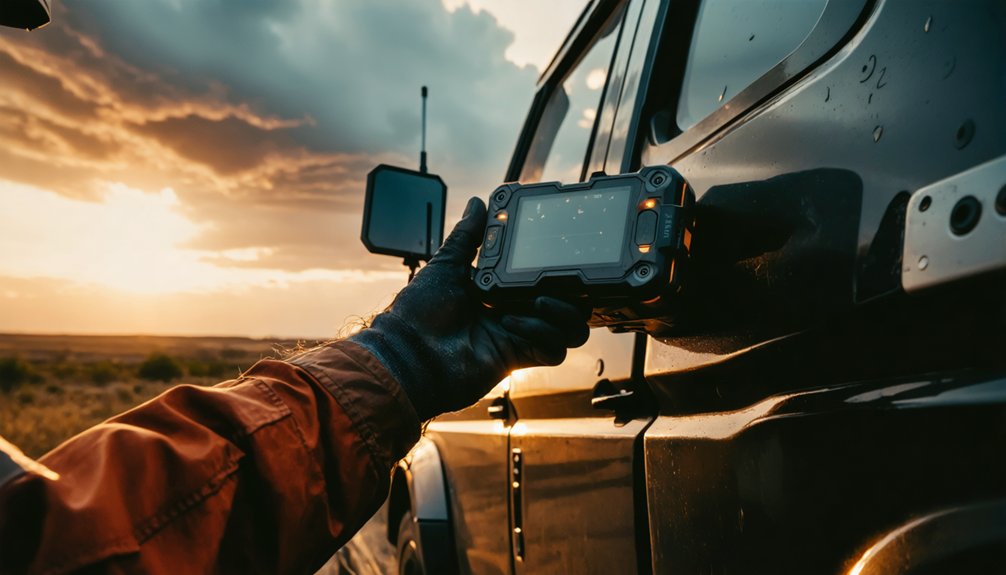
Storm chasers face a critical deployment challenge: securing tracking equipment to vehicles within seconds while maintaining operational reliability through extreme conditions. Magnetic mounting systems deliver immediate solutions through device versatility and proven field performance.
Magnetic trackers solve storm chasers’ rapid deployment needs through instant mounting, extreme-weather durability, and reliable performance during high-speed pursuit operations.
Quick Deployment Advantages:
- Industrial-strength magnets maintain secure attachment through high-speed pursuit and rough terrain without tools or installation delays
- Waterproof housing protects components when mounted on undercarriages or wheel wells during precipitation events
- Compact form factors (matchbox-sized) enable covert placement in confined spaces while preventing detection
- Alternative mounting methods include under-seat installation or frame attachment points for enhanced concealment
You’ll eliminate professional installation costs while transferring trackers between vehicles instantly. The magnetic systems withstand environmental stress without vibration or dislodgment, ensuring continuous operation throughout storm intercept missions. Battery systems support 3+ months deployment without retrieval.
Geofencing and Alert Systems for Safety Monitoring
When severe weather systems develop rapidly across unpredictable terrain, geofencing technology transforms GPS trackers into automated safety perimeters that monitor your position against predefined geographic boundaries. You’ll receive instant notifications when crossing safe zones you’ve established around chase routes or base camps—delivering affordable safety monitoring without constant supervision.
These alert systems trigger when you’ve wandered beyond designated areas during active pursuit or after-hours operations. Real-time notifications reach your dashboard, mobile app, or API within seconds of boundary violations. Combined with panic button integration, you’ll gain enhanced connectivity solutions that reduce emergency response times in remote locations with limited cellular coverage.
Speed-based alerts paired with geofence crossings provide layered protection, while IP67+ waterproof ratings guarantee functionality throughout severe weather conditions.
Historical Data Tracking and Route Documentation
Beyond real-time safety monitoring, your GPS tracker builds an extensive archive of every chase deployment, creating permanent records that serve multiple operational purposes. Advanced data aggregation methods compile coordinates, timestamps, and environmental conditions into retrievable databases.
Key Documentation Capabilities:
- Route Analysis – Storm Chaser Atlas apps automatically log miles, paths, and trip history for tax deductions and operational review
- Performance Monitoring Metrics – Track deployment efficiency by analyzing response times, positioning accuracy, and intercept success rates across seasons
- Integration Systems – SpotterNetwork platforms merge your historical positions with radar archives through GRLevelX and RadarPro
- Multi-Source Documentation – 360-degree cameras and mobile weather stations timestamp observations alongside GPS coordinates for detailed storm event reconstruction
These permanent records transform raw tracking data into actionable intelligence for future chase strategy optimization.
Top-Rated GPS Trackers for Severe Weather Pursuit
Storm chasing demands GPS trackers that withstand torrential rain, hail, and extreme temperatures while maintaining uninterrupted real-time positioning. You’ll need devices with IP67 waterproof ratings, magnetic mounts that won’t dislodge during high-speed pursuits, and 4G LTE update intervals of 3-10 seconds to track rapidly evolving storm systems.
The following trackers combine rugged weatherproofing, instant location updates, and secure vehicle attachment for safe severe weather documentation.
Extreme Weather Durability Features
Critical durability specifications include:
- IP67 waterproof rating – Complete protection against dust ingress and water immersion during heavy rain, flooded roads, and hurricane conditions
- Extended temperature range – Reliable operation from subzero conditions to extreme heat without performance degradation
- Rugged construction materials – Impact-resistant housing that withstands hail, wind-driven debris, and physical shock
- Long-lasting battery systems – Up to 10 years of operation with dual-power capabilities and solar recharging options
Over 100,000 units deployed in hazardous sites validate these systems’ reliability. Your freedom to pursue severe weather depends on equipment that survives it.
Real-Time Update Capabilities
When milliseconds determine whether you escape a tornado’s path or drive into it, your GPS tracker’s update frequency becomes a life-or-death specification. Professional-grade trackers deliver position updates every 1-3 seconds, compared to consumer models’ sluggish 30-60 second intervals.
You need satellite connectivity that penetrates dense precipitation cores where cellular networks fail. Look for devices offering dual-mode positioning—GPS plus GLONASS or Galileo—ensuring accuracy in storms when atmospheric interference degrades single-system performance.
Real-time latency under two seconds allows your support team to monitor your position during rapid intercepts. Multi-constellation receivers maintain lock through heavy rain and hail that would blind inferior units.
Your tracker’s refresh rate directly impacts situational awareness when traversing zero-visibility conditions at highway speeds.
Magnetic Mounting for Mobility
Magnetic mounting systems transform GPS trackers from permanent installations into tactical instruments you’ll reposition within seconds as storm conditions evolve. Magnetic connectivity eliminates wiring constraints, letting you chase without vehicle modifications or permanent commitments.
Critical deployment advantages:
- Instant relocation flexibility – Move trackers between chase vehicles, spotter networks, or equipment based on intercept strategy shifts
- Secure installation under extreme conditions – Neodymium magnets withstand highway speeds, hail vibrations, and rough terrain without dislodging
- Weatherproof portability – IP67/IP68-rated cases survive pressure washing, mud splatter, and temperature swings during multi-day deployments
- Roof-mounting precision – External placement delivers superior satellite acquisition in steel-dense environments where internal trackers experience signal drift
Tool-free attachment means you’ll adapt positioning as meteorological conditions demand, maintaining operational independence throughout severe weather pursuits.
Subscription Plans and Cost Analysis for Storm Chasers
Storm chasers face recurring subscription costs that directly impact operational budgets and real-time tracking capabilities. LoneStar’s month-to-month plan starts at $14.95 with no contracts, offering unlimited geofences and instant movement alerts through cloud connectivity.
LandAirSea provides tiered options: 1-minute updates at $24.95 monthly or $224.55 annually (25% discount), while 3-second intervals cost $449.55 yearly. Tractive’s 2-year plan drops to $6/month with included cellular data and 365-day history. You’ll maintain operational flexibility through subscription management without activation fees or long-term commitments.
RadarScope Tier 3 and GRLevel3 deliver sub-minute dual-pol data essential for tornado identification, while MyRadar’s Aviation Charts grant tactical overlays at $24.99 annually. Strategic plan selection maximizes tracking precision while controlling recurring expenses during extended chase deployments.
Frequently Asked Questions
Can GPS Trackers Withstand Direct Hail Impact During Severe Storms?
GPS trackers with waterproof housing design and impact-resistant construction can survive moderate hail, but you’ll need military-grade protection for severe storms. Data shows devices rated IP67+ withstand most conditions, though direct hits from 2+ inch hailstones often cause failure.
Do These Trackers Work in Areas With Limited Cellular Coverage?
Yes, you’ll maintain tracking in cellular dead zones. Eastern Colorado’s coverage gaps affect 40% of storm chasers, but portable satellite communication and alternative positioning methods like LoRa P2P or Iridium-hybrid systems deliver reliable location data where cell networks fail.
Yes, you’ll enable real-time data sharing through platforms like SpotterNetwork, allowing coordinated chase tactics with multiple chasers. You’ll simultaneously track positions, optimize intercept routes, and maintain safe spacing while pursuing storms independently or collaboratively.
Are Replacement Batteries Available for Extended Multi-Day Chase Expeditions?
You won’t be left high and dry—replacement batteries extend tracking up to 90 days through battery life optimization. Power bank compatibility guarantees you’ll maintain continuous location data during multi-day pursuits, with rapid-charge options restoring full capacity under two hours.
Will Trackers Function Properly in Extreme Temperature Fluctuations During Chases?
Yes, you’ll find most trackers operate reliably across -40°C to 85°C ranges with IP67-rated durability in high winds. However, battery life concerns emerge during extreme fluctuations, so you should monitor power levels and carry backup devices for safety.