For field wind measurement, your sensor type matters more than brand or price. Vane sensors handle outdoor conditions best, offering ±2% accuracy with durability against dust and moisture. Budget-friendly options like the BTMETER BT-100 ($35) suit recreational use, while the Extech 45118 delivers ±0.5% precision for professional reporting. The Kestrel 5700 meets MIL-STD-810G standards for demanding environments. Match your required accuracy to your application before buying, and the right choice becomes clear.
Key Takeaways
- Vane sensors are best for outdoor field use, offering ±2% accuracy and durability against dust, moisture, and variable gusts.
- The BTMETER BT-100 is a reliable budget option under $35, featuring backlit LCD, compact design, and max/min/avg modes.
- The HoldPeak 866B adds Bluetooth connectivity and dual temperature sensors while maintaining ±2% accuracy at a similar price.
- The Extech 45118 delivers ±0.5% accuracy, meeting strict calibration standards for professional reporting and critical decision-making.
- The Kestrel 5700 offers MIL-STD-810G durability, multi-variable sensing, and Bluetooth logging for demanding fieldwork environments.
What Field Use Actually Demands From a Handheld Anemometer
When you’re measuring wind speed in the field, conditions rarely cooperate the way they do in a lab. You’re dealing with dust, variable gusts, and limited time to fuss with complicated controls. Your instrument needs to keep pace.
Wind resistance matters more than most buyers anticipate. A unit that can’t handle sustained exposure to moving air and debris becomes a liability, not a tool. You need a sensor housing that holds up under real outdoor stress.
Battery life determines how long you can stay operational without resupplying. Extended field sessions demand units that don’t die mid-measurement. Models running standard AA or AAA cells give you more flexibility than proprietary battery packs.
Portability, durability, and readable displays in direct sunlight round out what field use actually requires from any serious handheld anemometer.
Vane vs. Hot-Wire: Which Handheld Anemometer Sensor Fits Field Work?
When you’re choosing a handheld anemometer for field work, the sensor type determines both accuracy and practical suitability for outdoor conditions.
Vane-style sensors handle variable open-air wind reliably, making them the standard choice for drone operations, shooting ranges, sailing, and general field measurement.
Hot-wire sensors excel in controlled HVAC and airflow testing where low-velocity precision matters most.
Matching sensor type to your actual use case is the single most critical spec decision you’ll make before purchasing.
Sensor Type Differences
Choosing the right sensor type determines how useful your anemometer will actually be in the field. Vane sensors spin mechanically to detect airflow, making them durable, straightforward, and well-suited for open-air environments like shooting ranges, drone operations, and sailing checks. They require minimal sensor calibration and deliver consistent readings across variable outdoor conditions.
Hot-wire sensors measure wind by detecting heat loss across a thin wire element. They’re highly sensitive but fragile, performing better in controlled HVAC environments than rugged field settings. Hot-wire units also consume more power, reducing battery longevity during extended outdoor sessions.
If you’re carrying your anemometer into unpredictable terrain, a vane-style unit gives you the reliability and portability you need without sacrificing measurement accuracy where it counts.
Field Performance Comparison
Knowing the sensor difference is only half the equation—seeing how each type actually performs under field conditions tells you which one earns a spot in your kit.
Vane sensors dominate open-field work. They deliver ±2% accuracy across wind speeds, handle dust and moisture better, and their sensor durability holds up through repeated outdoor exposure. Handheld ergonomics favor vane models too—compact, foldable designs like the BTMETER BT-100 slip into a pocket without bulk.
Hot-wire sensors offer higher sensitivity but surrender sensor durability in harsh conditions. Exposed filaments break under debris or rough handling, making them liabilities outside controlled environments.
For drone operation, sailing, or shooting-range checks, vane-type handhelds give you reliable data without fragility. If you’re working outdoors, the vane sensor wins on every practical metric.
Choosing Your Best Fit
Your application determines the answer before specs ever enter the equation. If you’re measuring wind in open fields, at shooting ranges, on water, or during drone ops, a vane sensor delivers the portability, sensor durability, and ±2% accuracy you need. It handles variable outdoor conditions without fuss.
Hot-wire sensors belong in HVAC ducts and controlled airflow environments — not exposed field conditions where dust, moisture, and gusts compromise their sensitive elements.
Ergonomic design matters once you’re actually carrying the unit. A pocket-sized vane meter with a backlit LCD, max/min/avg modes, and a foldable build — like the BTMETER BT-100 or HoldPeak 866B — travels light and reads fast.
Match the sensor type to your environment, then let accuracy requirements and budget close the decision.
How Much Accuracy Do You Actually Need?
How accurate does your anemometer actually need to be? It depends entirely on your application. Wind measurement requirements vary sharply across use cases, and buying beyond your actual needs wastes money.
Match your sensor calibration standard to your task:
- Recreational use (drone flying, hiking, sailing): ±2% accuracy is sufficient — models like the BTMETER BT-100 deliver this reliably under $35.
- Sports and shooting: ±2% handles most conditions without overcomplicating your kit.
- Professional field research: Target ±0.5% — the Extech 45118 meets this threshold.
- Military or advanced meteorological work: Kestrel 5700-level calibration and MIL-STD-810G durability become non-negotiable.
Don’t pay for precision you won’t use. Define your tolerance range first, then select accordingly.
Backlit Displays, Tripod Mounts, and Data Logging: Features That Earn Their Cost
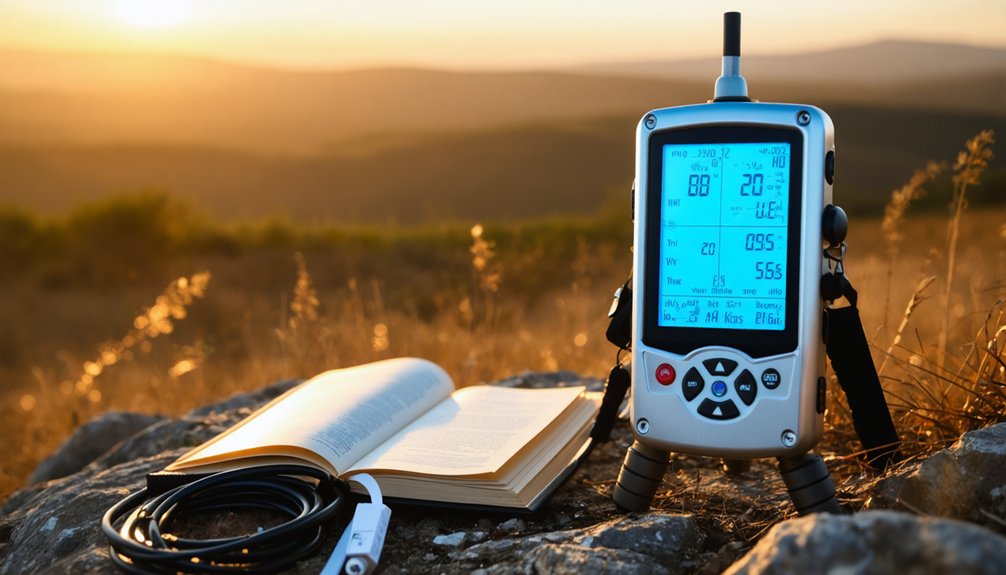
When you’re measuring wind speed in variable lighting or across extended sessions, three features separate functional tools from frustrating ones: backlit LCDs, tripod mounts, and data logging.
A backlit display lets you read values directly in low-angle sunlight or pre-dawn conditions without repositioning yourself or the sensor.
A tripod mount stabilizes your readings over time.
Data logging eliminates manual transcription errors and gives you min/max/avg trends you can actually act on.
Backlit Displays Aid Visibility
Although it’s easy to overlook display quality when comparing spec sheets, a backlit LCD makes a measurable difference in real field conditions. Low-angle sunlight, overcast skies, and dawn readings all reduce contrast on unlit screens. Backlighting removes that variable.
Key visibility advantages in the field:
- Low-light readability — Take accurate readings before sunrise or after sunset without squinting or guessing.
- Glare resistance — Backlit screens maintain contrast when direct sunlight washes out passive displays.
- Wind resistance positioning — You can orient the unit away from wind without losing screen visibility.
- Battery life trade-off — Backlit models draw more power, so carry spare batteries or choose units with auto-shutoff to preserve runtime.
Prioritize backlighting if your fieldwork extends beyond standard daylight hours.
Tripod Mounts Improve Stability
Backlighting solves a visibility problem, but a shaky hand introduces a measurement error that no display quality can fix. When you’re holding a vane anemometer in gusting conditions, involuntary movement skews airflow alignment and corrupts your readings before sensor calibration even matters.
A tripod mount eliminates that variable. Several field-recommended models, including units in the BTMETER and HoldPeak lines, include a tripod hole specifically for this purpose. You lock the sensor into a fixed position, align it precisely with the wind direction, and collect max/min/avg data without physical interference.
This matters most in exposed environments where weather resistance is already taxed by wind, dust, and temperature shifts. Stable mounting converts a handheld tool into a semi-fixed instrument, giving you repeatable, defensible data instead of approximations.
Data Logging Saves Time
Tripod stability solves the physical interference problem, but if you’re collecting readings across shifting wind conditions, manually recording each value introduces its own error layer. Data logging eliminates transcription drift and gives you verifiable timestamps tied to actual wind tunnel validation standards.
Models like the HoldPeak 866B with Bluetooth connectivity let you:
- Export max/min/avg datasets directly to your device
- Track calibration methods across multiple measurement sessions
- Document wind-speed trends without interrupting fieldwork
- Build audit-ready records for professional reporting
You’re not just saving time — you’re removing human error from your data chain. When calibration methods require baseline comparisons, logged data gives you the reference points that memory can’t.
That autonomy over your own records is what separates reliable field work from guesswork.
Best Budget Handheld Anemometer: BTMETER BT-100
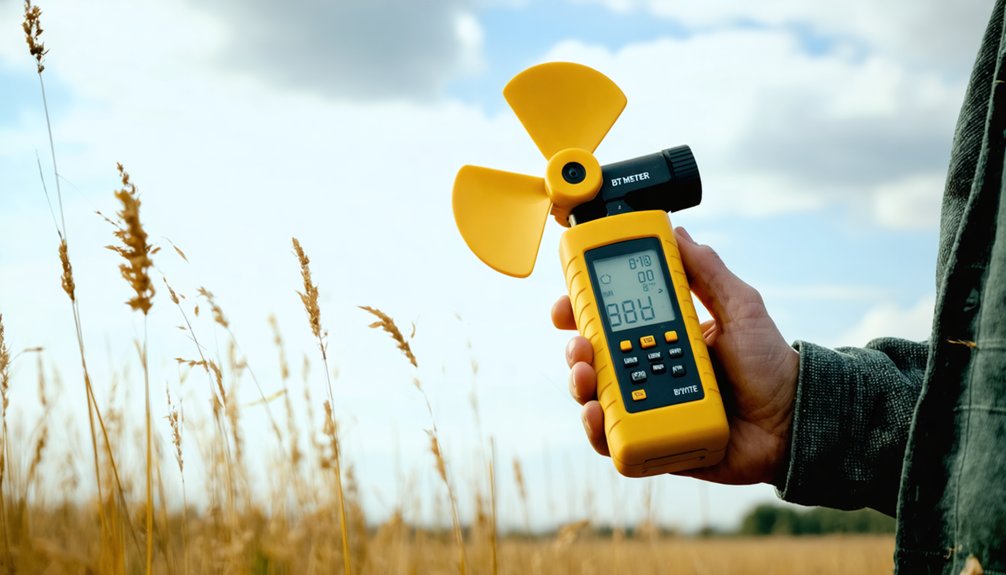
When you need a reliable handheld anemometer without spending much, the BTMETER BT-100 consistently tops budget-category roundups at under $35. Its vane-based sensor technology delivers ±2% wind measurement accuracy, which is sufficient for drone operation, shooting conditions, sailing checks, and general outdoor fieldwork.
You’ll get max, min, and average reading modes, letting you track shifting conditions without manual logging. The backlit LCD keeps data visible in low-light environments, and the compact form factor means it won’t slow you down in the field.
It’s not built for professional-grade documentation or multi-variable environmental tracking, but for straightforward wind speed capture on a tight budget, the BT-100 gives you accurate, portable performance without unnecessary complexity or cost.
It’s a practical tool that earns its place in any field kit.
Best Feature-to-Price Balance: HoldPeak 866B
If the BT-100 is your floor, the HoldPeak 866B is your ceiling at nearly the same price point. You’re getting more capability without surrendering portability or budget discipline.
More capability, same price point — the HoldPeak 866B raises your ceiling without raising your budget.
Here’s what separates the 866B:
- ±2% accuracy with consistent sensor calibration across wind-speed ranges
- Max/min/avg modes let you track shifting conditions in real time
- Dual temperature sensing expands your field data beyond basic wind measurement
- Bluetooth connectivity enables data export and remote monitoring via app
Its weather resistance makes it viable in variable outdoor conditions where cheaper units fail. You’re not just buying a wind meter — you’re buying a compact environmental tool.
For drone operators, shooters, and sailors who want documented readings, the 866B delivers measurable returns on a modest investment.
Most Accurate Handheld Anemometer: Extech 45118
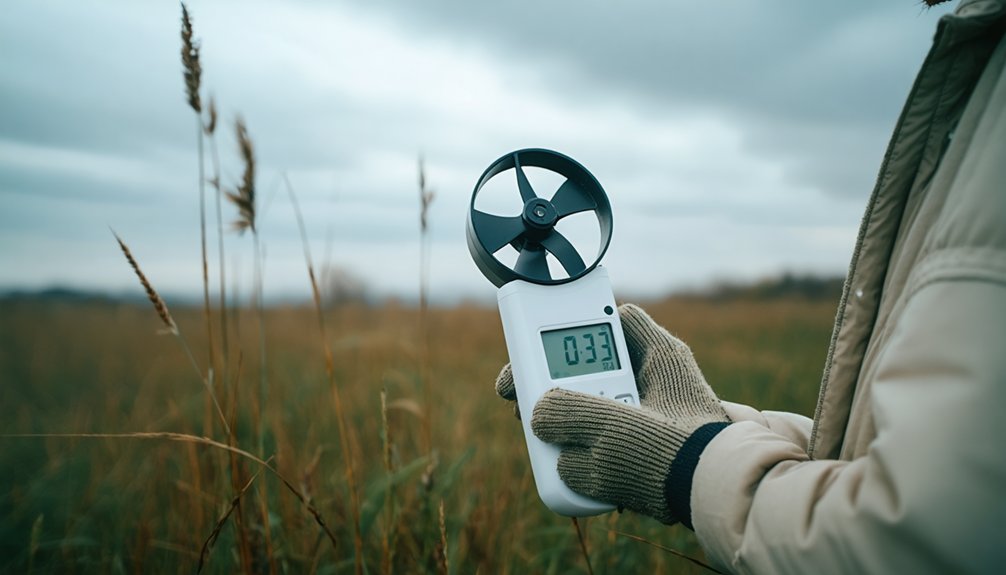
Accuracy has a number — and for the Extech 45118, it’s ±0.5%, a full four times tighter than the ±2% tolerance you’re accepting with the BT-100 or HoldPeak 866B. That gap matters when you’re making decisions that depend on precise wind data rather than ballpark readings.
The 45118 meets stricter calibration standards, meaning its measurements hold up against traceable benchmarks rather than manufacturer estimates alone.
Sensor durability supports consistent performance across variable field conditions, so you’re not sacrificing accuracy when weather turns unpredictable.
You’ll pay more than you’d for a budget vane meter, but you’re buying verified precision. If your field work requires documentation, professional reporting, or any use case where a 1.5% error creates real consequences, the Extech 45118 earns its place in your kit.
For Professional Field Work: Kestrel 5700
The Extech 45118 sets a high bar for accuracy, but the Kestrel 5700 pushes further into territory that dedicated precision instruments rarely reach — adding military-grade durability, multi-variable environmental sensing, and calibrated performance built for sustained professional field deployment.
When your wind measurement demands go beyond casual readings, the Kestrel 5700 delivers:
- MIL-STD-810G durability — built to survive wind, dust, and harsh field conditions
- Factory sensor calibration — ensuring traceable, repeatable precision across deployments
- Multi-variable sensing — captures wind speed, humidity, pressure, temperature, and altitude simultaneously
- Bluetooth data logging — exports field data directly for analysis and documentation
You’re not buying convenience — you’re buying reliability when conditions are unforgiving and accuracy is non-negotiable.
For serious field professionals, the Kestrel 5700 justifies every dollar.
Which Handheld Anemometer Is Right for You?
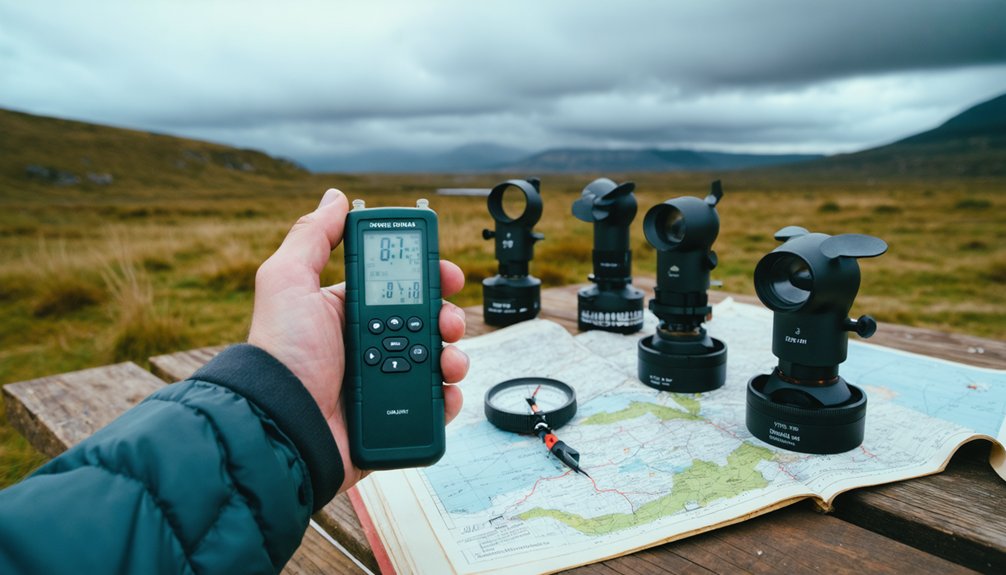
Choosing the right handheld anemometer comes down to three variables: required accuracy, intended use case, and budget.
The right anemometer hinges on three things: how accurate you need it, what you’re doing with it, and what you’ll spend.
For recreational wind measurement — drone flying, sailing, or shooting conditions — a ±2% vane-type unit like the BTMETER BT-100 or HoldPeak 866B delivers reliable data under $35.
If you need tighter sensor calibration and multi-variable tracking, the Extech 45118’s ±0.5% accuracy justifies the step up.
For sustained professional field work demanding MIL-STD-810G durability and precision sensor calibration across multiple environmental variables, the Kestrel 5700 is the clear choice.
Prioritize portability above all else — a meter you’ll actually carry beats a capable unit left behind.
Match the tool’s specification ceiling to your actual field requirements, and you won’t overspend or underperform.
Frequently Asked Questions
How Long Do Handheld Anemometer Batteries Typically Last in Field Conditions?
You’ll typically get 200–400 hours of battery life from handheld anemometers under normal field conditions. Smart power management features like auto-shutoff help extend runtime, so you’re not constantly swapping batteries during critical measurements.
Can Handheld Anemometers Measure Wind Speed Accurately at High Altitudes?
Yes, you can measure wind speed accurately at high altitudes, but altitude impact reduces air density, affecting measurement precision. Models like the Extech 45118’s ±0.5% accuracy help compensate, though you’ll want pressure-sensing units for full reliability.
Are Handheld Anemometers Safe to Use During Thunderstorms or Lightning?
Don’t use handheld anemometers during thunderstorms. Lightning safety overrides device durability—even MIL-STD-810G-rated units won’t protect you outdoors. You’re an exposed target. Wait for the storm to pass, then resume your measurements safely.
How Should a Handheld Anemometer Be Cleaned After Dusty Field Use?
Like brushing off the trail dust from a long expedition, you’ll want to prioritize dust removal using compressed air, then gently wipe sensor blades. Consistent sensor maintenance prevents accuracy drift and extends your anemometer’s reliable field life.
Do Handheld Anemometers Require Regular Professional Calibration to Stay Accurate?
Most handheld anemometers don’t require professional calibration frequently. You can maintain accuracy through routine maintenance procedures like sensor cleaning and zero-checks. Calibration frequency depends on use intensity—verify against a known standard annually if precision matters.
References
- https://www.amazon.com/Best-Sellers-Anemometers/zgbs/industrial/3206432011
- https://www.amazon.com/Best-Sellers-Wind-Speed-Gauges/zgbs/lawn-garden/13825011
- https://acfc.org/best-handheld-anemometers/
- https://mydroneauthority.com/best-handheld-weather-meters/
- https://bestsportsreviews.org/best-wind-gauge-for-track-and-field/
- https://www.amazon.com/anemometer/s?k=anemometer
- https://mydroneauthority.com/best-handheld-anemometers/
- https://street-photographers.com/best-anemometers-and-wind-meters/
- https://kayakcambria.com/best-handheld-anemometers/
- https://rosenberryrooms.com/best-handheld-anemometers-for-wind-speed/