You’ll need harnesses rated for minimum 3,000-pound breaking strength per attachment point—recreational climbing gear won’t survive 100+ mph lateral wind loads. Full-body tactical restraint systems with multi-point anchoring distribute forces across your shoulders, chest, and pelvis while allowing operational mobility. Look for quick-release mechanisms like OKTALOCK buckles that function under load with gloved hands, reinforced vehicle roll cage mounts, and aramid fiber construction. The difference between theoretical load calculations and actual crash dynamics could determine whether you’re walking away or getting airlifted out.
Key Takeaways
- Select harnesses with minimum 3,000-pound breaking strength per attachment point, exceeding recreational climbing or industrial fall-arrest standards.
- Choose multi-point systems distributing lateral wind loads across shoulders, chest, and pelvis rather than single dorsal attachment configurations.
- Prioritize quick-release mechanisms like OKTALOCK buckles that function under load with gloved hands in under two seconds.
- Install reinforced vehicle mounting points or ground auger systems rated for 5,000-pound loads and tested to 150 mph winds.
- Use tactical or industrial harnesses with aramid fiber construction and shock-absorbing lanyards, avoiding generic automotive restraint systems.
Understanding the Unique Safety Requirements of Storm Chasing
Storm chasers operate in environments where conventional vehicle safety systems fall short. You’re maneuvering rapidly changing conditions—sudden stops, extreme winds, and debris impacts that standard seatbelts weren’t engineered to handle. When you’re positioning your vehicle in a storm’s path, you need restraint systems that account for lateral forces, rollover scenarios, and prolonged exposure to severe turbulence.
Specialized harness designs address these unique threats. Multi-point configurations distribute impact forces across your body’s strongest skeletal structures, reducing injury risk during violent vehicle movement. You’ll require proper harness attachment methods that integrate with reinforced mounting points—factory anchor locations won’t suffice when you’re operating at the edge of tornadic circulation.
Your freedom to pursue extreme weather demands equipment that matches your operational reality, not generic automotive standards.
Full-Body Harness Systems for Vehicle-Based Storm Observation
How do you maintain operational mobility while securing yourself against 100+ mph lateral wind loads? You’ll need specialized full-body harness systems with vehicle-integrated tether attachment points. Standard industrial harnesses won’t cut it—they’re designed for vertical falls, not horizontal wind shear.
Vehicle-based systems require multi-point anchoring to your chase rig’s reinforced frame. Your harness must distribute lateral forces across shoulders, chest, and pelvis while allowing 360-degree camera operation. Look for quick-release mechanisms you can operate single-handed during rapid weather changes.
Harness portability matters when you’re repositioning between intercepts. Choose lightweight aramid fiber construction with modular components. Your tether length determines your operational radius—too short restricts positioning, too long increases impact force if wind catches you.
Tactical Restraint Harnesses for High-Wind Environments
When you’re positioning yourself outside a chase vehicle in 60+ mph winds, your harness anchor points must distribute lateral loads across multiple D-rings—dorsal positioning alone won’t prevent dangerous torso rotation or equipment entanglement.
You’ll need quick-release mechanisms like OKTALOCK buckles that function under load and with gloved hands, since fumbling with standard cam buckles during a rapidly intensifying squall line creates unacceptable exposure time.
Your anchor configuration should incorporate both primary and redundant attachment points rated for lateral wind forces, not just the vertical fall protection loads that standard climbing harnesses address.
Wind Load Anchor Points
Your survival in 100+ mph winds depends on anchor points that won’t fail when you need them most. You’ll need structural connections rated for minimum 5,000-pound loads—standard climbing gear won’t cut it in severe weather conditions.
Critical anchor point specifications include welded steel D-rings, reinforced vehicle roll cage mounts, and ground-based auger systems tested to 150 mph wind loads. Your anchor must handle dynamic forces, not just static weight.
Wind load testing reveals that lateral forces multiply exponentially above 80 mph, creating shear stresses that destroy inadequate mounting points.
Storm-rated carabiners and shock-absorbing lanyards distribute force across multiple connection points. You’re betting your life on these components—inspect them before every deployment.
Freedom means calculated risk, not reckless exposure.
Quick-Release Safety Mechanisms
Even the strongest anchor point becomes a death trap if you can’t disconnect from it in seconds. Your quick-release mechanism must function under load while you’re fighting 100+ mph crosswinds. Standard climbing releases won’t cut it—you need single-hand operation that works with gloves on and requires zero finesse.
Look for systems with harness load ratings exceeding 5,000 lbf and integrated dynamic force absorption that prevents shock loading during sudden wind gusts. The mechanism should activate in under two seconds, even when tensioned. Test it repeatedly in controlled conditions before trusting your life to it.
Remember: you’re not climbing static rock. You’re tethered to a vehicle in chaotic, rapidly-changing conditions where quick egress isn’t optional—it’s survival.
Five-Point Racing Harnesses Adapted for Storm Chaser Vehicles
You’ll need bolt-in mounting systems anchored to your vehicle’s roll cage or reinforced structural points—improper installation creates catastrophic failure risks during tornado encounters.
Weather-resistant high-strength nylon webbing with metal latch buckles withstands moisture, temperature extremes, and UV exposure that degrade standard materials in field conditions.
Your quick-release mechanism must function reliably under stress while preventing accidental deployment, as failed egress systems have trapped crews in compromised vehicles during active storm situations.
Installation and Mounting Requirements
Racing harness technology transfers directly to storm chaser applications, but the stakes change when you’re anchoring life-safety equipment in a civilian vehicle that wasn’t engineered for motorsport loads. Proper anchor point positioning demands steel backing plates (40 cm², 3mm thick) welded to chassis-grade metal—not body panels that’ll tear loose when deployment forces hit 3,000+ pounds.
Critical load distribution requires precise geometry:
- Lap belts: 60-80° from horizontal, never exceeding 30° off seat plane
- Shoulder straps: Zero to -30° angle maximum, mounting within 8 inches behind seat
- Anti-submarine belt: 10-20° forward angle through seat to floor pan
- All anchor points: FIA-compliant spacing with locking hardware
Stock mounting points rarely meet spec. You’ll need fabrication skills or professional installation—your freedom depends on engineering, not improvisation.
Weather-Resistant Material Considerations
Once your anchor points can handle the loads, you face a different engineering problem: harness materials that’ll survive what storms deliver. Polyester webbing with Revolta treatment repels oil, water, and dirt—essential when you’re working in muddy chase positions. However, water repellency characteristics alone won’t cut it. You need polyurethane-coated outer shells that provide tear-resistant, waterproof barriers with fully seam-sealed construction.
Material breathability concerns become critical during extended pursuits. High-density polyethylene components maintain flexibility across temperature extremes without compromising structural integrity. For electrical storm environments, arc-rated materials prevent catastrophic failure during lightning exposure. Pair these with high-tensile steel alloy buckles and you’ve got harnesses that won’t fail when conditions deteriorate. Your materials either perform or they don’t—storms expose every weakness.
Quick-Release Safety Mechanisms
Storm chasers face a split-second paradox: the same restraint system protecting you during violent wind shear or hail impact can trap you if the vehicle rolls into water or fire. Quick-release mechanisms solve this contradiction through engineering that meets harness certification requirements while enabling one-handed emergency egress.
Field-Proven Release Systems:
- AustriAlpin Cobra™ buckles – Aluminum construction provides reusable quick release design that withstands 18kN force loads
- SFI 16.1 certified knob-twist mechanisms – Motorsport-grade systems ($252-$286) enable sub-two-second disengagement
- Front-mounted leg loops – Accessible during vehicle entry without removing camera gear or laptops
- NFPA CLASS II compliance – Backcountry rescue standards applicable to wilderness pursuit scenarios
These systems eliminate fumbling with traditional buckles when seconds determine survival outcomes.
Quick-Release Mechanisms: Essential Features for Emergency Situations
When seconds determine survival outcomes, your harness’s quick-release mechanism becomes the critical interface between controlled extraction and catastrophic entanglement. Chest-mounted releases let you disengage with either hand—crucial when storm currents fold you over and waist-mounted systems become inaccessible. Your rescue mission planning must account for metal triglide components that insulate plastic buckles from sudden forces, preventing premature release during debris impacts.
Acetal cam buckles with 2-inch pull tethers enable complete webbing extraction even under minimal tension. AustriAlpin Cobra™ quick-releases on leg loops facilitate rapid doffing when vehicle extraction becomes necessary. Release mechanism testing should verify the two-phase gate-opening motion functions at various pressure levels. Stainless steel friction plates adjust tension settings, while 1,200 lb. capacity ratings provide structural integrity during high-force scenarios that freedom-seeking storm chasers inevitably encounter.
Anchor Point Installation in Storm Chasing Vehicles
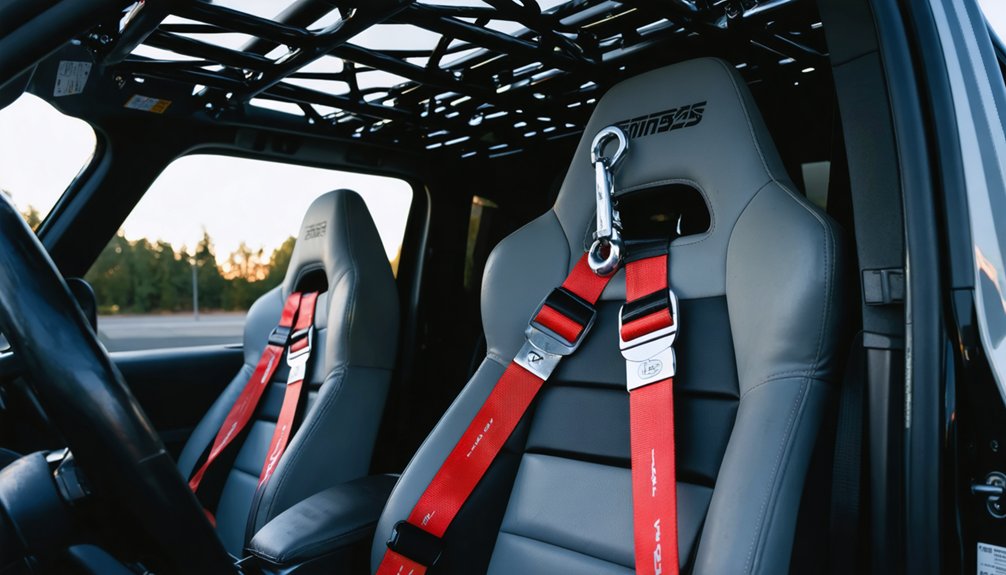
Your vehicle’s structural integrity determines whether anchor points protect or fail during violent atmospheric events, making proper installation the foundation of your entire tether system. Unlike conventional emergency vehicle harnesses, storm chasing demands mounting solutions that withstand unpredictable forces while maintaining compliance with storm chasing safety regulations.
Critical installation requirements include:
- Frame-direct mounting through reinforced vehicle chassis—never through seat frames or floor pans that compromise under torsional stress
- Load-rated hardware capable of 3,000+ pounds per anchor point, tested to prevent catastrophic failure
- Six-point distribution spreading forces across multiple structural members to prevent localized failure
- Professional certification ensuring installations meet both manufacturer specifications and field-tested safety standards
Your freedom to pursue severe weather depends on engineering that won’t compromise when conditions deteriorate rapidly.
Materials and Weather Resistance: What to Look for in a Harness
Properly installed anchor points mean nothing if your harness materials degrade when hail punctures the webbing or electrical discharge compromises the steel components. Your material selection demands polyester webbing with tight yarn construction—it resists UV degradation and moisture absorption during extended deployments.
Electrical resistance requirements become critical near power infrastructure during severe weather events. Arc flash-rated harnesses incorporate Kevlar™ or Nomex™ with dielectric steel components to prevent conductivity during lightning proximity. Standard polyester webbing provides 6,500 lbs breaking strength, while 2-ply construction delivers 12,000 lbs at attachment points.
Skip polypropylene alternatives—their low water absorption won’t compensate for reduced abrasion resistance when you’re securing equipment against 70mph winds. Galvanized steel hardware prevents corrosion failure during repeated moisture exposure across tornado alley deployments.
Comfort and Mobility Considerations During Extended Chases
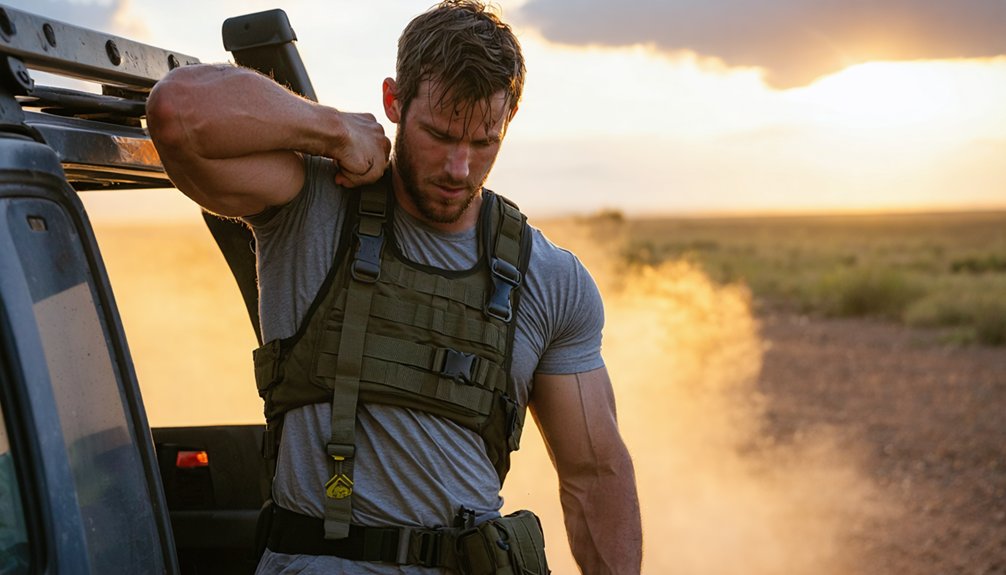
During twelve-hour deployment windows across the Great Plains, inadequate padding integration transforms your harness from safety equipment into a circulation-restricting liability. Field-tested models demonstrate that removable cushioned mesh delivers superior shock absorption metrics while maintaining the 6.6-pound weight threshold critical for unrestricted movement.
Suspension trauma mitigation requires these proven features:
- Trauma relief straps enabling standing position post-fall, extending viable rescue time beyond standard suspension limits
- Spring-loaded dorsal D-rings maintaining upright orientation for rapid self-rescue access
- Quick-connect buckles allowing sub-60-second adjustments between vehicle repositioning and deployment
- Elasticized leg straps preventing pressure-point development during extended observation periods
Your harness must balance protective cushioning against the mobility demands of dynamic storm environments—restrictive fits compromise reaction time when conditions deteriorate rapidly.
Budget-Friendly Harness Options for Beginning Storm Chasers
You’ll find ANSI-compliant harnesses starting under $50 that meet OSHA standards without compromising critical fall protection capabilities. The KwikSafety SCORPION ($49.39) and MONSOON ($49.87) deliver tested safety certifications and proper D-ring configurations at entry-level price points.
Your initial investment shouldn’t force you to sacrifice damage indicators, adjustable strapping systems, or verified load ratings—features that prevent equipment failure during severe weather deployments.
Entry-Level Harness Features
Essential entry-level specifications include:
- Weight distribution across hip and dorsal D-rings for multi-directional fall arrest
- Pass-through buckles enabling single-handed adjustments while monitoring storm data
- 130-310 pound capacity accommodating varied body types and gear loads
- Non-recycled synthetic construction resisting UV degradation during extended field exposure
This harness supports roofing and tower-climbing applications, proving its durability translates directly to storm-chasing demands where equipment failure isn’t negotiable.
Cost-Effective Safety Standards
While premium harnesses offer advanced features, beginning storm chasers can achieve ANSI-compliant protection without exceeding $150—if they prioritize core safety functions over convenience add-ons. Budget considerations shouldn’t compromise safety compliance with Z359.11-2021 standards. You’ll need full-body construction with dorsal D-rings, adjustable leg and chest straps, and impact-resistant hardware.
Models like the KwikSafety TORNADO deliver certification-grade protection at entry-level prices by eliminating padding upgrades and quick-connect systems. Your freedom to chase storms depends on meeting baseline fall arrest requirements, not luxury features. Focus procurement dollars on ANSI-marked harnesses with documented load ratings.
Field-tested veterans confirm that basic certified models perform identically to expensive alternatives during actual deployment—they just lack comfort refinements that matter less when you’re securing equipment against 80mph winds.
Professional-Grade Harnesses Used by Veteran Storm Research Teams
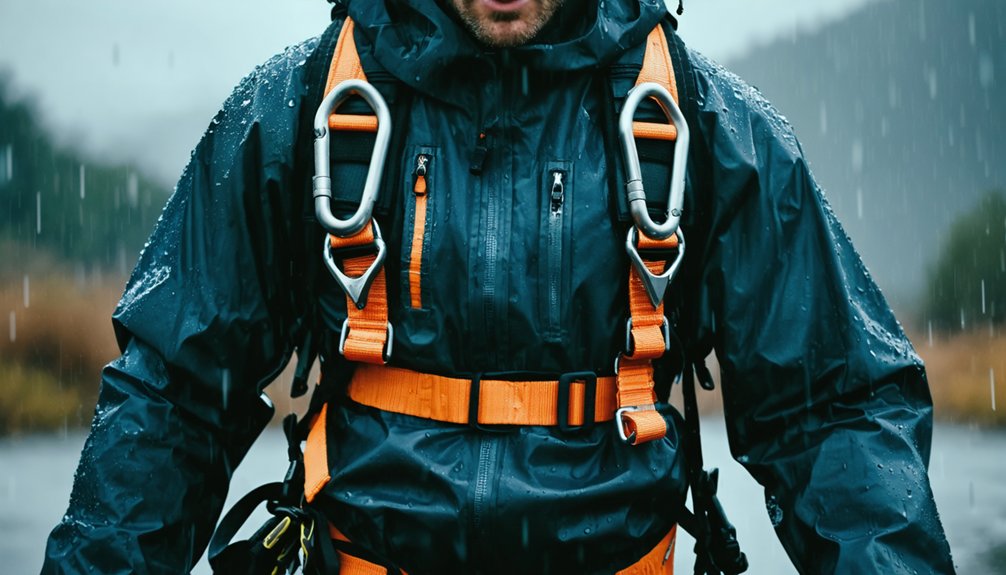
Storm research teams operating in severe weather environments rely on vehicle-mounted five-point harness systems that meet or exceed SFI 16.1 racing safety specifications. These professional setups incorporate extreme weather durability through corrosion-resistant hardware and UV-stabilized webbing that won’t degrade under constant sun exposure.
Veteran teams prioritize field research adaptations including:
- Quick-release mechanisms that function with gloved hands during rapid deployment scenarios
- HANS device compatibility for head and neck restraint integration during high-speed intercepts
- Adjustable shoulder and lap belt geometry accommodating equipment vests and communication gear
- Anti-submarine belts preventing body slide-under during sudden deceleration events
You’ll need harnesses rated for minimum 3,000-pound breaking strength per attachment point. Skip recreational-grade equipment—your life depends on components tested against actual crash dynamics, not just theoretical load calculations.
Frequently Asked Questions
Can Safety Harnesses Be Worn Over Heavy Storm Chasing Gear and Clothing?
Yes, you can wear safety harnesses over heavy storm gear. With 3,600-pound arresting force capacity, harness flexibility and pass-through buckles guarantee layered clothing compatibility. Adjust straps over bulky jackets while maintaining ANSI-compliant fit for your pursuit.
How Often Should Storm Chaser Harnesses Be Inspected and Replaced?
You’ll need regular maintenance checks before every chase and formal inspections every six months minimum. Replace immediately after any fall or when webbing shows damage. Proper storage techniques between deployments extend lifespan, but retire harnesses showing UV degradation or hardware corrosion.
Are There Harness Options Compatible With Both Vehicles and Ground Observation?
Like a chameleon adapting environments, you’ll find EZ-ON harnesses excel with portable harness attachments and versatile tether configurations. They transfer seamlessly between chase vehicles and ground observation posts, maintaining NHTSA-standard security whether you’re mobile or stationary.
Do Insurance Policies Cover Storm Chasing Accidents When Using Safety Harnesses?
Most policies won’t cover storm chasing accidents, even with harnesses. You’ll need specialized extreme sports coverage with specific policy coverage limits and deductible requirements. Standard plans exclude voluntary high-risk pursuits, leaving you financially exposed without proper riders.
Can Harnesses Interfere With Camera Equipment Operation During Active Chases?
Picture yourself tangled like a marionette in twisted straps. Yes, harnesses create cable management concerns and affect equipment weight distribution. You’ll fight restricted torso rotation, snagged cords, and compromised camera access—field-tested frustrations that demand strategic gear placement for operational freedom.