You’ll achieve robust global hailstorm research by deploying dual-polarization radar with ZH, ZDR, ρhv, and KDP thresholds to discriminate hail from rain, then validating classifications against strategically positioned hailpad arrays that overcome sparse observer networks. Implement GPU-accelerated COSMO models embedding HAILCAST microphysical schemes at kilometer-scale resolution, apply pseudo-global warming methodologies to project end-of-century scenarios, and normalize historical databases using population-density weighting to correct reporting biases exceeding 300% in urban corridors. Cross-sector partnerships with insurance claims data further refine damage thresholds and quantify infrastructure vulnerabilities across diverse geographical markets.
Key Takeaways
- Deploy dual-polarization radar with hydrometeor classification algorithms using ZH, ZDR, ρhv, and KDP thresholds for accurate hail detection.
- Establish comprehensive ground-truth networks combining strategic hailpad arrays, volunteer observers, and automated imaging systems for validation.
- Implement kilometer-scale atmospheric models with GPU acceleration and hail-specific parameterization schemes like HAILCAST for improved predictions.
- Apply pseudo-global warming methodology to project future hailstorm scenarios under end-of-century climate conditions and assess regional impacts.
- Address reporting bias through population density normalization and cross-sector partnerships integrating insurance claims data for robust model validation.
Leverage Dual-Polarization Radar and Hydrometeor Classification Algorithms for Accurate Detection
When implementing dual-polarization radar systems for hail research, you’ll leverage the transmission of both horizontally and vertically polarized electromagnetic waves to obtain backscattered signals that yield critical polarimetric variables. You’ll compute reflectivity (ZH), differential reflectivity (ZDR), correlation coefficient (ρhv), and specific differential phase (KDP) to enhance hail classification models.
Recognize hail signatures through ZH exceeding 55 dBZ, ZDR between 0-1 dB, ρhv below 0.9, and KDP near 0 deg/km. Deploy hydrometeor classification algorithms that achieve POD=100% and FAR=11%, surpassing conventional methods.
Integrate CNN models with MESH proxies to quantify local thunderstorm environments with CSI=0.89. You’ll capture low-level signatures at 2 km altitude, discriminating hail from rain using optimized thresholds that empower independent verification of severe weather phenomena.
Establish Comprehensive Ground-Truth Networks Using Hailpads and Volunteer Observers
You should establish dual-component ground-truth networks by deploying strategic hailpad arrays at locations with minimal shadowing and integrating trained volunteer observer networks to capture extensive hail climatology data. Hailpads provide quantitative measurements of thousands of hailstones per survey through impact dent analysis, while volunteer observers contribute critical hailfall duration and size distribution observations that remain limited in peer-reviewed literature.
This combined approach yields robust verification datasets for validating operational radar-based hail detection algorithms and polarimetric techniques across diverse geographical regions.
Deploy Strategic Hailpad Arrays
Establishing detailed ground-truth networks requires strategic deployment of hailpad arrays that capture high-resolution spatial data on hailstone size distributions and impact intensities. You’ll optimize hailpad deployment strategies by positioning dense arrays in hail-prone regions where topographic factors minimize wind-induced displacement errors.
Coordinate placement with seismic nodal stations to enable joint precipitation monitoring across multiple storm cells. Your array configuration should span sufficient coverage to capture intra-storm variability while maintaining centimeter-scale spatial resolution for indentation mapping.
To calibrate hailpad networks, implement automated imaging systems that quantify size spectra through established calibration curves linking indentation diameter to kinetic energy. Statistical filters eliminate non-hail artifacts, while exponential distribution fitting refines spectral analysis.
This multidisciplinary approach provides essential ground-truth for validating radar-derived hail indices and probability of hail estimates.
Recruit Trained Volunteer Networks
While instrumented hailpad arrays provide quantitative precipitation measurements, trained volunteer networks extend spatial coverage beyond fixed monitoring stations and deliver critical observational data at scales unachievable through automated systems alone.
CoCoRaHS demonstrates effective volunteer recruitment approaches through nationwide observer networks reporting hail sizes searchable by state, county, or date ranges. RICOWI’s Hail Investigation Program trained fifty-seven volunteers from engineering, insurance, and manufacturing sectors for Oklahoma City’s 100-roof deployment.
Retention strategies include structured team roles—captain, photographer, data recorder—maintaining engagement through defined responsibilities. IBHS partnerships with Central Michigan University collected nearly 10,000 hailstones across twenty storms, while NWS integrates trained spotter reports into Storm Events Database archives.
International models like Switzerland’s sensor-supported volunteer network demonstrate scalable frameworks for extensive ground-truth validation beyond radar limitations.
Implement Kilometer-Scale Atmospheric Models With Hail-Specific Parameterization Schemes
How do researchers capture the intricate physics of hailstone formation and growth within numerical weather prediction systems? You’ll need kilometer-scale atmospheric models operating at 1.3–2.2 km horizontal resolution to resolve convective dynamics explicitly. HAILCAST diagnostics integrated into frameworks like COSMO-crCLIM calculate ground-level hailstone sizes, while Thompson-Eidhammer schemes predict maximum hail diameter from graupel mass, number, and density.
To accelerate model validation, you should evaluate Lightning Potential Index alongside hail parameterizations across observed severe convection cases. These approaches improve microphysics parameterizations through 2-moment graupel/hail schemes with density prediction.
Essential implementation components:
- Deploy GPU-accelerated COSMO or globally scalable ARP-GEM2 configurations
- Integrate HAILCAST or Thompson-Eidhammer surface diagnostics
- Validate against high-resolution radar and lightning observations
- Leverage MPAS 1-km AGL hail diameter calculations
- Implement MYNN subgrid-scale cloud parameterization for effective radius
Apply Pseudo-Global Warming Approaches to Project Future Hailstorm Scenarios
Because climate projections demand event-specific attribution of hailstorm changes, you’ll employ pseudo-global warming (PGW) methodology to simulate historical severe convection cases in end-of-century thermodynamic environments. This spatial downscaling technique applies monthly temperature deltas from CMIP5 worst-case scenarios to high-resolution (1.2 km) simulations, perturbing historical fields through TPgw = Thist + ΔTmonth.
You’ll recognize synoptic environment constraints fundamentally regulate hailstorm responses—frontal systems yield 110% increases in large hail (>2.5 cm) versus 30% for GPLLJ regimes.
Cold-season events demonstrate intensified hail production and expanded hailfall areas, while warm-season storms produce diminished hail sizes despite enhanced rainfall. PGW methodology enables you to quantify updraft dynamics, melting-level shifts, and microphysical process variations across predictable large-scale atmospheric patterns.
Address Reporting Bias Through Population-Detrended Historical Data Analysis

PGW methodology quantifies future hailstorm behavior under altered thermodynamic conditions, yet historical validation of these projections requires accounting for systematic observational artifacts. You’ll need population-based correction factors to neutralize observer density effects that distort spatial hail climatologies.
Implement data uncertainty quantification through statistical detrending of archival records, treating raw reports as provisional indicators rather than definitive damage evidence.
Key detrending protocols:
- Normalize historical databases using population density metrics as weighting functions
- Apply Kolmogorov-Smirnov tests at 99% confidence to validate corrections
- Cross-verify adjustments against NOAA Severe Weather Data Inventory baselines
- Filter duplicate urban reports from identical storm events
- Integrate forensic engineering assessments where observer networks show spatial gaps
This approach liberates your analysis from institutional reporting conventions, enabling unbiased hail frequency reconstructions essential for validating climate projections.
Focus Research Efforts on Rapidly Changing Hotspots Like Northern Italy and European Regions
You should prioritize research in northern Italy, where considerably severe hail (>5 cm) frequency has tripled since 1950 and VLH probability has increased faster than any global region between 1950-2023. European detection networks exhibit substantial gaps despite the 267% increase in hailstorms from 3,217 (2019/20) to 11,808 (2023/24), necessitating enhanced observation infrastructure across identified hotspots in the Po Valley, northeastern Spain, and southwestern France.
Regional climate projections require refinement through high-resolution soundings that capture instability and low-level moisture trends more accurately than ERA5 reanalysis, particularly for regions demonstrating rapid atmospheric change.
Northern Italy’s Record Increases
Northern Italy’s emergence as Europe’s most rapidly intensifying hailstorm hotspot demands immediate scientific attention, with observational data revealing unprecedented changes in both hail frequency and magnitude since the 1950s. You’ll find compelling evidence for prioritizing this region in hailstorm mitigation strategies and regional monitoring enhancements.
Frequency escalation: 200% increase in large hail occurrence since 1950, with tripling of >5cm events in northeastern sectors
Record-breaking magnitudes: 19cm hailstone (July 2023) approaches world record, breaking previous European records twice within one week
Economic devastation: US$6.5 billion insured losses from July 2023 storms alone, demonstrating critical infrastructure vulnerabilities
Climate correlation significance: Strongest global trends toward enhanced convective potential, driven by moisture and instability increases
Geographic concentration: Po Valley and Friuli Venezia Giulia exhibit maximum lightning activity and hail event clustering
European Detection Network Gaps
Europe’s radar coverage infrastructure presents significant operational limitations that compromise accurate hail detection across regions experiencing the most dramatic increases in severe convective storms. You’ll find lightning networks like ENTLN provide limited spatial coverage compared to North America’s 700+ CONUS sites, restricting updraft identification capabilities.
Alternative radar parameters—40 dBZ echo-top altitudes and column-maximum radial divergence—demonstrate reduced skill against select single-polarization and dual-polarization metrics.
To address these observational data gaps, you should implement volunteer recruitment strategies targeting high-risk zones like northern Italy, where the 19 cm hailstone (Europe’s largest) fell in 2023. Citizen science programs utilizing high-density hailpad networks can supplement sparse radar coverage, capturing spatiotemporal patterns that institutional monitoring misses while expanding forensic damage documentation.
Regional Climate Projection Priorities
As global temperatures accelerate warming trajectories across Mediterranean basins, climate projection models must prioritize research allocation toward rapidly transforming hailstorm hotspots where atmospheric instability metrics show disproportionate amplification. Northern Italy’s Po Valley demonstrates critical vulnerability with CAPE values exceeding 2000 J/kg, warranting immediate national funding allocations for enhanced observational infrastructure.
Priority research targets include:
- Northern Italy anticipating 15-25% hail event increases by 2050 from 4-5°C temperature rises
- Cross-border modeling integrating at least three EU Member States (Italy, France, Germany)
- IPCC-aligned projections forecasting 20-30% severe hail day increases in Alps foothills
- Stakeholder coordination networks linking Horizon Europe projects (R4C, RESIST) with Copernicus real-time data
- Agricultural zones where annual losses exceed €100 million requiring urgent protection strategies
You’ll maximize climate resilience through targeted hotspot investment.
Develop Cross-Sector Partnerships With Insurance Industry for Data Validation and Feedback
Cross-sector collaboration between research institutions and the insurance industry has emerged as a critical mechanism for validating hail risk models and establishing robust feedback loops for damage assessment. You’ll find partnerships like WTW-KIT-NASA and Munich Re’s ICECHIP project demonstrate how you can leverage cross-institutional relationships to advance predictive capabilities.
These collaborations enable validation through real-world claims data—property, motor, and agricultural losses—against satellite observations and field measurements of 658+ hailstones. You should foster data aggregation platforms that integrate high-resolution satellite imagery with catastrophe models spanning multiple continents. The Willis Research Network exemplifies this approach, informing reinsurance pricing and regulatory capital requirements.
Such partnerships provide unrestricted access to empirical datasets, allowing you to refine damage thresholds, validate climate projections, and optimize risk transfer mechanisms across diverse geographical markets.
Integrate Multiple Detection Methods Including Ground Reports, Radar, and Phone Surveys
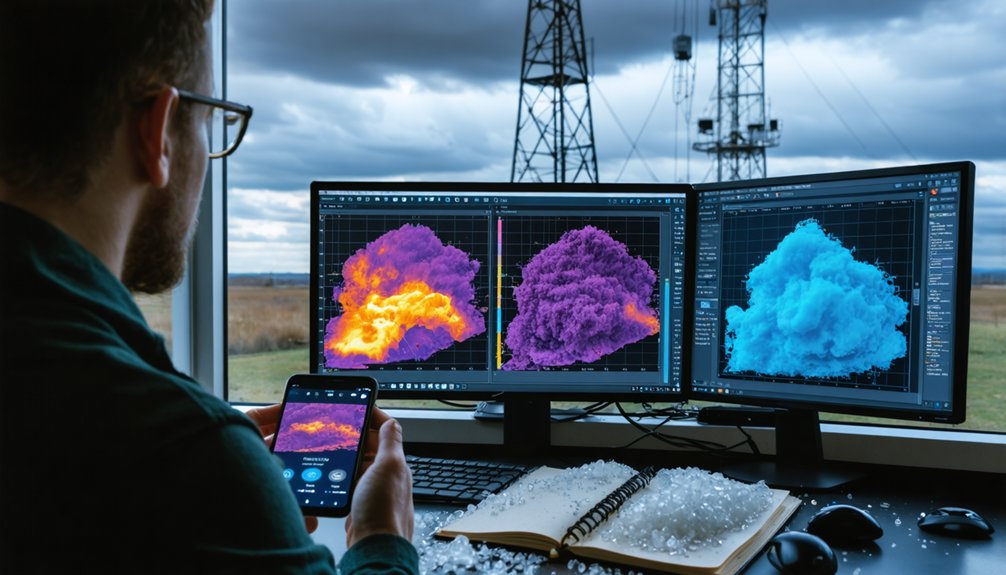
Ground networks utilizing standardized hailpads provide direct measurements of kinetic energy and size distribution, achieving verification accuracies exceeding 85% when deployed at spatial densities of 1 station per 100 km².
You should implement dual-polarization radar systems that leverage differential reflectivity (ZDR) and specific differential phase (KDP) to discriminate hail from rain with 20-30% improved skill compared to single-polarization configurations.
Integration of these complementary methods—ground-truth measurements with sub-centimeter precision and radar’s volumetric scanning—enables probabilistic hail detection models that reduce false alarm rates by 15-25% across diverse geographic regions.
Ground Networks and Hailpads
While radar systems provide broad spatial coverage for hail detection, they can’t capture the ground-level impacts that matter most for damage assessment and model validation. You’ll need autonomous sensors like HailSens IoT devices that provide real-time impact detection with flexible connectivity options including LoRa and wireless IP modems. Impact disdrometers measure particle size distribution and kinetic energy, delivering damage indicators that commercial instruments can’t provide.
Deploy your ground network strategically:
- Install sensors every 0.50 miles as standard density to capture hailstorm chaos
- Integrate impact disdrometers into existing mesonet stations like West Texas’s 90+ station network
- Deploy rapidly deployable probes following severe weather forecasts
- Combine ground observations with radar and lightning data for hybrid fusion capability
- Measure kinetic energy directly rather than inferring from radar reflectivity alone
Dual-Polarization Radar Systems
How can you maximize hail detection accuracy when individual methods show overlapping precipitation signatures? You’ll need to integrate dual-polarization radar systems with complementary detection networks. Leverage convolutional neural network architectures trained on three-dimensional reflectivity grids, incorporating polarimetric variables including differential reflectivity (ZDR), specific differential phase (KDP), and cross-correlation coefficient (ρHV) for enhanced particle classification.
Your radar algorithm evaluation must account for overlapping precipitation type distributions by implementing fuzzy logic classification schemes that distinguish meteorological echoes at multiple altitudes. Environmental radar integration strengthens severe-hail detection (≥2 cm) when you combine low-altitude polarimetric features with ground-based verification networks. This multi-variable approach reduces false alarm rates while maintaining operational independence from centralized monitoring systems, providing autonomous capabilities for real-time storm analysis and hazard assessment.
Quantify Risk to Infrastructure Using Point Probability Engineering Assessments
Because infrastructure damage from hailstorms requires precise spatial probability estimates rather than broad categorical forecasts, point-based engineering assessments have emerged as the standard for quantifying financial exposure. You’ll need tailored risk analytics combining radar-derived probabilities with vulnerability functions specific to your assets.
Model calibration techniques now integrate 250,000 geolocated damage reports with smooth-empirical impact functions, where mean severity increases sharply above 50 mm MESHS.
Critical assessment components include:
- Probability of Affected Area exceeding 20% at validated damage thresholds
- Mean Damage Ratio surpassing 0.1% for cost-benefit analyses
- Hail Resiliency Curve testing quantifying failure probabilities via Weibull distributions
- Spatial factor copula regression capturing dependence in property claims
- Event-level features incorporating spatially varying hail size and insured property density
These methodologies reduce insurance premium uncertainty while supporting excess layer decisions.
Account for Regional Variability When Projecting Climate-Driven Hail Frequency Changes
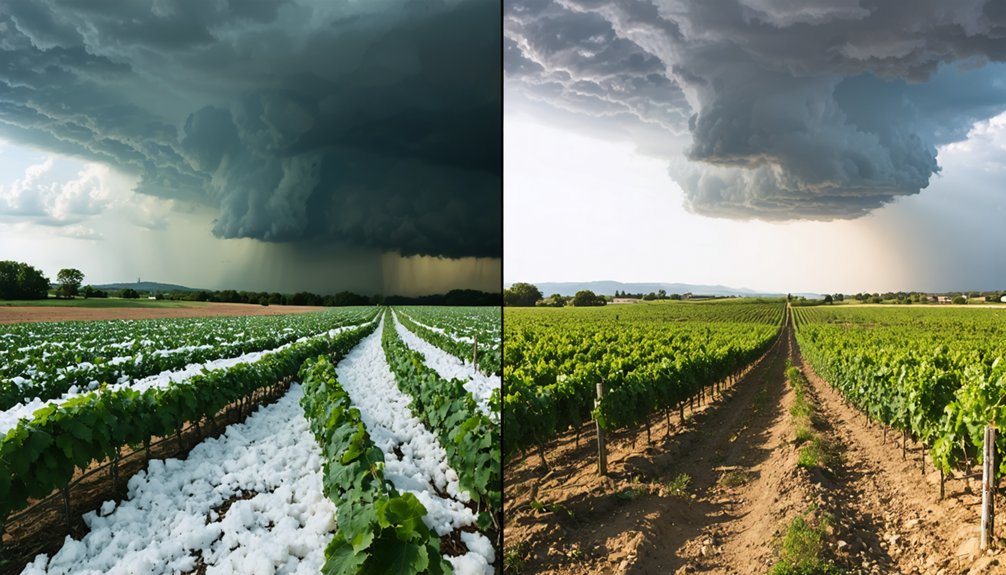
Climate-driven changes in hailstorm frequency don’t follow uniform global patterns, demanding region-specific projection frameworks that account for competing atmospheric mechanisms. You’ll find Northern Italy and Austria experiencing increased hailstorm activity, while East Asia shows declining trends since the early 1990s.
When projecting future hail impacts on population density trends, you must evaluate local sea surface temperature variations—particularly in regions like the southern Great Plains, where Gulf of Mexico SSTs explain 57% of interannual variability through aerosol concentrations and moisture variability impacts. Don’t rely on global correlation coefficients (r < 0.30); instead, analyze vertical wind shear changes, convective inhibition, and CAPE trends specific to your target region.
Mongolia’s declining hail frequency (−0.214 days per decade) contrasts sharply with increasing southern Oklahoma trends, exemplifying spatial heterogeneity.
Frequently Asked Questions
How Do Funding Constraints Affect Long-Term Hailstorm Monitoring Program Sustainability?
Funding allocation strategies dictate you’ll face program discontinuations after fixed durations like HailNet’s 7-year timeline, while inadequate long-term budget planning forces resource-limited deployments, preventing systematic ground-level monitoring networks from achieving sustained, exhaustive datasets essential for peer-reviewed climatological research.
What Training Is Required for Volunteer Observers to Ensure Data Quality?
Like NSSL’s mPING project refined radar algorithms through crowd-sourced reports, you’ll need standardized observer training protocols covering measurement techniques, photographic documentation, and data validation procedures—ensuring your volunteer network delivers research-grade observations that meet peer-reviewed scientific standards.
How Can Developing Nations Implement Hail Research With Limited Technical Resources?
You’ll implement hail research cost-effectively using voluntary observer networks, satellite proxies, and open-source ML tools. These approaches enable community resilience strategies and hail mitigation techniques without expensive infrastructure, providing statistically robust data for risk assessments in resource-constrained settings.
What Are Best Practices for Sharing Hail Data Across International Borders?
How can you guarantee data integrity internationally? You’ll establish harmonized data standards with embedded metadata, implement secure cross-border data exchange protocols using encryption, and conduct Transfer Impact Assessments. Automate quality controls while maintaining transparent governance frameworks for collaborative research.
How Do You Communicate Hail Risk Projections to Policymakers Effectively?
You’ll maximize policymaker buy-in by presenting probabilistic risk assessment data through stakeholder engagement strategies that emphasize actionable scenarios. Combine peer-reviewed climatological projections with local vulnerability mapping, empowering decision-makers to independently evaluate adaptation options suited to their community’s unique needs.