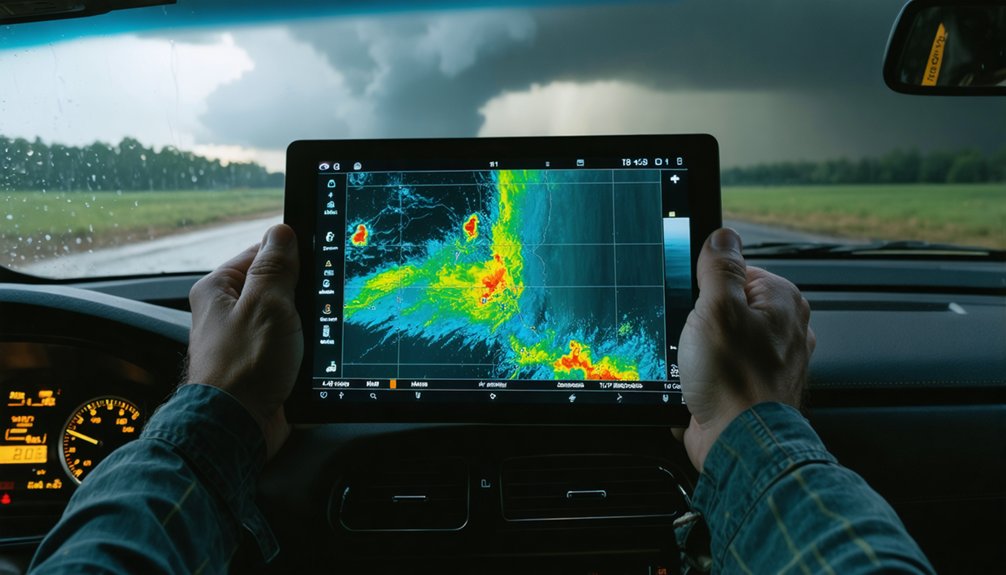
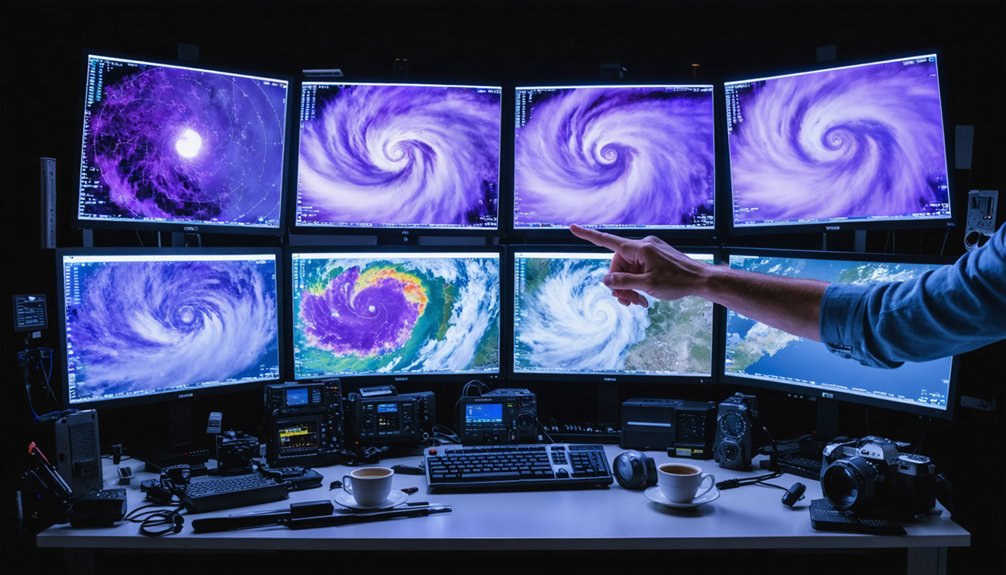
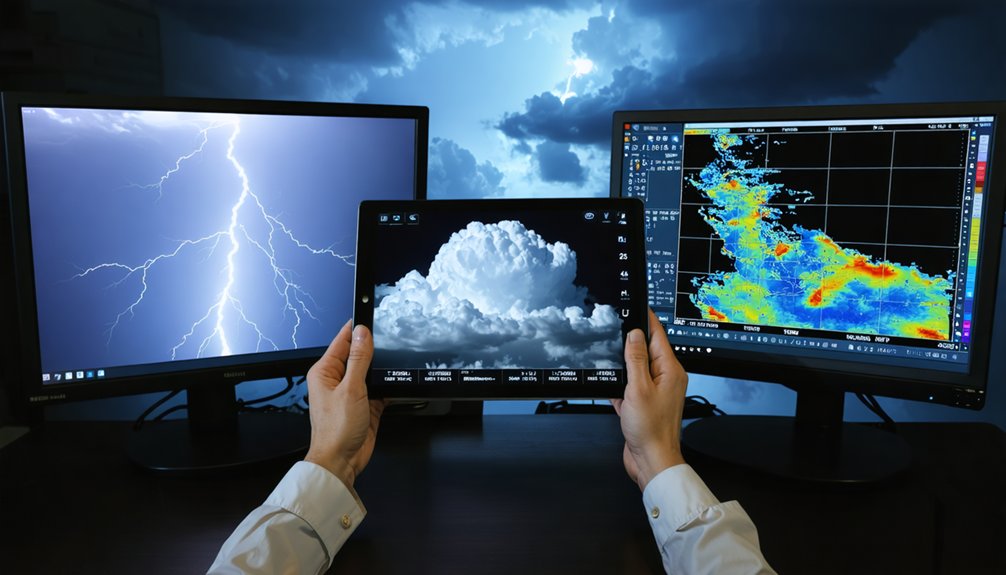
You’ll get the most accurate storm predictions from IBM Weather Insights, which integrates nearly 100 global forecast models with AI validation from expert meteorologists, or AccuWeather AI, which delivers hyperlocal MinuteCast forecasts with 37.8% improved intensity predictions and 19-hour earlier warnings. For enterprise needs, Climavision’s Horizon AI offers 1km resolution forecasts that outperformed ECMWF during recent hurricanes, while NOAA’s AI system generates 16-day forecasts using 99.7% fewer computing resources. Each platform below provides specialized capabilities for different forecasting requirements.
Key Takeaways
- IBM Weather Insights combines nearly 100 global forecast models with AI and NASA data for refined storm predictions.
- AccuWeather AI delivers hyperlocal MinuteCast forecasts with 37.8% better intensity predictions and 19 hours earlier warnings.
- Climavision’s Horizon AI blends 100+ models at 1km resolution, outperforming traditional systems on major hurricanes.
- FloodSENS AI maps flood extents in 30 minutes using satellite imagery, even through cloud cover obstruction.
- NOAA AI System generates 16-day forecasts in 40 minutes using 99.7% fewer computing resources than traditional methods.
IBM Weather Insights: Enterprise-Grade AI for Multi-Industry Storm Forecasting
As atmospheric conditions grow increasingly volatile, IBM Weather Insights deploys an AI forecasting engine that integrates input from nearly 100 global forecast models, weighing each contribution based on geography, time horizon, weather phenomenon type, and recent forecast accuracy metrics.
This weather forecasting integration leverages machine learning algorithms to identify atmospheric patterns and refine predictions in real-time, enabling accurate storm event tracking through numerical weather prediction augmented with advanced analytics. The system’s human-over-the-loop methodology combines AI capabilities with nearly 100 expert meteorologists who validate outputs and deliver personalized storm recommendations.
IBM’s GRAF (Global High-Resolution Atmospheric Forecasting) system provides the first hourly-updating global model capable of predicting thunderstorms at granular scale, utilizing 40 years of NASA MERRA-2 Earth observation data to generate forecasts at resolutions 12 times greater than conventional outputs.
AccuWeather AI: Hyperlocal Street-Level Storm Predictions for Billions
When storm systems threaten populated areas, AccuWeather’s hybrid AI architecture delivers precipitation forecasts at unprecedented granularity—MinuteCast® pinpoints rainfall type, intensity, and start/end times for the next four hours down to your exact street address or GPS coordinates across 210 countries. Their patented reinforcement learning engine processes real time data streams from global sources, achieving 6.2% superior storm track accuracy and 37.8% improved intensity predictions.
You’ll receive forecasts 19 hours earlier than competitors, with landfall locations 8.6% more precise. The platform’s integration with Perplexity enables on demand forecast integration for millions, while hybrid AI combines machine learning with 100+ meteorologists. AccuWeather’s severe weather alerts have documented 12,000+ lives saved, delivering actionable intelligence without bureaucratic delays or geographic restrictions.
Climavision’s Horizon AI: Advanced Modeling for Extreme Weather Events
Beyond street-level nowcasting, multi-day severe weather prediction demands enterprise-grade numerical weather models that resolve atmospheric dynamics at kilometer scale. Climavision’s Horizon AI deploys three specialized variants: HIRES models storms down to 1km resolution for 5-day forecasts, Point blends 100+ NWP models for 15-day predictions, and S2S extends accuracy to seasonal timescales with 50% performance gains over public systems.
You’ll access data assimilation techniques that integrate proprietary radar networks with satellite data integration from novel observational sources. The system outperformed ECMWF and GFS by forecasting Hurricane Beryl’s landfall nine days ahead and predicting Helene’s extreme rainfall totals for Asheville.
Trained on 15,000 simulation years, these neural networks deliver explainable forecasts without government gatekeeping—giving you direct API access to hyperlocal wind, precipitation, and severe weather alerts.
FloodSENS AI: Satellite-Powered Flood Detection and Risk Mapping
FloodSENS AI processes Sentinel-2 optical imagery through U-Net architectures to map flood extents within 30 minutes of satellite data availability, delivering actionable intelligence for disaster response and risk assessment. You’ll leverage satellite data integration combining L2A-level imagery with digital elevation models, flow accumulation grids, and topographic wetness indices for enhanced accuracy across diverse biomes.
The system’s squeeze-and-excitation networks enable cloud cover overcoming by reconstructing flooded areas beneath partial cloud obstruction—though dense cloud conditions remain limiting. Running on NVIDIA T4 and L4 GPUs, you’ll access globally transferable flood intelligence for insurance underwriting, ESG compliance verification, and humanitarian operations.
The platform overlays semi-transparent flood extent visualizations on infrastructure imagery, empowering you to make autonomous risk decisions without dependency on centralized emergency services or government-controlled data streams during critical flood events.
NOAA AI System: Free Climate Tools for Long-Term Disaster Planning
NOAA’s AI-Driven Global Forecast System (AIGFS) generates 16-day forecasts in approximately 40 minutes while consuming 99.7% less computing resources than conventional numerical weather prediction models. You’ll gain access to three cutting-edge systems through NOAA’s Open Data Dissemination Program at zero cost.
AI forecast accuracy improvements deliver:
- AIGFS – Reduces tropical cyclone track errors at extended ranges with 6-hourly atmospheric field updates
- AIGEFS – Extends forecast skill 18-24 hours beyond traditional ensembles using 31 members at 9% computing power
- HGEFS – Combines 62 AI and physics-based ensemble members, consistently outperforming single-approach systems
- Project EAGLE – Provides visualization and verification graphics through DESI platform for independent validation
You’ll evaluate ai model performance against established metrics, enabling informed long-range planning without government dependencies.
Frequently Asked Questions
How Do AI Weather Prediction Tools Compare in Accuracy to Traditional Forecasting Methods?
You’ll find AI excels in storm prediction accuracy for most scenarios—GenCast outperformed traditional methods in 97.2% of tests—yet struggles with extreme events. Weather modeling advancements show AI’s faster, though it underestimates unprecedented storms beyond its training data.
What Is the Typical Cost Difference Between Enterprise and Free Storm Prediction Tools?
You’ll find enterprise storm tools cost $35-$40+ monthly with unlimited API calls, while free versions cap at 1,000 daily requests. Subscription costs vary by vendor pricing models—premium delivers hyper-local forecasts whereas free updates lag six hours behind real-time conditions.
Can These AI Storm Prediction Systems Integrate With Existing Emergency Management Software?
Bridging the gap seamlessly, you’ll find cloud-based integrations enable AI storm prediction systems to connect with your existing emergency management software through unified dashboards, delivering real-time forecast data and predictive analytics without disrupting operational workflows or constraining your response autonomy.
How Far in Advance Can AI Accurately Predict Severe Storm Formations?
You’ll get the most accurate predictions 2-4 hours ahead, where machine learning algorithms achieve 8-16% accuracy improvements through real-time data analysis. AI systems can forecast up to 4 hours in advance, outperforming traditional methods notably.
Do These Tools Require Special Technical Expertise to Interpret Their Forecasts?
Yes, you’ll need specialized training to interpret storm prediction tools effectively. Professional meteorologists develop model interpretation techniques through 100+ hours of coursework, mastering data analysis capabilities that translate complex atmospheric models into actionable forecasts you can trust.