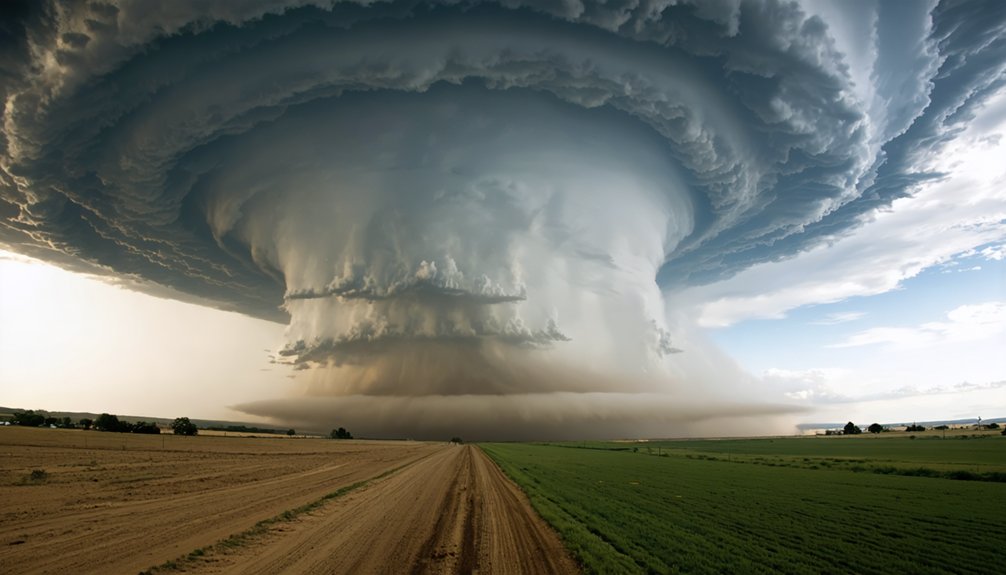
Climate change is making storms markedly more dangerous through multiple mechanisms. You’ll encounter hurricanes that intensify 8.3 m/s faster than pre-industrial conditions, with 80% of major storms now rapidly strengthening. Warmer oceans fuel 20% more precipitation, while rising sea levels—up 8-9 inches since 1880—amplify coastal flooding damage. These factors contributed to 2025’s $115 billion in disaster losses from just 23 events. The scientific evidence reveals how interconnected atmospheric and oceanic changes create compounding risks that demand your attention to protect communities and infrastructure.
Key Takeaways
- Warmer ocean temperatures from climate change cause hurricanes to intensify faster and spin 8.3 m/s stronger than pre-industrial conditions.
- Rapid intensification events now affect 80% of major hurricanes, with storms jumping categories more than twice as frequently.
- Climate change increases hurricane rainfall by up to 20%, causing more severe flooding in coastal and inland regions.
- Rising sea levels amplify storm surge damage, with Hurricane Sandy’s four-inch rise contributing $8.1 billion in additional damages.
- Weather disasters now cost over $200 billion annually, with climate-driven storms threatening to reduce household income growth by 11-29% by 2050.
Warmer Oceans Are Fueling More Powerful Hurricanes
As ocean temperatures climb to unprecedented levels, the fingerprints of climate change have become unmistakable in hurricane intensity patterns. Human-caused warming has elevated sea surface temperatures by 2.5 degrees, directly fueling storm strengthening across the Atlantic Basin.
Between 2019-2023, 80% of hurricanes intensified by an average 18 mph due to these warmer waters. Climate change attribution studies reveal that storms now spin 8.3 m/s faster than they would’ve without anthropogenic forcing.
Ocean heat content—a more expansive measure than surface temperature alone—provides the energy that enables hurricanes to reach higher wind speed thresholds. This translates to storms roughly one category stronger on the Saffir-Simpson scale. You’re witnessing measurable intensification: every 2024 Atlantic hurricane gained 9-28 mph from elevated ocean temperatures.
The Growing Phenomenon of Rapid Storm Intensification
You’re witnessing a measurable shift in how quickly tropical cyclones intensify, with rapid intensification defined as wind speed increases of at least 30 knots (35 mph) within 24 hours—and extreme cases exceeding 50 knots (58 mph) in the same period. Atlantic storms intensifying from Category 1 or weaker to major hurricane status more than doubled between 2001-2020 compared to 1971-1990, while 70% of the 63 billion-dollar U.S. tropical cyclones since 1980 underwent rapid intensification.
Of the 177 Atlantic tropical cyclones that rapidly intensified at landfall from 1980-2023, 22% (39 storms) experienced extreme rapid intensification, underscoring the scale of this accelerating phenomenon.
Defining Rapid Intensification Rates
When meteorologists track hurricane development, they measure rapid intensification as an increase of at least 30 knots (35 mph) in maximum sustained wind speed within a 24-hour period—a threshold established by the National Hurricane Center and National Weather Service. This benchmark escalates a storm from Category 1 to Category 3 on the Saffir-Simpson scale.
However, rates of maximum intensity change can reach extreme levels—the definition extends to increases of at least 50 knots (58 mph) in 24 hours. Hurricane Wilma holds the record at 125 mph in 24 hours.
The frequency of rapid intensification events is staggering: 80% of major hurricanes undergo this phenomenon, with 177 Atlantic landfalling cyclones rapidly intensifying between 1980-2023. You’ll find 22% of those storms exceeded extreme rates.
Recent Atlantic Intensification Trends
Between 1980 and 2023, 177 landfalling Atlantic tropical cyclones surged past the 30-knot rapid intensification threshold, and 39 of those storms—22%—achieved extreme rates exceeding 50 knots in 24 hours. From 1982 to 2009, Atlantic basin data confirmed escalating intensification rates.
The number of storms jumping from Category 1 or weaker to major hurricane strength more than doubled when comparing 2001-2020 against 1971-1990. These rapid intensification thresholds pose severe real time forecasting challenges that compromise evacuation protocols. Hurricane Helene exemplified this danger, exploding from 80 mph to 140 mph within 24 hours before striking Florida’s Panhandle in September 2024.
Warmer sea surface temperatures drive this acceleration—the 99.5th percentile of maximum 12-hour intensification rates expanded from 42 mph to 60 mph during 1970-2020.
Climate-Driven Increases in Hurricane Rainfall and Flooding
Climate change has demonstrably intensified hurricane rainfall across the United States, with recent storms delivering up to 20% more precipitation than they would’ve in a pre-industrial climate. Rainfall attribution methodology applied to 2020’s North Atlantic hurricane season quantified a 10% increase in hourly totals, while Hurricane Helene’s southeastern U.S. impacts saw nearly 20% intensification from climate change impacts on precipitation.
You’re witnessing century-level storms becoming twice as frequent due to this rainfall escalation. The mechanism is straightforward: warmer oceans fuel greater evaporation, and the atmosphere holds 7% more water vapor per 1°C of warming. This enhanced moisture capacity directly translates to heavier downpours and flash flooding.
The Northeast has experienced 60% more intense rainstorms since the 1950s, demanding infrastructure adaptation for escalating flood risks.
Rising Sea Levels Amplify Storm Surge Damage
Since 1880, global mean sea level has risen 8-9 inches, creating a permanently elevated platform from which storm surges now launch their assault on coastal communities.
You’re facing quantifiable consequences: Hurricane Sandy’s four-inch rise contributed $8.1 billion of $63 billion in damages, flooding 36,000 additional homes. The likelihood of Sandy-level flooding has tripled, with future severe events now four times more probable.
Projections indicate 10-12 inches of U.S. coastal rise by 2050, with Western Gulf areas experiencing 16-18 inches. Century-level extremes will become annual events at some gauges by mid-century.
Hurricane Katrina demonstrated 15-60% higher flood elevations compared to 1900 conditions. Effective coastal adaptation strategies and increased public awareness remain essential as each additional inch amplifies surge penetration inland, compounding property exposure and economic losses.
Why Hurricanes Are Moving More Slowly Across Land
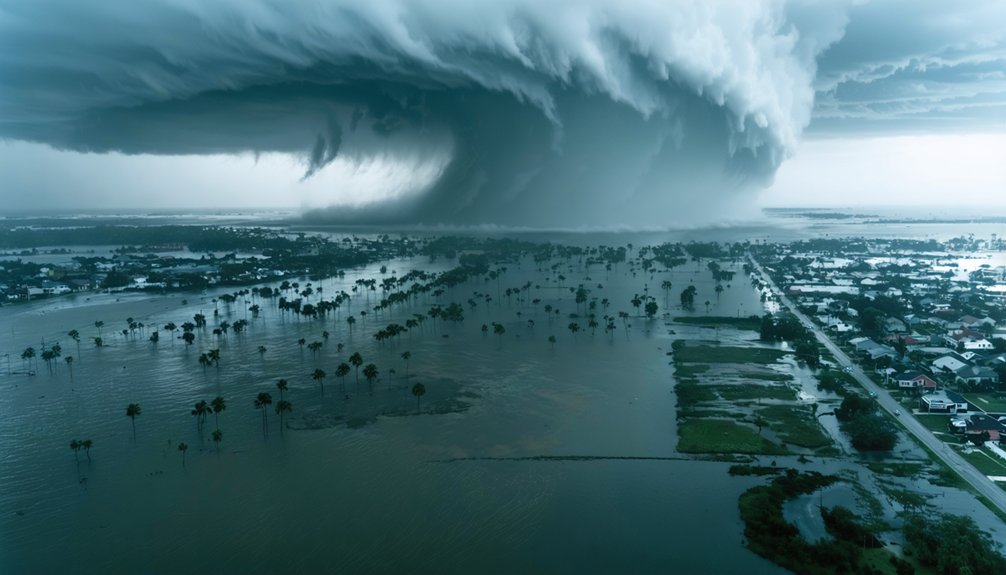
As atmospheric circulation patterns shift under warming conditions, hurricanes are exhibiting measurably reduced translation speeds across land—a trend with profound implications for rainfall accumulation and flood risk. Weakening jet streams and altered pressure systems diminish the steering currents that traditionally propel storms across regions.
This extended landfall exposure allows hurricanes to linger over communities, compounding precipitation impacts as warmer atmospheric conditions simultaneously increase moisture retention capacity. You’re facing storms that combine slower movement with enhanced rainfall rates—a multiplier effect that transforms moderate events into catastrophic flooding scenarios.
Research projects significant increases in tropical cyclone precipitation under continued warming, with slower translation speeds amplifying cumulative water accumulation. The combination extends wind exposure duration while maximizing rainfall totals, creating compound damage potential that escalates both economic losses and infrastructure impacts beyond historical precedents.
The Mounting Economic Toll of Weather Disasters
Beyond the physical destruction wrought by slower-moving, intensified storms lies a cascading financial crisis reshaping economic landscapes. You’re witnessing unprecedented economic damage: 2025’s 23 billion-dollar disasters generated $115 billion in losses, with record-breaking insurance losses reaching $42 billion from severe convective storms alone. Los Angeles wildfires delivered $61.2 billion in damages—double any previous wildfire event.
The costs of disaster recovery extend far beyond immediate destruction. Global disasters now trigger $2.3 trillion in cascading impacts through supply chains, reduced household incomes, and diverted government resources. Since 1980, 426 US billion-dollar events have exceeded $3.1 trillion in damages. Climate-driven disasters threaten to slash household income growth 11-29% by 2050, with direct annual losses surpassing $200 billion—a stark reality demanding proactive adaptation over reactive spending.
Coastal Communities Face Heightened Vulnerability

Nearly 128 million Americans—40% of the nation’s population—inhabit coastal counties where converging climate threats create compounding risks that inland communities don’t face. You’ll find these areas demonstrate measurably higher distress through economic indicators, with social support needs intensifying as storms damage critical systems.
In rural eastern Virginia, household incomes reach just half the state average while poverty rates double it.
Rising seas expand the 1-in-20 year floodplain to encompass 73 million people’s current homes by 2100 under moderate emissions scenarios. Housing infrastructure impacts escalate through saltwater intrusion into aquifers, elevated water tables, and increased storm surge heights.
Low-income populations lack resources to remediate contaminated properties or rebuild damaged structures, creating systematic barriers to recovery that government interventions haven’t adequately addressed.
What the Science Tells Us About Future Storm Patterns
Climate models demonstrate unambiguous trajectories for tropical cyclone intensification, with global storm intensities projected to increase 1-10% under 2°C warming scenarios. You’ll observe Category 4-5 storm frequency trends rising 45% in early decades and 39% by century’s end.
Rainfall rates within 100 km of storm centers will intensify 14%, while rapid intensification events become increasingly common. Atlantic hurricanes will generate higher peak winds and lower central pressures, though tropical cyclone size won’t diminish—meaning destructive potential per storm escalates.
Warmer oceans fuel faster hurricane growth near landfall, while elevated atmospheric moisture amplifies precipitation extremes. Detection-attribution studies confirm greenhouse warming drives these intensification patterns globally. You’re facing unprecedented extreme heat frequency and duration alongside heightened storm risks.
Frequently Asked Questions
How Do Hurricanes Differ From Typhoons and Cyclones Around the World?
Ever wondered why these storms have different names? They’re actually identical phenomena—only their geographic locations differ. You’ll find hurricanes in the Atlantic, typhoons in the Northwest Pacific, and cyclones elsewhere, with varying storm formation patterns and storm intensity variations regionally.
Can Individual Storms Be Directly Attributed to Climate Change?
No individual storm is directly caused by climate change, but you can measure how regional climate patterns and atmospheric circulation changes made specific storms more intense, wetter, or likely—quantifying human influence on that particular event.
What Technologies Are Used to Predict Hurricane Intensity and Track?
Picture storm systems swirling across your screen in real-time. You’ll find forecasters use satellite data analysis and weather modeling algorithms—including AI systems like NASA’s Deep Learning Estimator and Google’s DeepMind—achieving 40% better accuracy than traditional methods.
How Do Building Codes Help Protect Homes From Hurricane Damage?
Building codes protect your home through structural reinforcement and roof anchoring systems that resist wind-borne debris and pressure. They’ve reduced hurricane losses by 12-15% and saved $1.6 billion annually, proving your investment in code-compliant construction pays off.
Are Certain Geographic Regions More Affected by Storm Changes Than Others?
Climate change doesn’t play favorites—regional temperature variations concentrate hurricane intensification along Atlantic coasts while Northwestern Europe faces strengthened storm tracks. You’ll find coastal population growth in vulnerable areas like Bangladesh and the U.S. Gulf Coast magnifies risk exposure dramatically.