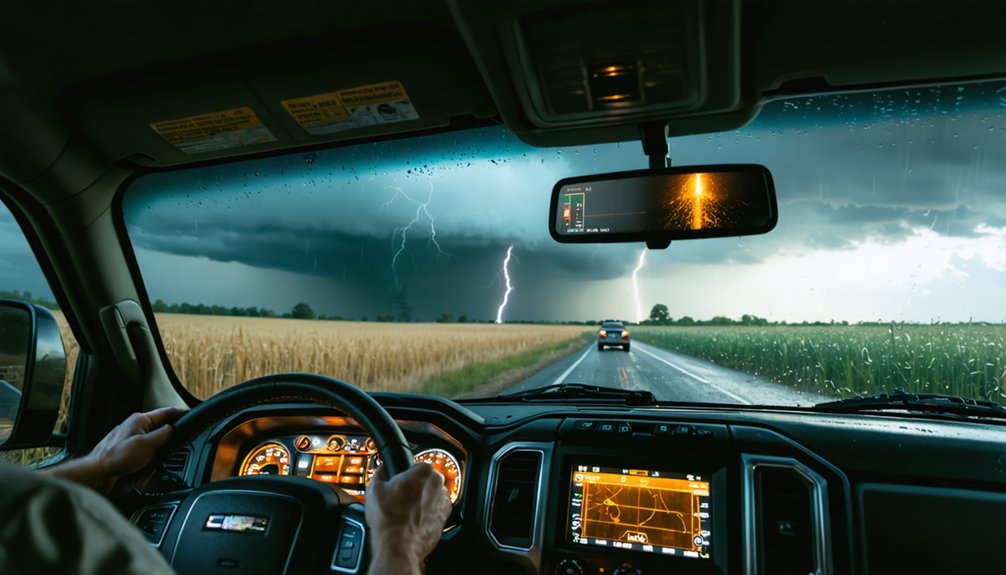
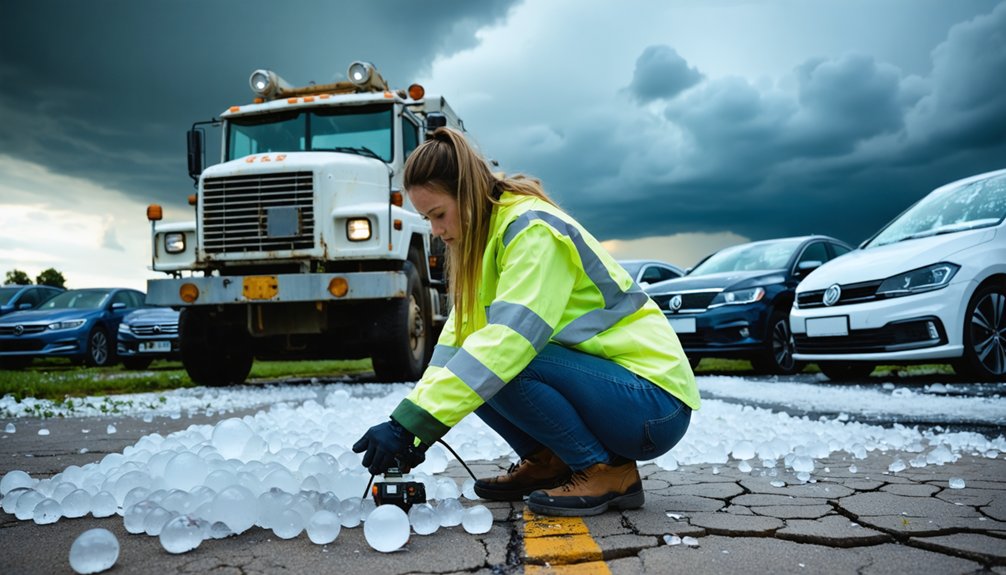
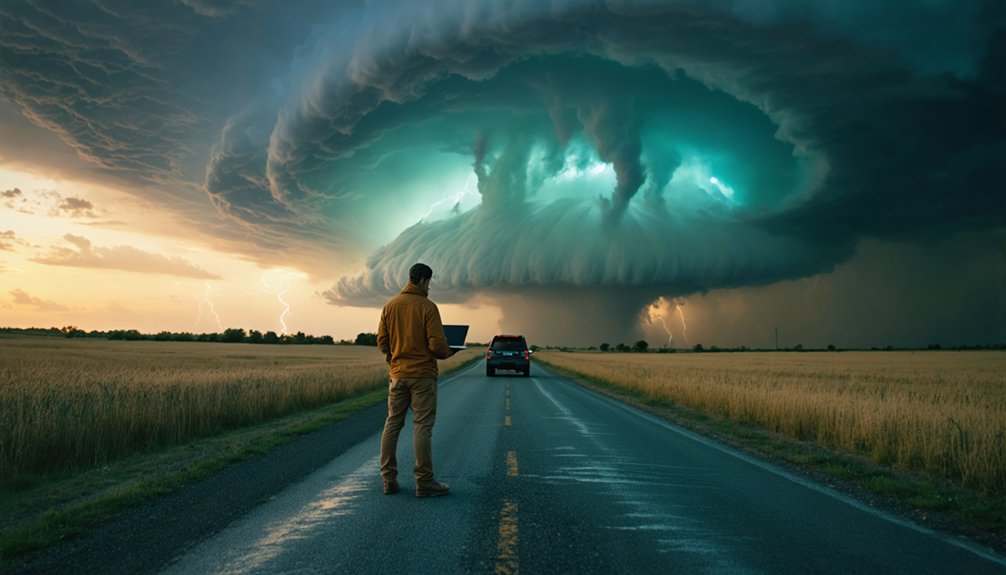
You’re drawn to waterspouts because they’re exceptionally rare—comprising fewer than 5% of global tornado reports—and offer unique opportunities to document thermal energy converting into rotational force across open water. You’ll utilize specialized forecasting tools like the Szilagyi Waterspout Index, GOES-16 satellite imagery, and Skew-T diagrams to predict formation conditions. Beyond the adrenaline rush, you’re contributing quantifiable data to the International Centre for Waterspout Research‘s global climatology database, transforming your chase into peer-reviewed science while building recognition within the meteorological community through systematic documentation of these atmospheric vortices.
Key Takeaways
- Waterspouts represent rare phenomena, comprising fewer than 5% of global tornado reports, making them highly sought documentation targets.
- Advanced forecasting tools like the Szilagyi Waterspout Index and satellite imagery enable chasers to predict and intercept these events.
- Marine settings transform atmospheric vortices into visually spectacular subjects for photography and scientific documentation purposes.
- Contributing observations to global databases like ICWR provides chasers recognition while advancing meteorological research and climatology.
- Social media platforms create digital ecosystems where chasers build community, share knowledge, and gain visibility for their work.
The Science Behind Waterspout Formation That Captivates Chasers
Waterspouts manifest in two distinct forms, each governed by fundamentally different atmospheric mechanisms that determine their structure, intensity, and behavior. Fair weather variants emerge from boundary layer disturbances, initiated when warm water heating destabilizes the air above.
You’ll observe horizontal shear along convergence lines spinning air upward through a five-stage cycle: dark spot formation, spiral pattern development, spray ring creation, condensation funnel visibility, and eventual decay. These systems require light winds and high humidity beneath developing cumulus clouds.
Tornadic waterspouts operate through supercell dynamics, extending downward from cumulonimbus bases with diameters exceeding 100 meters. Rising air tilts horizontal rotation vertical, creating intense pressure drops detectable by radar. Both types demand specific conditions: heat, humidity, wind shear, and unstable atmospheric profiles that transform thermal energy into rotational force.
Contributing to Global Research Through the International Centre for Waterspout Research
Since 2008, the International Centre for Waterspout Research (ICWR) has transformed amateur observations into systematic scientific datasets through its collaborative infrastructure.
ICWR bridges citizen science and formal meteorology, converting casual sightings into rigorous climate records through structured global collaboration since 2008.
You’ll access three pioneering systems when exploring ICWR’s collaborative research initiatives: the Global Waterspout Forecast System delivers worldwide potential maps, the Global Waterspout Database archives events across continents, and the Global Waterspout Watch Network coordinates independent spotters. You’re empowered to contribute directly through Twitter (@ICWR) or Facebook submissions, bypassing traditional gatekeepers.
When highlighting unique ICWR projects, their nomogram—originally developed for specific regions—now extends to European waters, validated through peer-reviewed research. You’ll find daily North American forecasts, live reporting capabilities, and interactive hotspot mapping (2021-2025).
Your observations become quantifiable data within their World Waterspout Climatology rankings, advancing meteorological understanding through decentralized participation.
Forecasting Tools That Enable Successful Waterspout Chasing
While amateur storm chasers once relied on intuition and visible cloud formations, modern waterspout forecasting integrates quantitative indices, thermodynamic profiles, and real-time satellite data to predict favorable conditions with unprecedented accuracy. You’ll leverage the Szilagyi Waterspout Index (SWI), which consolidates atmospheric parameters into a single -10 to +10 value, eliminating tedious multi-variable analysis.
GOES-16 satellite imagery reveals convective development through rapid cloud growth and wind shear estimates, while model soundings via Skew-T diagrams expose vertical instability profiles critical for waterspout genesis. Despite these advances, forecasting limitations persist—radar can’t detect non-supercellular waterspout rotation, creating observational data gaps that demand direct visual confirmation.
StormCenter apps synthesize radar, spotter networks, and live reports, enabling you to navigate uncertainty independently and intercept formations others miss.
The Rush of Documenting Rare Weather Phenomena on Water
Though fewer than 5% of global tornado reports involve waterspouts, their marine setting transforms atmospheric vortices into sought-after documentation targets that deliver visual spectacle unmatched by terrestrial phenomena. You’ll capture rotating funnels against open horizons while adrenaline fueled filming drives you toward spray rings and multiple vortices that distinguish these events from land tornadoes.
Safe observation techniques maximize documentation quality:
- Position tripod-stabilized cameras with zoom lenses at measured distances from developing funnels
- Monitor RadarScope signatures correlating visual rotation with velocity couplets in real-time
- Submit high-definition footage to Spotter Network for NWS verification and tornadogenesis research
- Log formation timestamps, GPS coordinates, and dissipation paths for climatology databases
Your equipment—extra batteries, radar apps, chase logs—ensures uninterrupted scientific contribution while storm movements at 50-60 knots demand rapid repositioning for multi-angle captures.
Building Community and Recognition in the Storm Chasing World
Social media platforms have restructured storm chasing from isolated field operations into interconnected digital ecosystems where your documentation efforts simultaneously serve scientific purposes and community-building functions. Your YouTube channel or Twitter feed establishes measurable social media influence through real-time content distribution, transforming you from anonymous observer into recognized information source.
These platforms generate networking opportunities extending beyond digital interfaces—celebrity chasers with substantial followings now encounter fellow community members at chase locations, converting virtual relationships into collaborative field partnerships. The 320 registrants in Girls Who Chase’s Spring Training program demonstrate democratized access to operational knowledge previously restricted through closed networks.
You’ll find gas stations near storm targets functioning as spontaneous gathering points where concentrated chaser populations facilitate knowledge exchange across expertise levels, eliminating traditional barriers that created safety disparities.
Frequently Asked Questions
How Dangerous Are Waterspouts Compared to Land-Based Tornadoes?
Fair-weather waterspouts you’ll encounter are considerably less dangerous than land tornadoes, with wind speed variations reaching only 200 km/h versus 500+ km/h. Water temperature effects create weaker vortices that dissipate quickly upon landfall, posing minimal threat.
What Equipment Do Storm Chasers Need for Waterspout Chasing?
Like a nautical observatory on wheels, you’ll need portable radar equipment to track formation dynamics, specialized camera gear with waterproof housing for documentation, marine-band radio for coastal warnings, and GPS navigation systems ensuring you’re positioned safely offshore or coastally.
Can Waterspouts Occur During Winter Months or Only in Summer?
You’ll find waterspouts can occur during winter months, though they’re rare. Winter formation patterns require extremely cold air over warm water, while seasonal variances show peak activity occurs late-summer through early-autumn when conditions optimize naturally.
How Much Does It Cost to Participate in Waterspout Chasing?
You’ll spend $500-$2,000 depending on charter costs, waterspout monitoring equipment like marine radar, and boat safety protocols. Fuel, permits, and specialized weather instruments add expenses, but carpooling reduces individual costs markedly for your independent maritime pursuit.
What Should Boaters Do if They Encounter a Waterspout Nearby?
Eighty percent of boating deaths are preventable with life jackets. You’ll maintain safe distance by steering perpendicular to the waterspout’s path, monitor weather alerts continuously, and head immediately toward shore while ensuring everyone’s wearing Coast Guard-approved PFDs.