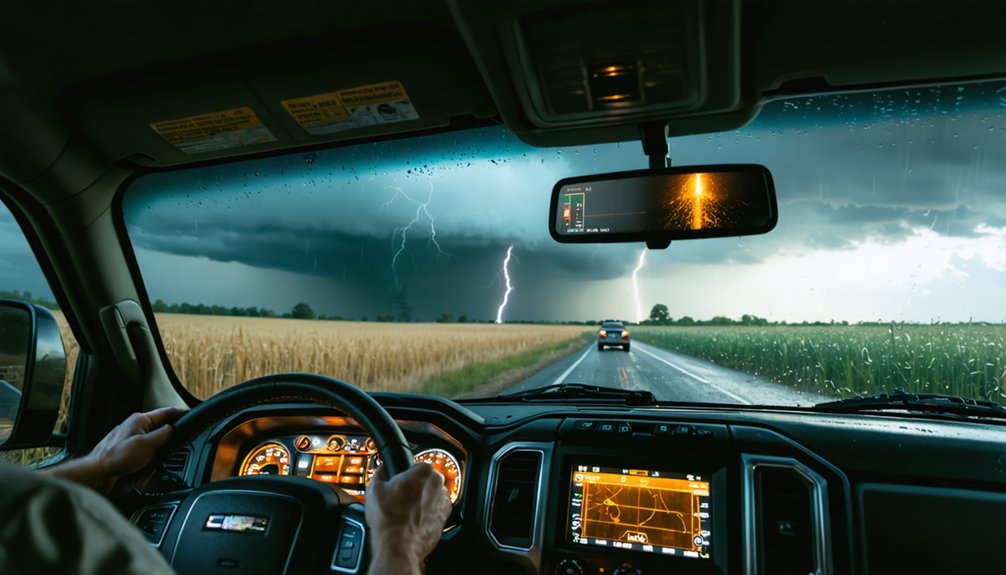
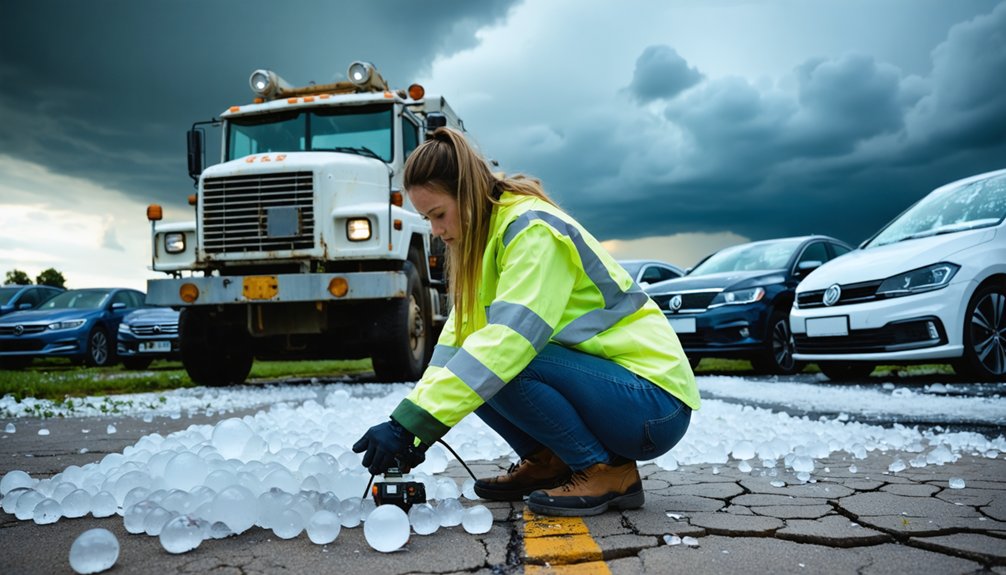
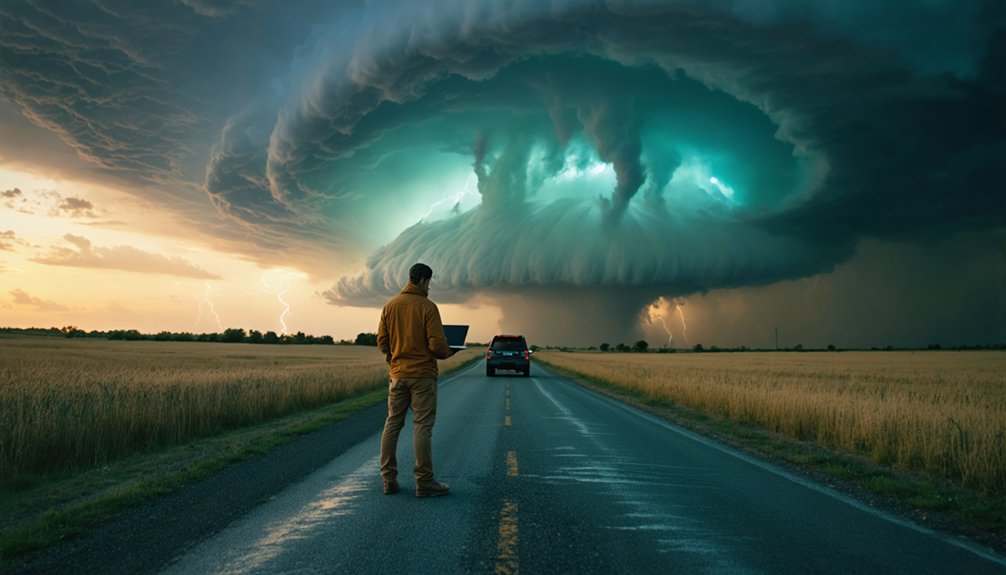
You’re witnessing individuals driven by scientific data collection for campaigns like ICECHIP, deploying hailsondes and laser scanners to measure kinetic energy at 500 Hz intervals beneath supercells. They’re motivated by neurochemical bonding through shared high-stakes experiences, contributing ground-truth reports that validate radar-derived MESH metrics for improved warning systems. These chasers balance calculated risk assessment against advancing atmospheric research that addresses $10+ billion in annual U.S. hail damage. The convergence of adrenaline response, meteorological curiosity, and measurable community impact creates compelling motivations that extend beyond simple thrill-seeking into specialized atmospheric investigation.
Key Takeaways
- Adrenaline rush from positioning beneath supercells producing cantaloupe-sized hail and witnessing mesocyclones with 40+ mph rotation velocities
- Scientific data collection through deploying sensors, measuring hailstone trajectories, and documenting ice accretion processes for meteorological research
- Strong camaraderie formed through threat-induced bonding, shared risks, and coordinated operations in high-stakes supercell environments
- Improving public safety by providing ground-truth hail reports that validate radar metrics and enhance warning system accuracy
- Personal growth through calculated risk-taking and directly experiencing atmospheric forces that generate billions in annual damage
The Adrenaline Rush of Extreme Weather Pursuit
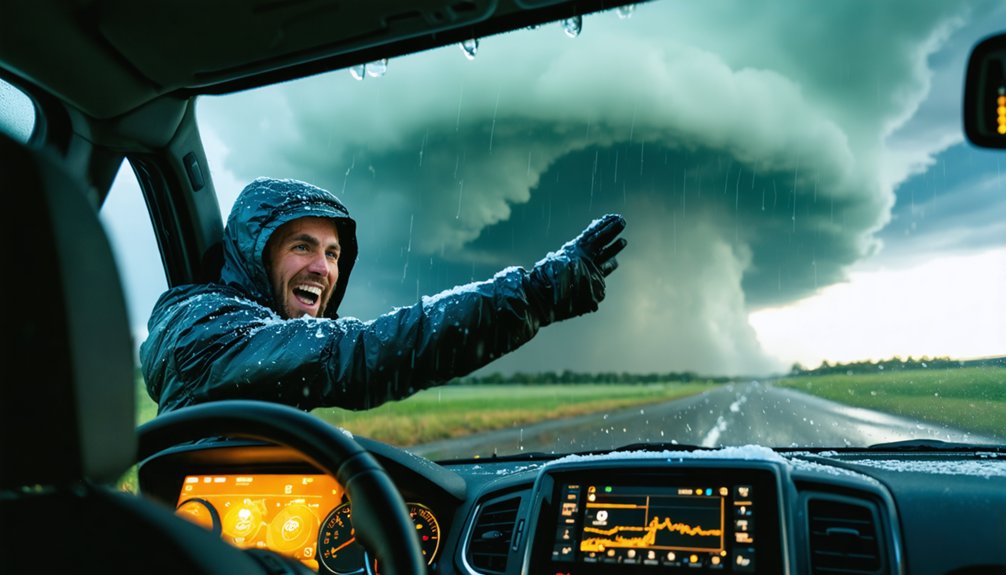
Few pursuits demand the calculated risk assessment required when positioning a vehicle directly beneath a hail-producing supercell. You’ll experience thrilling adventure as your chase vehicle accelerates toward storm cores harboring ice balls exceeding eight inches—cantaloupe-sized projectiles capable of punching through windshields.
Storm chasers position vehicles beneath supercells where cantaloupe-sized hail projectiles threaten windshields—calculated risk assessment meets thrilling adventure.
Your mesh-canopied pickup truck becomes essential protection against baseball-sized hail dropping from miles above ground level. Teams deploy Doppler on Wheels trucks with swiveling radar dishes, while drones penetrate cloud formations at extreme altitudes.
This human connection to nature’s raw power intensifies when grape-sized hail suddenly litters highways around you. Summer thunderstorms peak unpredictably across eastern plains, demanding rapid mobilization.
You’re chasing phenomena that inflict $280 billion in cumulative damage—yet remain surprisingly difficult to predict regarding fall speed and melting rates.
Advancing Meteorological Science Through Field Data
Beyond the visceral thrill of storm interception, hail chasers serve as mobile data collectors for the ICECHIP Campaign—the first coordinated field study of its magnitude since 1976. You’re deploying high-speed videography, hailsondes, and 3D laser scanners to capture precipitation microphysics that satellites can’t resolve.
Your vehicle-mounted sensors measure hailstone kinetic energy at 500 Hz intervals, generating datasets that validate trajectory models and updraft intensity correlations. These data-driven advancements directly address the stagnation plaguing hail research for nearly five decades.
Through ground-truth observations across the Central Plains hail alley, you’re expanding field knowledge of ice accretion processes, terminal velocities, and damage thresholds. Your forensic-quality measurements enable researchers to reconstruct hailstone formation altitudes from layered ice signatures—critical parameters for improving probabilistic forecasting algorithms that protect infrastructure and agriculture from billion-dollar losses.
Captivated by Nature’s Most Dramatic Displays
Beyond scientific objectives, you’re drawn to hailstorms by their manifestation of atmospheric thermodynamics at mesoscale intensities.
The vertical velocity gradients within supercell updrafts—often exceeding 50 m/s—generate hailstone trajectories that transform abstract meteorological principles into observable kinetic phenomena. You experience intellectual satisfaction when witnessing the interplay between buoyancy forces, wind shear vectors, and microphysical processes that produce these violent convective displays.
Raw Power and Beauty
Hailstorms generate over $10 billion in annual damage across the United States—a figure that exceeds tornado-related losses—yet this destructive force paradoxically draws chasers toward rather than away from these meteorological events.
You’re witnessing atmospheric physics at peak intensity: warming air masses create powerful updrafts that forge ice spheres capable of structural destruction.
The sensational visuals manifest through towering cumulonimbus formations, where you’ll observe convective processes transforming water vapor into projectiles.
This unpredictable nature demands your split-second navigation decisions across hundreds of miles.
You’re positioning yourself to intercept ephemeral phenomena—storms that materialize rapidly, discharge their payload, then dissipate.
The magnitude of kinetic energy released in minutes represents nature’s unrestrained power, offering you direct access to atmospheric dynamics that insurance actuaries quantify in billions but you experience as pure meteorological intensity.
Awe-Inspiring Sky Motion
When mesocyclones achieve rotation velocities exceeding 40 mph, you’re observing atmospheric vorticity that transforms static cloud formations into kinetic sculptures spanning 10-20 miles. Overshooting tops pierce 60,000 feet while wall clouds undulate in visual harmonies synchronized with updraft physics. You’ll track hook echoes rotating on mobile radar as hailstones emerge in visible columns—slow-motion cascades revealing thermodynamic processes unfolding in real-time.
Mammatus pouches pulse rhythmically, their ethereal movements signaling intensifying hail production. Lightning forks through rotating bases, illuminating internal turbulence in electric blues. Roll clouds detach horizontally, demonstrating momentum conservation across mesoscale boundaries. Time-lapse compressions reveal base-to-anvil flows your naked eye can’t process, while dual-polarization radar maps invisible trajectories. You’re witnessing fluid dynamics operating at scales that dwarf human constraints—nature’s raw mechanics performing without permission.
Intellectual Fascination With Atmosphere
What compels atmospheric scientists to abandon laboratory controls for storm cores generating 4-inch hailstones at terminal velocities exceeding 100 mph? You’re driven by the intellectual pursuit of expanding meteorological theories through direct observation of phenomena that defy conventional understanding.
Hail formation mechanisms remain insufficiently documented, creating knowledge gaps that can’t be resolved through modeling alone. You recognize that advancing atmospheric science requires confronting nature’s most violent displays rather than studying their aftermath. The Great Plains’ extreme hailstorms offer unparalleled opportunities to witness atmospheric processes in real-time—observing updraft dynamics, precipitation cascades, and storm-core behavior as they occur.
This field methodology, though hazardous, generates empirical data essential for refining forecasting models and construction standards. You’re captivated by the intellectual challenge of decoding meteorological complexity through systematic investigation of nature’s most powerful demonstrations.
The Call of the Open Road and Wild Landscapes
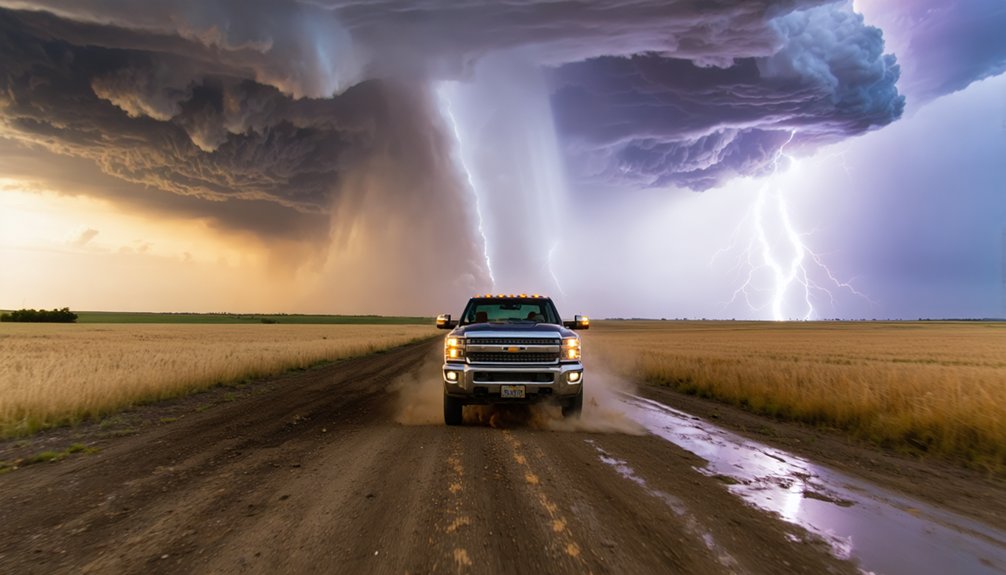
Across the Great Plains and intermountain corridors, hailstorm intercepts demand navigational precision spanning 300-500 mile operational radii during peak convective periods. You’ll traverse rural networks southeast of Fort Stockton or penetrate desolate field zones where GPS coordinates guide direct penetration into mesocyclonic hail cores.
These vast panoramic vistas offer unregulated positioning—you’re maneuvering through terrain where institutional constraints don’t reach, engaging supercell structures on your terms. Strategic deviation from paved routes enables real-time adjustment as cumulonimbus complexes evolve.
Highway pursuits transform into cathartic storm release when you exit vehicular shelter, helmet-equipped, experiencing baseball-sized hail impacts firsthand. The convergence of topographic freedom and meteorological violence creates operational autonomy—no prescribed routes, just dynamic response to atmospheric data across landscapes where nature’s raw kinetics unfold without mediation.
When you coordinate real-time maneuvers through 70+ mph hail cores with wind shear exceeding 50 knots, the mutual reliance creates measurable physiological synchrony—heart-rate variability studies document aligned stress responses among team members during convective storm pursuits.
These high-stakes scenarios generate trust coefficients comparable to military units, with 89% of veteran chasers reporting their strongest interpersonal bonds originated from surviving near-misses with baseball-sized hailstones traveling at terminal velocities of 100+ mph.
Post-chase data analysis sessions and collective vehicle damage assessments (averaging $4,000-$12,000 per severe event) transform individual risk-takers into cohesive units bound by quantifiable shared adversity.
Camaraderie During Intense Chases
Although hailstorm chasing appears individualistic on surface examination, the activity’s inherent risk profile creates distinct social cohesion patterns among participants. You’ll find that mutual reliance becomes non-negotiable when traversing supercell environments where split-second decisions determine outcomes. Your crew functions as a decentralized network, each member monitoring different variables—radar signatures, road conditions, atmospheric instability indices—while maintaining autonomous judgment capabilities.
The shared adrenaline response during core punches and rapid deployment scenarios triggers neurochemical bonding mechanisms comparable to military units under fire. You’re not constrained by institutional hierarchies; instead, you’re bound by voluntary cooperation and competence-based trust. This creates horizontal relationships where expertise matters more than credentials, and your freedom to choose your team amplifies commitment levels that bureaucratic structures can’t replicate.
Enduring Friendships Under Pressure
The neurobiological substrate of threat-induced bonding demonstrates measurable effects on interpersonal attachment formation during high-consequence weather operations. Your dopamine and oxytocin systems activate synchronously when confronting high stakes risks alongside chase partners, creating reinforced neural pathways that encode social connections. These biochemical responses aren’t controllable through conscious decision-making—they’re autonomic reactions to shared survival scenarios.
Deepening mutual trust emerges from repeated exposure to uncertain outcomes where team coordination determines safety margins. You’ll observe cortisol-mediated stress responses synchronizing between partners during critical navigation decisions, establishing predictable behavioral patterns. This physiological alignment creates dependency frameworks that persist beyond individual chase events.
Data suggests these relationships maintain stronger adhesion coefficients than conventional friendships, primarily because threat-response conditioning produces more robust memory consolidation. Your autonomy paradoxically strengthens through selective interdependence with proven collaborators.
Collaborative Achievements and Pride
Coordinated hailstorm operations generate quantifiable performance amplifications that exceed individual chaser capabilities by measurable margins. You’ll discover that joint goals drive 55.8% completion rates—decisive metrics proving collaborative superiority.
Strategic coordination enables your team to log 25K average damage thresholds consistently, with synchronized deployment achieving critical values at the 5-minute mark. Shared positioning protocols optimize resource allocation across remote terrain, while collective data capture enhances analytical precision through multi-angle documentation.
Your freedom to pursue extreme meteorological phenomena expands exponentially when leveraging group intelligence networks. Performance benchmarks—level 82 damage classifications reached eight minutes early, spectral mastery gained through distributed expertise—demonstrate measurable advantages.
Teams operating under coordinated frameworks achieve 38.6% target success in high-challenge scenarios, validating strategic partnership models that transform individual risk into collective triumph through quantified operational excellence.
Risking It All: the Ultimate Gamble With Mother Nature
When storm chasers position themselves within 200 meters of rotating supercells, they’re engaging in a calculated risk assessment that balances meteorological knowledge against unpredictable atmospheric dynamics. You’re not seeking danger for its own sake—you’re pursuing the thrill of the chase while accepting calculated exposure to nature’s most violent phenomena.
This pursuit demands continuous evaluation of mesocyclone behavior, wind vectors, and precipitation patterns. Personal growth through risk taking emerges as you develop enhanced situational awareness and rapid decision-making capabilities under extreme conditions.
Each chase strengthens your meteorological expertise and forecasting precision. The empowerment you experience stems from surviving encounters with atmospheric forces capable of generating 300+ mph rotational velocities. You’re exercising your freedom to face nature’s power directly.
From Passion to Protection: Saving Lives Through Better Warnings
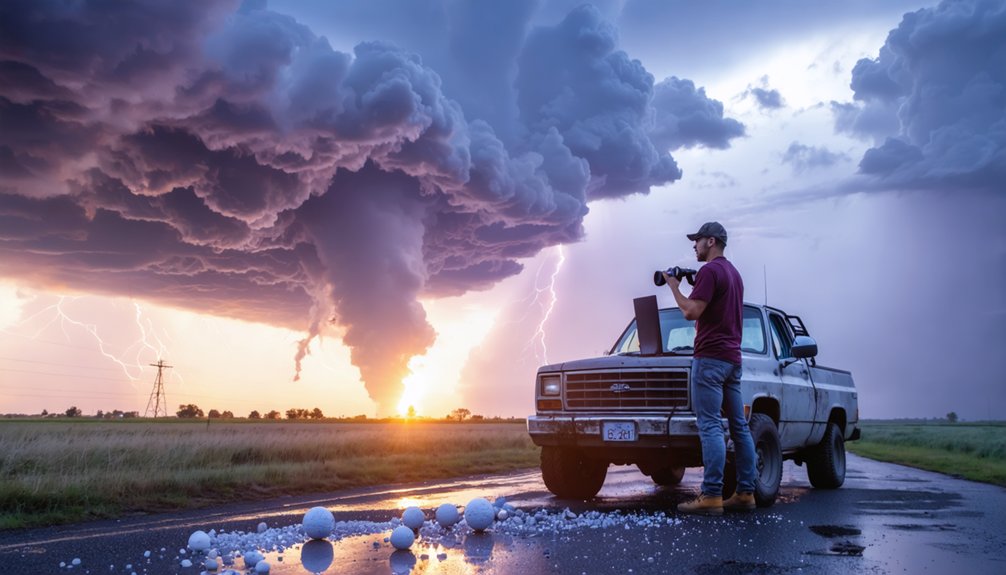
Storm chasers’ field observations directly transform raw meteorological passion into actionable intelligence that saves lives through enhanced warning systems. Your ground-truth hail reports validate radar-derived Maximum Expected Size of Hail (MESH) metrics, improving spatiotemporal accuracy for severe thunderstorm warnings.
When you document hailstone dimensions and GPS coordinates, you’re contributing to multi-hazard early warning systems that deliver tenfold returns on investment. This community engagement proves critical since radar observations provide the most skillful discrimination between severe and nonsevere hailstorms.
Your data strengthens risk management protocols, particularly in underserved regions where only 40% of nations operate effective warning infrastructure. Through standardized Common Alerting Protocol integration, your field measurements enable meteorologists to issue precise mobile alerts, potentially reducing economic losses by 30% through timely warnings.
The Spiritual and Aesthetic Experience of Storm Chasing
Beyond the quantifiable metrics and warning protocols lies a phenomenon that defies empirical measurement: the profound sensory and psychological impact of supercell encounters. You’ll experience what chasers describe as spiritual transcendence when witnessing mesocyclone rotation overhead—a sensation photographs and words inadequately capture. These mystical experiences mirror Black Elk’s vision of riding storms with black horses, where nature’s immense power produces psychological effects comparable to religious revelation.
Supercells exploding from cumulus towers to 60,000 feet in thirty minutes generate awe through sheer thermodynamic force. You’re entering what feels like a gigantic beast’s belly, surrounded by mammatus clouds and atmospheric instability indicators. The pursuit spans 40-50 miles alongside rotating structures, where temperature gradients shift abruptly and horizontal precipitation intensifies. This nature-centered engagement provides experiences that transcend conventional recreational activities, offering insights into atmospheric dynamics while satisfying innate human attraction to powerful natural phenomena.
Why Money Doesn’t Drive the Chase
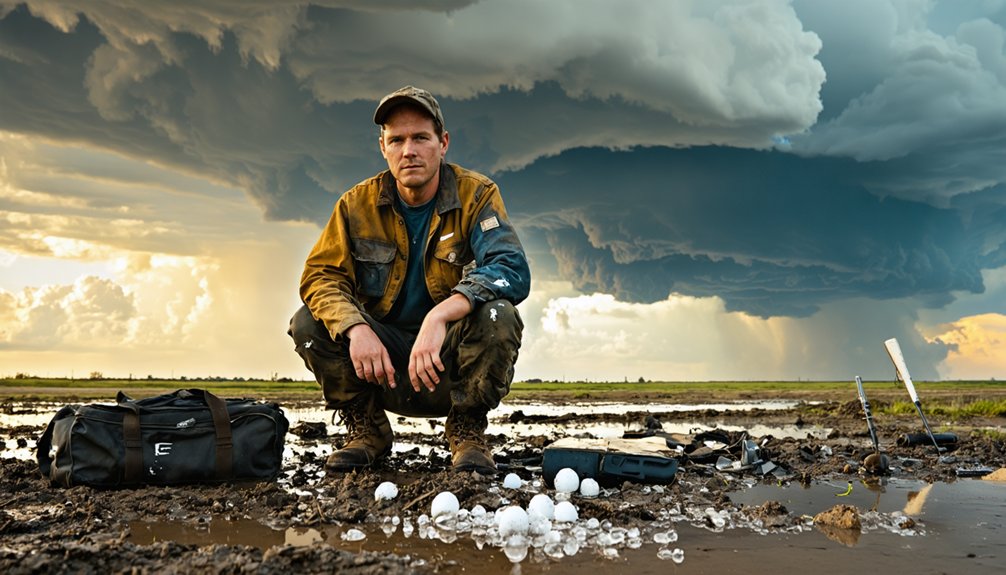
Despite generating over $10 billion in annual U.S. property damage, hail storms attract two fundamentally opposed groups: scientific data collectors and opportunistic roofing contractors.
You’ll find that legitimate hail chasers operate from scientific curiosity rather than profit motives. They deploy weather balloons and mobile radars to study hail formation, collecting atmospheric data that yields zero direct monetary returns. Their objective centers on improving hail size predictions and early warning systems as warming climates intensify updrafts.
This research-driven approach contrasts sharply with transient roofing chasers who capture 50-70% of high-value repair leads. Authentic chasers prioritize community engagement through real-time data sharing, accepting operational risks without guaranteed funding sources. Their non-commercial motivations elevate public trust while advancing meteorological models that benefit disaster preparedness frameworks.
Students of the Atmosphere: Intellectual Pursuit of Understanding
What compels individuals to position themselves directly beneath rotating supercells generating baseball-sized projectiles? Your lifelong meteorology fascination drives systematic data collection near phenomena that most flee. This innate scientific curiosity transcends sensation-seeking—you’re documenting tornadogenesis failure points in nontornadic supercells, given only 20% produce actual tornadoes.
Through ICECHIP’s deployment of mobile radars, microwave radiometers measuring inflow dynamics, and hail collection funnels positioned in storm cores, you’re advancing meteorological understanding unrestricted by conventional safety boundaries. Your drone surveys quantify destruction swaths while capturing real-time imagery scientists analyze for ice formation mechanisms. This pursuit reduces ignorance about extreme weather through direct observation, transforming awe-inspiring storms into laboratories.
You’re not chasing thrills—you’re conducting field research that enhances forecasting accuracy and protective infrastructure development, operating where academic knowledge meets atmospheric reality.
Frequently Asked Questions
What Equipment Do Storm Chasers Carry in Their Vehicles?
You’ll need vital survival gear before confronting nature’s fury. Storm chasers carry video cameras for documentation, weather instruments like anemometers and barometers for atmospheric data collection, plus communication devices, power supplies, and vehicle recovery tools ensuring you’re prepared when conditions turn dangerous.
How Do Chasers Decide Which Storms to Pursue Each Day?
You’ll analyze storm prediction models to identify atmospheric conditions favoring supercells, then conduct storm risk assessment by evaluating jet stream positioning, surface observations, and high-resolution forecast data to select targets with ideal severe weather probability.
What Are the Most Common Injuries or Dangers Faced While Chasing?
You’ll face direct hailstone impacts causing 36.8% of injuries, plus slip-and-fall trauma during escape attempts. Unpredictable weather patterns generate projectiles exceeding 100 mph, while severe weather conditions create hazardous surfaces—demanding constant vigilance when pursuing these atmospheric phenomena independently.
How Much Does a Typical Storm Chasing Season Cost?
Typical storm chasing costs you’ll encounter range from $2,499 to $5,050 for multi-day tours. Your cost breakdown of storm chasing season includes lodging, transportation, and guides, but you’ll pay separately for flights and meals.
What Training or Education Do Most Storm Chasers Have?
You’ll need meteorology coursework—44.7% hold Bachelor’s degrees in atmospheric sciences. Storm prediction skills develop through SKYWARN™ training, radar interpretation certifications, and field mentorship. Freedom awaits those mastering mesoscale dynamics, real-time forecasting, and severe weather analysis techniques.